

Access course entry requirements vary significantly by provider and destination university. You'll commonly need GCSE English and maths at grade C/4, or Level 2 Functional Skills, and you may also need to achieve specific subject and grade combinations within the Access Diploma's 60 credits, including 45 credits at Level 3.
You might be returning to education after years away, changing career, or trying to reach a degree that once felt out of reach. Then you start comparing courses and find that one college accepts an alternative qualification, while a university asks for particular Distinction and Merit grades. It's easy to assume that completing an Access course automatically guarantees progression, but the process usually involves two separate decisions: whether a provider will admit you to the Access course, and whether your chosen university will accept your final results.
The rules aren't designed to catch you out. They exist because an Access Diploma is a structured preparation for higher education, and each degree has its own expectations. Once you understand which requirements apply at each stage, you can plan around gaps instead of discovering them after enrolment.
Understanding Access Course Entry Requirements
Sam has worked for years after leaving school without the qualifications usually requested for university. Now Sam wants to enter a professional career and searches for “access course entry requirements”. The results mention GCSEs, Functional Skills, interviews and university grade offers, but they answer two different questions. Can Sam join the Access course, and will Sam's eventual results meet the chosen degree's offer?
An Access to Higher Education Diploma provides adults without traditional qualifications with a structured route into university study. UCAS describes Access courses as a route for adults aged 19 and over, while the QAA Access Diploma specification sets the national framework for the award.

The framework gives the Diploma a consistent academic structure. It does not create one universal admissions checklist. Individual colleges and universities set their own conditions. A college may assess whether you are ready to study, while a university may require particular GCSE subjects, tariff expectations, or grades in named Access units.
Why the requirements exist
English and maths requirements help providers judge whether you can manage reading, written assignments, research and routine numerical work. A science or healthcare route may also expect school-level science knowledge before you begin specialist Level 3 study.
Your motivation, employment history, caring responsibilities, personal statement and interview can help a provider assess your readiness. These details support an application, but they do not replace a qualification that a university has stated as compulsory.
The harder issue is the two-stage eligibility trap. A provider might accept Level 2 Functional Skills and admit you to an Access course, yet your chosen university may still require GCSE English or maths. The same applies to the Diploma result. Completing the course may not be enough if the university offer specifies particular Merit and Distinction grades, subjects, or credit combinations. Check both decisions before enrolling.
The guide to what an Access to Higher Education course involves can clarify how the qualification works before you compare providers. Write the requirements in two columns: course admission requirements and degree progression requirements. Sam can then identify missing qualifications early, ask whether Functional Skills are accepted at both stages, and choose an Access route whose credit grades match the intended university offer.
The Typical Academic and Non-Academic Criteria
Sam has the grades to join an Access course, receives an offer, and starts planning for university. Later, the target degree asks for GCSE English and maths, plus a particular pattern of Access credits. Sam has passed the course, but the qualification does not match the university's conditions. This two-stage check is the part many applicants miss.
Existing qualifications
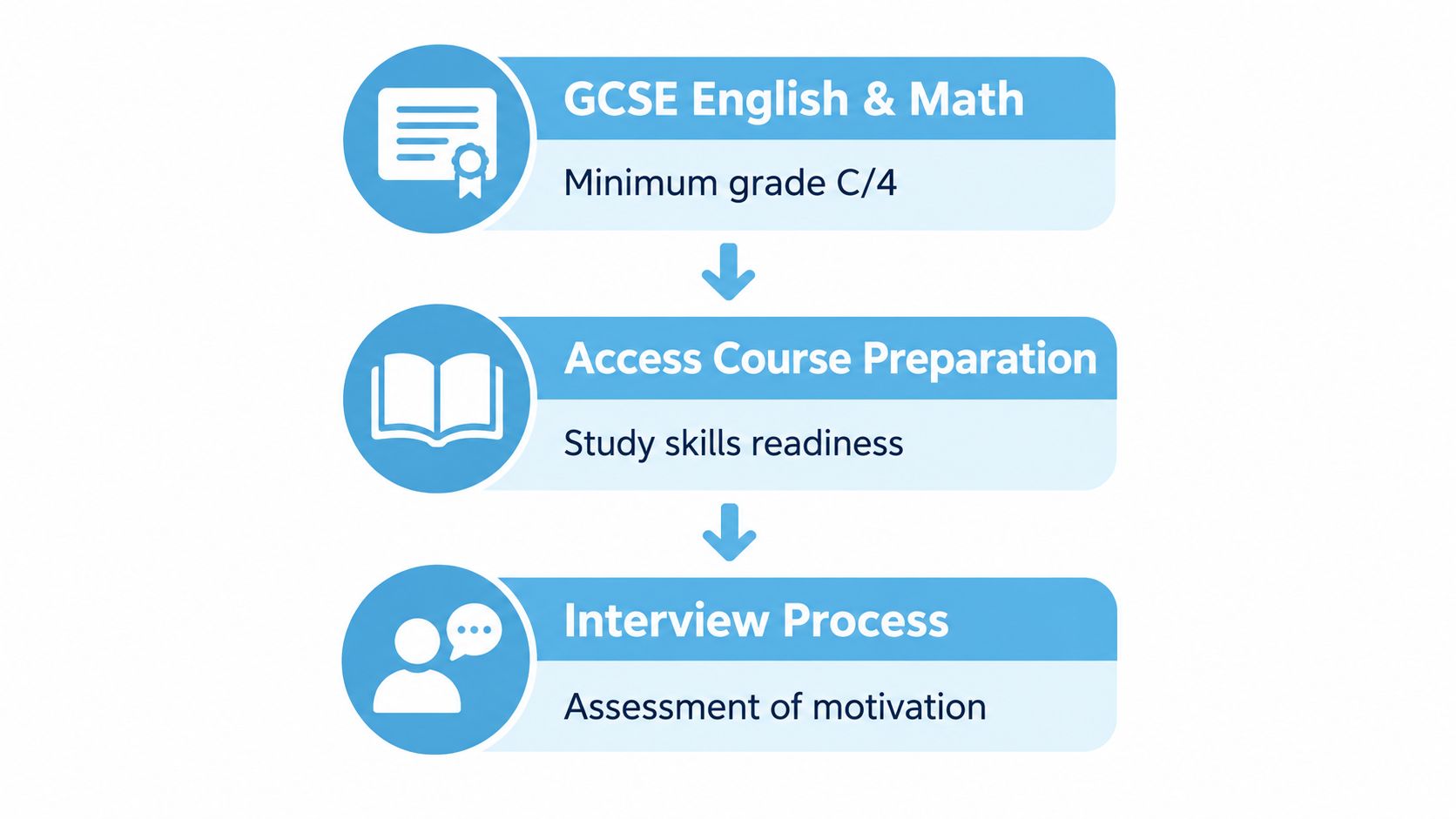
Colleges commonly ask for GCSE English and maths at grade C/4, and some routes also expect a science subject. Prospects' guidance on Access to HE Diplomas explains that some providers accept Level 2 Functional Skills in place of GCSEs. That substitution is not accepted universally, however.
Functional Skills may satisfy the college's admission rule while failing to satisfy a university's degree-entry rule. A student applying for nursing, teaching or another regulated profession could therefore pass the first check and meet a problem at the second. Ask both organisations whether the qualification is accepted, and record the answer before enrolling.
The Access Diploma also follows a defined credit structure. It carries 60 credits in total, including 45 Level 3 credits, according to the QAA specification. The course must include at least one unit worth 6 or 9 credits, while named units must be registered within 12 weeks of the course start date under the framework in force since 1 September 2014.
Readiness and motivation
Academic evidence is only one part of an application. A provider may ask about your previous experience, intended degree and plans for managing study alongside employment or family commitments. An interview may test whether you understand the workload and have investigated the subject. It can also lead to a recommendation for a foundation unit, skills support or another pathway.
A disrupted school record does not prevent you from showing readiness. Explain why you are returning to education, what you have done since leaving school and how the course connects with your intended career. A specific account gives the tutor more useful evidence than a general wish for a fresh start.
Practical rule: Ask two questions before applying: “Can I enrol with my current qualifications?” and “Will my intended university accept those qualifications when I apply for the degree?”
Some providers use diagnostic assessments or equivalency tests when applicants lack the usual GCSE evidence. Others allow enrolment with a Level 2 qualification but advise gaining a GCSE equivalent before a university application. Get the provider's answer and check the destination university's current course page or written guidance. Then compare not only entry subjects, but also the required Merit and Distinction grades and credit combinations.
How Requirements Vary Between Providers and Universities
A student may be accepted by a college with Functional Skills Level 2, then discover that a chosen university requires GCSE English and maths. The student has passed the provider's entry check, but not the university's degree-entry check. Access requirements work in stages, and each stage can involve a different decision-maker.
The QAA sets the structure of the Access to HE Diploma. Universities decide how that qualification fits their own admissions policies. As a result, two students with the same Diploma may receive different conditions for different degrees.
| Stage | Who decides | What may be assessed |
|---|---|---|
| Joining the Access course | The college or course provider | GCSEs or alternatives, subject preparation, motivation and study readiness |
| Applying for a degree | The destination university | Access credits, grades, relevant subjects, GCSE evidence and course-specific conditions |
| Receiving an offer | The university admissions team | The exact profile you must achieve before enrolment |
The University of Manchester shows how specific a university offer can be. Its undergraduate entry requirements state that Access applicants need 60 credits overall, including at least 45 at Level 3. The profile must include 30 credits at Distinction and 15 at Merit in a relevant subject area. A student who hears only “an Access pass is accepted” could therefore miss the grade pattern attached to the offer.
Widening-access routes work differently
The University of Glasgow provides another model. Its Access Programme eligibility guidance can consider applicants who have been out of formal education for three years or more. It also lists circumstances such as living in an SIMD decile 1-4 postcode area, being care-experienced, estranged, or a refugee or asylum seeker.
Meeting a widening-access criterion does not remove the academic demands of the intended subject. Glasgow indicates that applicants for science-related access routes may need prior knowledge equivalent to National 5 or GCSE in relevant subjects. The access programme may widen who can be considered, while the degree still requires evidence of subject readiness.
The two-stage eligibility trap
A college might say, “You can start with Functional Skills Level 2.” A university might say, “This degree requires GCSE English and maths.” Both statements can be accurate because they answer different questions.
The question is whether you can start the Access course and whether the completed qualification, grades and supporting evidence will satisfy your chosen degree offer.
Before enrolling, compare a provider's admissions page with the university pages for your intended degrees. Check the credit total, Level 3 expectations, Merit and Distinction grades, English and maths rules, subject prerequisites, and any interview or assessment conditions. Treat “equivalent” as an invitation to verify the detail. Ask which institution accepts the qualification, for which decision, and for which degree.
Meeting the Gaps in Your Qualifications
Missing a GCSE doesn't necessarily end your plans, but you should deal with the gap deliberately. Start by identifying whether the missing subject affects Access course enrolment, university application, or both. Those outcomes can differ.
Step one is to confirm the alternative
If you don't have GCSE English or maths, ask the Access provider whether it accepts Level 2 Functional Skills. Prospect's guidance confirms that many colleges do, but it also makes clear that arrangements vary by institution. Then check your intended university directly. A university may accept Functional Skills for one degree and insist on GCSE evidence for another.
The guidance on starting an Access course without previous qualifications is useful when you're unsure whether your school history prevents enrolment. Use it as a starting point, then ask the relevant admissions teams about your particular route.
Step two is to prepare for subject demands
A taster day can help you test whether a subject suits you before committing to a full diploma. Use the opportunity actively. Ask what assignments look like, which topics the course assumes you already know and whether your target university expects a particular science or subject background.
A bridging module can fill a knowledge gap without requiring you to pretend that you're already confident. It may introduce academic writing, biology, chemistry, mathematics or digital study skills. The value isn't only the content. Completing preparatory work gives you a clearer picture of your pace, concentration and support needs.
Step three is to record every answer
Keep a simple document containing:
- The qualification you lack: Write down whether the gap concerns English, maths, science or another requirement.
- The proposed alternative: Record the exact Functional Skills level, equivalency test or preparation route offered.
- The university's position: Save the relevant course-page wording and the date you checked it.
- The timing: Confirm whether you must complete the alternative before applying, before receiving an offer or before enrolment.
This record protects you from relying on a general college statement when your chosen degree has a stricter policy. If a course adviser says an exception may be possible, ask how the university will assess it and whether you need formal confirmation.
How Access Course Performance Affects University Progression
You finish the Access Diploma with the grades you expected, then read your university offer more closely. It asks for Distinctions in named Level 3 credits, not only a pass. Your Functional Skills result may also satisfy the college's entry conditions while failing to meet the university's requirements. This two-stage eligibility trap catches applicants who check only whether they can start the Access course.
The qualification's 60-credit total and 45 Level 3 credits create the basic framework, but the destination university may examine how those credits are distributed. A general pass can therefore fall short of a course requiring a specific number of Distinctions in relevant modules.
Read the offer as a specification
Treat the offer like a recipe rather than a single score. Each ingredient matters: the number of credits, their level, the grades attached to them and the subject area in which you earned them. A Distinction in a relevant Level 3 unit may support a nursing or science application more directly than the same grade in an unrelated unit.
The University of Manchester illustrates this level of detail. Its published requirement includes 30 Level 3 credits at Distinction and 15 at Merit, within a relevant subject area, together with the full 60 credits overall. Check the Manchester undergraduate requirements page detailed in the previous section before choosing modules or accepting an offer.
Your Access tutor can explain the academic standard and help you identify suitable units. The university's admissions wording should determine your plan. Confirm whether your pathway includes the subjects the degree expects and whether the required grades must appear in particular modules.
Functional Skills creates a separate checkpoint. A provider may accept it as evidence for enrolling on an Access course, while your chosen university may still require GCSE English or maths, or accept only specified equivalents. Passing the provider's screening stage therefore does not automatically clear the university's admissions stage. Check both rules before assuming that one result covers the other.
Plan from the degree backwards
A practical sequence is:
- Choose a degree family: Nursing, Midwifery, Science, Social Science, Computer Science or another route.
- Compare university conditions: Record the required Access credits, grade distribution, GCSE evidence and subject prerequisites.
- Select a compatible Access pathway: Confirm that its units and assessment structure can produce the profile you need.
- Track performance early: Use feedback from initial assignments to find where academic support could protect your target grades.
- Review the offer before completion: Check that any change to your university choices still matches your modules and results.
The guide to Access course UCAS points explains how Access results may be represented in the admissions process. Tariff points alone do not replace course-specific conditions. A university can ask for both a tariff outcome and particular grades or subjects.
Adult applicants also follow varied routes into higher education. That makes personal comparison more useful than assumptions about mature students. Review your qualifications, experience and intended degree together, because an Access Diploma can be suitable for one course while another requires a different evidence or grade profile.
Your Next Steps Toward University Entry
You can make the process manageable by turning broad research into a short admissions checklist. Start with the degree, not the Access course. Identify the universities and specific courses you're considering, then write down their requirements for Access credits, grades, English, maths, science and any additional assessment.
Next, compare those conditions with the entry page for each Access provider. Ask whether your current qualifications are enough to enrol, which gaps you can address through Functional Skills or preparation, and whether the proposed Access subject includes the units your university expects. Keep the answers together so you can spot contradictions before paying a deposit or starting study.
Contact admissions advisers when the wording isn't clear. Ask direct questions about your own situation, especially if you have Functional Skills, overseas qualifications, long-term work experience or a significant gap in formal education. Also check funding and payment arrangements early, because financial planning affects whether you can commit to the study schedule.
Your practical order is:
- Choose the destination: Begin with the degree you want.
- Verify the conditions: Check the university's current course page.
- Map your gaps: Separate missing evidence from missing subject knowledge.
- Confirm the route: Ask the provider whether its course can support your intended progression.
- Prepare to study: Use taster sessions, bridging work and tutor guidance before the workload builds.
You don't need to solve every requirement alone, but you do need accurate answers from the organisations making the decisions.
Access Courses Online offers accredited online Access to Higher Education Diplomas, flexible study designed around work and family, tutor guidance, taster days and advice on progression and funding. If you want help checking your qualifications and choosing a route that matches your target degree, visit Access Courses Online to explore your options.