
You may be working shifts, raising children, or supporting relatives while thinking about nursing, midwifery or another health profession. The problem isn't motivation. You may lack A levels, have been away from education for years, or feel unsure whether your GCSE English and Maths results will prevent you from moving forward.
That uncertainty is common among adult returners. An Access to HE Diploma in Health can provide a structured route back into academic study and towards a health-related degree, but it isn't a shortcut that removes every entry condition. You'll need to understand the qualification, check the GCSE rules for your chosen universities, plan around the workload and examine whether the financial commitment fits your life.
This guide takes you through those decisions in practical language. You'll see how the diploma works, what studying feels like, where it can lead, how online learning and funding may affect your plans, and which checks to complete before applying.
Introduction to Your Health Career Restart
At 34, Nadia has a full-time job, two children and a long-held ambition to become a nurse. She left school without the qualifications universities usually list, and the thought of returning to a classroom feels intimidating. She knows how to care for people, organise a demanding day and stay calm under pressure, but she isn't sure whether those strengths count as preparation for higher education.
Her first question is familiar: “Can I still get to university without A levels?” Her second is more complicated: “What happens if I also need to improve my English or Maths?”
An Access to HE Diploma in Health is designed for adults facing that kind of restart. It gives learners a recognised Level 3 route into university-level health study while helping them rebuild skills such as academic writing, research, biology and critical thinking. The qualification is used by adults progressing towards nursing, midwifery and allied health degrees, rather than only by school leavers following a traditional route.
The route still requires careful planning. A diploma may meet the academic preparation requirement for a degree, while a university may separately require GCSE English and Maths or an accepted equivalent. Some course providers may offer support with those qualifications, but you need to confirm the position before enrolling.
You'll also need to decide how study fits around your existing responsibilities. A flexible course can reduce travel and make planning easier, but assignments still require regular attention. Family support, work patterns, childcare, funding and your target university all belong in the same decision.
The aim isn't to persuade you that every health degree is automatically within reach. It's to help you replace a vague hope with a workable plan. Once you know the conditions, workload and progression route, the next step becomes much less daunting.
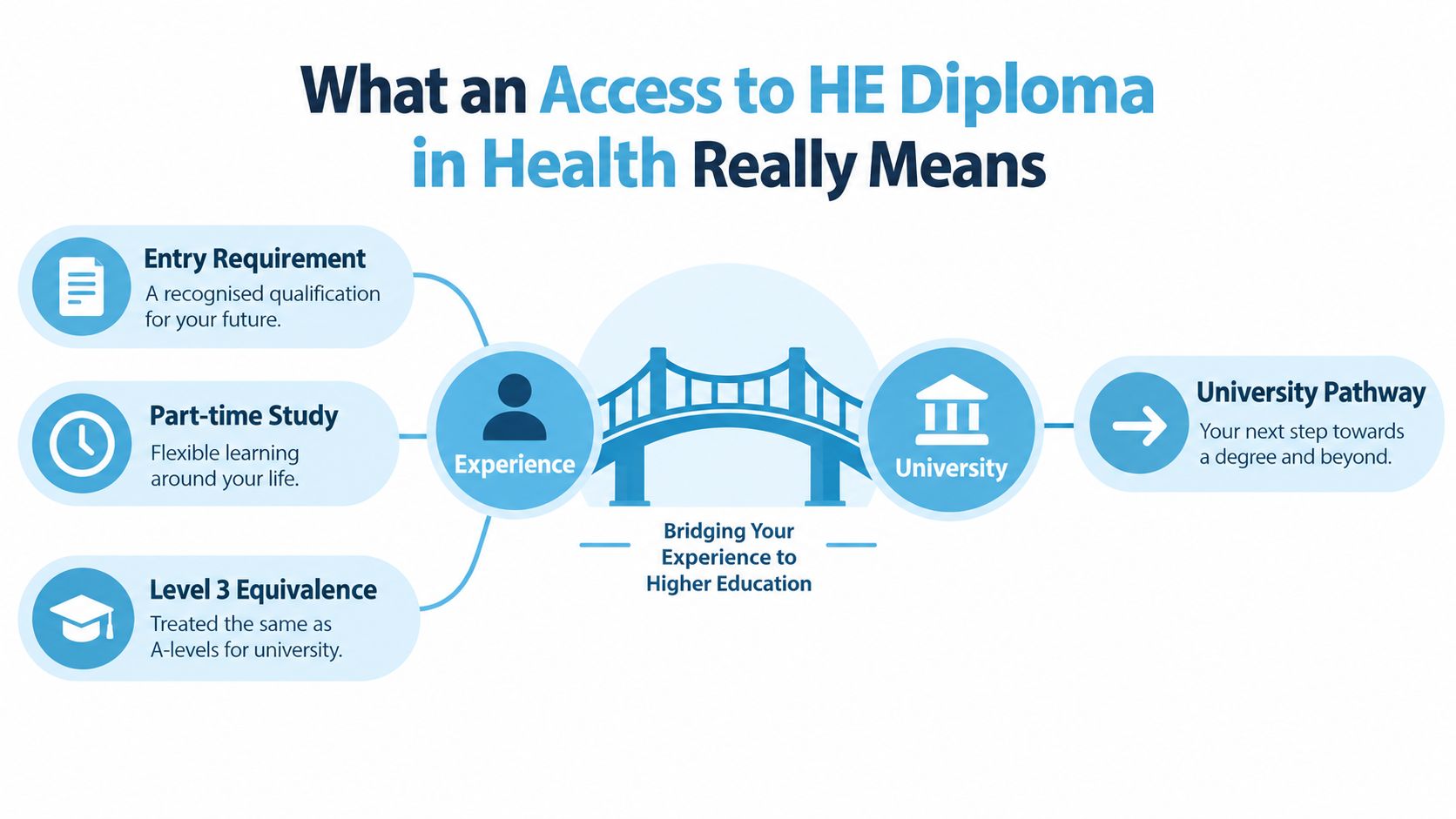
What an Access to HE Diploma in Health Really Means
Think of the diploma as a bridge. On one side, you have your existing experience, motivation and life skills. On the other side, you have university study in nursing, midwifery or an allied health profession. The bridge supplies the academic structure between the two.
Level 3 in everyday language
The Access to HE Diploma is a Level 3 qualification equivalent to three A levels. That doesn't mean you'll study exactly the same subjects or sit the same style of assessments as a sixth-form student. It means the qualification sits at the same broad level within the UK qualifications framework and is designed to prepare you for higher education.
Providers commonly build health diplomas around subjects such as human biology, health studies, psychology and study skills. These areas give you a foundation for understanding the body, health conditions, care environments, evidence and professional responsibilities. A course may also include units that help you plan essays, reference sources and communicate ideas clearly.
Why health attracts adult learners
Health is the largest part of the Access market. In 2021–22, 24,745 registrations were in health, public services and care, representing over 60% of all Access registrations according to the official Access to HE key statistics. This sustained demand reflects the number of adults who want to enter caring professions after taking a different route through work or family life.
The qualification also has a strong history as a widening-participation pathway. In 2017–18, half of all Access registrations were in health courses, and more than 8,000 Access students entered higher education to study nursing, as reported in the Quality Assurance Agency's Access to HE statistics summary.
Those figures don't guarantee an individual university offer. They do show that health-related Access study is an established route, not an experimental alternative to A levels.
What the bridge actually prepares you for
University health degrees involve more than caring instinct. You'll need to read evidence, write clearly, understand scientific concepts, manage deadlines and reflect on professional practice. An Access course introduces those habits gradually, so the first university assignment doesn't feel like a completely unknown task.
The diploma opens the academic route, but your chosen university decides how that route is accepted. Always check the degree's current entry requirements before you enrol.
Providers use the qualification for progression into nursing, midwifery, paramedic science, occupational therapy, physiotherapy, radiography and related courses. A course page from North Staffordshire College Group describes the diploma as a Level 3 route into health professions, while individual universities may specify particular units, grades or subject combinations.
Who This Diploma Is For and What You Need to Start
The diploma is aimed at adults who want to progress to university but don't hold the traditional qualifications normally associated with degree entry. Many learners are returning after a long break, changing direction after years in employment or combining study with caring responsibilities.
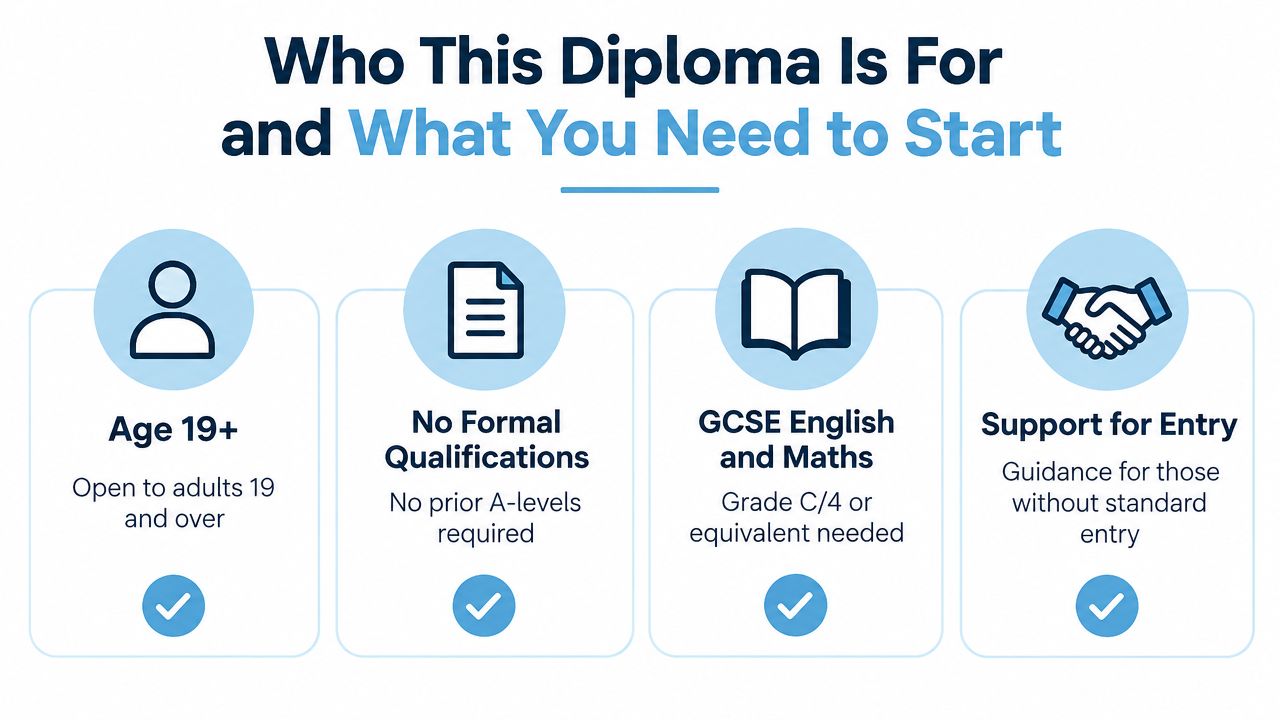
Age matters because Access courses are generally intended for adult learners, commonly those aged 19 or over. Previous A levels aren't normally the point of the route. However, “no A levels required” doesn't mean “no requirements at all”.
The GCSE question that catches people out
Health courses often require GCSE English and Maths at grade C or 4, or an accepted equivalent such as Functional Skills Level 2. Some providers check this before enrolment, while universities may apply their own conditions before confirming progression. The York College health science professions course information illustrates why you should treat these qualifications as a separate part of your plan.
The diploma and GCSE requirements serve different purposes:
- The Access diploma: demonstrates preparation for higher education and develops subject knowledge.
- English: supports essay writing, communication, reading and professional documentation.
- Maths: supports calculations, interpreting information and meeting course-specific entry standards.
- Functional Skills: may be accepted by some providers, but acceptance isn't universal.
If you don't have the required GCSEs, ask whether you can study them alongside the diploma, complete them before enrolment or use an alternative qualification. Don't assume that one university's policy applies to another.
A readiness check before you apply
Start by writing down the exact degree you want, then identify several universities offering it. Check the required Access pathway, GCSE conditions, accepted alternatives, required grades and any interview or experience expectations.
You should also ask yourself:
- Time: Can you protect regular study periods each week?
- Technology: Do you have reliable internet and a suitable computer?
- Writing: Can you read instructions carefully and develop an argument?
- Support: Who can help with childcare, transport, work changes or quiet study?
- Planning: What will you do if an assignment takes longer than expected?
Practical rule: Confirm the GCSE position with both the Access provider and your intended university before paying fees or committing to a timetable.
Inside the Course Modules and How You Are Assessed
An Access course isn't a collection of health facts. It combines subject learning with the study behaviours university tutors expect. You may begin with guided tasks and straightforward explanations, then move towards independent research and more demanding written work.
The academic building blocks
Human biology may involve cells, tissues, body systems and the way illness affects the body. You could be asked to explain how a system functions, compare the effects of conditions or connect biological knowledge to patient care.
Health studies can introduce public health, care delivery, safeguarding, communication and the factors that influence wellbeing. These topics help you see health as more than diagnosis and treatment.
Psychology and sociology can help you understand behaviour, development, relationships, inequality and the experience of illness. Not every provider uses the same module names, so compare the syllabus with your target degree.
Study skills form the practical foundation. You may learn how to plan an essay, use academic sources, reference correctly, interpret feedback and prepare for university applications.
What assessment feels like
Assessment usually tests whether you can use information, not merely repeat it. A tutor might ask you to write a report on a health issue, produce an assignment comparing perspectives, deliver a presentation or complete a scientific task. Some courses also use examinations or practical activities, while online providers may rely more heavily on submitted coursework. Confirm the assessment model before enrolling.
A typical assignment process looks like this:
- Decode the brief: highlight the action words, such as explain, analyse, compare or evaluate.
- Research carefully: find suitable material and record where each idea came from.
- Plan the answer: create a logical sequence rather than writing from the first page onwards.
- Draft and edit: check whether each paragraph answers the question.
- Use feedback: identify a specific improvement for the next assignment.
The marking language can seem unfamiliar. Providers often assess against learning outcomes and grading criteria. Your work may receive feedback about knowledge, application, analysis, structure, evidence and presentation. That feedback isn't a judgement on your intelligence. It's a map showing what university-level work requires.
Managing the weekly workload
Online study may remove commuting, but it doesn't remove deadlines. Set up a simple weekly routine with one session for reading, one for notes and one for drafting or reviewing. Short, consistent sessions are often easier to sustain than waiting for a completely free weekend.
Ask tutors early when an instruction is unclear. Students who have been away from education for years often need time to regain confidence with referencing and formal writing. That's normal, and regular feedback helps you turn unfamiliar tasks into repeatable skills.
Where a Health Diploma Can Take You Next
Your preferred profession should shape the diploma you choose. Nursing, midwifery, paramedic science and allied health degrees overlap in their commitment to care, but their scientific content, professional expectations and university requirements differ.
National figures show the scale of the health pathway. In 2022–23, 7,105 Access to HE students applied to higher education for nursing and midwifery, according to Open Awards' Access to HE progression information. The same source reports that health-related degrees, including nursing and midwifery, attracted 1,372 students at typical offers of 64 to 144 UCAS points in its published progression commentary. Treat those figures as context, not as a promise of your own outcome.
| Degree Pathway | What You Will Study | Typical Offer Range |
|---|---|---|
| Nursing | Patient care, anatomy, health assessment and professional practice | 64 to 144 UCAS points |
| Midwifery | Pregnancy, birth, postnatal care and maternity practice | 64 to 144 UCAS points |
| Paramedic science | Urgent assessment, emergency care and clinical decision-making | Check each university |
| Physiotherapy | Movement, rehabilitation, anatomy and physical function | Check each university |
| Occupational therapy | Daily living, rehabilitation, participation and adaptations | Check each university |
| Radiography | Imaging, anatomy, patient safety and clinical technology | Check each university |
The range in the table comes from the published health-related degree progression summary, while the individual degree descriptions are a practical guide. Universities can set different conditions for the same profession. They may ask for particular Access units, a minimum number of credits at a particular grade, GCSEs, an interview, relevant experience or evidence that you understand the role.
Match the course to your target
A nursing applicant should check whether the Access course includes the biology and health content required by target universities. A midwifery applicant may need to investigate competition, interview preparation and the provider's preferred qualification profile. An aspiring physiotherapist or radiographer should check scientific prerequisites particularly carefully.
Use the health professions progression guide to compare the kinds of university routes associated with health study, then verify every requirement on the university's own course page.
A realistic application plan often includes more than one university, but it shouldn't be a random list. Choose courses whose academic conditions match your diploma, GCSE position, predicted grades and personal circumstances. If travel or placement locations matter, check those practical details before submitting applications.
Studying Online Funding Options and Making It Affordable
For a working adult, affordability includes more than the course fee. You're also investing time, energy, childcare, travel to any required activities and the opportunity cost of reducing work or overtime. A lower travel burden can make online study more manageable, but only if you create enough protected time to complete assignments.
Some provider pages advertise one-year study, part-time options and course fees such as £3,384, while funding eligibility depends on your circumstances and the provider's arrangements. The official Access to HE statistics and funding information is a useful starting point, but you should confirm current fees and support directly with the course provider.

Make the numbers practical
Ask for a full fee breakdown, not just the headline price. Check whether assessment, tutor support, registration, study materials and any required extras are included. Some providers offer interest-free payment plans over 12 months, which can spread the cost, but a monthly commitment still needs to fit your household budget.
Then estimate your real study capacity. If you work shifts, plan around your most predictable periods rather than promising yourself late-night study every day. If you have children, agree on specific times when another adult can cover interruptions. A flexible course gives you control over timing, not unlimited time.
A course is affordable only when the fee and the weekly workload fit your actual life, not an idealised timetable.
You may also benefit from tools that reduce friction during professional conversations and placements. For example, learners can follow doctor discussions with iScribe to explore ways of keeping a clearer record of important appointment information.
For provider-specific guidance, review Access to Higher Education funding options and ask questions before enrolling. Access Courses Online offers fully online Access diplomas, tutor guidance, flexible pacing and payment support, but compare its course requirements with your intended university rather than choosing on flexibility alone.
Weigh value against trade-offs
The value of the diploma depends on what it changes for you. If it supplies the Level 3 qualification and academic preparation you need, it may be a direct route that avoids returning to a traditional school timetable. If you still need GCSE English and Maths, the overall plan may take more time and require additional study.
Write down the likely benefits, costs and risks. Include the degree's placement demands, travel, future funding and the possibility that you may need to apply more than once. A balanced decision is stronger than a promise that the diploma will automatically lead to a job.
Your Next Steps to Secure a University Place
Begin with the destination, not the course catalogue. Choose a profession, list universities that offer the degree and record each institution's Access, GCSE, grade and experience requirements. That list will tell you whether you need a health-specific diploma, Functional Skills, GCSE catch-up or additional preparation.
Use a simple application checklist
- Confirm qualifications: Check your GCSE English and Maths status and ask whether alternatives are accepted.
- Compare modules: Make sure the diploma includes subjects that match your intended degree.
- Plan your time: Put study sessions, deadlines, work shifts and caring responsibilities on one calendar.
- Build evidence: Look for suitable volunteering, paid care work or health-related experience where possible.
- Prepare your statement: Explain why the profession suits you, what you've learned from experience and how you understand its demands.
- Practise interviews: Prepare examples showing communication, compassion, teamwork, reflection and resilience.
- Check applications early: Review the current requirements before you submit your university choices.
Admissions teams want to see more than enthusiasm. They need evidence that you understand the profession and can handle academic and practical demands. Your employment, caring experience and personal responsibilities can provide useful examples, but present them thoughtfully and connect them to the skills required in healthcare.
Read the nursing degree entry requirements guide, then verify the details with each university. Requirements can vary even when two courses lead to the same professional title.
The route may include setbacks, especially if you need to complete GCSEs or adjust your work pattern. That doesn't make the ambition unrealistic. It means you need a sequence of manageable decisions, reliable advice and enough time to complete each requirement properly.
Access Courses Online provides fully online Access to HE Diploma courses, including a Health Professions pathway, with tutor support, flexible pacing and guidance on university progression. Visit Access Courses Online to review the course, ask about GCSE and funding options, and take the first practical step towards your health degree.