

You may be sitting at the kitchen table, searching for a way into midwifery while wondering whether your school qualifications have closed that door. Perhaps you left education years ago, built a career in another field, or spent your time caring for family. The Access to HE Diploma Midwifery route can provide a structured bridge to a university midwifery degree, but it's important to understand both its opportunities and its limitations before you enrol.
The qualification can help you develop the science, academic writing, research and study skills needed for higher education. It can also reveal requirements that many general guides underplay, especially GCSE English and Maths criteria and differences between universities. A realistic plan starts with encouragement, then adds careful checking.
Why the Access to HE Diploma Opens the Door to Midwifery
Consider someone who has always wanted to become a midwife but never took the A-level route. They may have valuable experience from parenting, social care, healthcare support or another demanding role, yet lack the Level 3 qualifications listed on university course pages. An Access to HE Diploma gives that learner a recognised academic route towards a degree without requiring them to recreate their entire school experience.
This isn't a fringe option. In 2022–23, 38,220 students registered for an Access to HE Diploma, and 7,105 progressed into higher education in nursing and midwifery in September 2023, according to the Access to HE key statistics for 2022–23. That progression volume places nursing and midwifery among the strongest subject pathways for adult learners entering health-related degrees.

A bridge, not a shortcut
The diploma doesn't qualify you to practise as a midwife. You'll still need to apply for and complete an approved university midwifery degree, meet the university's conditions and satisfy the professional requirements that apply to registration. Its role is to prepare you academically and support your progression into higher education.
That distinction matters. The course can give you a clearer foundation in subjects relevant to midwifery, but it can't guarantee an offer from every university. Admissions teams assess the whole application, including qualifications, grades, GCSEs, interviews and evidence that you understand the profession.
Practical rule: Treat the diploma as a route into university, not as an automatic university place.
The qualification is especially relevant to adults who need a Level 3 programme designed around higher education progression. The official qualification record for Access to HE Diploma Midwifery identifies qualification number 40011720 as a Level 3 qualification. Its recorded approval for funding routes, including Advanced Learner Loans and legal entitlement, ran from 1 August 2019 until 18 November 2024.
For an adult learner, the mental model is straightforward:
- Check your existing GCSEs and target university requirements.
- Choose an appropriate Access to HE provider.
- Complete the diploma and meet its academic conditions.
- Apply to approved university midwifery degrees.
- Complete degree study and clinical preparation before seeking professional registration.
Your previous route doesn't define your potential. It does determine which foundations you need to put in place first.
What the Access to HE Diploma Midwifery Covers
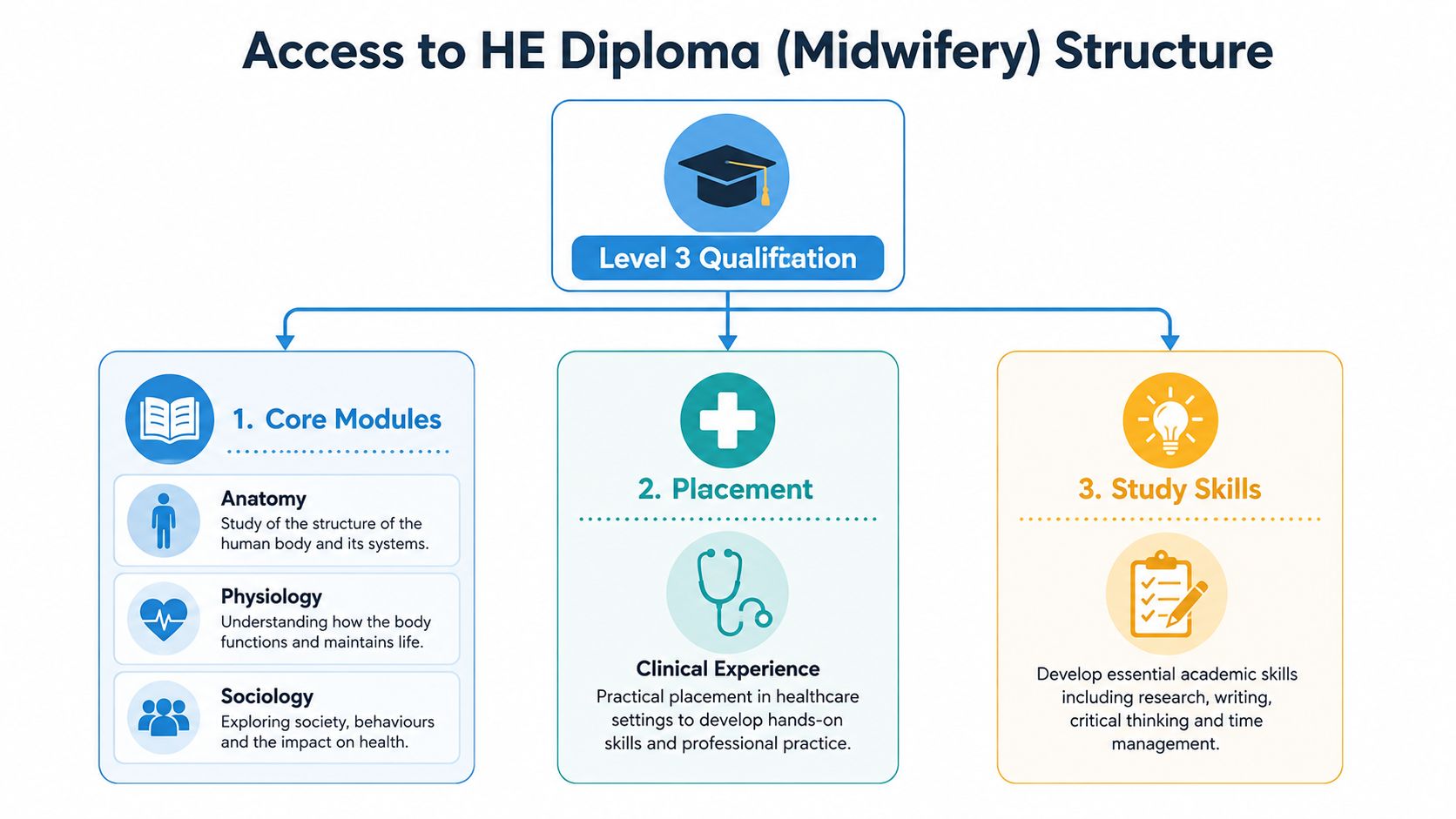
A midwifery Access diploma combines subject knowledge with higher education study skills. The exact units vary between providers, so you should compare course specifications rather than assume every programme has identical content. Most relevant programmes introduce the science and social context needed for degree-level midwifery study.
The official qualification record places the named qualification at Level 3, the broad level associated with A-level study, while its purpose is specifically to support progression into higher education. That combination is useful for adults because the course isn't just repeating school subjects. It develops academic habits alongside relevant health and science understanding.
Science that supports clinical learning
Human biology, anatomy and physiology help you understand how the body works and how pregnancy, labour and postnatal recovery involve interconnected systems. You won't be expected to become a practising clinician during the diploma, but the subject gives you language and concepts that can make later degree learning more manageable.
Reproductive health connects biological knowledge to the central field of midwifery. It can help you explore changes across pregnancy and birth while developing the ability to read, interpret and discuss health information carefully.
Psychology and sociology add the human context. Midwives support people with different backgrounds, beliefs, family structures, experiences and needs. These subjects can help you consider emotional wellbeing, communication, inequality and the social factors that influence health.
Academic skills are part of the preparation
An Access course also teaches the mechanics of university study. You may practise:
- Academic writing: Building a clear argument rather than merely describing information.
- Research and referencing: Finding appropriate evidence and acknowledging sources correctly.
- Critical thinking: Comparing ideas, questioning assumptions and explaining your reasoning.
- Time management: Planning assignments around deadlines and other responsibilities.
- Professional communication: Presenting information in a clear, respectful way.
Assessment is commonly coursework-based, although the exact methods depend on the provider. Assignments can feel unfamiliar if you haven't studied recently, but they serve a practical purpose. Writing, researching and responding to feedback are skills you'll continue using throughout a demanding degree.
A good programme should show how its units support progression. Ask whether the provider explains its awarding organisation, unit content, assessment approach and links to the universities you're considering. That conversation can prevent you from choosing a course that sounds suitable but doesn't match your intended degree requirements.
Entry Requirements and the GCSE Bottleneck
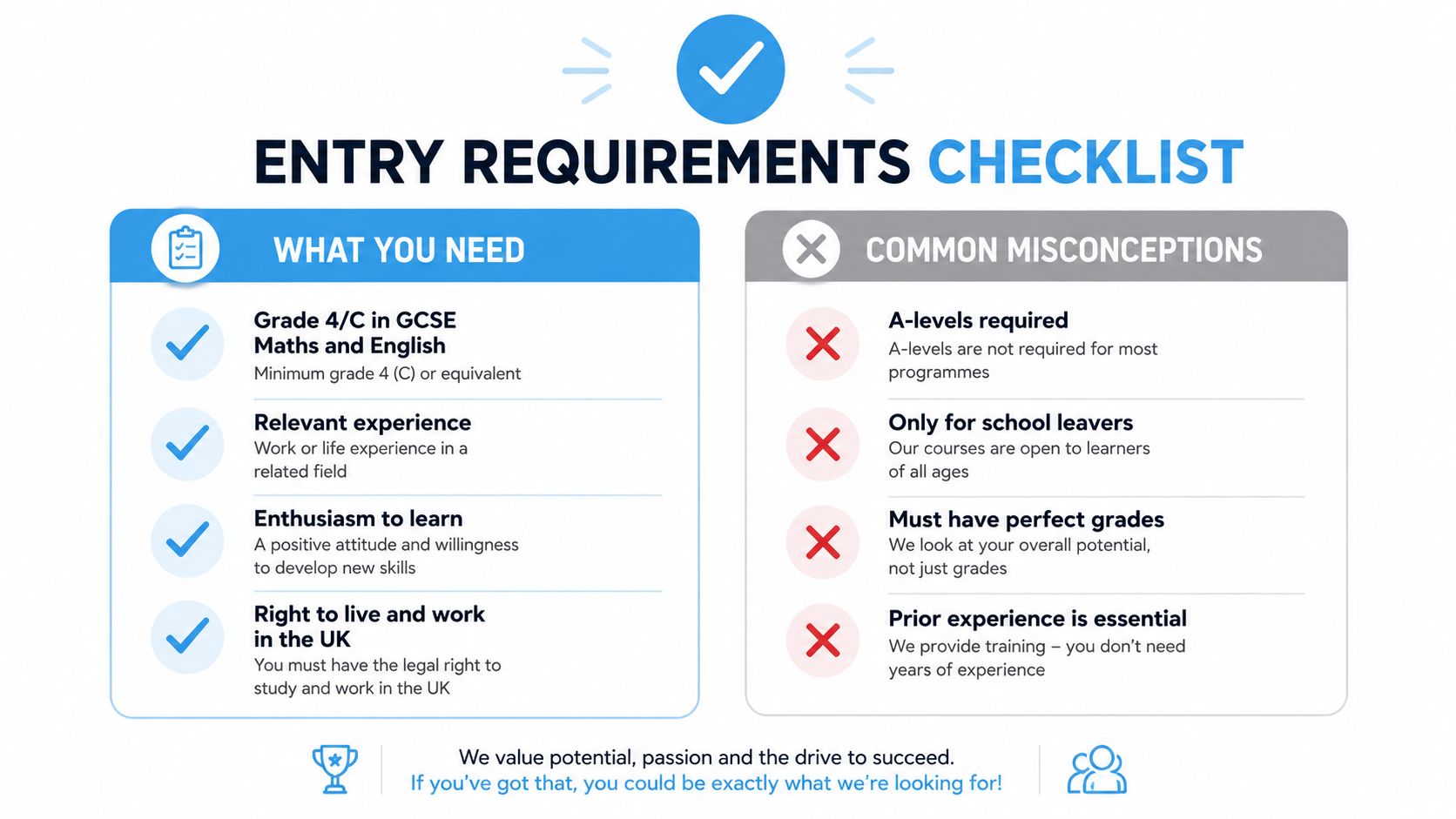
The diploma is designed for adults who may not have traditional qualifications, but that doesn't mean the wider route has no academic conditions. The most common hidden barrier is GCSE English and Maths, because many universities require both subjects at grade 4/C or equivalent for midwifery degree entry.
Some institutions may not accept Functional Skills for every applicant or every subject requirement. Others may require specific evidence, additional testing, an interview or particular grades within the Access diploma. You can't safely assume that completing any Access course will satisfy every university's conditions.
Check the degree before choosing the diploma
Start with the universities you might apply to, not with a provider's general description. Read each midwifery course page and record the requirements in your own notes. Look specifically for:
- GCSE conditions: Check English Language, Maths and any science requirement.
- Accepted equivalents: Confirm whether the university accepts Functional Skills or another qualification.
- Access grading: Look for required credits, subject units or achievement levels.
- Selection stages: Note interviews, literacy tests, numeracy tests and other assessments.
- Experience expectations: Check whether the university asks applicants to demonstrate care experience or understanding of the role.
- Application details: Confirm the personal statement and reference expectations.
This variation means Access to HE Diploma Midwifery isn't one completely standardised admissions pathway. The qualification has a recognised framework, but universities decide how they assess it for their own programmes. A course provider can offer useful guidance, yet the university remains the authority on whether your combination of qualifications is acceptable.
If your GCSE profile needs attention, don't treat that as a reason to abandon the plan. It may mean you need to complete an additional qualification before, or alongside, your wider preparation. A practical guide to retaking GCSEs as an adult can help you consider the available route.
Before enrolling: Ask your preferred university admissions team to confirm the exact GCSE and Access requirements in writing or by email.
Funding can also differ depending on where you live. Some English learners may qualify for support under applicable rules, while learners in Scotland, Wales and Northern Ireland can face different arrangements. Ask both the provider and your intended university about eligibility rather than relying on a generic national statement.
Flexible Study Formats for Adult Learners
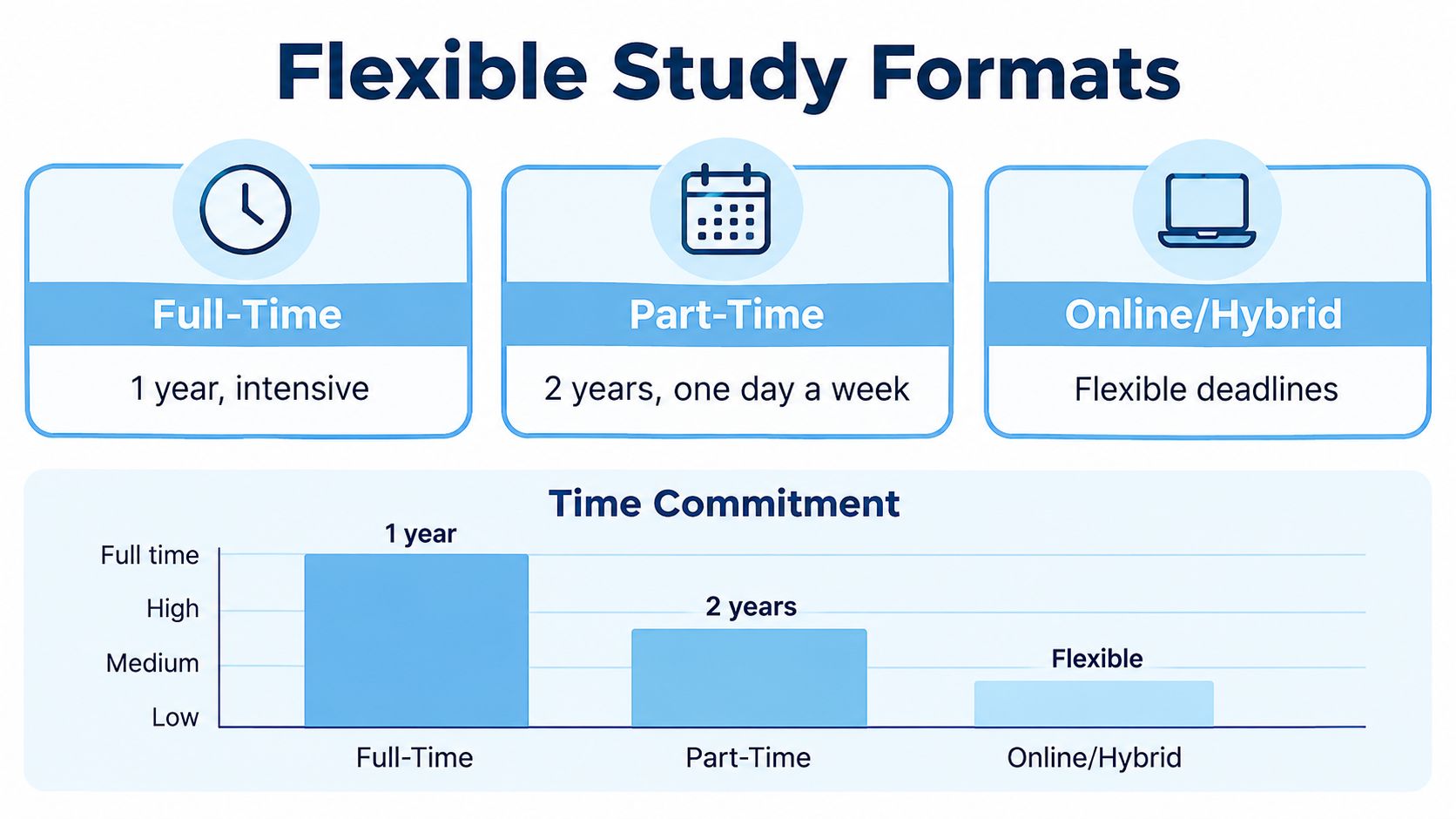
A study format needs to match your real life, not your ideal week. Someone working regular daytime hours may need evening or online learning, while a learner who benefits from immediate classroom support may prefer a college setting. Parents and carers often need a timetable that can absorb interruptions rather than penalise them.
Compare the main options
Classroom-based study offers routine, face-to-face teaching and direct contact with classmates. It can suit learners who want a clear timetable and a physical separation between home and study. The disadvantages may include commuting, fixed attendance and less flexibility when work or family needs change.
Evening or part-time study can spread the workload across a longer period. It may work well if you're employed during the day, although you'll still need protected time for reading and assignments outside scheduled sessions.
Online learning gives you more control over when and where you study. Providers may offer digital materials, tutor feedback and flexible deadlines, but you'll need to create your own routine and monitor your progress. A course page describing online Access to HE study can help you compare how distance learning is organised.
Build a routine you can maintain
Start by identifying your dependable study windows. Put them in a calendar, tell the people you live with when you're unavailable and keep one smaller backup slot for weeks when plans change. A quiet desk, reliable internet connection and organised folder system can remove daily friction.
Don't wait for motivation to appear. Set a modest weekly target, break assignments into research, planning, drafting and editing, and contact your tutor before a problem becomes a missed deadline. Online learning works best when flexibility comes with structure.
Career changers also need to consider the wider personal transition. Guidance on how to switch careers in your 50s can offer useful reflection prompts if you're balancing a new professional direction with established responsibilities.
Funding Your Diploma and Degree Pathway
Funding has two separate stages, and confusing them can make the whole route seem more expensive or uncertain than it is. First, you need to fund the Access diploma. Later, you'll need to arrange finance for the university midwifery degree.
For eligible learners in England, an Advanced Learner Loan can help cover the tuition cost of an approved Access to HE course. The official qualification record confirms the historic funding approval attached to qualification number 40011720, but current eligibility depends on the course, provider and applicable rules. Ask for a written breakdown before accepting any loan.
Understand the loan write-off condition
The key feature is progression. If you complete a subsequent higher education course, the Advanced Learner Loan used for the Access course can be written off under the relevant rules. That doesn't mean you should borrow without checking the conditions. Confirm which higher education courses qualify, what completion means and whether your chosen diploma is currently eligible.
You should also ask providers about payment alternatives. Some offer interest-free instalment plans, which can help learners avoid borrowing for tuition if they can manage regular payments. Compare the total cost, payment schedule and what happens if your circumstances change.
The Access to Higher Education funding guide can help you prepare questions for a provider.
Plan for the university stage separately
In England, most pre-registration nursing and midwifery degree students moved from NHS bursaries to the standard student finance package from 1 August 2017, as explained in guidance on funding a midwifery degree. Tuition fee loans and living-cost support are therefore the usual finance mechanisms, subject to eligibility and the current rules.
Funding isn't identical across the UK. If you live in Scotland, Wales or Northern Ireland, check the arrangements for your nation rather than applying England's rules to your situation.
Create a simple financial plan covering course fees, travel, equipment, childcare, reduced working hours and degree living costs. Speak to the provider's funding team and the university's student finance service early. Clear information won't remove every cost, but it can stop surprises from derailing your progression.
The Reality of Midwifery Jobs After Graduation
Midwifery workforce headlines can give adult learners an incomplete picture. Vacancy pressure exists across the NHS, but that doesn't guarantee that every newly qualified midwife will find an immediate post in their preferred location.
NHS-related reporting recorded 106,432 vacancies across England's NHS at 30 March 2025, including 25,632 vacancies in the Registered Nursing staff group, which includes midwives, with a 6.0% vacancy rate, according to reporting on NHS staff shortages. Those figures indicate significant workforce pressure, yet recruitment decisions still vary between trusts.
A 2026 Sky report said the Royal College of Midwives surveyed more than 300 newly qualified midwives and found 31% had not secured a post, despite continuing staffing shortages. The same reporting highlights why a national shortage doesn't translate evenly into local opportunities.
Why the contradiction exists
Trusts may have different budgets, vacancy controls, workforce plans and recruitment timelines. A trust recruiting actively may be relatively close to filling its available posts, while another area has urgent staffing needs but limited immediate hiring capacity. Geography matters too, especially if you can only work within a narrow travel area.
One 2025 Royal College of Midwives update said more than 800 places were being freed up for newly qualified midwives, but not evenly across NHS trusts. That uneven distribution means you should research employers and placement areas during your degree rather than waiting until graduation.
Career planning insight: A national shortage can coexist with local competition. Keep your options open without assuming that any particular trust must recruit you.
Use placements, university careers support and professional conversations to learn how recruitment works in different areas. Develop a strong application that shows reflective practice, communication, academic achievement and a grounded understanding of contemporary midwifery. The labour market is nuanced, not hopeless, and informed planning gives you more choices.
Your Step-by-Step Application Roadmap
Begin with the destination. Choose several university midwifery degrees that interest you, then record their GCSE requirements, Access subject expectations, selection methods and application instructions. This research should happen before enrolment, because it determines whether your diploma content and existing qualifications fit the route.
Follow a practical sequence
- Audit your qualifications. Gather GCSE certificates and equivalent evidence. Identify any English or Maths gaps before you commit to the diploma.
- Contact admissions teams. Ask each university whether your intended Access course is accepted and whether it requires particular science units or grades.
- Compare providers. Check awarding arrangements, assessment methods, tutor support, study format, start options and funding guidance. Attend a taster day if one is available.
- Prepare your experience. Paid healthcare work isn't the only way to understand caring practice. Volunteering, support roles and conversations with professionals can help you reflect on the responsibilities involved.
- Create an application file. Keep certificates, references, course notes, feedback and examples of relevant experience in one organised place.
- Plan your UCAS application early. Midwifery degree applications can involve detailed personal statements, references and interviews. Give yourself time to explain why the profession suits you and what your preparation has taught you.
- Practise for selection. Review communication, safeguarding, professional conduct, numeracy and ethical scenarios. Use examples from your life, not memorised answers.
Ask for help at the right moment
A good provider should explain the course requirements and help you understand the next stage. Ask whether experienced tutors can review your academic work, whether advisers can discuss university progression and whether support is available by email, phone or WhatsApp.
Keep a written checklist and update it as each university responds. Your aim isn't to apply blindly. It's to build a route where your qualification, GCSE profile, finances and chosen degree work together.
If you're ready to explore a flexible route, Access Courses Online offers an online Access to HE Diploma Midwifery course with coursework-based assessment and tutor support. Visit the provider to review the course details, ask about eligibility and discuss how the diploma could fit your route into university.