

Yes. An Access to HE Diploma in Nursing is a direct, government-recognised route into undergraduate nursing degrees for adults without traditional A-levels, and it accounted for 7,105 nursing and midwifery entrants to higher education in September 2023. In total, 38,220 students registered for an Access to HE Diploma in the UK during 2022–23, making nursing and midwifery one of the largest progression destinations that year.
You may be weighing study around shifts, childcare, or a job you can't leave immediately. Perhaps you have the motivation to become a nurse but not the A-levels a university admissions page appears to demand. The practical question isn't only whether the route exists. It's whether you can meet the entry conditions, complete the academic work, secure a university place at the right time, and manage the transition from adult education into professional training.
The Access to HE route can make that transition possible, but it rewards careful planning. Your course choice, English and maths qualifications, predicted grades, application dates, funding position, and preferred university all affect how smoothly you progress.
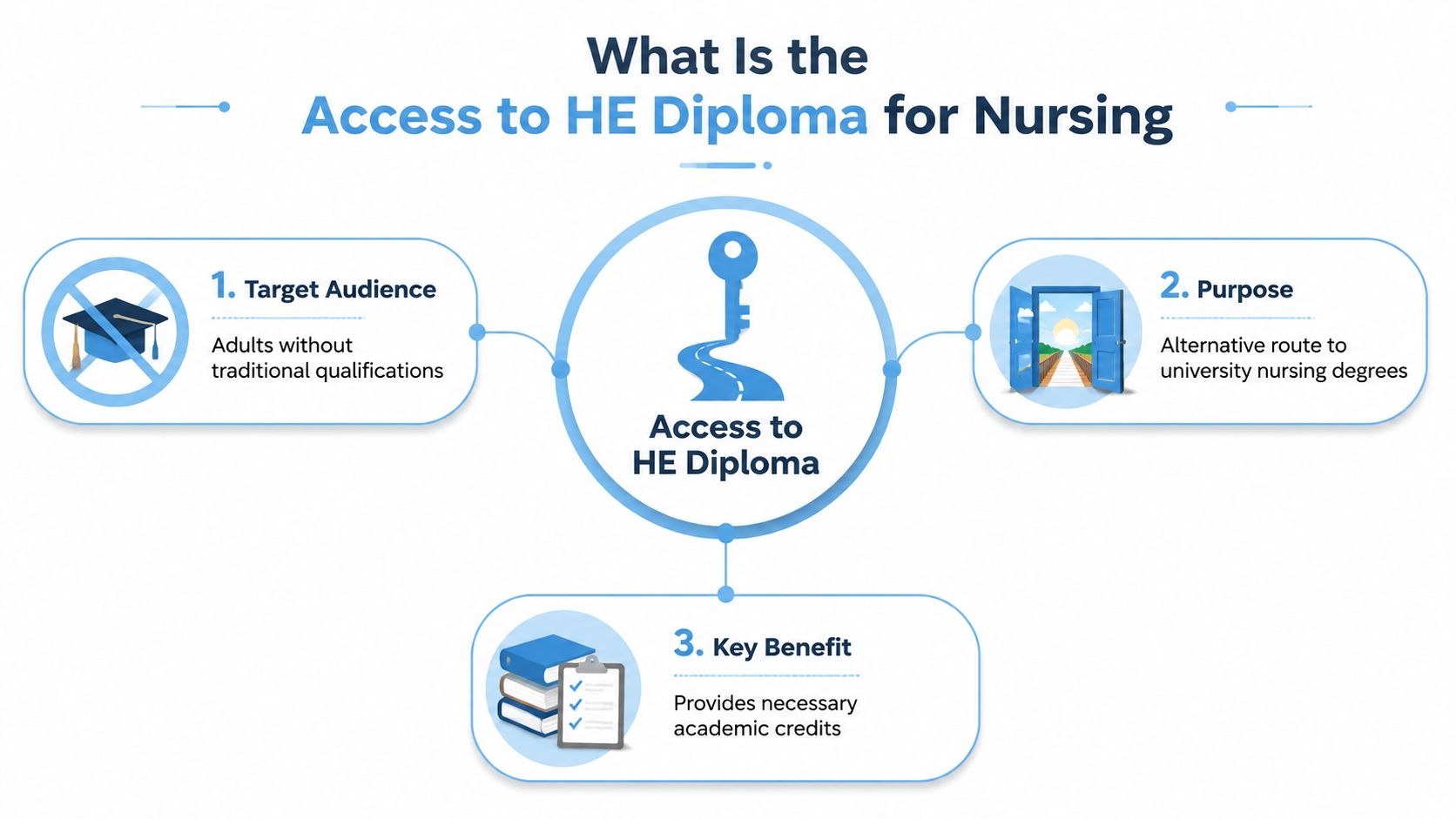
What Is the Access to HE Diploma for Nursing
A healthcare assistant who has spent years supporting patients may already understand compassion, confidentiality, teamwork, and the pressure of clinical environments. Yet without the traditional qualifications normally associated with university entry, that experience can feel invisible on an admissions form. The Access to HE Diploma in Nursing exists for precisely this kind of adult learner.
It's a structured Level 3 qualification designed to prepare students for higher education. This isn't a short introductory certificate or an informal vocational course. The qualification develops academic knowledge and study skills that nursing degree providers expect, while recognising that mature applicants may bring substantial workplace and life experience.
A route built for adult learners
The diploma suits people changing careers, returning to education, or applying to university after taking a different path earlier in life. It gives you a formal academic record that universities can assess, rather than asking admissions teams to judge your potential from employment history alone.
The national figures show that this pathway is well established. In 2022–23, 38,220 learners registered for an Access to HE Diploma, while 7,105 students entered higher education in nursing and midwifery in September 2023, the largest single progression area from Access study that year. Those figures demonstrate that nursing is a major destination for Access learners, not a marginal use of the qualification. You can review the qualification record through the official Access to HE qualification information.
The diploma can also become part of your graduation story. If you're planning a future nursing ceremony, practical details such as Graduation Cap and Gown nursing stoles can help mark the achievement, but the important milestone comes earlier: meeting the academic and admissions requirements that lead to university.
Understanding the Diploma Structure and Requirements
The qualification has a defined academic structure, so you should understand how it's assessed before enrolling. An Access to HE Diploma consists of 60 credits, divided into 45 graded credits and 15 ungraded credits. The graded credits determine the main academic profile universities see, while the ungraded credits still need to be completed successfully.
The diploma is set at Level 3, which places it within the same broad qualification level as A-level study. Its value for university applications depends on both the course requirements and the grades you achieve. If all 45 graded credits are awarded at Distinction, the diploma can carry up to 144 UCAS Tariff points, a tariff value equivalent to three A-levels at grade A. These figures are set out in the Access to HE Nursing course directory.
What the credit profile means
A useful way to read the structure is:
- Complete the full credit requirement. You must achieve the graded and ungraded units, not just collect enough high marks in selected assignments.
- Build the strongest graded profile you can. Universities may specify a number of Distinctions and Merits rather than accepting any pass profile.
- Compare the exact university criteria. A tariff total alone may not be enough. A nursing degree can also require particular subject units, GCSE equivalents, an interview, health checks, or other evidence.
- Treat the diploma as preparation, not a guarantee. It can satisfy an academic entry route, but every university makes its own admissions decision.
Assignments often require research, academic writing, referencing, reflection, and applied understanding. That workload can challenge adults who haven't written formally for years. The advantage is that you're developing the habits needed for degree study before entering a demanding nursing programme. A practical explanation of the qualification's purpose and expectations is available in this guide to the Access to HE Diploma.
Practical rule: Choose your target universities before you start, then check their Access grade requirements and required subjects against the course specification.
Choosing Between Online and Classroom Study Options
The best study format is the one you can sustain when life becomes inconvenient. Online learning may suit a parent who studies after bedtime or a healthcare worker whose rota changes regularly. Classroom learning may work better for someone who needs fixed sessions, immediate tutor contact, and a clear boundary between study and home life.

Online study
An online Access course can remove travel and give you more control over when you read, plan, and submit work. That flexibility matters if you're combining study with employment, caring responsibilities, or a long commute. It also demands self-management. No timetable can rescue you if you repeatedly postpone assignments.
Check how the provider delivers support rather than assuming “online” means either complete isolation or constant live teaching. Ask about tutor feedback, assignment submission, access to course materials, technical help, study planning, and guidance with university applications. You'll find a useful comparison of the practical issues in this university guide to online Access to HE courses.
Classroom study
A college-based course offers routine and physical separation from domestic distractions. You can ask questions face to face, learn alongside other adults, and build relationships with tutors and peers. The trade-off is less flexibility. Travel, attendance requirements, fixed sessions, and timetable changes can create problems for shift workers or parents.
| Choose online study if you need | Choose classroom study if you value |
|---|---|
| Flexible study around work | A fixed weekly routine |
| No regular travel | Immediate face-to-face discussion |
| Control over your study location | A dedicated learning environment |
| Strong independent organisation | Regular contact with peers and tutors |
Before applying, test your schedule. Block out regular study periods, identify childcare or work conflicts, and decide where you'll complete assignments. Flexibility helps only when you turn it into a reliable routine.
Navigating the Application Process and Evidence
A strong application starts with evidence, not polished enthusiasm. Providers need to know that you meet their entry conditions, and universities later need enough information to assess your suitability for nursing. Gather the documentation before you submit an application so missing records don't delay your plans.
Prepare the essentials
Start with a checklist:
- English and maths records: Confirm whether you hold the qualifications your provider requires. Some centres expect Level 2 English and maths or equivalent Functional Skills qualifications, and some may not accept applicants who still need both subjects. The South Essex College nursing Access course information illustrates why applicants should check conditions directly with the chosen centre.
- Identity and residency evidence: Providers may ask for documents confirming who you are and where you live. Eligibility can depend on residency rules, so don't assume every adult applicant receives the same funding treatment.
- Previous qualifications: Include certificates, transcripts, and evidence of relevant study. If documents are missing, ask the awarding body or previous institution how to obtain replacements.
- References: Approach someone who can comment reliably on your responsibility, communication, attendance, or professional conduct. A vague reference from someone who barely knows your work is less useful than a specific account from a supervisor or tutor.
Your personal statement should connect motivation with evidence. Explain why nursing appeals to you, what you've learned from care, customer service, volunteering, administration, or another role, and how those experiences shaped your understanding of patient dignity and teamwork.
Avoid presenting nursing as merely a secure job. Admissions teams need to see that you understand the emotional, academic, and practical demands of professional healthcare. Check each university's requirements separately, because an Access provider's entry decision doesn't automatically confirm that every nursing degree will accept your profile.
Exploring Funding and Payment Pathways
Funding decisions can determine whether an adult learner can start, not just whether the course looks suitable. Begin by asking the provider which tuition funding routes apply to your circumstances, particularly if you're a UK resident aged 19 or over and returning to education after a substantial break. Eligibility rules can depend on residency, previous study, the qualification, and the provider's arrangements.
Some learners may be able to apply for a tuition fee loan through student finance. Don't treat that as automatic approval. Confirm the application process, evidence required, repayment position, and what happens if your study plans change. The clearest approach is to request a written fee and funding breakdown before accepting an offer.
Build a realistic budget
Monthly affordability is more useful than looking only at the total course fee. List the time costs as well as direct costs:
- Study time: Identify when assignments will be completed around shifts and family responsibilities.
- Technology: Check that your computer, internet connection, software, and workspace are suitable.
- Travel and childcare: Classroom attendance can create costs that online study may reduce, but online learning can still require a dependable home environment.
- Income changes: Consider whether reduced overtime or altered working hours could affect your household budget.
- Contingency planning: Allow room for periods when work, illness, or caring duties disrupt your study routine.
Some providers offer interest-free instalment arrangements. Access Courses Online, for example, describes 12-month interest-free payment plans, alongside funding guidance and tutor support. You can compare the practical questions to ask in this guide to Access to HE funding.
Employer sponsorship may be available if you work in health or social care, although it depends on the organisation and its internal policy. Ask your manager or learning and development team about study support, paid development time, or bursary information. Don't commit until you know the payment schedule and whether funding remains available if you defer, withdraw, or change provider.
Progression Routes and NHS Nursing Opportunities
Completing the diploma is a bridge to university, not the final professional qualification. Your next stage is usually an application to an approved nursing degree, followed by degree-level study, clinical learning, and the requirements for registration with the Nursing and Midwifery Council. Admissions teams will assess your grades alongside your personal statement, interview performance, references, health information, and any course-specific conditions.
Timing creates a practical issue that generic advice often misses. An Access course may finish after a university application deadline or too close to a degree start date for final results to be confirmed. Ask each university how it handles conditional offers, predicted Access grades, final certificates, and late results. A conditional offer can depend on achieving specified grades and completing other requirements, so it isn't the same as a guaranteed place.
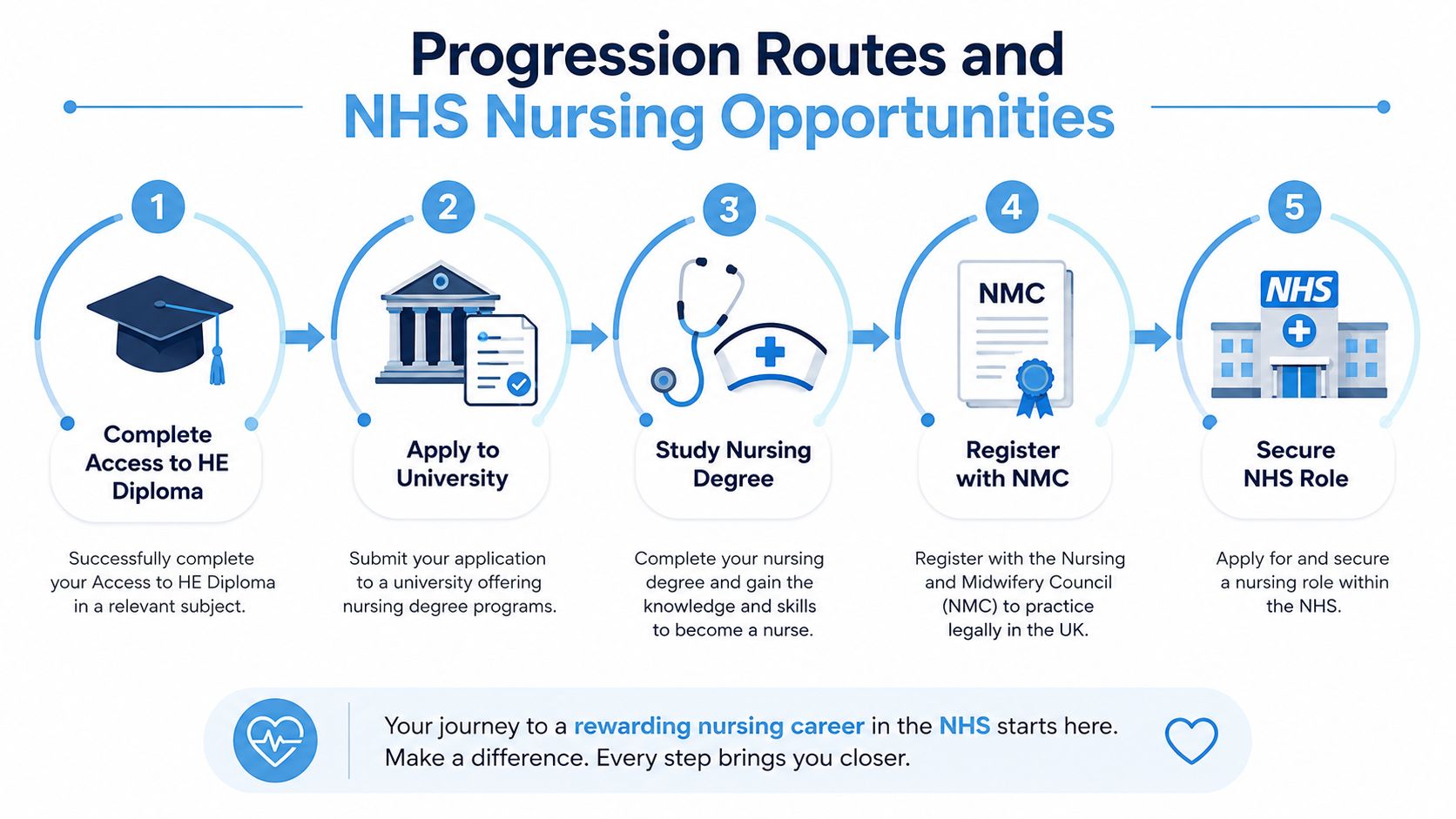
The route in practical order
- Complete the Access diploma and meet the required graded and ungraded credit conditions.
- Apply to suitable universities, checking their nursing-specific Access requirements.
- Study the nursing degree, combining academic learning with supervised clinical placements.
- Meet NMC registration requirements after completing the approved programme.
- Apply for nursing roles, including opportunities within the NHS and other healthcare employers.
The employment context remains significant. England had 25,632 registered nursing vacancies at 31 March 2025, representing a 6.0% vacancy rate, while the NHS nursing workforce reached 384,000 full-time equivalent nurses by November 2025, according to the Nuffield Trust NHS staffing tracker. Vacancies had fallen from the previous year's 7.5%, so applicants shouldn't assume an unlimited or automatic pipeline. Demand remains substantial, but location, specialty, recruitment timing, and competition can influence your options.
A learner interested in developing clinical knowledge later might also use resources such as this refresher for continence assessment nurses, although specialist learning belongs after the relevant professional foundation.
Tips for a Strong Application and Next Steps
A convincing application doesn't need dramatic language. It needs a clear reason for choosing nursing, credible examples of how you work with people, and evidence that you've investigated the demands of the profession. Describe what you did, what you learned, and how that experience relates to safe, respectful patient care.
Strengthen the evidence behind your motivation
Use examples from employment, volunteering, caring responsibilities, or community work where they demonstrate relevant qualities. Listening, reliability, emotional resilience, teamwork, boundaries, and clear communication matter more than vague claims about wanting to help people.
Keep your academic plan equally specific:
- Check the university first: Confirm Access grade requirements, required units, English and maths conditions, interview arrangements, and application deadlines.
- Ask about conditional offers: Find out how the university treats predicted grades and when it needs final results.
- Plan the calendar: Match your diploma completion date to university start dates, placement expectations, notice periods, and family arrangements.
- Test your study routine: Complete a realistic weekly plan before enrolling, including protected time for reading and assignments.
- Seek direct advice: Contact course providers and university admissions teams with your exact qualifications rather than relying on general forum guidance.
NHS values should appear in your thinking, not just as copied phrases in a personal statement. Show how your experience has shaped your approach to dignity, inclusion, accountability, teamwork, and patient safety. If you're unsure about an entry condition, ask early. A short conversation with a provider can prevent you from choosing a course that doesn't meet your intended university's requirements.
The route is demanding, but it's achievable when you treat it as a sequence of decisions rather than one large leap. Start by checking English and maths eligibility, identify realistic university destinations, and map course completion against application dates.
Access Courses Online offers a fully online Access to HE Diploma in Nursing, tutor support, university application guidance, and funding information for adults preparing for nursing degrees. Visit Access Courses Online to review the course and ask for advice about eligibility, study planning, and your next application step.