

You might be reading this after another long shift, or late at night when the house is finally quiet. You know you want more from your working life. Maybe you've always wanted to become a nurse, a biomedical scientist, a radiographer, or work in environmental science, but one thought keeps stopping you: I don't have A-Levels, so university probably isn't for me.
That feeling is common. Adult learners often carry a mix of ambition and doubt. You can see the career you want, but the route into it looks built for people who stayed on the standard school path. If you left education years ago, changed direction, or never got the grades you needed first time round, it's easy to assume the door has closed.
It hasn't.
An Access to HE Diploma in Science exists for exactly this situation. It's a route built for adults who want to move into higher education without relying on traditional qualifications from school. Instead of asking you to go backwards, it gives you a structured way to move forwards.
Your Dream Science Career Starts Here
A science career rarely begins with perfect timing. More often, it starts with a quiet realisation that you want work that feels more meaningful, more secure, or more aligned with who you are now.
For some people, that means nursing after years in care work. For others, it means aiming for biomedical science after time in retail, admin, or raising a family. I've also spoken to adults who loved science at school but left education early and assumed they'd missed their chance.
What changes things is not confidence. It's a plan.
The Access to HE route gives adult learners a realistic next step. You don't need to pretend the process isn't challenging. You'll need commitment, study time, and careful choices about where you apply. But you also don't need to solve everything today. You only need to know that there is a recognised starting point.
Many adult learners don't need a miracle. They need a route that makes sense for the life they're living now.
That's why the science pathway matters. It doesn't just help you “get back into education”. It starts to reconnect your day-to-day effort with a future goal. When you study biology, chemistry, maths-related concepts, and academic skills in the context of a degree application, the work feels purposeful.
If you're anxious, that's normal. Most adults returning to study worry about whether they're “academic enough”, whether universities will take them seriously, and whether they can balance study with the rest of life. Those worries don't mean you're not ready. They usually mean the decision matters to you.
A dream career in science becomes much easier to pursue when you stop treating university as a vague wish and start treating it as a sequence of steps.
What Is an Access to HE Science Diploma
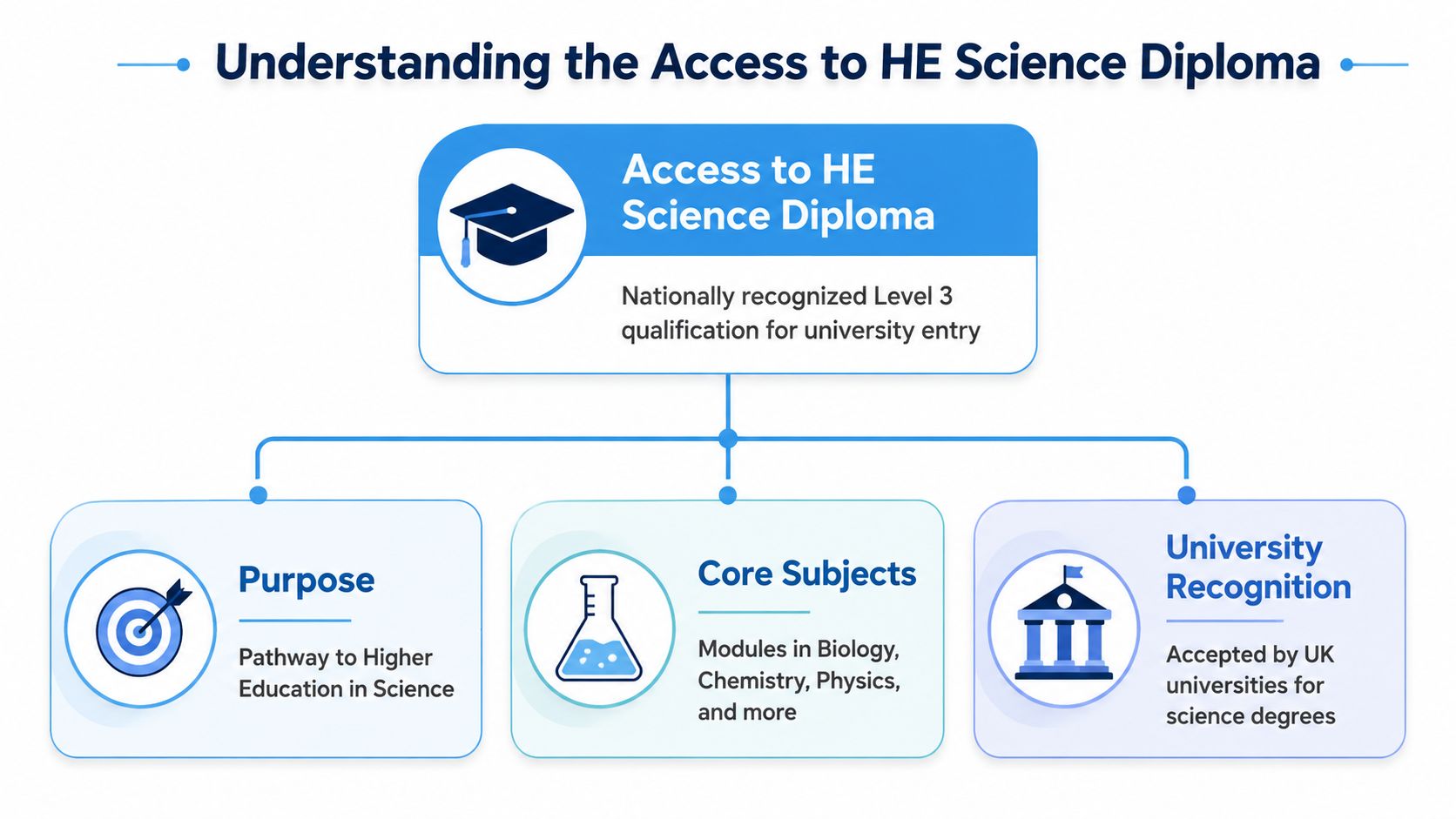
The Access to HE Diploma is a nationally recognised Level 3 qualification in the UK, designed for adults who want to enter higher education without traditional Level 3 qualifications such as A-Levels or BTECs. It is equivalent to 3 A-Levels and follows a 60-credit structure made up of 45 credits from assessed subject-specific modules and 15 credits from academic skills units, with over 20,000 students annually progressing to UK universities through this route, as outlined in this overview of the Access to HE Diploma.
Here's a visual summary of how the qualification works:
What the qualification is for
An Access to HE Science Diploma isn't a watered-down course. It's built to prepare adults for degree-level study. That means it teaches subject knowledge, but it also helps you rebuild study habits, writing skills, and academic confidence.
The science version is aimed at learners who want to progress into science-based degrees. Depending on the provider and pathway, that can include health and laboratory-focused subjects as well as broader science routes.
How the credits work
The 60-credit structure tends to confuse people at first, so it helps to break it down.
| Part of the diploma | What it covers | Why it matters |
|---|---|---|
| 45 graded credits | Subject-specific science units | These are the marks universities usually look at most closely |
| 15 ungraded credits | Academic skills and study support | These help you write, research, reference, and study at degree level |
The graded part is where your performance really shapes your application. The academic skills units matter too, because they help you adjust to university-style learning, especially if you've been out of education for a while.
A short video can help make the structure feel less abstract:
Why universities recognise it
Universities recognise the qualification because it was created to bridge the gap between adult learners and higher education. It's not a workaround. It's an established progression route.
That matters if you've been worrying that an access course is somehow “less valid” than other options. In practice, it's a qualification with a clear purpose. It gives admissions teams evidence that you can study demanding material and cope with the expectations of higher education.
Exploring the Science Curriculum and Assessment
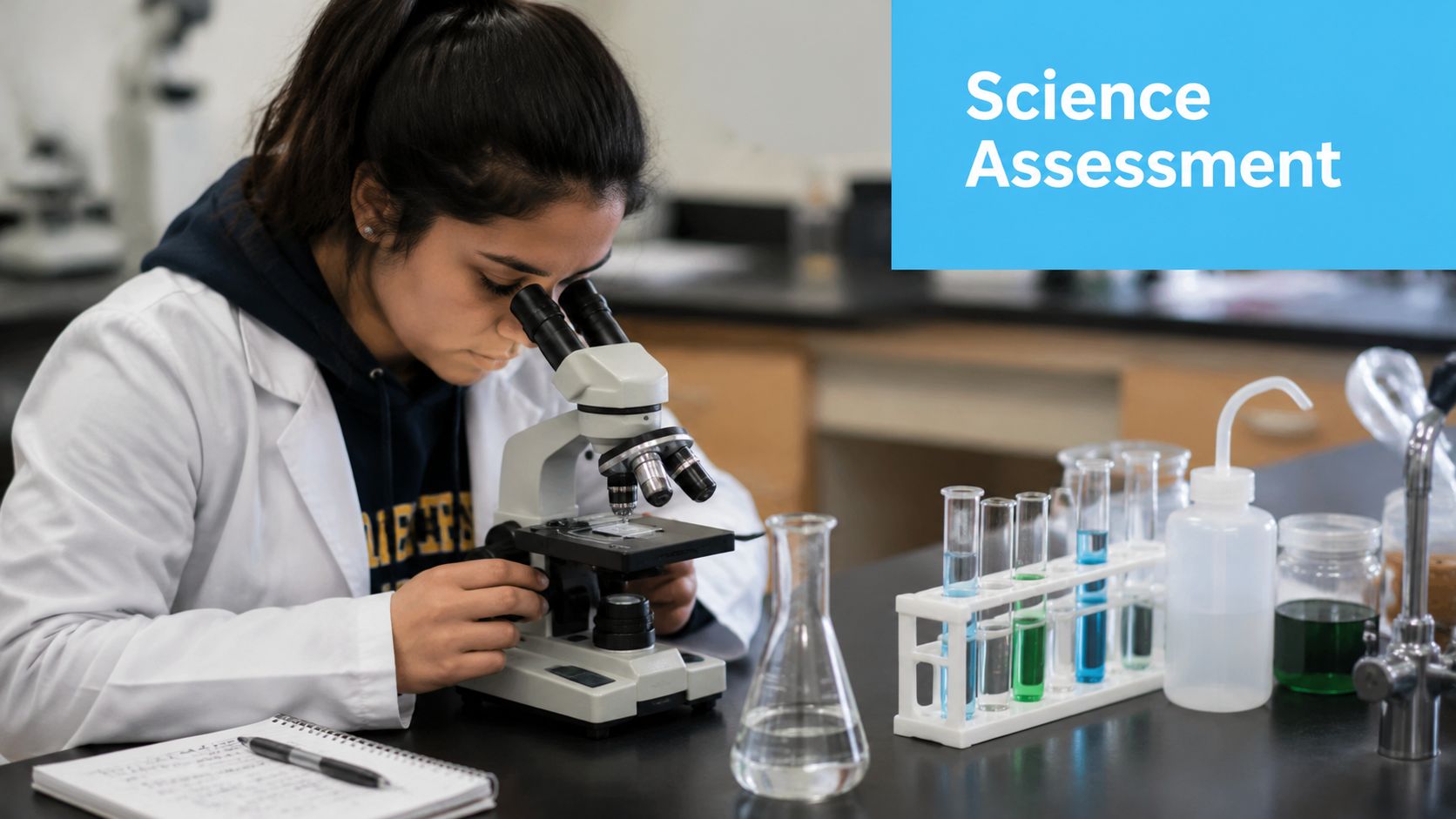
What you study on an Access to HE Science Diploma depends on the provider, but most science pathways centre on the subjects universities expect to see: Biology, Chemistry, and often some combination of Physics, Maths, or applied science topics.
What you're likely to learn
Biology units often cover cells, body systems, genetics, and human physiology. If you're aiming for nursing, midwifery, radiography, or biomedical science, this foundation matters because it supports later degree work in anatomy, pathology, and health-related science.
Chemistry usually introduces topics like atomic structure, bonding, acids and bases, and practical chemical ideas that underpin laboratory and health sciences. Even if chemistry feels intimidating now, many adult learners do well once the teaching is linked to real examples and broken into manageable assignments.
Some courses also include topics such as data handling, scientific investigation, or introductory physics. Those units can be especially useful if your target degree involves technical reasoning or evidence-based practice.
If you want to get a feel for the kind of content involved, this sample biology lesson for Access to HE Science gives a helpful example.
How assessment usually works
For many adult learners, the biggest relief is that Access courses are often assignment-based, rather than relying heavily on final exams. That changes the experience completely.
Instead of revising everything for one high-pressure test, you'll usually complete work such as:
- Written assignments that ask you to explain scientific ideas clearly
- Reports or research tasks that show you can use evidence
- Short analytical pieces where you compare, interpret, or evaluate information
- Study skills tasks that build referencing, structure, and academic writing
Practical rule: Don't judge yourself by how you did in school exams years ago. Assignment-based study rewards consistency, organisation, and steady improvement.
How grades connect to university applications
The graded units are typically marked at Pass, Merit, or Distinction. Universities often make offers based on a required profile across those graded credits, so your target isn't just “finish the course”. It's to build the strongest grade profile you can for the degree you want.
That's why subject choice and course planning matter so much. A science diploma should do more than tick a box. It should prepare you for the next academic step, both in content and in workload.
Your Pathway to a University Science Degree
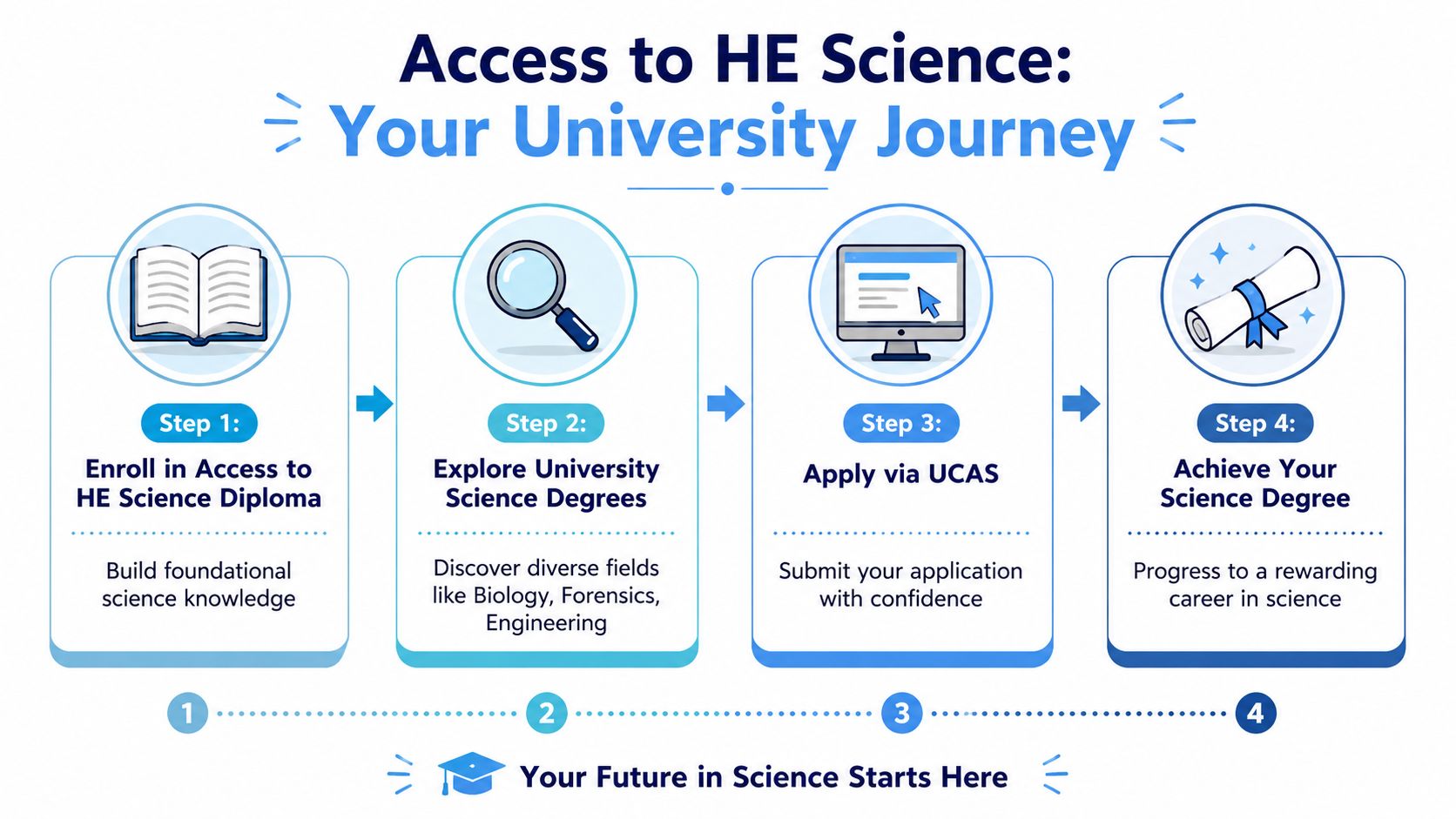
An Access to HE Science Diploma can open the door to a wide range of university courses. For many adults, this is the moment the route starts to feel real. You're no longer thinking in abstract terms about “getting qualifications”. You're connecting your current study to a degree and a profession.
In the 2021-22 academic year, 23,290 students with an Access to HE Diploma entered higher education, and the diploma's 45 graded credits at distinction level attract the same UCAS tariff points as three A-Levels at Grade A, according to the 2021-22 Access to HE key statistics.
Degrees learners often progress to
Science-based Access diplomas can support applications to courses such as:
- Nursing and Midwifery for learners moving into clinical practice
- Paramedic Science for those aiming at frontline healthcare roles
- Biomedical Science if you're drawn to laboratory, diagnostics, or research settings
- Radiography for diagnostic and imaging careers
- Environmental Science if your interests are broader and less clinically focused
- Health and allied health degrees where a science background strengthens your application
Some providers also support progression into newer health-focused pathways. The key point is that a science diploma can lead in several directions, not just one.
What universities will look at
Universities usually care about three things. First, whether your diploma pathway matches the degree. Second, whether your grades meet the offer. Third, whether you also meet any extra entry requirements, such as English, Maths, or specific science expectations.
That means your application strategy should be practical, not vague.
A simple way to approach it is:
- Choose the degree first. Don't start with a random diploma and hope it fits later.
- Check entry requirements at each university. Look for subject expectations, grade profiles, and GCSE or equivalent requirements.
- Match your Access course to those requirements. A general route may not be enough for a specialised degree.
- Use your assignments to build evidence. Strong written work can help you speak confidently in personal statements and interviews.
If you're trying to understand the kind of written work that supports success on a science pathway, these science report examples are useful to review early.
A realistic note about competitive courses
This route is powerful, but it isn't universal. Some highly competitive courses, especially Medicine, may have additional requirements or may not accept the diploma on its own. The QAA guidance on the Access to HE Diploma notes that learners should check carefully because courses such as Medicine can present significant barriers for Access applicants.
That doesn't make the diploma a poor option. It means you need to plan with accurate information.
Aim for clarity, not wishful thinking. A well-matched application is far stronger than an ambitious application that ignores entry requirements.
Funding Your Course and Future Career
Cost stops many adults before they even enquire. Not because the course is impossible to afford in every case, but because the funding rules can feel confusing and nobody wants to commit without understanding the implications.
A major barrier for adult learners is uncertainty about fees and support. The diploma can cost over £1,200, many providers offer interest-free payment plans, and understanding whether Functional Skills Level 2 can replace GCSEs can be important for funding access, as explained in this guide to Access to Higher Education costs and support.
What to check before you enrol
The most useful funding conversations are specific. Don't ask only “Is there funding?” Ask what type, what the eligibility rules are, and what evidence you need to provide.
Focus on these points:
- Total fee position. Ask for the full course cost, not just a deposit or monthly figure.
- Payment options. Some providers spread the cost with interest-free instalments.
- Entry qualifications. Check whether Functional Skills Level 2 is accepted in place of GCSE English or Maths for your course and your intended university.
- University finance planning. Think beyond the diploma itself. You're planning for a degree pathway, not a standalone year.
Why adults often get stuck here
Many learners can handle the academic challenge, but they delay because the money side feels vague. That uncertainty creates unnecessary stress. A clear budget, a clear timeline, and a clear understanding of qualification requirements can make the decision much easier.
If funding is your main concern, it helps to review a practical explanation of Access to Higher Education funding options before you apply.
Questions worth asking a provider
When you speak to an admissions adviser, keep your questions grounded in your own situation:
| Question | Why it matters |
|---|---|
| Can I pay monthly? | This affects whether the course fits around your current income |
| Do I need GCSEs or will Functional Skills count? | This can affect both entry and future university applications |
| What happens if I need more time? | Adult learners often need flexibility around work or family commitments |
| Is the course fully online? | This matters if you need to study around irregular hours |
Short-term affordability matters, but so does fit. A payment plan won't solve a course that doesn't line up with your university goal.
Choosing a Provider and Starting Your Application
You may be at the point where the goal feels real. You can see yourself studying biomedical science, nursing, radiography, paramedic science, or another science-based degree. Now the question becomes practical. Which provider will help you get from “I want this career” to “my application is submitted”?
That choice matters because providers can look similar at first glance while offering very different experiences once you enrol. For an adult learner, the right course needs to fit real life, not an ideal version of it.
What to look for in a provider
A good provider does more than deliver course materials. It should give you a clear route from enrolment to university application, with enough structure to keep you progressing and enough flexibility to work around your responsibilities.
Focus on a few practical checks:
- Recognition and accreditation so the diploma supports progression to higher education
- Tutor access because science subjects are easier to manage when you can ask questions and get feedback
- Flexible pacing if you are balancing study with work, childcare, or caring responsibilities
- Clear progression advice so you can match the diploma to the degree you want
- Transparent fees and payment options so there are no surprises after you apply
If you are comparing online training providers more broadly, this guide to selecting a medical certification provider is useful because the same decision points apply. Check legitimacy, support, communication, and whether the course fits your end goal.
One example in this space is Access Courses Online, which offers fully online Access to HE Diplomas, including science-related pathways, with tutor support and interest-free payment plans. It is one provider to compare alongside other recognised options.
How the application process usually works
This stage often feels bigger than it is. Many adult learners spend weeks worrying about the application, then find the first step is just having a conversation with a provider about their goal.
A sensible process looks like this:
- Contact your chosen provider and explain the degree or career area you want to pursue.
- Check the course matches your progression plan so you are not studying the wrong science pathway for your intended degree.
- Review the practical details such as start dates, study format, tutor contact, deadlines, and fees.
- Complete the application or enrolment form and prepare any identification or previous qualification details requested.
- Set up a weekly study routine that fits your current schedule.
A provider is a bit like the route planner for a long journey. The destination is your science degree and future career. The diploma is the road that gets you there. You want a route that is clear, realistic, and well supported, especially if you are returning to education after time away.
Choose the provider that matches your degree aim, your weekly routine, and the level of support you will use. A course can look strong on paper and still be the wrong fit if its pace, communication style, or structure do not work for your life.
Frequently Asked Questions for Adult Learners
Do I need GCSEs in English and Maths to start
Sometimes yes, sometimes no. Provider requirements vary, and university requirements vary too. In some cases, Functional Skills Level 2 may be accepted in place of GCSEs, but you should check this both with the course provider and with the universities you plan to apply to.
How many hours a week will I need
That depends on your pace, your background in science, and how quickly you want to complete the course. Most adults do better when they block regular study time into the week instead of relying on spare moments. If you struggle with focus or consistency, these student productivity techniques can help you build a routine that feels manageable.
Is an online diploma respected like one from a college
What matters is whether the qualification is recognised and appropriate for university entry. Universities look at the qualification and your grades, not whether you sat in a physical classroom every week. Online study can work very well for adults because it lets you fit learning around existing responsibilities.
Am I too old to do this
No. The qualification is designed for adults. In 2021-22, 77% of students entering higher education with an Access to HE Diploma were female, and 79% of all Access students studied locally, which highlights how this route supports learners balancing work, family, and other commitments, according to these Access to HE key insights.
Can I start at any time of year
That depends on the provider. Some online providers offer more flexible start dates than traditional college settings. Always ask how enrolment works, when tutor support begins, and whether your timeline lines up with the university application cycle you're aiming for.
If you're ready to turn a science career goal into a practical next step, Access Courses Online offers fully online Access to HE Diploma options for adults who want a flexible route to university. You can explore course details, ask about funding, and check whether a science pathway fits the degree you want to apply for.