

You might be reading this while juggling a job, children, shift work, or all three, and wondering whether becoming a nurse or midwife is still realistic if you don't have A-levels. That question comes up all the time with adult learners. The short answer is yes, it can be realistic, but only if you understand the route clearly and check the fine print early.
The part that often catches people out isn't motivation. It's admissions detail. Many learners find an Access course, feel hopeful, then discover later that a university still wants specific GCSEs, won't accept some Level 2 equivalents, or expects a very particular mix of Access credits. That's why access to HE nursing and midwifery needs to be approached practically, not just optimistically.
Why the Access to HE Diploma Matters for Aspiring Nurses and Midwives
A common adult-learner scenario goes like this. Someone decides they are ready to train as a nurse or midwife, finds an Access course, and feels they have finally found the route back into education. Then admissions questions start. Will the university accept the diploma? Do GCSEs still matter? Does the course meet the exact subject requirements?
That is why the Access to HE Diploma matters. It is not just a study option. It is the bridge many adults use to return to formal education and show universities they can cope with degree-level work, even without recent A-levels.
For aspiring nurses and midwives, that bridge only works if both ends connect. One end is the Access diploma itself. The other is the university admissions criteria, which can be more specific than course adverts first suggest. Adult learners often lose time by assuming any nursing or midwifery Access course will automatically satisfy every university requirement. Sometimes it does. Sometimes it does not.
That gap between marketing and admissions detail is where careful planning matters most.
The qualification was built for adults who took a different route first. You might be working in care, returning after raising children, or changing direction after years in another job. In that sense, the diploma works like a conversion year. It gives universities a recognised way to judge current academic ability rather than qualifications you may have missed years ago.
Many learners choose this route because it has a clear purpose. You are not trying to collect general qualifications and hope they lead somewhere useful. You are building evidence for a specific next step. If you want a plain-English overview first, this guide on what an Access to HE diploma is explains the qualification clearly.
A practical way to view the diploma is this. It is a test of readiness, not a guarantee of entry.
That distinction matters because nursing and midwifery admissions can be strict. Universities may ask for the Access diploma and still require English, maths, and sometimes science GCSEs at a particular grade. Some accept functional skills or equivalencies. Others do not. Some want a certain number of science credits from the diploma. Others are more flexible. For adult learners, this is often the friction point, not willingness to study.
The route still matters because it keeps higher education open to people who are capable, committed, and starting from an unconventional point. Without it, many strong future applicants would be filtered out long before interview stage.
There is also a practical reality to the careers themselves. Nursing and midwifery are demanding jobs, and adult learners often want an honest picture before they commit. Even everyday details become relevant once placements begin, including what you wear for long hours on your feet. Resources on nurse shoes for long shifts can sound minor at first, but they reflect the working conditions you are preparing for.
Treat the Access diploma as a planned route with checkpoints, not as a hopeful shortcut. Learners who do that early usually avoid the most frustrating admissions surprises later.
What the Access to HE Nursing and Midwifery Diploma Covers
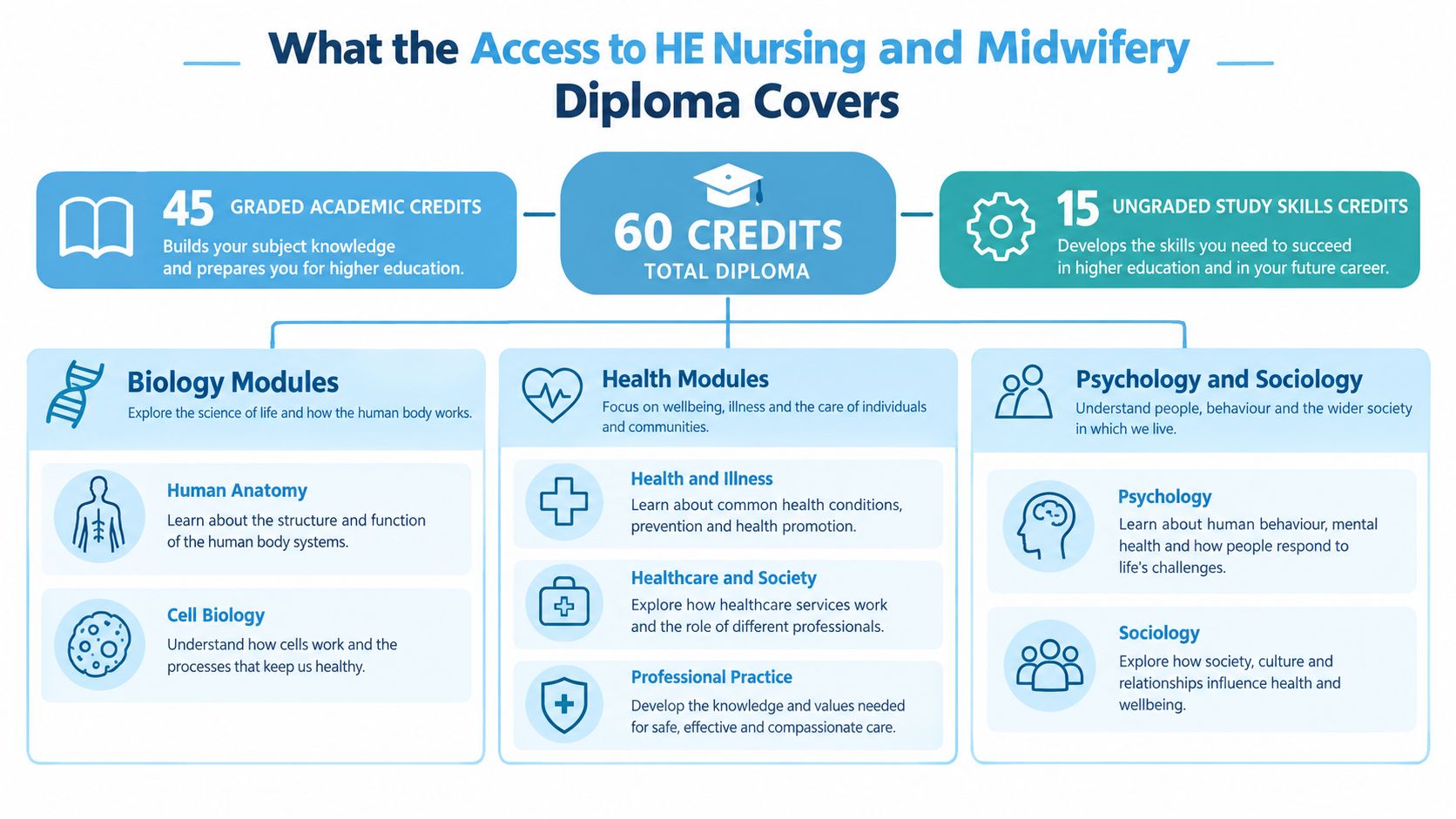
The diploma usually combines academic subject content with the study skills needed for higher education. That second part is easy to underestimate, especially if you haven't written an essay, referenced a source, or sat an assessment in years.
Recent NMC reporting noted 909 accredited pre-registration nursing courses and 123 midwifery courses across the UK, with 23,800 applicants accepted onto pre-registration courses in 2024/25. The same report said intake was broadly unchanged from 2019/20 but 21% below 2021/22, which suggests that access isn't mainly limited by whether courses exist, but by applicant flow and conversion into accepted places, as set out in the NMC spotlight reporting on nursing and midwifery education.
The academic side
Most access to HE nursing and midwifery courses are built around health science subjects. Exact module titles vary by provider, but the pattern is familiar. You'll usually see topics linked to:
- Biology for healthcare: Human anatomy, body systems, cells, and basic physiology
- Health studies: Professional values, communication, public health, and care contexts
- Psychology or sociology: Behaviour, development, mental health, and social influences on care
In plain terms, that means you might study the cardiovascular system one week, then move into communication in healthcare, then work on a psychology unit that helps you understand behaviour and patient experience. The subjects don't sit in neat little boxes for long. Universities want to see that you can connect them.
The study skills side
Many adult learners make the biggest leap here. The course often includes ungraded units that teach you how to function as a university applicant and future undergraduate.
These usually cover things like:
- Essay writing: How to structure an argument and answer the actual question
- Referencing: How to acknowledge sources properly
- Research skills: How to find and use academic material
- Assessment technique: How to plan timed work, presentations, or written assignments
Many adults worry they've “forgotten how to study”. Usually, they haven't. They just haven't used these academic habits recently.
Who it tends to suit
This route often works well for people who already know healthcare is their goal. That includes support workers, carers, career changers, and parents who need a qualification that fits around family life more realistically than a traditional college timetable once did.
It also suits learners who need structure. A clear course, set deadlines, and visible progression can feel far less overwhelming than trying to piece together separate qualifications without a plan.
Entry Requirements and the GCSE Question
The section many people need most, because the friction usually sits.
An Access course can open the path to nursing or midwifery. It doesn't automatically remove every other admissions requirement. In the UK, universities may still require GCSE English, maths, and sometimes science at grade 4/C or above, and some course guidance explicitly says they do not accept Level 2 equivalents. That mismatch between Access marketing and actual admissions rules is one of the most important things adult learners need to understand, as discussed in the Bradford College guidance on Access to HE Nursing and Midwifery routes.
The honest version
Many learners assume the Access diploma replaces missing GCSEs. Sometimes it helps. Often it doesn't. Universities can be very specific about what must be held separately before entry to a nursing or midwifery degree.
Midwifery can be especially strict because admissions standards may still be demanding even without a national admissions test, and recognition of prior learning is not permitted for pre-registration midwifery programmes in the guidance summarised above.
Typical Entry Requirements for Access to HE Nursing and Midwifery
| Requirement | College Entry (Access Diploma) | University Progression (Nursing/Midwifery) |
|---|---|---|
| Age | Usually adult learner age range | Usually accepted for mature applicants |
| Study goal | Clear intention to progress into healthcare | Must match the degree applied for |
| English | College may assess literacy at enrolment | University may require GCSE English at grade 4/C or above |
| Maths | College may assess numeracy at enrolment | University may require GCSE maths at grade 4/C or above |
| Science | Sometimes helpful, not always required for course start | Some universities also ask for science evidence |
| Access diploma | Main Level 3 route into application | Must meet the required grade profile and subject mix |
| Equivalents | College may discuss alternatives | Some universities won't accept Level 2 equivalents |
What to do before you enrol
Check university requirements before you choose your Access course, not after. That means opening actual prospectus pages, reading the admissions wording line by line, and contacting admissions if anything is vague.
Use this checklist:
- Pick universities early: Even a shortlist of three is enough to start.
- Read the GCSE wording carefully: “Accepted” and “preferred” are not the same thing.
- Ask about equivalents in writing: If you're relying on Functional Skills or another Level 2 qualification, get a clear answer.
- Book resits in good time: GCSE maths or English resits can take longer to organise than people expect.
If a university requirement looks unclear, assume nothing. Ask admissions directly and keep the reply.
Nursing vs Midwifery Routes Compared
People often choose an Access diploma title before they've fully worked out whether they want nursing or midwifery. That's understandable because the early content can look similar. The difference becomes clearer when you focus on who you want to care for, what kind of clinical setting suits you, and what sort of training the degree will expect.
Where the overlap sits
Both routes usually share a foundation in biology, health studies, communication, and psychology. That common base makes sense. Nurses and midwives both need academic stamina, professional awareness, and the ability to understand people as well as body systems.
That shared start is useful if you're still deciding. It gives you enough exposure to healthcare study to test whether your interest is broad patient care or specifically maternity and neonatal care.
Nursing vs Midwifery Routes Compared
| Aspect | Nursing Route | Midwifery Route |
|---|---|---|
| Main focus | General patient care across settings | Pregnancy, birth, postnatal care, and newborn support |
| Biology emphasis | Broader anatomy, physiology, and pathology | Reproductive anatomy, maternal health, and neonatal topics |
| Degree pathways | Adult, child, mental health, learning disability nursing | Midwifery |
| Personal statement focus | Wider care environments and patient groups | Women's health, maternity care, and continuity of support |
| Likely placements later | Hospital wards, community, specialist services | Maternity units, antenatal, labour, postnatal services |
| Best fit for | Learners who want breadth or are still exploring | Learners already drawn strongly to maternity care |
A useful decision test
Ask yourself which of these feels more natural:
- You want variety across patient groups and settings
- You're strongly pulled toward supporting women, babies, and families through pregnancy and birth
- You enjoy acute clinical environments
- You value continuity of care and relationship-building over time
There isn't a superior choice. There's a better fit.
Historically, access to midwifery-led care in England has expanded, but unevenly. Research mapping maternity services found alongside midwifery units increased from 53 to 97 between 2010 and 2016, free-standing midwifery units rose from 58 to 61, and services with neither type fell from 75 to 32. The same study found the share of births occurring in midwifery units trebled to 14% of all births in England, with variation between services ranging from 4% to 31%, according to the City research mapping maternity services in England. That variation matters if midwifery is your goal, because local service patterns can shape placement experience and future working environments.
Assessment, UCAS Progression, and Degree Pathways
A lot of adult learners reach this stage and hit the same worry. “If I do all this work, will it get me into university?”
That question matters because an Access course is only part of the route. The diploma helps you show academic ability, but universities still look closely at how you were assessed, what grades you achieved, and whether you meet every extra condition attached to the degree.
How you're assessed
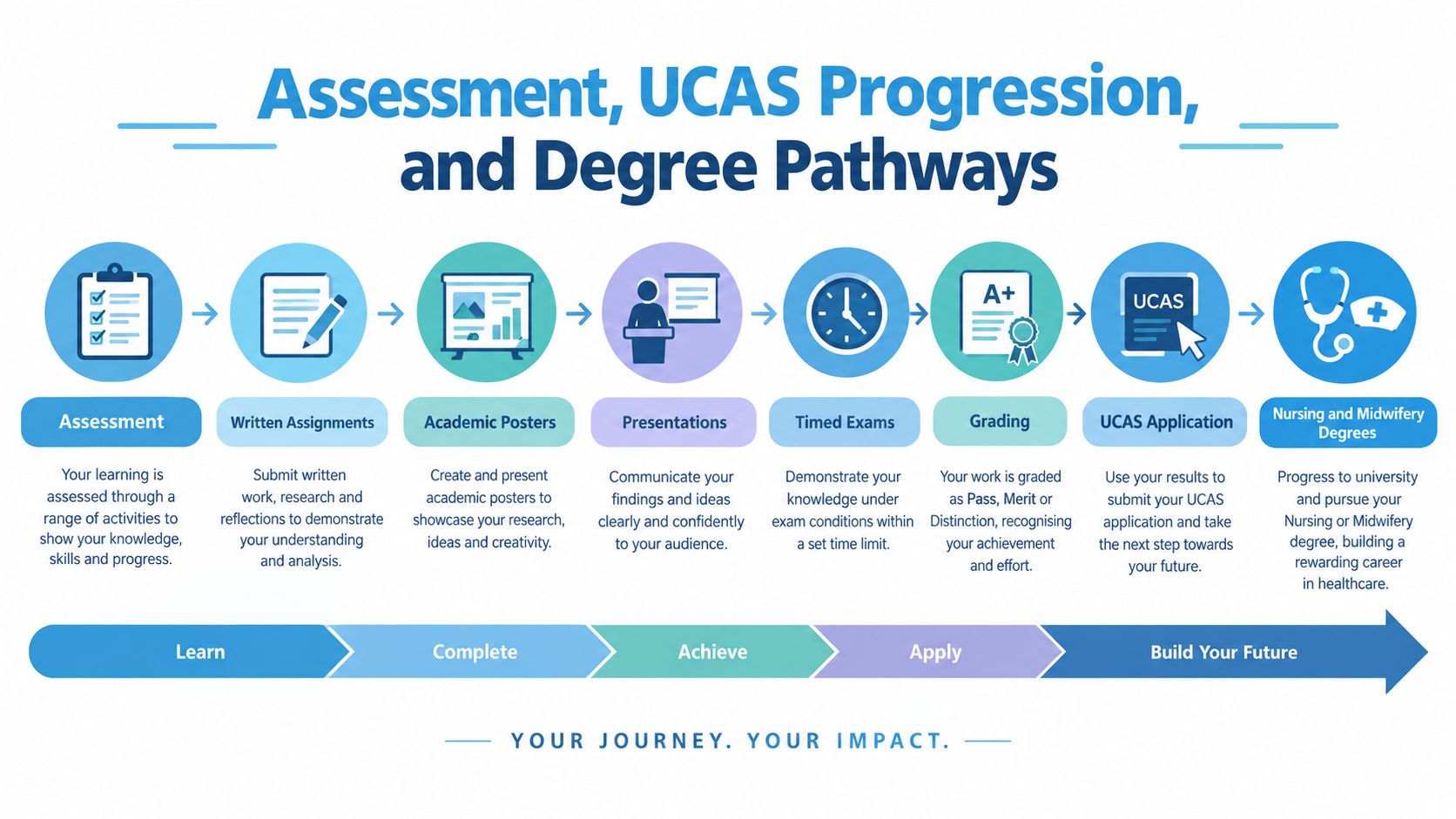
Access courses rarely rely on one final exam. For many adults returning to study, that is a relief. Your progress is usually built from several pieces of work over time, a bit like building a case file that shows a university you can study at degree level.
Common assessment types include:
- Written assignments: Essays, reports, or case-based responses
- Presentations: Short talks that test understanding and communication
- Academic posters: Visual summaries of a topic or argument
- Timed assessments: Used by some providers to test recall and application under pressure
The detail that catches some applicants out is this. Universities do not always look only for a pass. Nursing and midwifery courses often ask for a particular number of credits at Merit or Distinction in science or health-related units. So while you are studying, it helps to keep one eye on the exact offer wording for each university, not just the diploma overall.
How UCAS fits in
Your UCAS application usually runs alongside the diploma, not after it. In practice, that means you may be drafting a personal statement, arranging a reference, and comparing university entry criteria while you are still completing assignments.
This overlap is where admissions friction often shows up for adult learners. Course marketing can make progression sound straightforward, but universities set their own conditions. One institution may accept an Access diploma with the right grade profile. Another may also ask for specific GCSEs, recent study, or evidence of care experience. The safest approach is to check each university's admissions page line by line.
If a course page mentions tariff points and you are not sure how that translates from an Access qualification, this guide to UCAS points for an Access to HE Diploma can help you read the wording more clearly.
A conditional offer means the university will confirm your place if you meet the exact grades and other stated requirements.
Some learners also find it helpful to hear the process explained visually and verbally:
Where the diploma can lead
For nursing, the usual degree outcome is Year 1 entry to a pre-registration course in adult, child, mental health, or learning disability nursing. For midwifery, the route usually leads to a pre-registration midwifery degree.
The practical point is less about the job market in general and more about degree matching. An Access diploma can open the door, but only if the subjects, grades, GCSEs, and university conditions line up properly. Adult learners often save themselves time by shortlisting universities early, then checking whether their Access provider and unit mix fit those entry rules before submitting applications.
Funding, Payment Plans, and Flexible Online Study
Money worries stop a lot of capable adults before they even apply. Usually, the issue isn't lack of ability. It's fear of committing financially while already managing rent, bills, travel, or childcare.
The good news is that access to HE nursing and midwifery is often designed with adult life in mind. Providers know many applicants are fitting study around work and family rather than building life around college.
Paying for the course
Funding options depend on provider and personal circumstances, but common routes include:
- Advanced Learner Loan support: Many adults use this to cover tuition
- Instalment plans: Some providers spread the cost over monthly payments
- Employer support: Occasionally relevant for learners already in healthcare roles
- Local bursary or hardship support: Availability varies
If you want a clear overview of the main route adult learners use, this guide to Access to Higher Education funding is a practical starting point.
Flexible study really matters
Flexibility isn't a luxury for most adult learners. It's what makes the course possible.
You may find options such as:
- Evening study
- Blended delivery
- Remote learning with tutor support
- Part-time pacing
- Online submission of work
One option in this space is Access Courses Online, which offers accredited online Access to HE pathways in subjects including nursing and midwifery, aimed at adults studying around existing commitments.
What to check with online study
Online doesn't mean “accepted everywhere automatically”, and it doesn't mean every provider structures support in the same way. Ask direct questions before enrolling:
- Is the qualification recognised within the Access to HE framework?
- How are assessments submitted and marked?
- What tutor contact is included?
- Are there any in-person requirements?
- Have you checked your target universities accept this route?
That final question is the one that matters most. The convenience of study mode is secondary if it doesn't align with university entry rules.
Application Tips and FAQs for Adult Learners
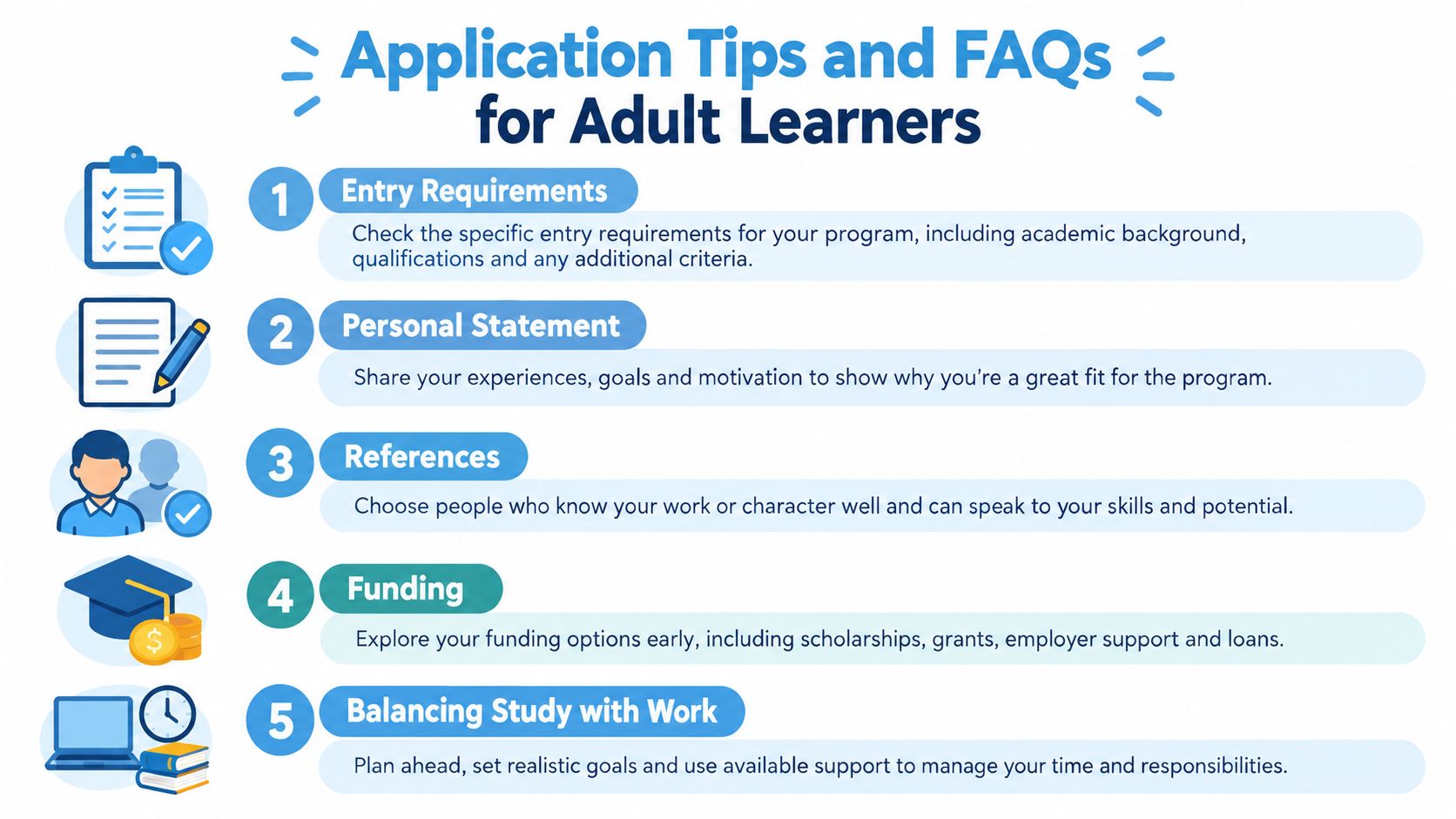
Adult learners often underestimate how much they already bring to a nursing or midwifery application. Caring for relatives, working in support roles, managing a household, returning after a career break, handling difficult conversations, staying calm under pressure. None of that is irrelevant. A lot of it is directly useful.
What admissions teams need is for you to frame that experience properly and support it with the right qualifications.
How to choose a provider sensibly
Don't choose on module titles alone. Look at the underlying structure and progression support.
Check for these points:
- Recognition: Make sure the diploma sits within the recognised Access to HE framework
- Progression support: Ask how they help with UCAS, references, and personal statements
- Delivery style: Decide whether live classes, self-paced learning, or blended study suits your life
- Admissions honesty: Strong providers are clear about GCSE issues instead of glossing over them
If a provider sounds vague when you ask about university progression, take that seriously.
What your personal statement should actually do
Mature applicants sometimes write far too much about wanting a “new challenge” and not enough about evidence. Universities need more than enthusiasm.
A stronger statement usually shows:
- Why this profession: Not just why you want change, but why nursing or midwifery specifically
- What you've already seen: Paid work, volunteering, shadowing, or informal caring experience
- How you've prepared academically: Returning to study is easier to trust when you explain how you'll manage it
- What you understand about the role: Clinical reality, emotional pressure, teamwork, responsibility
Don't apologise for age, gaps, or a non-traditional background. Use them as evidence of resilience, judgement, and commitment.
Common questions adults ask
Can I complete the diploma in one year?
Often yes, but it depends on the provider and your schedule. A faster course isn't always the better course if you also need GCSE resits or have heavy family commitments.
Will universities accept online Access study?
Many do, but you must check the exact university and degree requirements yourself. Acceptance depends on the qualification and the admissions policy, not on online study as a label.
What if I don't have the GCSEs yet?
Then deal with that first, or at least alongside your planning. Don't assume the Access diploma will solve the problem later.
Does part-time study weaken my application?
Not in itself. What matters is the qualification achieved and whether you meet the university's entry requirements.
Am I too old to start?
In most cases, no. Nursing and midwifery courses regularly include mature students. What matters more is readiness, planning, and a realistic understanding of the commitment.
A realistic planning timeline
A calm application usually follows a simple pattern:
- Research degree entry requirements first
- Check GCSE gaps immediately
- Choose an Access provider that matches your target progression
- Plan funding before enrolment
- Start collecting experience and examples for your personal statement
- Apply to university with evidence, not hope alone
That order helps because each step depends on the one before it. Many application problems happen when people reverse the sequence and enrol before checking university rules properly.
The biggest reassurance I can give is this. Adult learners are often better prepared for healthcare study than they think. They usually bring persistence, emotional maturity, and a stronger sense of purpose than they had at eighteen. Those qualities won't replace missing entry requirements, but once the paperwork is in order, they can make a real difference.
If you want a flexible route into access to HE nursing and midwifery, Access Courses Online offers accredited online diplomas designed for adults returning to study around work and family life. You can explore course options, funding guidance, and progression support in one place, then decide whether the route fits your target university and your current circumstances.