
You might be reading this after a late shift, with a search history full of nursing degrees, midwifery courses, and questions like “Can I go to university without A-levels?” That's a very common place to start. Many adults know they want a health career, but feel stuck between ambition and qualifications they never had the chance to finish first time round.
An Access to Health Professions course online can bridge that gap. But before you get swept up by phrases like “study from home” or “no qualifications needed”, there are two checks that matter more than anything else. First, can you get funding where you live? Second, do you already have, or can you get, the English and maths qualifications universities usually expect?
Those two points decide whether this route is practical for you. Everything else, the modules, the online format, the university progression, only makes sense once those are clear.
What an Online Health Professions Access Course Really Is
If you left school years ago and now want to become a nurse, midwife, paramedic or physiotherapist, an Access course isn't a vague “mature student option”. It's a specific qualification built for exactly that situation.
An Access to Higher Education Diploma is a Level 3 route designed to help adults progress into university, including health-related degree courses. Health-related Access diplomas are nationally recognised in the UK and can carry up to 144 UCAS points according to LearnDirect's explanation of Access to HE Health diplomas. That matters because universities can assess your application on a recognised academic basis even if you don't have A-levels.
It's not the same as a general return-to-study course
The Health Professions pathway is aimed at people targeting clinical and care-based degrees. That's different from an Access course focused on social work, education or humanities, where the academic content points in another direction.
In practice, that means your work is shaped around subjects that prepare you for healthcare study. You're not just “getting back into education”. You're building the academic base for university-level health training.
If you want a simple background overview, this guide to what an Access to HE course is gives the broad picture.
What “online” usually means
People often get the wrong idea. Online doesn't mean casual, unstructured or less respected. It usually means your college delivers the course through a virtual learning platform where you access lesson materials, readings, recorded teaching, assignment briefs and tutor feedback.
Practical rule: Online should mean flexible delivery, not lower standards.
The diploma still sits within the same recognised Access to HE framework. Universities don't normally split these into “good because classroom” and “less good because online”. What matters is that the diploma is properly recognised, that the modules match your target degree, and that you meet the university's wider entry requirements.
Why this route matters for adult learners
The Access route has been a major widening-participation path into higher education for years. QAA-linked reporting states that over three-quarters, 77%, of people who achieve an Access to HE Diploma progress to higher education, and around 40,000 mature students take Access to HE diplomas each year across the UK, according to the Access to HE report summary.
That's why this route exists. It gives adults a recognised second chance, but in a focused, academic way.
Core Modules and Topics You Will Study
Many students want to know one thing early on. “What will I study?” That's the right question, because the best way to judge an access to health professions course online is to look past the course title and inspect the academic content.
The health pathway usually combines science, health context, and study skills. Some providers vary the module names, but the underlying themes are fairly consistent.
The academic core
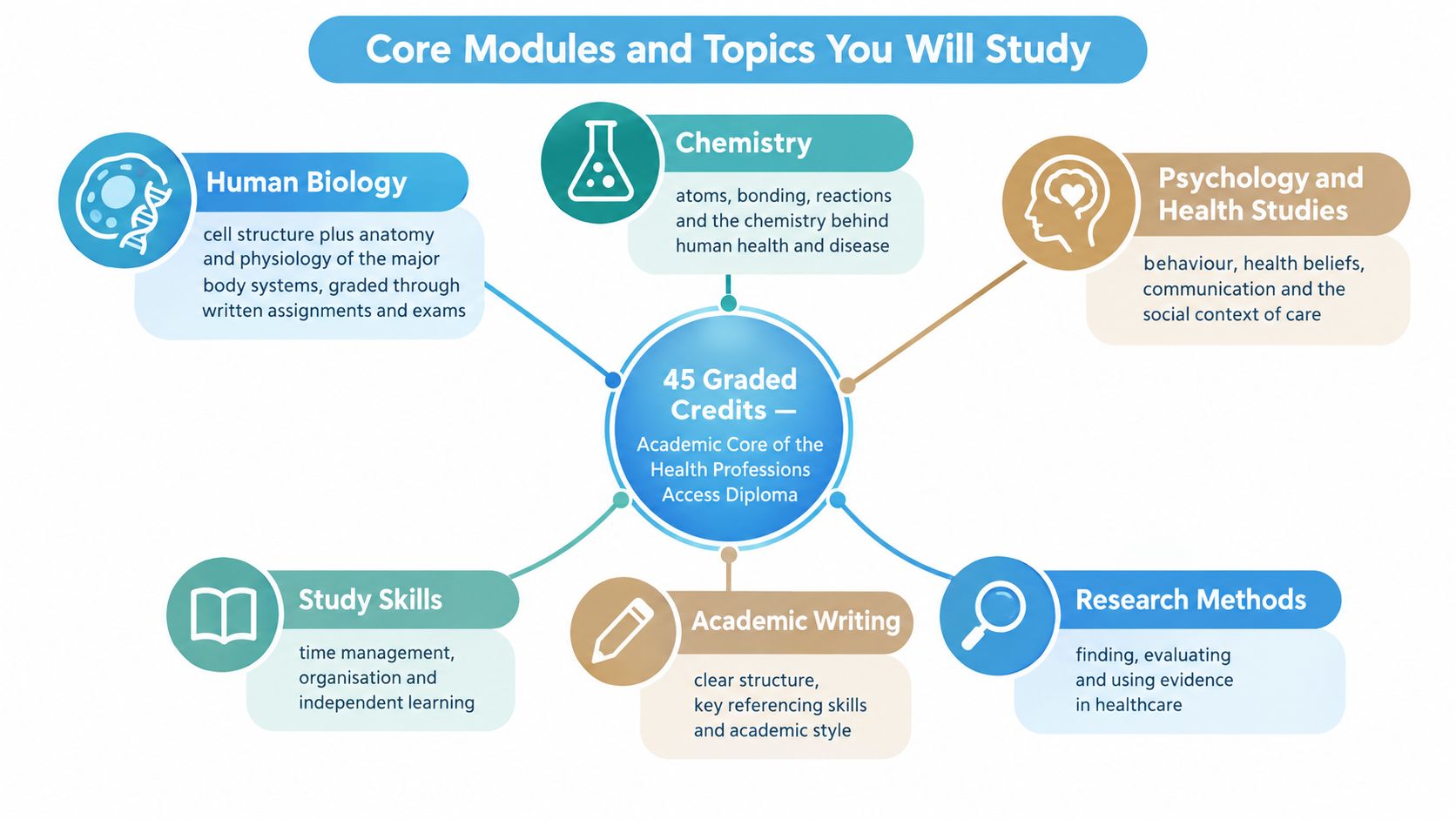
A typical Health Professions diploma centres on graded academic units that prepare you for university-level healthcare study. Common themes include:
- Human Biology: Cells, tissues, anatomy, and body systems such as circulatory, respiratory, digestive and nervous systems.
- Psychology: Behaviour, development, mental health awareness, and how people respond to illness, stress and change.
- Health Studies: Professional values, ethics, communication, public health ideas, and how care is organised.
- Science options: Some courses include chemistry or extra biology content, especially useful for learners aiming at science-heavy health degrees.
- Social context units: Sociology sometimes appears, particularly where understanding inequality, communities and care systems helps with nursing applications.
Here's a visual overview of the kind of curriculum structure learners often see:
Why these modules matter later
These subjects aren't there to make the diploma sound academic. They prepare you for what comes next.
Human Biology gives you a base for first-year bioscience teaching on nursing and midwifery degrees. Psychology helps when universities ask you to think about communication, vulnerability, development or mental wellbeing. Health Studies supports interview answers because it introduces the language of safe practice, ethics and person-centred care.
If anatomy worries you, this anatomy and physiology course guide can help you see how the science builds step by step.
The part providers often underplay
Alongside the academic units, many courses also include ungraded work on the skills adults usually need most when returning to study:
- Academic writing: Structuring essays, referencing, and using evidence properly.
- Research skills: Reading sources critically and building arguments.
- Study organisation: Time management, planning assignments, and working independently.
- Application support: Personal statement work and university preparation.
A strong Access course doesn't just teach health topics. It teaches you how to think, write and study at university level.
For many adults, those study skills make the difference between starting nervously and finishing confidently.
Entry Requirements and the GCSE Question
This is the section many course pages should put near the top, but often don't.
You may see phrases like “no formal qualifications needed” or “ideal for adults returning to education”. That can be partly true at course-entry level. But if your real goal is nursing, midwifery or another health degree, the more important question is what universities expect at the end.
The hidden barrier most adults meet first
One provider summary highlights a common problem with online health Access courses. Many still require GCSE English and maths at grade 4/C, or Level 2 Functional Skills plus an assessment, even when the marketing sounds more open-ended, as set out by USP College's online Health Science Professions course information.
That's why some learners feel confused. The Access diploma is meant to open doors, but English and maths can still be the first locked gate.
Requirement versus reality
| Advertised Requirement | Actual University Expectation | Why It Matters |
|---|---|---|
| “No A-levels needed” | Usually true for Access applicants | The diploma is designed as the alternative to A-levels |
| “Open to adult learners” | Often yes, but providers may still assess readiness | You may need an interview, written task, or evidence that you can cope with Level 3 study |
| “No qualifications needed” | Often not true in practice for English and maths | Universities frequently expect GCSE English and maths, or accepted Level 2 equivalents |
| “Fully accessible route” | Only if your current qualifications match progression rules | A learner can complete the course and still hit a problem if GCSE requirements are missing |
What to check before you apply
If you're considering an access to health professions course online, stop and confirm these points before paying a fee or submitting an application:
- Your English status: Do you already hold GCSE English at grade 4/C or above, or an accepted equivalent?
- Your maths status: Same question for maths.
- Your target universities: Do they accept Functional Skills Level 2, or do they insist on GCSEs?
- Your intended degree: Midwifery, nursing and allied health courses don't always use identical rules.
Some colleges let learners take Level 2 Functional Skills alongside or before the diploma. That can be useful, but you must still check whether your chosen universities accept it.
Don't ask only “Can I get on the course?” Ask “Will this course, with my current English and maths, get me onto the degree I want?”
That one shift in thinking can save you a year of effort and disappointment.
Progression Routes into Nursing, Midwifery and Allied Health Degrees
A lot of course pages make progression sound simple. Finish the diploma, apply to university, job done.
For some learners, that is broadly how it works. For others, the key decision sits underneath the headline. Will your course content match the degree you want, and will your English and maths qualifications satisfy the university as well as the college? If either piece is missing, progression can stall at the application stage even after a good year of study.
How universities look at an Access diploma
Admissions teams usually read an Access application in layers, a bit like checking a passport, ticket and destination rather than glancing at one document and waving you through.
They often look at:
- Your grade profile across the diploma
- Whether the units include enough relevant science or health content
- Your English and maths qualifications
- Your personal statement and any care-related insight or experience
- Interview performance or selection activity, if the course uses it
That matters because different degrees look for different evidence. A university may be happy with a general health Access route for one course, but expect stronger biology or science grades for another. The diploma title gets you considered. The detail inside it often decides how competitive your application is.
The same diploma can lead to different outcomes
Two learners can complete very similar Access courses and end up with different progression options.
One may be a strong fit for a care-focused degree because they have relevant experience, solid written work and the right Level 2 qualifications already in place. Another may achieve decent grades but find that a chosen university wants GCSE maths rather than Functional Skills, or asks for more science than their course included.
That is why it helps to work backwards from the degree, not forwards from the course brochure.
What universities may focus on by subject
Here is the practical part many adults need.
- Adult or mental health nursing: Universities often weigh your academic profile alongside your understanding of care, communication, professionalism and the realities of placement learning.
- Midwifery: Providers may look closely at maturity, insight into the role, and evidence that you understand the demands of both academic study and clinical practice.
- Paramedic science: Selection can be competitive. Courses may pay attention to resilience, decision-making and whether your science background is strong enough.
- Physiotherapy, radiography, occupational therapy or operating department practice: Universities may scrutinise science content more closely, especially if their entry profile is more academic or clinically specific.
The pattern is simple. The more specialised the degree, the more carefully you need to check the fine print.
A safer way to plan your progression
Before you enrol, make a shortlist of universities and compare three things side by side:
| What to check | Why it matters |
|---|---|
| Accepted Access diploma subjects | Some universities want a health or science-based Access route, not just any Access qualification |
| Required grade profile | Offers are often framed around distinctions, merits, or a mix of both |
| English and maths policy | This is where applicants are often caught out, especially if a university will not accept Functional Skills |
You can then ask much better questions. Not "Can this diploma lead to university?" but "Will this exact diploma, with my current qualifications, meet the entry rules for these specific universities?"
That is the difference between a course that looks promising on paper and a route that gets you to application stage with confidence.
A typical path is straightforward once those checks are done. Complete the diploma, apply through UCAS, attend any interviews or selection days, then meet the conditions of your offer. The hidden work happens earlier, when you match your Access course and Level 2 qualifications to real university entry rules rather than marketing claims.
How Online Study, Flexibility and Tutor Support Work in Practice
“Flexible” is one of the most overused words in education marketing. It sounds comforting, but adults need to know what it means on a Tuesday evening after work.
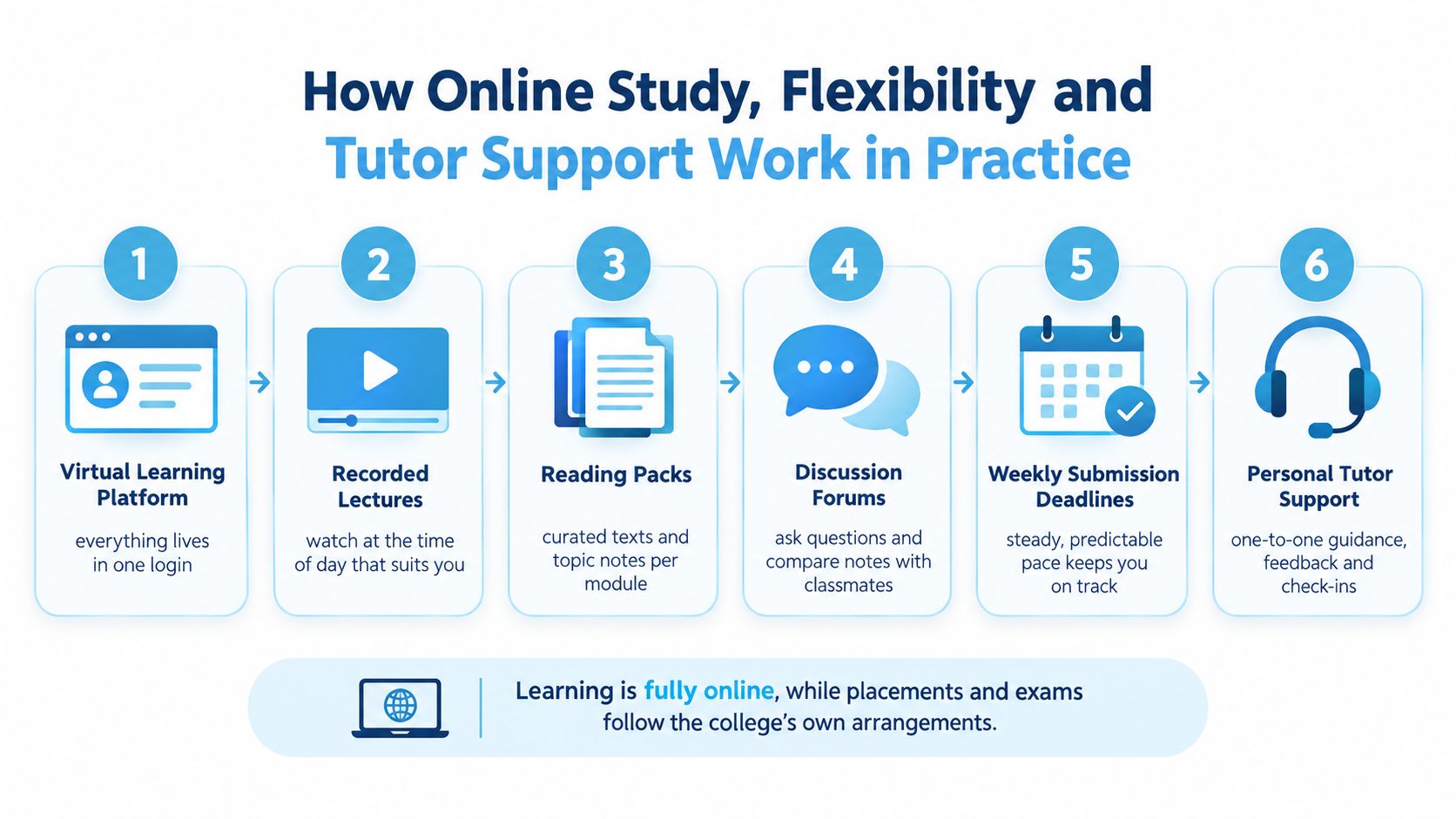
Most online Access courses are built around a virtual learning environment. That's the digital home for your modules, assignment briefs, reading materials, recorded content and tutor messages.
What your week usually looks like
For many adults, online study works because it is asynchronous. That means you don't always have to sit in a live classroom at a fixed hour. You log in when your life allows, then work through what has been set.
A typical week may include:
- Recorded teaching: You watch when you can, then make notes in your own time.
- Reading and note-making: Much of the learning happens here.
- Assignment work: Drafting, editing and uploading written tasks.
- Tutor contact: Feedback, messages, and sometimes scheduled support sessions.
- Discussion spaces: Useful when you want to ask questions without waiting for the next class.
Flexible doesn't mean unstructured
This catches people out. Online doesn't always mean self-paced in the casual sense. Many courses still use weekly deadlines or a clear teaching schedule. The flexibility comes from where and when you study within that structure.
If you need someone physically standing at the front of a room each week, online study may feel harder than you expect.
You'll also need practical basics: reliable internet, a device that works properly, and somewhere you can concentrate often enough to keep momentum. The adults who do well usually build a routine quickly. They don't wait to “feel ready” every day.
One provider in this space, Access Courses Online, offers fully online Access diplomas with tutor support and flexible study built around adult learners' schedules. That model suits people who need structured remote learning rather than campus attendance.
Funding, Advanced Learner Loans and the Geography Question
This is the first big filter, even though many learners only discover it after they've become emotionally invested in a course.
Funding for online Access to HE health courses in the UK isn't the same everywhere. One provider states that learners usually need to be 19+ and living in the UK, with fee remission tied to England residency, while learners in Scotland, Wales and Northern Ireland typically self-fund, according to Activate Learning Reading College's online Access to HE Health and Social Care course information.
Why your postcode changes the conversation
A second provider summary puts the issue even more bluntly. Some providers say learners in England can use the Advanced Learner Loan, while learners in Scotland, Wales and Northern Ireland may have to self-fund, and eligibility can also depend on age and prior qualifications, as explained by Activate Learning's adult course funding guidance for online Access to HE Health and Social Care.
That means two learners looking at the same course page may face very different costs because they live in different parts of the UK.
Funding rules across the UK
| Nation | Typical Funding Route | Learner Cost |
|---|---|---|
| England | Often Advanced Learner Loan, depending on eligibility | Can be funded through the loan route where eligible |
| Scotland | May need self-funding with some providers | Varies by provider and local arrangements |
| Wales | May need self-funding with some providers | Varies by provider and eligibility |
| Northern Ireland | May need self-funding with some providers | Varies by provider and eligibility |
If you want a broader explanation of the finance side, this guide to Access to Higher Education funding is a useful starting point.
The checks to do before you enrol
Don't rely on a headline that says “funded” or “affordable” without reading the conditions. Confirm:
- Your nation of residence: England, Scotland, Wales or Northern Ireland
- Your age: Some support rules depend on being an adult learner
- Your previous qualifications: Prior Level 3 study can affect eligibility
- The provider's exact policy: Each college may phrase this differently
- Your backup plan: If funding doesn't apply, can you realistically self-fund?
Geography isn't a small detail. It can decide whether this route is available to you at all.
That's why I'd put the funding check before almost everything else.
Your Next Steps from Taster Day to Enrolment
Once you've checked funding and qualification fit, the process becomes much clearer. At this stage, you're not browsing anymore. You're testing whether a specific course can carry you all the way to a university application.
A good first move is to speak to a real person at a college or provider. Ask direct questions. Don't just request a brochure.
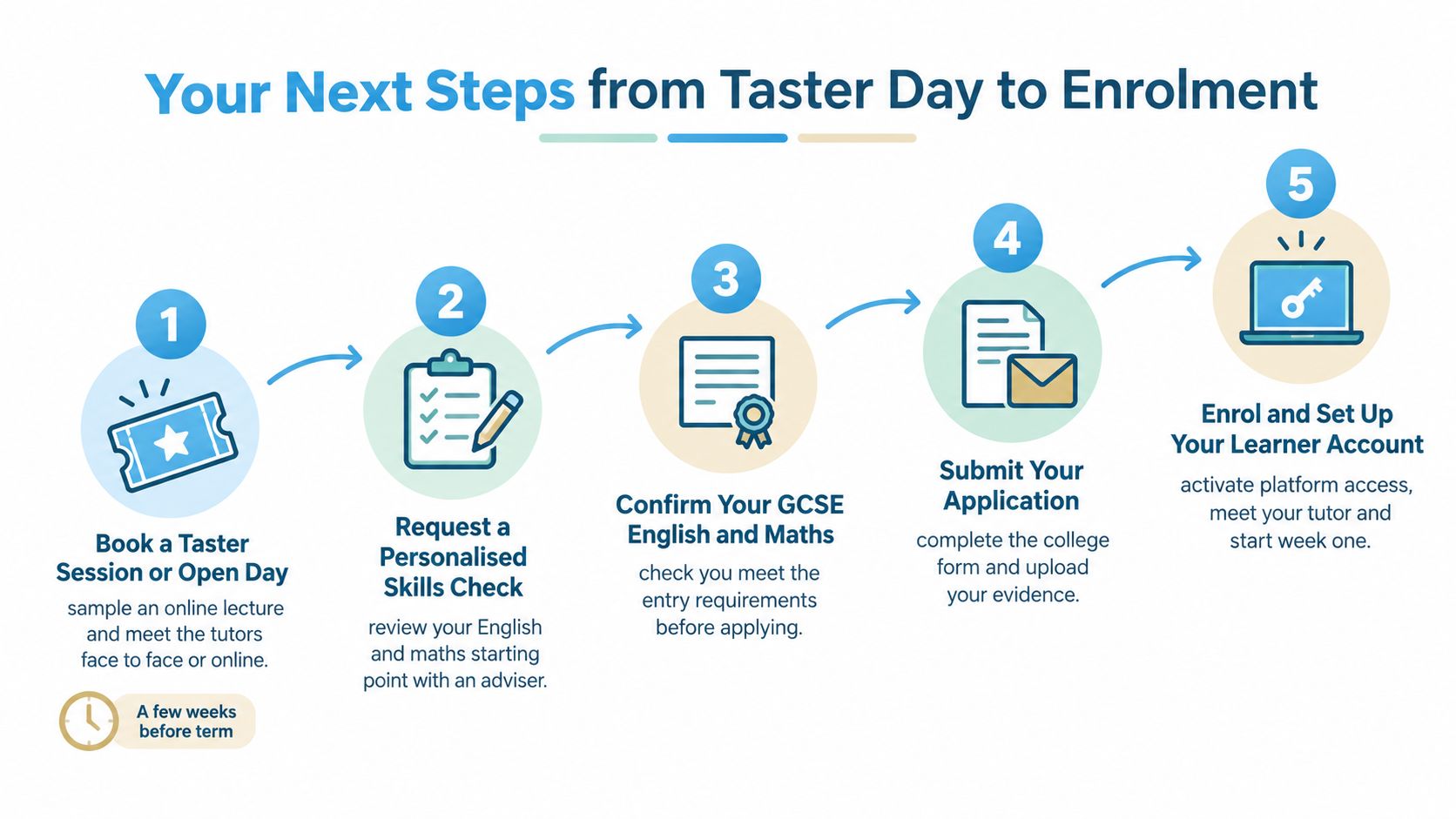
A sensible order to follow
-
Book a taster session or open event
You want to see how the online platform feels and how staff answer practical questions. -
Ask for a skills check
This helps you find out whether your current English and maths position is enough for entry and progression. -
Gather your evidence
Pull together certificates, old results, ID documents, and any relevant work or care experience. -
Check your target universities before enrolling
Don't assume all nursing or midwifery courses treat Access applicants in exactly the same way. -
Apply and complete admissions steps
This may include an interview, a written assessment, or a readiness conversation.
A short video can also help you picture the route more clearly:
Questions worth asking on day one
Take these with you when you speak to a provider:
- Do my current English and maths qualifications meet the entry and progression requirements?
- Which universities do learners on this course usually apply to?
- Does this pathway suit nursing, midwifery, paramedic science, or my chosen degree?
- How is the online teaching structured each week?
- What support do returning adult learners get if they're rusty with study skills?
You don't need every answer immediately. You do need enough clarity to know that you're building towards a real university application, not just collecting another qualification.
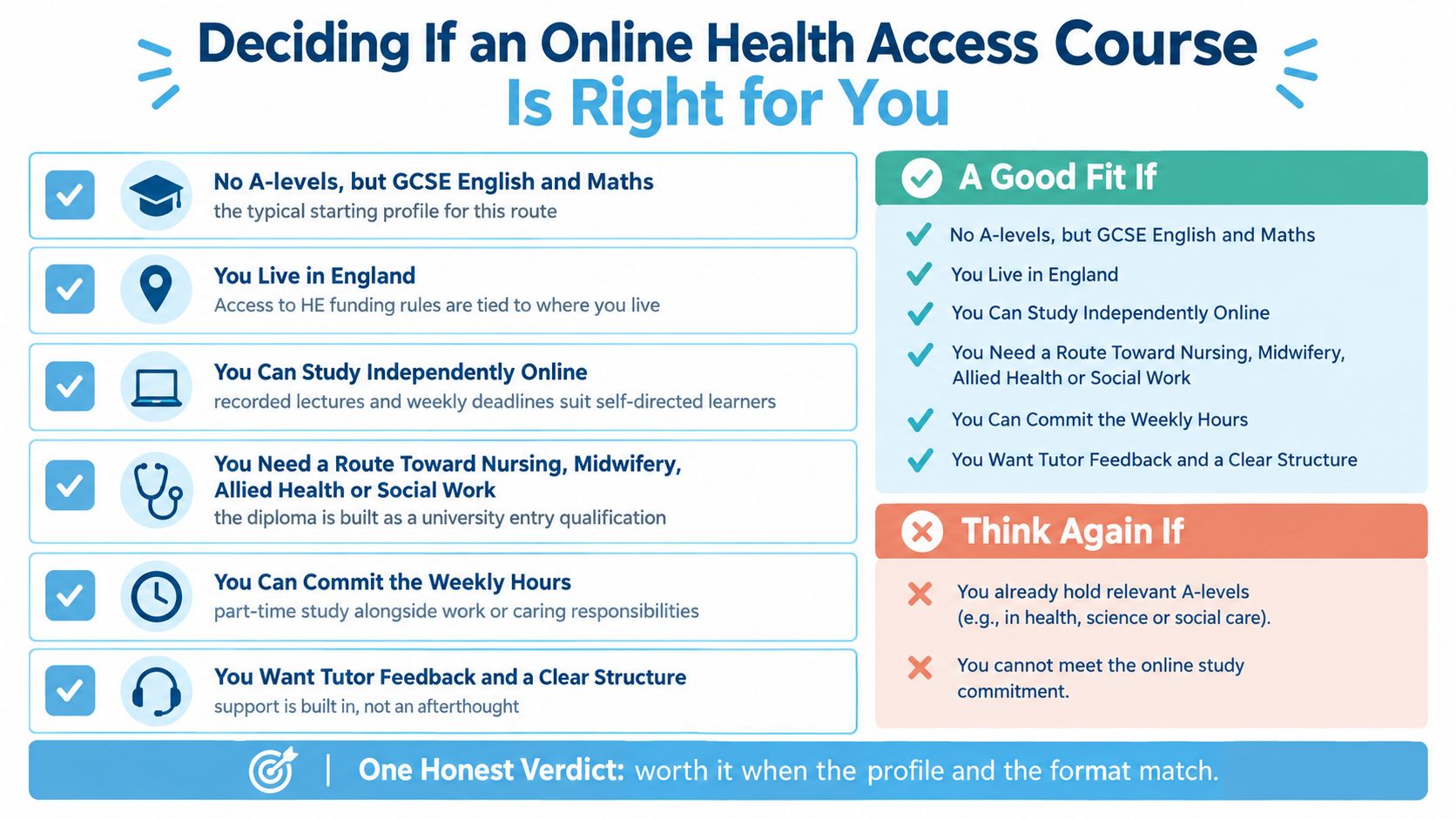
Deciding If an Online Health Access Course Is Right for You
For the right person, this route can be a practical and respected way into healthcare study. It suits adults who don't have traditional qualifications for university entry, but are ready to work steadily and study independently.
It's usually a good fit if you want a structured route towards nursing, midwifery or an allied health degree, and you're comfortable learning online with deadlines, written assignments and tutor feedback. It becomes far less suitable if your English and maths position still blocks progression, or if the funding rules where you live make the course unrealistic.
That's why I'd reduce the whole decision to two gating questions.
- Can you meet the English and maths expectations for your target universities?
- Can you fund the course based on where you live and your eligibility status?
If the answer to both is yes, an online Access course can be a very sensible next step. The wider demand for health-related pathways also helps explain why this matters. In 2022-23, 38,220 students registered to study an Access to HE Diploma in the UK, and 60.6% of all registrations were in Health, Public Services and Care, with 7,105 registrations in midwifery and 1,100 in health and social care, according to the Skills and Education Group Access statistics summary.
Those numbers tell you this isn't a niche fallback. It's a mainstream route for adults moving into health careers. Just make sure you check the hidden practicalities before you commit.
If you're weighing up an online route into nursing, midwifery or another health degree, Access Courses Online offers accredited online Access to HE Diplomas designed for adult learners who need flexibility around work and family. You can explore course options, check how online study works, and get guidance on funding and entry requirements before deciding whether this path fits your goals.