

You may be staring at a criminology degree page with genuine enthusiasm, then stopping at the entry requirements. Perhaps your school qualifications don't match the tariff, you've been away from formal education for years, or you're unsure whether your work and family commitments leave room for university study. That uncertainty is common, but it doesn't mean the route is closed.
An Access to Higher Education Diploma in criminology or a related subject can help you rebuild academic confidence, develop degree-level study skills and prepare a credible university application. The important point is to choose and use the qualification strategically. Criminology courses assess more than interest in crime. They expect evidence-based reasoning, careful reading, structured writing and an ability to connect social issues with research.
Why Adults Choose Access to Higher Education Criminology
Consider someone who has spent years working in care, security, administration or public services. They may have followed crime and justice debates for a long time, perhaps through work or personal experience, but they don't have the traditional qualifications listed on a university website. The desire is there. The obstacle is knowing how to turn that desire into an application an admissions team can assess.
A mature applicant may also worry about returning to essays, referencing and independent study. Those concerns are practical, not signs that university is beyond reach. An Access course gives you a structured opportunity to practise academic work before you face the demands of an undergraduate criminology degree.

A route designed for adult returners
Mature applicants are a substantial part of the university population. UCAS data recorded 757,600 applicants for full-time undergraduate places in 2024, while applicants aged 21 and over increased by 4%. The increases were 11% among applicants aged 30 to 34 and 8% among applicants aged 35 and over, according to the House of Commons Library briefing on undergraduate applications.
Those figures don't promise that every criminology application will succeed. They do show that changing direction later in life is a recognised part of higher education. Your employment history, caring experience and understanding of public services may also give you useful context for studying crime, punishment and inequality.
Practical rule: Treat your previous education as background, not a final verdict on your academic potential.
An Access route can be especially valuable if you need to demonstrate recent study, produce graded work and prove that you can manage a sustained programme. It doesn't remove the need to meet university requirements, but it can replace an unclear past with current evidence of readiness.
Understanding the Access to HE Diploma Structure
An Access to Higher Education Diploma is a Level 3 qualification intended to prepare adults for degree-level study. It is not just a collection of informal lessons about crime. You complete taught material, submit assessed work and develop the study habits universities expect from new undergraduates.
The exact units and grading pattern depend on the provider and pathway. That's why you should read the specification rather than assume that every course called “criminology” has the same content. Some routes are directly focused on criminology, while others relate to social science, public services or policing.
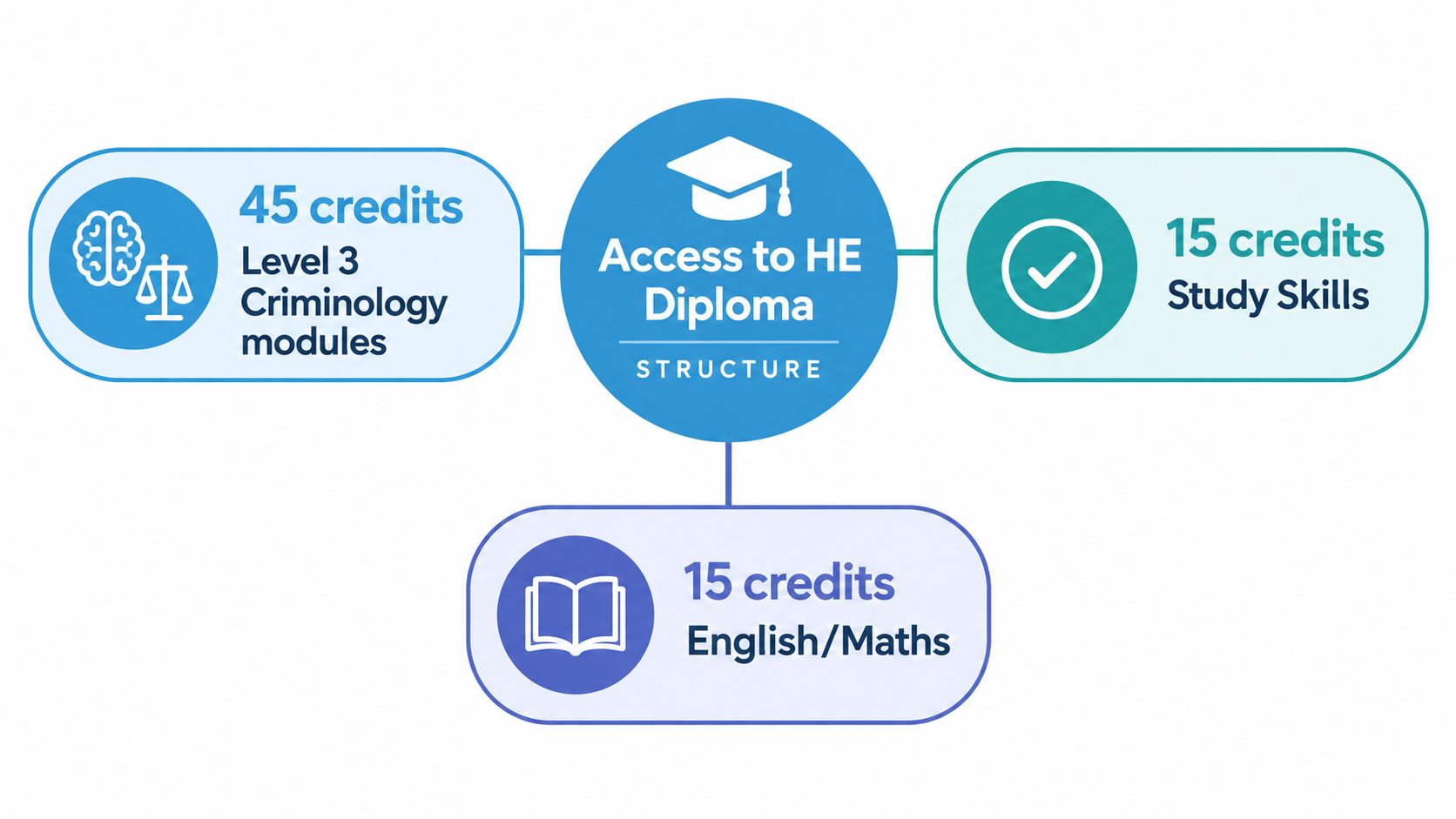
Credits, grades and admissions
A useful example comes from Manchester's published entry criteria. The university specifies a QAA-recognised Access to HE Diploma with 60 credits overall, including 45 Level 3 credits, alongside required performance at Merit and Distinction level in a relevant subject area. This illustrates why the name of the diploma alone isn't enough. Admissions teams may examine the number of credits, their level, your grades and the subject content.
Access qualifications commonly use the language of Pass, Merit and Distinction. In practical terms, that means your application may depend not only on completing the diploma, but also on achieving particular grades in relevant units. A course that includes research methods, sociology or public policy may be more useful for a criminology application than one with limited connection to your chosen degree.
Check four details before enrolling:
- Qualification status: Confirm that the diploma is recognised for higher education progression and ask which universities have accepted it for relevant degrees.
- Credit composition: Compare the course structure with the credit and Level 3 requirements listed by your target universities.
- Grade expectations: Look for required Merit or Distinction performance, not just a general statement that Access qualifications are accepted.
- Subject relevance: Make sure the units support criminology, social science, law, psychology or another area named by your preferred course.
The diploma can provide a bridge, but you still need to build that bridge towards a specific destination.
Criminology Course Content and Key Skills
A criminology-focused Access course should introduce you to the questions that shape the discipline. Why do societies define some behaviour as criminal? How do policing, courts and prisons respond to offending? How do inequality, media reporting, communities and public policy influence the way people understand crime?
You might encounter units covering criminal justice, sociology of deviance, crime and the media, psychology and crime, social policy or research methods. The exact titles vary, so focus on the skills behind the titles. A unit about crime and the media, for example, should help you examine how news reports and popular culture construct ideas about offenders, victims and public danger. It shouldn't encourage you to treat dramatic coverage as a reliable account of crime.
The academic toolkit
University criminology requires you to move from opinion to supported analysis. You may have a strong view about sentencing or policing, but an assessed essay will expect you to define the issue, consider competing explanations, use credible sources and reach a reasoned conclusion.
The most useful preparation includes:
- Critical reading: Identify an author's argument, evidence, assumptions and limitations rather than copying a summary.
- Source evaluation: Distinguish between academic research, official evidence, journalism, campaign material and unsupported online commentary.
- Structured writing: Build paragraphs around a clear claim, supporting evidence and an explanation of how that evidence answers the question.
- Referencing: Record source details as you work so that citations are accurate and your academic integrity is protected.
- Research methods: Understand how researchers collect and interpret qualitative and quantitative evidence.
- Ethical awareness: Consider privacy, consent, harm, representation and the responsibilities involved in researching sensitive subjects.
Why social science matters
Criminology draws on several disciplines. Sociology can help you examine social structures and inequality. Psychology can introduce questions about behaviour and decision-making. Law and public policy can show how institutions define offences and organise responses. Research methods help you test whether an appealing explanation is supported by evidence.
You don't need to arrive with specialist knowledge of every area. You do need to become comfortable asking precise questions. Instead of writing that “the media causes fear”, you might ask which media, among which audience, through what kind of representation and with what evidence of influence.
That habit of narrowing a claim is one of the clearest differences between casual interest in true crime and academic criminology.
Online Study for Working Adults
A fixed college timetable may not fit around shifts, school runs, disability, caring responsibilities or an existing professional role. Online access to higher education criminology can remove travel and timetable barriers, but it doesn't remove the work involved. You'll still need reliable access to learning materials, a realistic study routine and timely contact with tutors.

The wider participation picture explains why flexibility matters. In England, mature students entering higher education fell from 243,885 in 2010/11 to 191,340 in 2018/19, while mature part-time entrants fell from 149,140 to 70,880, a reduction of approximately 52%, according to the Office for Students review of mature student participation. The figures point to pressures involving employment, caring, finance and the ability to attend at set times.
Choosing between study formats
Classroom study offers immediate contact with tutors and other learners. It may suit you if you benefit from a regular physical setting, planned discussions and a clear separation between home and study. Online learning offers greater control over when you read, watch teaching materials and complete assignments, although you'll need to create that structure yourself.
Before you enrol, ask specific questions:
- Teaching access: Can you contact a tutor when you're stuck with an essay or research task?
- Assessment planning: Are deadlines clearly published, and can you see how feedback will help with later assignments?
- Accessibility: Can the provider support assistive technology, adjusted formats or other reasonable adjustments?
- Technical demands: Do you understand which devices, software and internet access the course requires?
- Pacing: What happens if work, health or family circumstances temporarily reduce your study time?
You can supplement formal study with free learning resources. For example, the Kindness Community Foundation skill guide may help you identify general learning opportunities while you strengthen your study routine. For subject-specific orientation, you can also review this guide to an online criminology course.
A flexible course works best when flexibility is matched by support. Set regular study blocks, keep a task list and contact your tutor before a difficulty becomes a missed deadline.
Here's a short media resource to consider alongside your planning:
Progression Routes and University Requirements
An Access qualification can lead to a wide range of universities, but “accepted by universities” is too broad to guide an application. You need to compare the actual requirements for each criminology course, including the overall tariff, relevant subject credits, required grades and GCSE conditions.
The national progression data is encouraging but should be read carefully. In England, 12,600 adult learners achieved an Access to HE course in the 2022/23 academic year, and 65% progressed to a sustained higher-education course in 2023/24, according to the government's Further Education Outcomes statistics. That progression rate indicates a substantial route into higher education, while also showing that completing an Access course doesn't automatically remove financial, personal, admissions or preparation barriers.
A separate set of 2024–25 AIM progression data found that Access students received offers from 16 of the UK's 20 highest-ranked universities. The same data covered full Access Diplomas across multiple subjects, so it shouldn't be presented as a criminology-specific admissions guarantee. It does, however, challenge the assumption that Access applicants are limited to less selective institutions.
Acceptance is not the same as an offer
Use a university comparison sheet before you apply. Record the requirements in the university's own wording and ask the provider whether your planned units meet them.
| Metric | Statistic |
|---|---|
| Adult learners achieving an Access to HE course in England in 2022/23 | 12,600 |
| Progression to sustained higher education in 2023/24 | 65% |
| Offers to Access students from the UK's highest-ranked universities in 2024–25 | 16 of the top 20 |
The central question is not “Will a university accept Access courses?” It is “Will this university accept my diploma, my subject pathway, my credit profile and my predicted or achieved grades for this criminology course?”
Manchester, for example, specifies a QAA-recognised diploma, a defined credit structure and relevant Merit or Distinction performance. Keele lists an Access Course among possible Level 3 qualifications for criminology entry. Those examples show why you should compare several universities rather than build your entire plan around one assumption.
Use a pathway planning resource for schools if you need help organising progression decisions, then read the admissions pages yourself. This guide to applying to university after an Access course can help you organise the application process, but your target university remains the final authority.
Funding, Fees, and Application Strategy
Money often determines whether an adult can begin and sustain an Access course. Funding rules can depend on your circumstances, previous study, residency and the type of qualification, so don't rely on a general promise of support. Ask the provider which funding routes may apply, whether tuition can be financed, and what happens if your circumstances change.
You should also ask about payment schedules, bursaries, childcare support, travel costs and the equipment required for online study. Keep a written record of the answers. A course that looks manageable at enrolment can become difficult if you haven't planned for software, internet access, books or reduced working hours.
Alternative routes matter because educational access remains unequal. In England, 28.9% of pupils eligible for free school meals at age 15 had entered higher education by age 19 in the 2023/24 cohort, according to the government's widening participation statistics. This is a school-to-university measure, not a prediction of your adult outcome, but it shows why routes beyond traditional post-16 qualifications matter.
Build an application that answers the requirements
Start with the degree, then work backwards:
- Choose target courses: Include ambitious, realistic and secure options, and check whether each course names criminology, social science or another relevant subject.
- Map the diploma: Compare your planned units, credit levels and grading targets with each admissions page.
- Check additional conditions: Look for GCSE English and maths requirements, enhanced checks or subject-specific expectations.
- Plan evidence: Use your personal statement to explain why criminology, what you've learned from work or life and how the Access course has prepared you.
- Confirm before enrolling: Ask admissions teams in writing if the proposed diploma meets their stated requirements.
Keep eligibility and competitiveness separate. Meeting the minimum requirement may allow an application, but strong grades in relevant units, a thoughtful statement and evidence of academic readiness can still matter.
For practical information about possible funding routes, consult this Access to Higher Education funding guide, then verify current rules with the relevant funding body and your chosen provider.
Career Outcomes and Future Pathways
A criminology degree doesn't lead to one fixed occupation. It can support progression towards work connected with policing, probation, youth justice, victim services, social research, community safety and public policy. The degree develops analytical and communication abilities, but some professional roles also have separate recruitment standards, training routes or background-check requirements.
An adult learner might begin with an interest in policing and discover that crime prevention, intelligence analysis or policy research is a better fit. Another person may be drawn to rehabilitation and move towards probation or youth justice. Someone with experience in support work may connect criminology with victim services or community-based intervention.
Connect your course to your destination
Use your Access assignments to test possible directions. A research methods project can help you decide whether you enjoy analysing evidence. Work on crime and the media can reveal an interest in public communication, representation or policy. A unit on criminal justice can help you compare institutional roles and understand where your existing experience may be relevant.
Keep a simple career evidence file while you study:
- Subject interests: Note the topics that hold your attention beyond the minimum assignment requirements.
- Transferable skills: Save examples of critical reading, report writing, source evaluation and presentation work.
- Experience gaps: Identify whether you need volunteering, observation, paid experience or further training.
- Entry conditions: Check the recruitment requirements for roles that interest you, rather than assuming a degree alone is sufficient.
The strongest outcome is not just receiving an offer. It's becoming a more capable independent learner who can question evidence, communicate carefully and make informed decisions about crime and justice. An Access route can help you reach university while also giving you a realistic test of whether criminology suits your interests, responsibilities and longer-term plans.
If you're ready to compare routes, Access Courses Online offers flexible online Access to Higher Education Diplomas, tutor support and guidance with university progression for adults preparing for higher education in social science and related public-service fields. Visit Access Courses Online to review the available pathways and discuss which option fits your criminology plans.