

You may be looking at your current job, your family commitments and a university course that seems just out of reach. Perhaps you're a supermarket shift leader considering nursing, or a care worker who wants to move into social work but left school without the qualifications universities usually ask for. The practical questions arrive quickly: Can you study around shifts? Will your GCSEs be enough? What happens if a university accepts an Access Diploma but rejects your Functional Skills qualification?
An Access to Higher Education Diploma in Health and Social Care can provide the academic bridge, but it isn't the final destination. It's designed to prepare adult learners for degree-level study, and the details behind university entry matter just as much as the diploma itself. The route can work well, but only when you check the rules early and choose a course that matches your intended degree.
A Realistic Starting Point for Adult Returners
Returning to education as an adult rarely involves only one decision. You may need to fit study around a mortgage, school runs, caring responsibilities, rotating shifts or a partner's working pattern. You may also worry that academic writing, referencing and exams will feel unfamiliar after years away from formal study.
Those concerns don't mean you're unprepared. Adult learners often bring experience of responsibility, communication, confidentiality and difficult conversations. A care worker may already understand person-centred support. A parent may have developed organisation and resilience through daily demands. A shift leader may already make decisions under pressure and support colleagues through change.
The Access to Higher Education Diploma gives those experiences an academic framework. It's a Level 3 route intended for people who need an alternative to traditional A Levels before applying for university. In health and social care, the subject content can help you move towards nursing, midwifery, social work or an allied health profession.
A useful distinction: the diploma is a bridge to university, not a professional registration or clinical qualification.
You won't qualify as a nurse or social worker just by completing Access study. You'll need to meet the university's entry conditions, complete the degree and, where applicable, satisfy professional registration requirements. That's why choosing a target degree before enrolling is sensible. The right Access course depends on the university requirements, the profession you want and the qualifications you already hold.
The route has a strong widening-participation role. In 2021-22, 24,745 registrations were recorded on Health, Public Services and Care Access to HE Diplomas, representing over 60% of all Access to HE registrations, according to published Access to HE key statistics. The same data recorded that 77% of students entering higher education with an Access Diploma in September 2021 were female, while 24% came from a disadvantaged area.
You don't need to feel completely confident before starting. You do need an honest view of your qualifications, available study time and preferred degree route.
What the Access to HE Diploma Actually Is
The Access to HE Diploma is a regulated Level 3 qualification designed for university progression. It's commonly treated as equivalent to three A Levels for admissions purposes, although universities still set their own grade profiles and subject conditions. A typical programme lasts one academic year when studied full time, or longer when studied part time.
The qualification normally carries 60 credits at Level 3. Subject units provide the health and social care knowledge, while study-skills units develop abilities such as research, academic writing and managing evidence. Health-focused pathways often place substantial credit weight on graded subject work, with other credits covering preparation for higher education.
How the grading works
Access courses use Pass, Merit and Distinction grades. Universities may ask for a particular combination, such as a specified number of Distinctions and Merits, rather than just accepting any completed diploma. Nursing and other competitive health degrees can therefore require careful attention to the exact profile.
The UCAS Tariff gives Access grades a points value, but the tariff doesn't replace the university's own entry wording. An admissions page might specify a total tariff score, a number of credits at Distinction, or particular biology and health units. Always read the full course profile rather than relying on the phrase “equivalent to three A Levels”.
Think of the diploma as a 60-credit academic portfolio. Your university application will be judged not only on the qualification's title, but also on your grades, units, GCSEs or equivalents, personal statement and any interview or assessment.
| Feature | Access to HE Diploma | A Level Equivalent |
|---|---|---|
| Purpose | Provides a route into higher education for learners without the usual school-leaving qualifications | Provides a traditional post-16 route into higher education |
| Level | Level 3 | Level 3 |
| Typical structure | 60 credits across subject and study-skills units | Usually three separate subjects |
| Assessment | Assignments, research tasks and other provider-set assessments | Exams and, depending on the subject, assessed coursework |
| Grading | Pass, Merit and Distinction | Subject grades |
| University use | Accepted by many universities, subject to each course's conditions | Commonly used for direct university entry |
The qualification isn't a substitute for checking admissions rules. A university may accept the diploma but still require GCSE English, maths or science. That distinction is one of the most important practical points for adult returners.
Curriculum and Skills You Will Build
A Health and Social Care Access Diploma is academic preparation with a professional focus. It may use healthcare examples, but it won't train you to carry out clinical procedures independently. Instead, it develops the knowledge and habits you'll need for degree assignments, placements and professional learning.
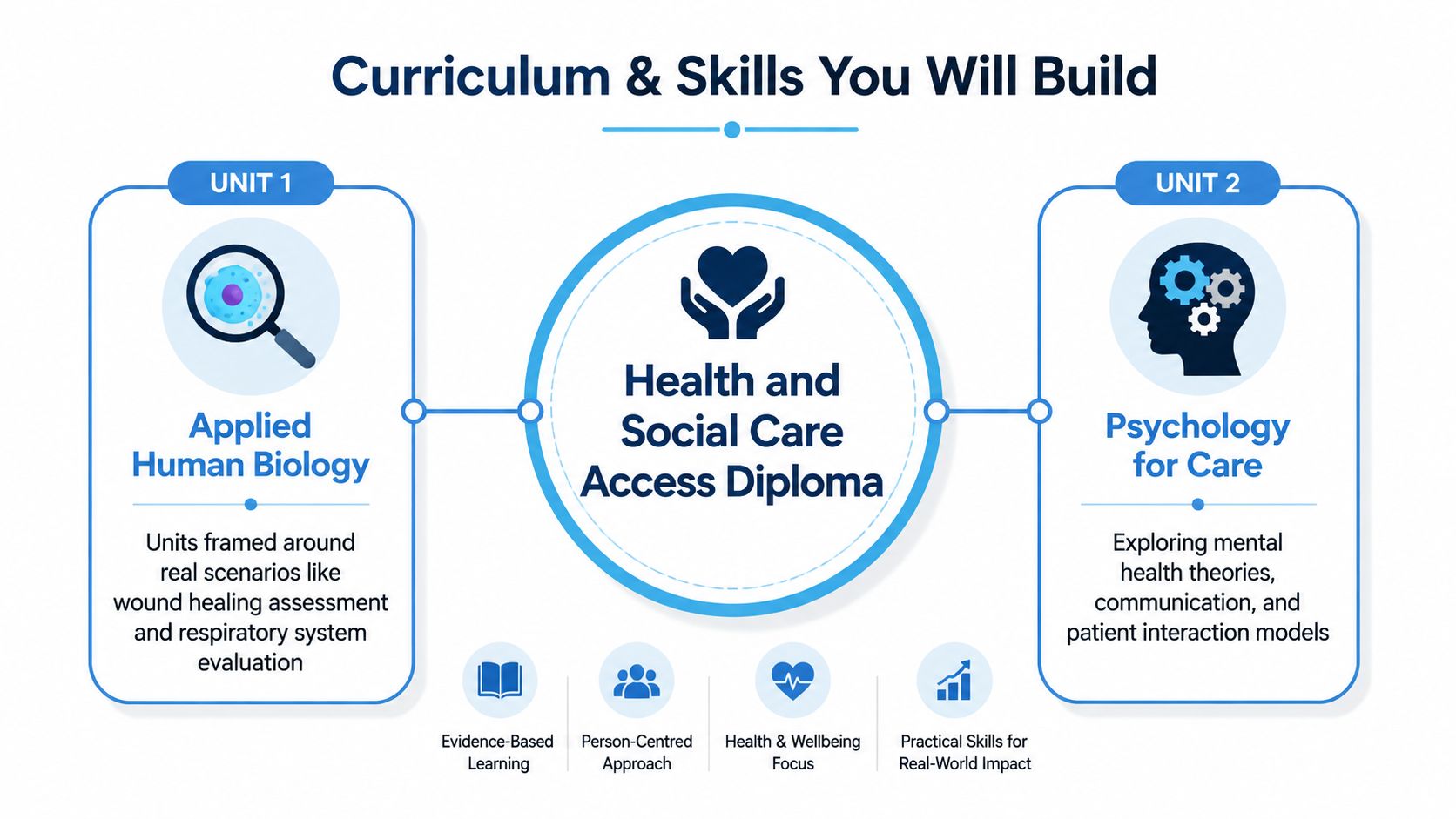
A human biology unit might ask you to connect anatomy and physiology with wound healing. You could examine how the body responds to injury, evaluate information from research and present a structured explanation. A respiratory topic might require you to interpret how the respiratory system works and relate that knowledge to an assessment scenario.
Psychology adds another layer. You may study communication, mental health theories or development, then apply those ideas to a scenario involving dementia care or a person experiencing distress. Health studies can introduce safeguarding, public policy, equality, professional values and the way services respond to population needs.
The academic abilities behind the subjects
Common units may include:
- Applied biology: Build an understanding of body systems and relate scientific principles to health scenarios.
- Psychology: Explore behaviour, communication and mental health in care contexts.
- Health studies: Consider safeguarding, ethics, policy and person-centred practice.
- Study skills: Learn how to plan assignments, use references, evaluate sources and write academically.
- Optional subjects: Depending on the provider, sociology or nutrition may support particular progression interests.
The value of these units appears in the work you produce. You'll practise turning a broad question into an argument, finding relevant evidence and explaining why a source supports your conclusion. Those skills matter when a nursing degree asks you to discuss evidence-based practice, or when a social work assignment asks you to analyse risk, relationships and professional judgement.
If you're already working in care, the course can also help you understand why practice is organised in particular ways. It won't replace workplace training, supervision or placement learning, but it can give you a stronger academic vocabulary for reflecting on experience. Resources about boost retention in care can also help employers and learners think about how development opportunities affect people already working in care settings.
The accompanying video offers another way to think about the study experience and the progression route:
Degree Routes That Welcome This Diploma
Health and social care Access routes can lead to several degree families, but “accepted” doesn't mean “accepted without conditions”. Universities may ask for different grades, science units, GCSEs, interviews, health checks or relevant experience.
Adult nursing is a common destination, with mental health nursing, children's nursing and learning disability nursing offering more specialised directions. Midwifery can also be possible, although applicants should investigate science requirements particularly carefully. Social work degrees may suit learners drawn to safeguarding, advocacy, assessment and work with families or adults. Allied health routes include physiotherapy, occupational therapy, diagnostic radiography and operating department practice.
Adult social care management is another possible direction, especially for people who want leadership, service development or care coordination rather than professional clinical registration. The degree title and the professional outcome aren't always the same, so ask what qualification or registration the course leads to.
Match the diploma to the admissions page
Start with three courses, not a vague list of professions. For each course, record the required Access grade profile, GCSE conditions, required units and any selection process. Then contact admissions if the wording doesn't answer your situation.
| Degree route | Typical Access grade ask | Extra requirements to check |
|---|---|---|
| Adult, mental health or children's nursing | A specified Merit and Distinction profile may be requested | GCSE English, maths and science, interview, occupational health and any professional suitability checks |
| Midwifery | Often a strong graded profile | GCSE science, science-rich Access content and whether Functional Skills are accepted |
| Social work | A completed Access Diploma with the university's required profile | GCSE conditions, interview, experience expectations and placement arrangements |
| Physiotherapy or occupational therapy | Often competitive grades with relevant science content | Recent biology or human biology, GCSE requirements and interview or assessment |
| Diagnostic radiography | Science-focused preparation may be important | Biology, physics or other specified units, depending on the provider |
| Operating department practice | Access study may support application where the profile is accepted | Science units, interview, health checks and placement expectations |
| Adult social care management | Requirements vary by degree and institution | Experience, GCSEs, professional background and the course's progression outcome |
The UCAS nursing data illustrates the importance of planning. In 2023, there were 48,625 nursing applicants and 26,330 accepted applicants, meaning roughly 54.1% were accepted, as reported in the British Journal of Nursing's discussion of nursing applications. That figure describes the overall applicant picture, not your personal chance of admission, and it doesn't remove the need to meet course-specific conditions.
For an allied health comparison, an exercise physiologist career guide can help you distinguish degree-based healthcare careers from roles with different training routes. The key question remains the same: what does your chosen university require from an Access applicant?
Entry Requirements and the Functional Skills Question
A learner can choose a suitable Access Diploma, complete the assignments and still meet a barrier at application stage. For many adult returners, the missing piece is not the diploma itself, but a university's rules for GCSEs and equivalent qualifications.
Many universities ask for GCSE English and maths at grade 4/C or above. Nursing and midwifery courses may also require science. Functional Skills Level 2 in English and maths is widely treated as an equivalent, but universities interpret equivalence differently. Some courses, especially certain midwifery routes, may require GCSE qualifications or name a science subject that Functional Skills cannot replace.
The safest approach is to start with the degree course, then work backwards to the qualifications it accepts. Ask the admissions team for written answers to these points:
- English and maths: Will it accept your exact GCSEs, Functional Skills qualifications or overseas equivalents?
- Science: Is GCSE science required, or must the Access Diploma contain particular science credits?
- Grade profile: Which Access credits need Merit or Distinction, and do those grades have to appear in named units?
- Timing: Can you complete a missing qualification alongside the Access Diploma?
- Evidence: Are certificates, transcripts or a formal equivalence assessment required?
Midwifery deserves particular care. A course may ask for science in addition to English and maths, so an Access Diploma with a health focus does not automatically satisfy every condition. Check the course page and confirm the position with admissions before enrolling.
Learners with overseas qualifications may need a UK equivalence check before applying. One university's decision does not guarantee that another provider will interpret the same qualification in the same way.
Practical rule: shortlist the degree first. Then choose the Access pathway and any GCSE or Functional Skills top-up around its published conditions.
A provider may let you work towards missing English or maths requirements within your wider study plan. That can help, but you remain responsible for checking that the university accepts the qualification by the application deadline. The Functional Skills Level 2 guidance explains the qualification, while the target university makes the final decision on equivalence.
Your timetable also needs to fit real life. A parent might reserve two evenings and part of a weekend. A care worker on shifts may need a repeating rota-based plan. Allow time for reading, drafting, feedback and resubmission, rather than treating every spare hour as study time.
Studying Online with Real Support
A parent may finish a shift, settle the household, and open a laptop for an Access assignment. That flexibility can make study possible, but a login and a library of files will not provide enough direction on their own. Choose a course with an ordered sequence of units, named tutors, useful feedback and a dependable way to ask questions.
Online learning often follows weekly blocks. You might read guidance, watch teaching content, complete activities and prepare written work. Tutors then assess your assignments, identify gaps in your reasoning and show how to strengthen the next submission. That feedback matters because academic writing and healthcare-related study may feel unfamiliar after time away from education.
Support should be visible before you enrol. Ask these questions during an enquiry or taster session:
- Who answers questions? Check whether you can message a named tutor about an assignment brief, source or difficult concept.
- How are tutorials delivered? Find out whether live sessions are offered and whether recordings are available when shifts prevent attendance.
- What feedback can you book? Individual guidance can help with a draft, study plan or concern that general comments do not resolve.
- How do learners connect? Peer discussion can reduce isolation, provided care-related examples protect confidentiality.
- Which study resources are included? Look for guidance on referencing, academic language, research and digital learning tools.
A realistic study plan needs regular protected time. The exact workload depends on the provider, your pace and the unit schedule, so ask how much independent reading and assignment work sits alongside taught activity. Evenings and weekends may work for a parent, while a care worker may need a repeating plan around shifts. Reliable internet, a suitable computer and a place to concentrate also affect whether online delivery is workable.
Use a taster session or open day to test the practical details. Request a sample unit, ask how quickly tutors usually respond and confirm whether any live attendance is expected. These conversations can also show whether the provider understands adult learners rather than treating flexibility as the absence of structure.
The guide to Access to HE courses online offers a starting point for comparing delivery arrangements. An online and classroom-based diploma can lead to the same regulated qualification when the provider and course are properly recognised. The format changes, while university admissions teams still consider your grades, units and wider application.
Funding, Payment Plans and Practical Costs
For an adult returner, the Access year has to fit around rent, work, family responsibilities and the cost of reaching a healthcare degree. Funding may make the route manageable, but course fees are not automatically free. Check your eligibility, payment terms and what happens if you leave before completing the Diploma.
Many eligible learners use an Advanced Learner Loan. It can cover approved tuition fees, and the government writes off the loan when the learner later completes an eligible higher education course. Repayments depend on earnings. Ask the provider and official funding services to confirm the current rules for your situation, including which fees the loan covers.
Some learners choose to self-fund because they do not qualify for the relevant loan or prefer not to borrow. Providers may offer monthly instalments, a deposit arrangement or another payment schedule. An employer might contribute where the Diploma supports an existing care role. Agree the amount, payment dates and what happens if your employment changes, preferably in writing.
Costs beyond tuition
Tuition is only one part of the budget. Check these possible expenses before accepting a place:
- Checks and documents: Some progression routes involve DBS or health-related checks.
- Travel: Interviews, taster events and later placements may require transport.
- Study materials: Textbooks, printing or specialist equipment may be needed.
- Professional preparation: A degree can involve uniforms, occupational health processes and other course-specific requirements.
Ask for the full cost in writing before paying a deposit. Late enrolment can affect access to funding if you miss the relevant loan year, and registration or administration fees may not be covered.
| Funding route | Who it suits | Key point |
|---|---|---|
| Advanced Learner Loan | Eligible learners on an approved Access Diploma | Confirm eligibility, fee coverage and write-off conditions |
| Monthly payment plan | Learners who can spread tuition costs from income | Check deposit, instalment dates and cancellation terms |
| Employer support | People already working in care or a related service | Agree exactly what the employer pays and what happens if employment changes |
| Self-funding | Learners with available savings or financial support | Request a full fee schedule and identify additional costs |
Before choosing a provider, compare the funding route with your likely study pattern. A lower monthly payment may still create pressure if the course includes costs you had not planned for. The Access to Higher Education funding guide can help you prepare questions about loans, instalments and fee arrangements. Treat funding as part of course selection, alongside entry requirements and the degree route you intend to pursue.
Your Action Steps Toward a Healthcare Degree
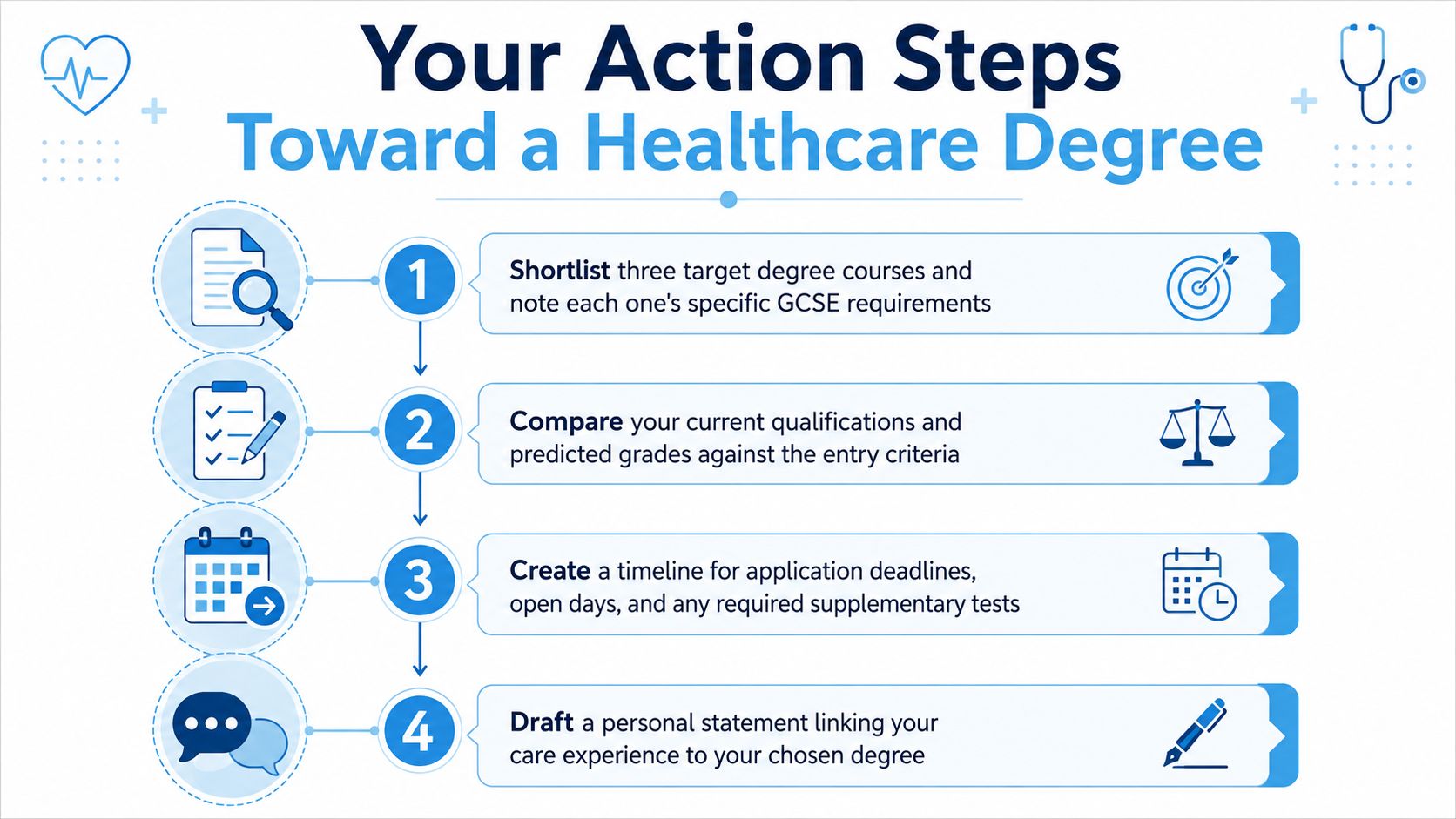
The most effective plan starts with a target degree, not a general wish to work in healthcare. Choose three realistic courses and place their requirements side by side. Record the Access grade profile, English and maths rules, science conditions, application deadline, interview format and any placement information.
Build a route that fits your circumstances
Use this sequence:
- Check your current qualifications. Find your GCSE certificates or contact the relevant awarding body. List English, maths, science and any overseas qualifications separately.
- Ask universities direct questions. Contact admissions teams at two or three institutions. Ask whether they accept your proposed Access Diploma, exact Functional Skills qualifications and intended unit combination.
- Choose the right course content. If midwifery or an allied health degree is your goal, confirm whether biology, human biology or another science subject is required.
- Test the learning format. Attend a taster session, request a syllabus and ask how tutor support works. You're checking whether the course fits your life, not merely whether it looks convenient.
- Create a weekly study plan. Mark work shifts, childcare, travel, rest and study time on one calendar. If the plan only works when nothing goes wrong, it isn't realistic.
- Work backwards from application dates. Add milestones for researching courses, drafting your personal statement, securing a reference, completing required tests and submitting your application.
Your experience can strengthen an application when you explain what you've learned, not only where you've worked. A care role may show communication and safeguarding awareness. Parenting, volunteering or managing a team may demonstrate responsibility, organisation and empathy. Link each example to the demands of the degree, and be precise about your contribution.
Care-experienced learners face a particularly serious participation gap. 14% go to university compared with 47% of the wider population, according to care-learning higher education evidence from Unite Students. That comparison reinforces why adult-access routes need clear guidance, financial planning and progression support, rather than assuming that a diploma alone removes every barrier.
Further education providers are also supporting a growing number of learners with additional needs. At January 2026, 100,800 children and young people with EHC plans were in further education, a figure reported as 12.3% higher year on year, while 9,900 were at UK Register of Learning Providers institutions, reported as 31.8% higher than in 2025, in the available UCEN Manchester nursing and midwifery guidance. If you need reasonable adjustments, ask about them before enrolment and confirm how support continues during progression.
Adult applicants shouldn't judge themselves against school-leavers. Your work and life experience can help in values-based interviews, but universities still need evidence that you meet their academic rules. This week, make one honest list of your qualifications and one shortlist of three degrees. That's enough to turn uncertainty into a plan.
Access Courses Online offers online Access to Higher Education Diplomas, tutor guidance, flexible study and information about progression into nursing, midwifery and related health degrees. Visit Access Courses Online to compare the Health Professions route, ask about entry requirements and discuss a study plan that fits around work and family.