

The kettle is boiling, your shift has just finished, and a university webpage is still open on your phone. You've been thinking about studying English, history, sociology or another humanities subject, but the practical questions keep interrupting the ambition: Will my old qualifications be enough? Can I fit study around work and family? What will it cost, and is there a course close enough to make it realistic?
An Access to Higher Education Humanities Diploma can provide a focused route into university for adults who don't have recent A-levels. It can also expose challenges that a general university guide may overlook, including local course closures, limited part-time choices and funding eligibility. This guide will help you judge the route through eight practical questions, covering the qualification itself, modules, assessment, degree progression, entry requirements, finance, provider choice and application timing.
Imagining Your Return to Study
Take a learner called Nadia. She left school without the qualifications she wanted, built a career, and now has a clear interest in social history. Her ambition is genuine, but her week is already full. She works during the day, helps with family responsibilities in the evening and can't move to a university campus.
For Nadia, access to higher education humanities isn't an abstract policy question. It's a timetable, a budget and a decision about whether an old educational gap can be crossed without putting the rest of life at risk. An Access Diploma may act as that bridge, but only if the subject, provider and study pattern fit the destination she has in mind.

A useful test: Don't ask only, “Can I get onto an Access course?” Ask, “Can I complete this course in my circumstances, and will it take me towards the degree I actually want?”
The wider system makes careful planning more important. UK student totals rose from 2,532,165 in 2019/20 to 2,862,620 in 2021/22, a net increase of 330,455 students, according to HESA's student numbers data. Yet the British Academy says access to SHAPE subjects, which include social sciences, humanities and arts, is “highly unequal and becoming more so”, with provision increasingly absent in some areas, particularly at lower-tariff providers. Your nearest realistic course may matter as much as your academic interest.
By the end of this guide, you should be able to identify the degree family that suits you, check whether the funding rules work for you, compare providers properly and create a sensible route from enquiry to enrolment.
What the Access to HE Humanities Diploma Actually Is
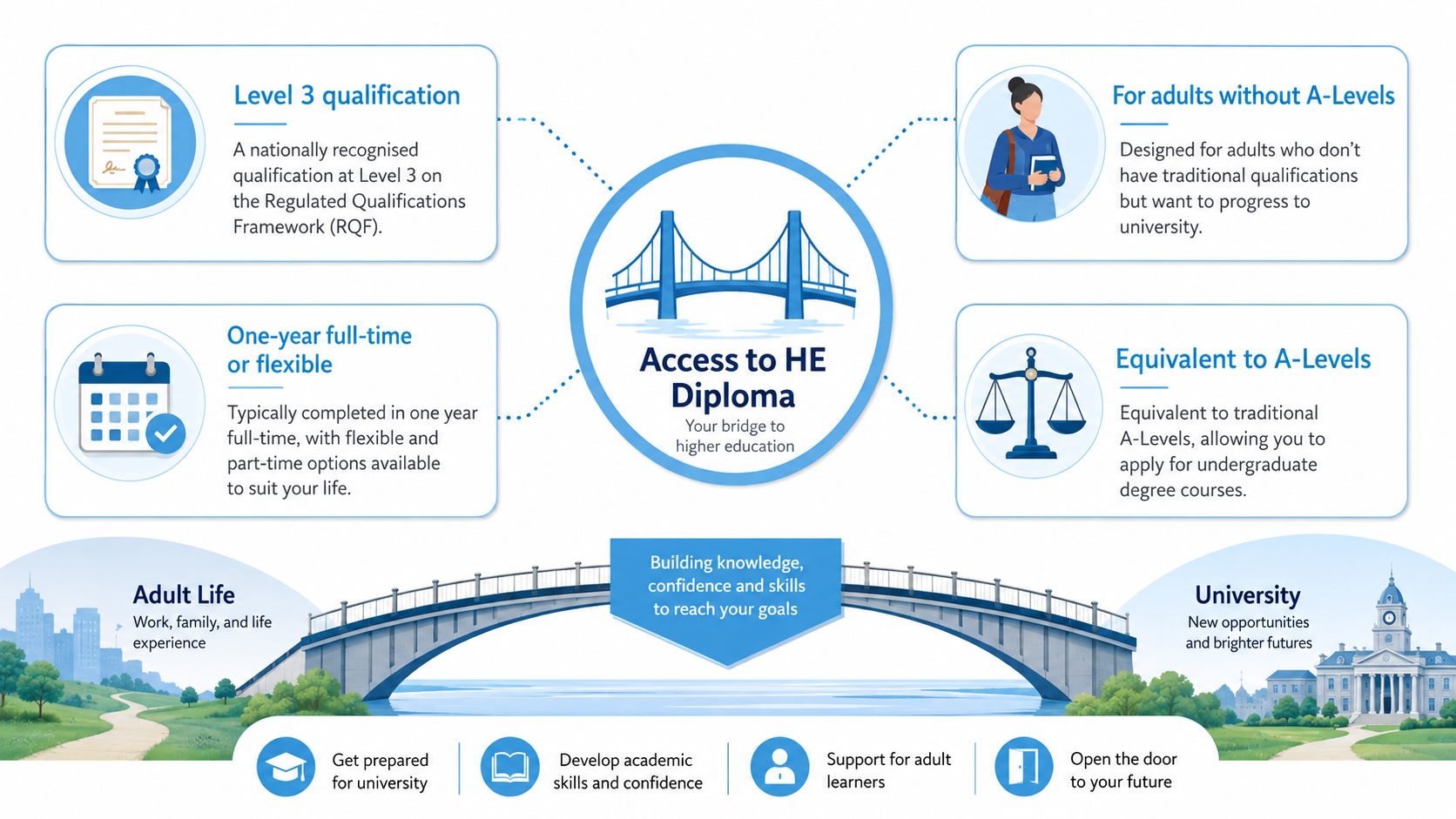
Think of the Access to HE Diploma as a one-year bridge. One side is your current position, perhaps with old or incomplete qualifications. The other side is a university admissions office that needs evidence of recent academic preparation. The Diploma gives you structured subject study, academic skills and assessed work to carry across that gap.
It's a regulated Level 3 qualification designed mainly for adults who don't hold the qualifications normally used for direct university entry. An approved Access Validating Agency, often called an AvA, validates the Diploma. The course normally contains 60 credits, with a combination of graded credits and ungraded credits. Universities then assess the result through their published entry requirements and tariff point conversions.
How it differs from other routes
An Access Diploma isn't a shorter version of A-levels. A-levels usually follow a school or college timetable and develop depth in selected subjects. An Access course is built around adult returners, so it combines subject knowledge with academic practices such as essay planning, source evaluation and referencing.
A BTEC may be vocational and practical, depending on the subject. A foundation year is usually attached to a specific university degree and forms part of that institution's progression route. An Access Diploma is more portable, although you must still check whether your intended university accepts your subject pathway and grades.
The qualification is often completed across an academic year, either full-time or through a more flexible pattern. That can make it a direct route back into higher education, but “one year” doesn't mean effortless. You'll need to produce regular assessed work while managing reading, tutorials and applications.
Why the destination matters first
Start with the degree, not the course title. A Diploma called Humanities may suit English, history or politics, but a particular university could ask for specific units, GCSE subjects or graded outcomes. Admissions requirements vary, so contact the degree department before choosing your provider.
The safest approach is to write down two or three possible degrees, check their Access requirements and then select a Diploma whose modules support those choices.
Typical Modules and How You Are Assessed
An Access to HE Humanities Diploma usually feels like a guided academic apprenticeship. You won't spend every week writing a polished university essay. Instead, you'll move between taught content, shorter exercises, reading, discussion and feedback, gradually producing work that demonstrates your readiness for degree-level study.
Common subject areas include English literature, history, sociology, psychology, politics and critical thinking. Many courses also include study skills, research methods and academic communication. The precise units depend on the provider, so treat the following table as a planning example rather than a fixed national syllabus.
Typical Access to HE Humanities modules at a glance
| Module area | Typical credit value | Assessment style |
|---|---|---|
| English literature | Course-dependent | Analytical essays and close-reading tasks |
| History | Course-dependent | Source analysis, research assignments and essays |
| Sociology | Course-dependent | Written assignments using theory and evidence |
| Psychology | Course-dependent | Reports, short-answer work and research tasks |
| Critical thinking | Course-dependent | Argument analysis and structured written responses |
| Academic study skills | Course-dependent | Referencing, research planning and skills exercises |
Graded units normally ask you to demonstrate subject understanding. You may compare interpretations of a text, evaluate historical evidence or build an argument about a social issue. Ungraded units often develop the machinery behind that work, such as finding reliable sources, planning an assignment and using a referencing system accurately.
What a normal study cycle looks like
A week might begin with a taught session introducing a theme. You could then read selected extracts, make notes, discuss an argument in a tutorial and submit a draft or short exercise. Your tutor's comments should show where your reasoning, structure, evidence or presentation needs work. You then apply that feedback to the next piece.
That cycle matters because adult learners often return with strong life experience but little recent practice in formal academic writing. The course should give you a controlled place to make mistakes, receive guidance and improve before the final assessed work is submitted.
Read the brief before you read the books: Assignment criteria tell you what the marker needs to see. Your reading should help you meet those criteria, not become an endless collection of interesting facts.
If literary analysis is unfamiliar, a sample literary theory lesson can help you see how a humanities topic may be introduced and developed. The important question isn't whether you already know the terminology. It's whether you're prepared to practise unfamiliar ways of reading and explaining evidence.
Where the Diploma Can Take You
The Diploma can lead to several degree families, but the strongest choice depends on your intended destination. English literature involves sustained interpretation of texts, while history focuses on evidence, change and competing accounts of the past. Sociology examines social structures and inequality, and politics considers institutions, power and public decision-making.
A humanities route may also support religious studies, media studies, cultural studies and linguistics. If you're drawn to writing, degrees in English can include literature, language, creative writing or combinations with other subjects. Each route develops a different kind of reading and argument, so browse actual module lists rather than relying on a degree title.
Access to HE Humanities Diploma and where it leads
| Degree Route | Typical Career Paths |
|---|---|
| English literature or English language | Teaching, publishing, communications, journalism and postgraduate study |
| History | Heritage, museums, research, civil service, teaching and public history |
| Philosophy or religious studies | Education, policy, charity work, writing and postgraduate study |
| Sociology | Community work, social research, public services, charities and policy |
| Politics | Civil service, public affairs, campaigning, journalism and local government |
| Media or cultural studies | Marketing, communications, content, cultural organisations and journalism |
| Linguistics | Teaching, communication roles, language services and further study |
| Law | Legal study, compliance, public services and a later law conversion route |
| Education | Teaching-related degrees, education support and youth work |
| Psychology | Psychology degrees and related support roles, subject to university requirements |
| Creative writing | Writing, publishing, communications, arts organisations and freelance work |
Life experience can be useful in subjects involving people, institutions and communication. Someone who has worked in public services may bring thoughtful questions to a sociology seminar. A parent returning after a career break may understand education or social policy through direct experience. That experience doesn't replace academic evidence, but it can give your work a grounded perspective.
Some destinations require additional preparation. Psychology applicants may need GCSE Maths, and certain professional or science-linked degrees can ask for a science subject or other specific qualification. Law courses may accept Access applicants but still set particular grade or subject conditions.
Use a simple self-check before enrolling: Can you name a degree that interests you, and can you explain why? If the answer is no, spend more time exploring subjects first. An Access Diploma is a demanding commitment, so curiosity should point towards a destination rather than merely away from your current job.
Entry Requirements, Funding and the Practical Realities
Most Access courses are designed for adults without traditional qualifications, and providers may not require a formal set of GCSEs for initial consideration. Instead, they commonly use an interview, written task or discussion to assess whether you're ready for the level of reading and writing involved.
English at Level 2, often GCSE grade 4 or C, or an equivalent qualification, is frequently the main academic benchmark. Providers may also ask about your motivation, intended degree and ability to study independently. If your qualifications are old, don't assume that means automatic rejection. Ask what evidence the admissions team will accept.
The funding question
The headline rule is that an Access course may be free for eligible UK residents aged 19 or over who don't already hold a full Level 3 qualification. Previous A-levels, another Level 3 qualification or a degree can change your eligibility, and local funding arrangements may affect the answer.
Current course information illustrates the complexity. Some Access to HE Humanities options restrict entry to adults aged 19 and above, while fee support for learners aged 19 to 23 can depend on local criteria. Other learners may need an Advanced Learner Loan. Review the provider's written funding guidance rather than assuming that “free” applies to everyone.
The Access to Higher Education funding guide can help you prepare questions, but your provider or funding authority must confirm your personal eligibility. If you already have substantial qualifications, ask about total fees, payment dates and what happens if your circumstances change.
Fitting study around real life
A full-time course may run across an academic year of around 30 weeks, with approximately 15 to 20 contact hours each week. Those figures come from the course-planning information supplied for this guide, but actual timetables differ. Evening, part-time, blended and online formats can be more workable if you're employed or responsible for children or relatives.
Budget for more than fees. Consider travel, books, equipment, childcare and the time needed for uninterrupted reading. If English is part of your wider preparation, Cathoven's guide to planning IELTS Academic preparation offers a structured way to think about language study alongside other commitments.
An 18-year-old may sometimes qualify where local access to A-levels isn't available, but the main audience remains adult learners. Ask early, because age, previous study and residence can affect funding decisions.
How to Choose a Provider That Fits Your Life
The first provider that appears in a search isn't automatically the right one. Choose it as carefully as you'd choose a childcare arrangement or a work-based qualification, because the course needs to survive contact with your actual week.
Four filters for a sensible shortlist
Recognition comes first. Check that the Diploma is validated through a recognised Access Validating Agency and that the provider can explain its quality arrangements. Ask how the course is monitored and how learner work is assessed.
Delivery must match your routine. Online study can remove travel, but it still demands a reliable study space and regular access to a computer. Evening or weekend teaching may suit a full-time worker, while in-person learning can provide structure if home is too distracting.
Location affects access. The British Academy's SHAPE mapping found that subject availability is increasingly uneven, particularly at lower-tariff providers. It also reports that 57% of UK-domiciled first-year first-degree undergraduates under 21 studied a SHAPE subject in 2023/24, rising to 59% when mature students are included, as shown in the British Academy's cold spots report. Mature learners clearly form an important part of participation, but local and flexible routes still determine who can realistically take part.
Progression evidence should be clear. Ask for information about completed Diplomas and university progression, not only enrolment figures. A provider should explain how tutors support applications and whether its former learners have progressed to the degree areas you're considering.
Warning signs and useful questions
Be cautious if a course offers very little tutor contact, doesn't name its academic staff, gives no clear progression information or relies on accreditation from bodies you can't identify. A low price may reflect fewer opportunities for feedback rather than better value.
Book a taster session or open evening if possible. Speak to current learners and ask:
- Tutor support: How quickly can students get help with an assignment or personal difficulty?
- University applications: Who checks personal statements, course choices and admissions requirements?
- Written work: How are drafts, feedback and resubmissions handled?
The right provider should make those answers easy to understand.
Study Tips That Help Adult Learners Thrive
Adult learners rarely fail because they lack interest. More often, study competes with work, family, health, money and tiredness. The most useful habits are therefore practical rather than heroic.
Build a routine you can repeat
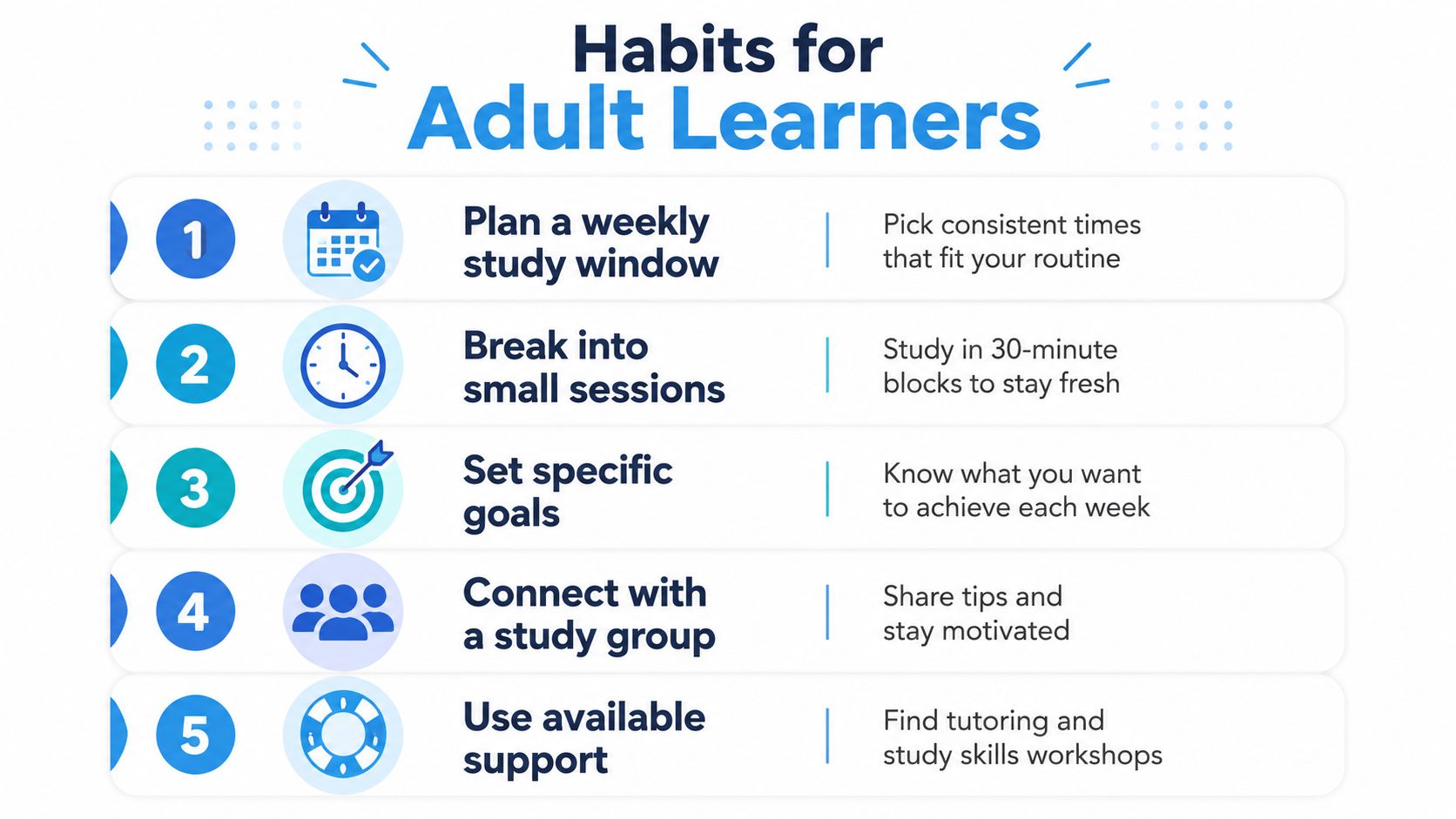
Choose a weekly study window that reflects your life as it is, not as you wish it were. Two reliable evening sessions may be more useful than an ambitious weekend plan that disappears whenever work or family needs change.
Break reading and writing into small tasks. One session might identify the assignment question, another might locate sources, and a later session could create the first paragraph. Specific goals reduce the feeling that “study” is an enormous task with no clear starting point.
Make feedback part of the work
Read the marking criteria before you begin. Highlight the verbs that tell you what to do, such as analyse, compare, evaluate or explain. Then check your draft against those requirements before sending it to your tutor.
A first draft isn't evidence that you're bad at writing. It's the point where you can see whether the argument works. Keep tutor comments in one document, note recurring issues such as weak paragraph structure or unclear citations, and look for those patterns in your next assignment.
Use other people intelligently
A small study group can turn an isolated task into a conversation. One person may understand the historical context, another may be confident with essay structure, and a third may spot a question the group has overlooked. Keep the group focused on explaining ideas and comparing plans, not copying answers.
Tell your provider about serious pressures early. A tutor may be able to discuss extensions, support services or a revised plan, but only if they know there's a problem before missed work becomes a pattern.
Consistency beats rescue work: A series of manageable study sessions gives you more control than trying to rebuild an entire assignment during one exhausted weekend.
The research load can feel heavy because humanities courses ask you to read closely and think carefully. You don't need to remember every detail. Build a small set of notes around the assignment question, record page references while reading and write a sentence explaining why each source matters.
Your Next Steps From Enquiry to Enrolment
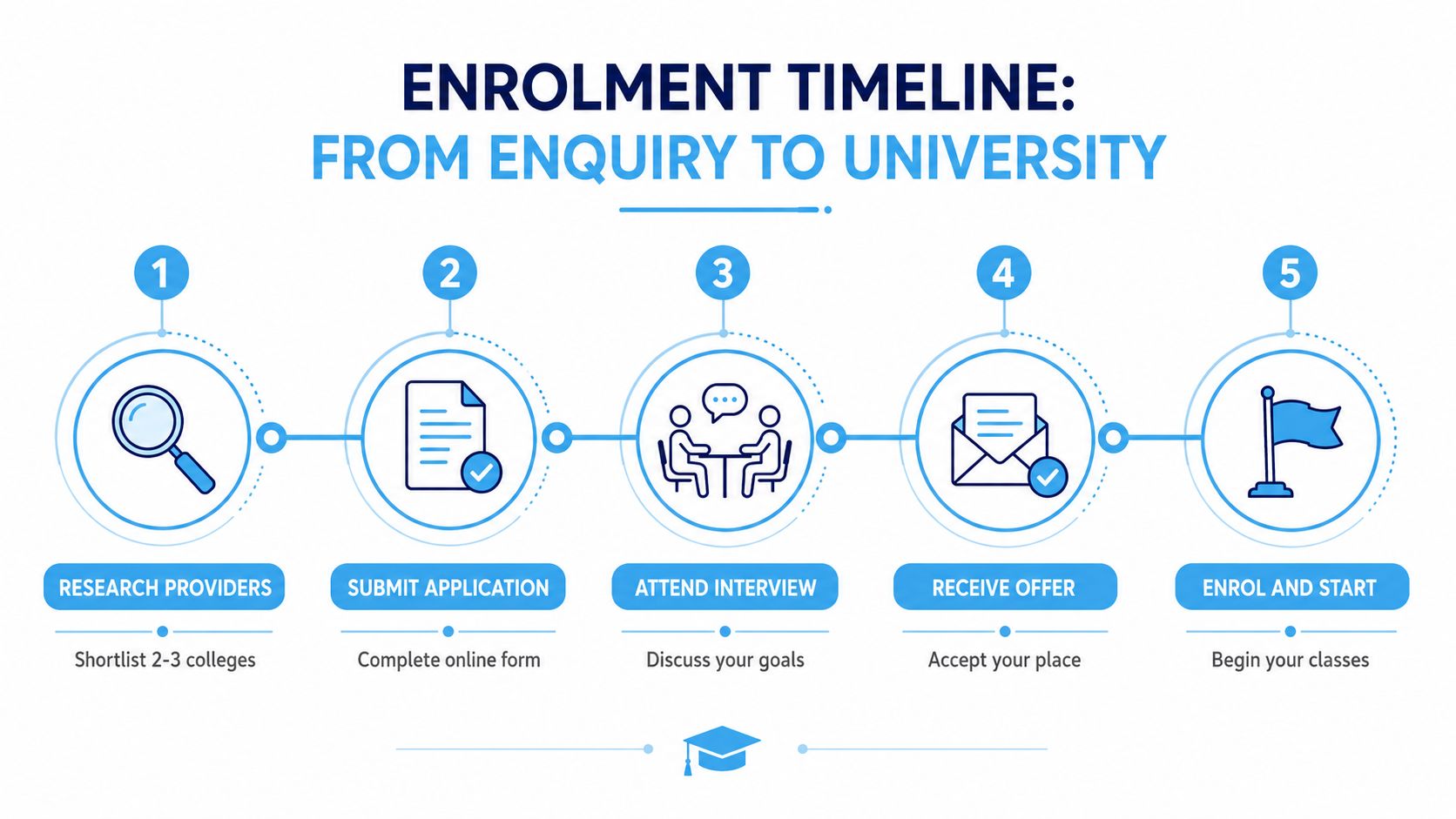
Start with a shortlist, not an application form. Choose two or three providers whose subject pathway, delivery mode and support arrangements appear compatible with your life. Attend an open evening or taster session, and ask direct questions about completion, university progression and the time expected outside taught sessions.
A practical route into the course
- Research providers. Check validation, modules, teaching pattern, tutor access and progression support. Compare the course requirements with the degree pages you're considering.
- Submit an application. Complete the form carefully and explain why you want to study humanities now. Include relevant employment, caring, volunteering or independent learning experience where it helps show your motivation.
- Prepare for the interview. The provider may discuss your goals, reading habits, writing confidence and available study time. Be honest about barriers. The interview should help both sides decide whether the course is workable.
- Complete any checks. Some pathways or placements may require identity, safeguarding or DBS procedures. Ask whether these apply to your chosen Diploma and how long they take.
- Confirm funding. Submit the relevant funding application early, clarify whether you qualify for fee support or an Advanced Learner Loan, and ask about payment arrangements if you're self-funding.
- Discuss additional support. If you have a disability, health condition or learning difficulty, ask about screening and support. A provider can explain whether a Disabled Students' Allowance assessment or other adjustment may be relevant.
Keep your university destination visible
Save course pages, entry requirements and admissions emails in one folder. Record the modules you complete and the feedback you receive, because that evidence can help when you prepare your UCAS application and discuss your readiness with a university.
For a September start, begin provider research well before the summer. Use the earlier months to compare courses, attend events, complete applications and resolve funding questions. Some providers have limited application windows, and university deadlines may not align neatly with Access course enrolment dates.
Part-time and online routes may offer more flexibility, but they don't remove the need for planning. Your final decision should connect three things: the degree you want, the provider's academic support and the week you can sustain.
Access Courses Online offers an online Access to Higher Education Diploma in Humanities and Social Science, with flexible study designed for adults preparing for university subjects such as history, sociology, politics, media studies and journalism. Visit Access Courses Online to review the course route, funding guidance and support options, then contact the provider to discuss whether it fits your intended degree and available study time.