

You're sitting at the kitchen table after work, with a university course open on your laptop and a familiar question in your mind: could I really do this? Perhaps you left school without the qualifications you need, or your certificates no longer reflect the person you've become. You may be caring for children, working shifts, or considering a move into nursing, midwifery, computing, or another profession.
That uncertainty is normal. It also doesn't mean university is out of reach. Access to Higher Education Level 3 offers adults a recognised route into degree study without requiring the traditional school-leaver pathway. The important decision isn't whether you're “academic enough”. It's whether the course, subject pathway, support and progression plan fit your goal and your life.
Starting Your Journey Back to Education
A former care worker might begin by searching for nursing degrees, then stop when the entry requirements mention A levels or another Level 3 qualification. A parent interested in computing may have practical digital experience but no formal evidence to show a university. Someone else may feel that too much time has passed since they last studied.
These situations are common among adult learners. The Access to HE Diploma acts as a bridge between where you are now and the degree you want to start. It gives you subject knowledge, academic practice and a qualification universities understand, while recognising that adult students may need a different route from someone leaving school.

Start with the destination
Before choosing a course, identify the degree or career you're working towards. A nursing degree may ask for particular science content, while a computing degree may value mathematics, programming or broader digital preparation. Universities set their own requirements, so the diploma title alone isn't enough. Check the course page and contact admissions if any requirement is unclear.
You'll also need a realistic study routine. Adult learners often underestimate the mental effort involved in switching between work, family responsibilities and assignments. Simple planning habits can help, particularly if you use practical executive function homework tips to break tasks into manageable actions.
A useful first question: What degree do I want, and what evidence will that university expect me to provide?
Returning to education can feel like a personal risk, but it's also a structured process. Read about the journey of lifelong learning and why it's never too late to start, then write down your intended degree, current qualifications, weekly availability and the support you may need. Those details turn a vague ambition into a decision you can test.
Understanding What Level 3 Really Means
Level 3 is an established qualification level in the UK framework, rather than a general label for an introductory adult course. Government guidance places the Access to Higher Education Diploma alongside A levels and other advanced post-16 qualifications at Level 3. The national Access to HE framework has existed since 1989, with 38,220 students registered for a diploma in 2022-23 according to UK qualification guidance.
That classification gives your course a clear place in the education system. An Access diploma is a regulated qualification designed to prepare adults for higher education, not just a certificate showing that you attended classes. The degree you want still matters, because universities set their own rules about accepted subjects, units and grades. A health applicant may need relevant science study, while a computing applicant may need preparation in mathematics, programming or digital subjects.
Where Access fits
Use this comparison as a guide:
| Qualification level | Typical position |
|---|---|
| Entry Level | Foundation skills and introductory learning |
| Level 1 | Basic vocational or academic study |
| Level 2 | GCSE-level standard |
| Level 3 | Access to HE Diploma, A levels and other advanced post-16 routes |
| Levels 4 and 5 | Higher education certificates and diplomas |
| Level 6 | Degree-level study |
| Level 7 | Master's-level study |
The Access diploma provides a Level 3 academic foundation before a Level 6 degree. It does not contain exactly the same material as A levels, and it does not guarantee admission to every university course. Instead, it gives admissions teams a recognised framework for judging your preparation.
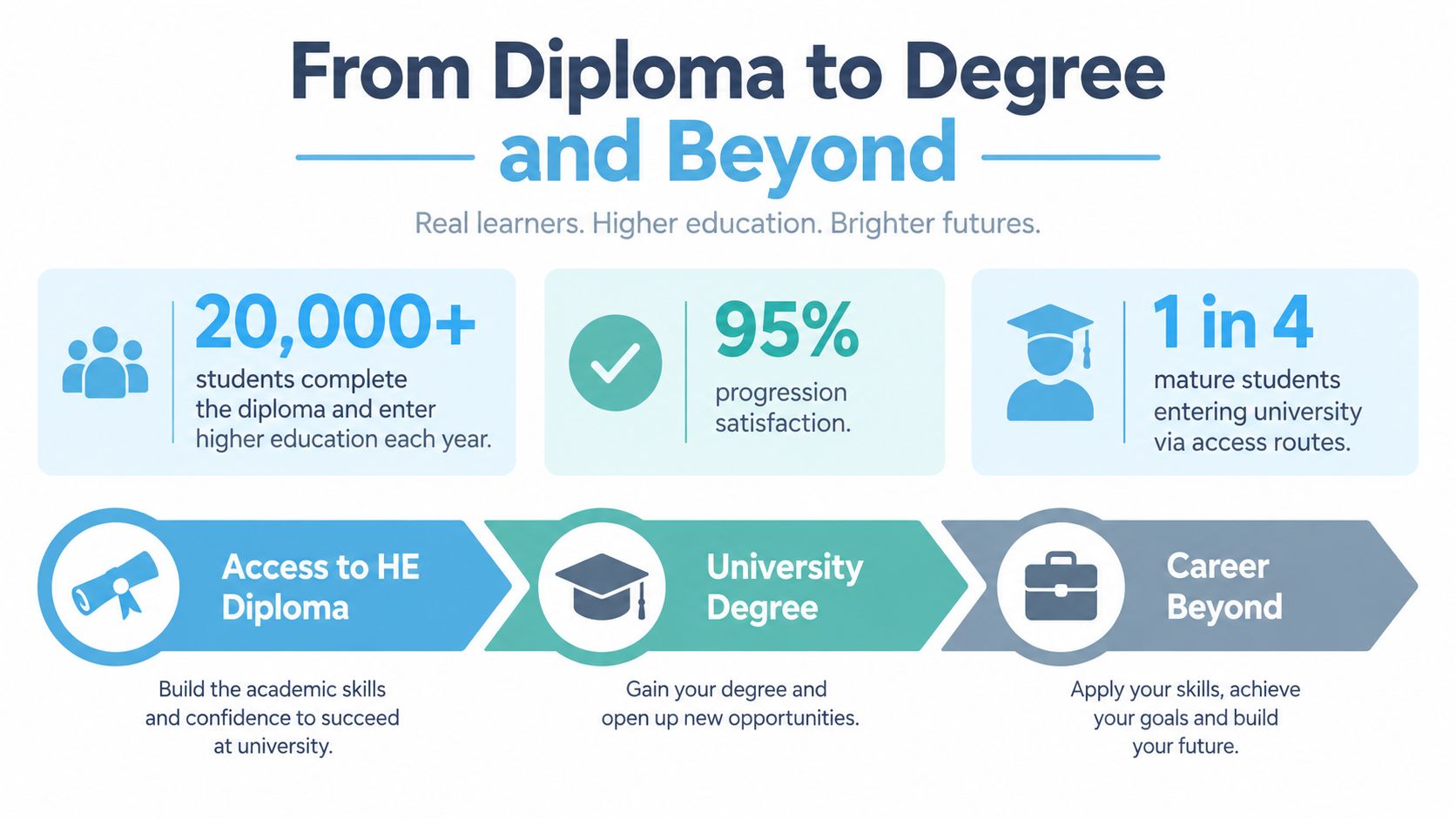
More than 20,000 students typically achieve the diploma and progress to university each year. That scale can make the decision feel less uncertain if you are returning to education after time away. You are choosing an established route, then checking whether its subject content and requirements match the degree you want.
How the Diploma Structure Works
The diploma contains 60 credits in total. Understanding the credit split makes the course less mysterious and helps you compare providers accurately.
Forty-five credits are at Level 3, delivered through graded academic subject units. These are the units most closely connected to your intended degree. On a health pathway, they might involve areas such as human biology or health-related study. On a computing pathway, they could develop technical understanding, problem-solving or academic work related to digital subjects.
The remaining 15 credits are ungraded, and they can sit at Level 2 or Level 3 within the national Access to HE diploma structure. They may support study skills, communication, research or other preparation that helps you handle the graded work.
Why the split matters
The structure balances two needs:
- Universities need evidence of academic readiness. The 45 graded Level 3 credits provide a consistent core for admissions decisions.
- Adult learners need room to rebuild confidence. The 15 ungraded credits allow providers to include support and preparation without making every part of the course a high-stakes grade.
You'll usually complete assignments, practical tasks, research activities or other forms of assessed work rather than relying only on traditional examination conditions. The exact assessment pattern depends on the provider and course, so ask for a unit list before enrolling.
A strong course should show you how grades are awarded, when feedback arrives and what happens if you need to improve an assignment. Ask whether the diploma has the subject units required by your target degree, not just whether it carries the words “Access to HE” in its title.
Practical rule: Treat the credit profile as an admissions document. Match the graded units to your university's published requirements before you pay or enrol.
Choosing Your Subject Pathway
Choosing a pathway starts with the degree you hope to enter. If you are asking, “Can I really do this?”, connect that question to a practical destination. A health-focused diploma may prepare you for nursing or midwifery, while computing may suit a future in software development or cyber security. Course titles vary, so compare the units, assessment methods and progression destinations rather than relying on the title alone.
| Pathway | Often suits learners considering | What to check |
|---|---|---|
| Health and social care | Nursing, midwifery, allied health and social care degrees | Whether the university requires specific science units or work experience |
| Science | Biomedical science, pharmacology and related degrees | Whether biology, chemistry or laboratory study is required |
| Computing and information technology | Computer science, software development, data analysis and cyber security | Mathematics, programming and other technical preparation |
| Business and management | Business, entrepreneurship, management and organisational leadership | Required grades, subjects and any practical experience |
| Social science | Psychology, sociology and education studies | Research methods and subject-specific admissions conditions |
Health pathways
Health can be a particularly practical choice because the academic work connects to a profession with clear responsibilities. Experience in care, supporting relatives or communicating with people at work may give you useful context, but the diploma adds the formal preparation required for degree-level study. Check each university's health, numeracy, interview, placement and fitness-to-practise conditions early. A pathway that looks suitable may still miss a required science unit.
Computing pathways
Computing often suits adults who already troubleshoot technology at work or manage digital tasks at home. An Access course can turn that practical confidence into structured preparation, much like moving from learning individual driving controls to understanding the whole journey. Compare programming content, mathematics expectations, assessment methods and the modules listed by your intended university.
The Quality Assurance Agency's information about the Access to HE Diploma provides wider context about the qualification. Use it alongside university admissions pages, then choose the pathway whose units match your planned degree and the preparation you still need.
Entry Requirements and Funding Options
Entry requirements vary, but Access courses are specifically intended for adults who may not hold the qualifications normally associated with university entry. Providers may consider your motivation, relevant experience, written communication and readiness to study, alongside any existing qualifications.
Start by asking four practical questions:
- Previous study: Does the provider require GCSEs, Functional Skills or another qualification?
- Subject preparation: Does the course include the units your target university expects?
- Support: Who gives feedback, and how quickly can you ask for help?
- Finance: Which loan, bursary, payment or employer-support options could apply?
Funding depends on your circumstances, previous study and the provider. Government support may be available for eligible learners, while some adults use employer sponsorship or a payment arrangement. Never assume a loan or bursary applies automatically. Ask the provider and check the current official guidance before making a financial commitment.
For a clearer overview of possible routes, read this guide to Access to Higher Education funding. If you're comparing online providers, you may also find interest-free instalments over 12 months offered by some providers, including Access Courses Online. Confirm the total price, cancellation terms, assessment fees and what support is included.
A sensible budget includes more than tuition. Allow for internet access, a suitable study space, travel to any required activities and time away from paid work. Writing these costs down can make the decision feel manageable rather than overwhelming.
Flexible Delivery for Busy Lives
Online study works best when flexibility is designed into your routine rather than treated as spare-time work. A parent might study after the school run, a shift worker may use several shorter sessions, and a full-time employee may reserve a regular evening for reading and assignment planning.
The useful question is not just whether a course is online. Ask how you'll interact with tutors, how feedback is delivered, whether live sessions are recorded, how assessments are submitted and what happens if work or family circumstances disrupt your schedule.

Build a routine that can survive real life
Choose a weekly pattern with a small amount of protected study time and a separate slot for catching up. Keep assignment deadlines visible, divide larger tasks into research, planning, drafting and checking, and contact your tutor before a missed deadline becomes a crisis.
Online delivery also lets you learn in familiar surroundings, but it requires self-management. You'll need to open the learning platform regularly, keep copies of your work and respond to feedback. The support model matters as much as the location.
The Access to HE framework provides the qualification standard. Your provider determines how that standard is delivered, so investigate the learner experience before you enrol.
For adult returners, this format can make progression possible without immediately leaving employment or relocating. It doesn't remove the work involved, but it can remove timetable barriers that stop capable learners from beginning.
From Diploma to Degree and Beyond
The key question changes from “Can I do this?” to “What must I achieve for my chosen degree?” A pass with 45 graded credits is worth 48 UCAS Tariff points, while a distinction-heavy profile can reach 144 points, according to QAA guidance on the Access to HE Diploma. These figures help universities interpret your results, but they do not guarantee an offer. Check whether your course requires particular grades in particular units, especially for health, science and computing degrees.
What progression involves
Your route will usually develop through four stages:
- Access diploma: Build the subject knowledge, academic writing and research habits required for degree study. A health pathway may prepare you for clinical learning, while computing can develop the technical and problem-solving foundation needed for a related course.
- University application: Use your diploma results, personal statement and references to apply to courses that accept your exact pathway.
- Degree study: Move into a larger academic environment with independent reading, practical work and placement expectations where relevant.
- Career development: Combine your degree with professional requirements and experience as you work towards your intended role.
An Access student brings more than recent coursework. Workplace knowledge, resilience and a clear reason for returning to education can support the transition, particularly when a subject leads to a practical profession. Those strengths work best alongside careful checking. Ask each university whether it accepts your diploma, requires specific graded credits or has an additional process for mature applicants.
Before enrolling, map the diploma requirements against the degree offer. The guide to applying to university after an Access course can help you understand the application stage and prepare evidence early. Treat that preparation as part of choosing the course, rather than a task to postpone until the final weeks.
Taking Your Next Practical Steps
Confidence usually follows action. You don't need to feel completely ready before you begin, but you do need enough information to make a responsible choice.
Use this decision checklist
- Name the destination. Write down the degree, university and career you're considering.
- Check entry requirements. Look for the accepted Access pathway, required subjects, graded credits and any GCSE or Functional Skills conditions.
- Compare providers. Ask who awards or regulates the diploma, how tutors support learners, how assessments work and whether you can study at a pace that fits your responsibilities.
- Test the learning experience. Attend a taster session or request a sample unit if one is available.
- Build a finance plan. Confirm tuition, payment dates, possible funding and what happens if your circumstances change.
- Prepare your application. Gather existing certificates, explain relevant experience and write candidly about why you're returning to education.
- Create your first study week. Decide when you'll read, take notes, complete tasks and contact your tutor.
If you're anxious about academic writing, start with a short diagnostic task. It can show whether you need help with referencing, paragraph structure, research or time management. If maths or English qualifications are part of your target university's conditions, address them early rather than hoping the issue will disappear.
Before enrolling: Ask for the course specification in writing and compare it with your chosen university's admissions page.
You should also check the provider's registration, awarding arrangements, learner support and complaints process. A professional conversation is a good sign. You should receive clear answers about assessment, deadlines and progression rather than pressure to sign up immediately.
The first step may involve sending an admissions team your target degree and asking whether the course is suitable. That message can replace general worry with a concrete answer.
Access Courses Online offers fully online Access to Higher Education Diploma pathways for areas including Nursing, Midwifery, Health Professions, Computer Science, Science, Social Science and Business, with tutor guidance and interest-free payment plans over 12 months. If you're ready to compare your goal with a suitable Level 3 route, visit Access Courses Online and request personalised advice about enrolment, funding and progression.