

You're finishing a care shift, checking childcare for tomorrow, and searching for access to higher education nursing near me on your phone. You don't have A levels. You can't attend college five days a week. You also can't afford to spend a year on a course your local university won't accept.
That's the decision to get right first. Choose the nursing degree, then choose an Access route that leads to it.
Access Routes Into Nursing Compared
A support worker on rotating shifts needs a course timetable that fits late finishes, school pickups and possible overtime. If changing shifts make attendance impossible, choose another route. Decide which nursing degree you want first, then compare Access courses against its entry requirements and the practical demands of placement travel, shift patterns and childcare.
An Access to HE Diploma is a Level 3 qualification worth 60 credits, designed for adults aged 19 or over without conventional university entry qualifications. It prepares learners for degree-level study, but routes differ in timetable, pace and support. Choose the study pattern before choosing a provider.
Access to HE Nursing Routes Compared
| Route | Study pattern | Typical length | Best for | Main trade-off |
|---|---|---|---|---|
| Full-time local college | In person, most weekdays | About 1 year | Learners who need tutor contact and a fixed routine | Commuting and a rigid timetable |
| Part-time or evening college | Classroom, 1-3 evenings a week | About 2 years | People in work or with childcare | Slower progression and fewer start dates |
| University-run Access programme | Campus-based, often with taster sessions | Usually 1 year full-time | Applicants targeting one specific university | Places may favour local applicants |
| Fully online, self-paced provider | Online with tutor support, flexible starts | Depends on your pace | Working adults across the UK | Needs self-discipline and careful validation checks |
Compare each route with the nursing degree's requirements and your weekly schedule. A campus course may offer regular tutor contact, but the commute can become difficult alongside placements or childcare. Online study gives more control over when you work, but you must keep pace without a fixed classroom routine. Ask providers about attendance expectations, start dates and how missed sessions are handled.
Demand is real, but it is not a reason to rush. In the 2024 UCAS cycle, 46,915 people applied for nursing degrees and 26,500 were accepted, an acceptance rate of 56.5%, according to the Council of Deans briefing on UCAS end of cycle data for 2024. The briefing also reports 14,940 acceptances at lower-tariff institutions. “Lower-tariff” refers to institutions with lower typical entry grades. That figure shows where those acceptances took place; it does not establish that a particular course accepts your Access Diploma. Check the target nursing degree's requirements directly.
Choose the route you can sustain during difficult weeks, not only when work is predictable. A slower course you complete is a better choice than a faster one that your shifts, placement travel or caring responsibilities make unworkable.
How to Search for Access Courses Near You
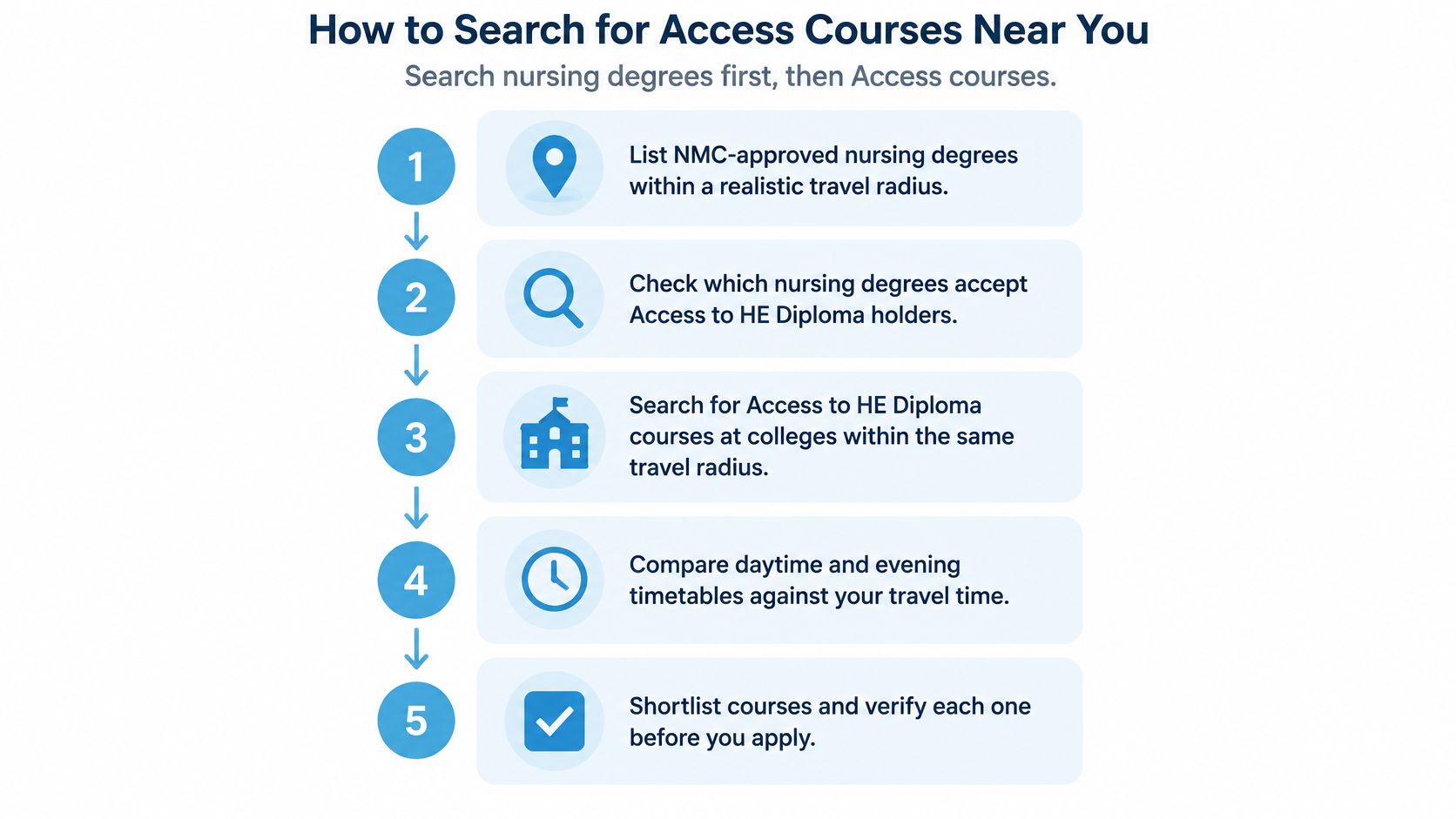
Search in this order: nursing degree first, Access course second. Starting with the nearest Access course is how adults end up with the wrong subjects, the wrong grade profile, or a diploma their target university doesn't name.
GOV.UK confirms mature applicants may enter higher education through an Access course, NVQ, BTEC, professional qualifications, or relevant work experience, but GOV.UK guidance on mature student entry and funding also makes clear that entry requirements vary by university. Nearby doesn't mean accessible.
Work Backwards From the Degree
- List NMC-approved nursing degrees: Use the NMC approved programme list and university websites. Set a travel radius you could manage for lectures and placements, not just for an open day.
- Check each course page: Search for Access to HE and mature applicant wording. Note exactly which Access subjects are named, because a general health diploma may not satisfy every nursing school.
- Search local colleges: Look for Access to HE Diplomas in health, science, or nursing pathways. Compare the named units with your university shortlist before you look at fees.
- Check the AVA directory: Search the Access Validating Agency directory of validated courses. This can surface recognised providers that don't appear in ordinary local search results.
- Compare practical details: Put study pattern, start dates, and taster options beside each provider. A September-only course may cost you a full application cycle if you miss enrolment.
- Email admissions in writing: Ask every university the same three questions. Which Access subjects do you accept, which GCSEs or Functional Skills do you require, and do you interview?
- Book a taster first: Attend a taster session or sample lesson before paying. You'll learn quickly whether the teaching style and workload fit your life.
Practical rule: Keep one spreadsheet with a row for each degree and columns for Access subjects, GCSEs, interviews, and placements. If a cell is blank, you don't have an answer yet.
Take the care assistant in Birmingham who shortlisted three nearby nursing degrees. Only one accepted the Access subjects she was about to study, so proximity alone would have sent her down the wrong route. She changed pathway before enrolling, which is exactly when changing costs nothing.
Verifying Accreditation and University Progression
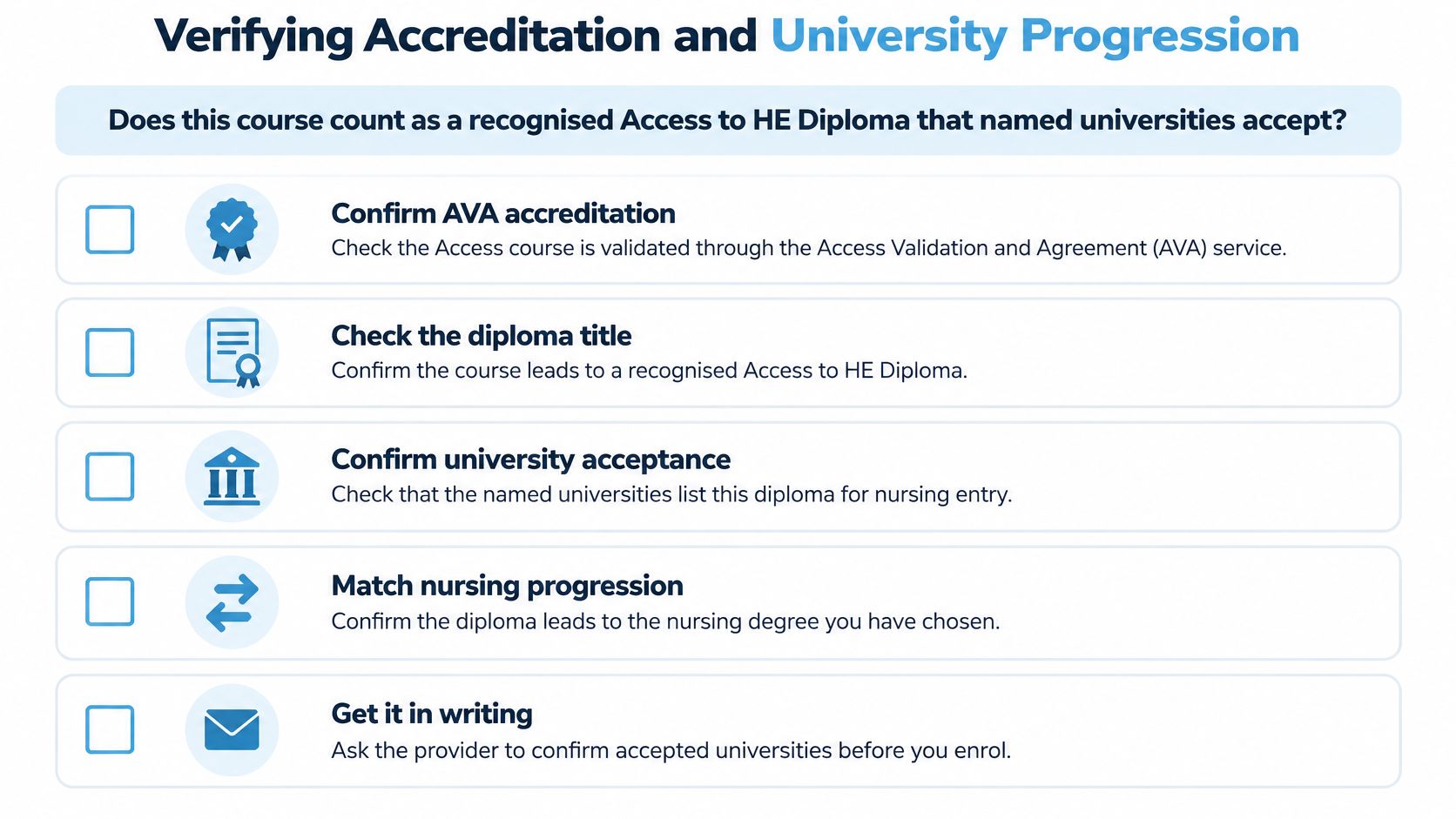
Work backwards from the nursing degree you want. Before enrolling on an Access course, confirm that the qualification is recognised and that your target universities accept it for the nursing pathway you plan to take. Ask for written confirmation. A provider that cannot answer clearly is not a sound choice.
Your Verification Checklist
- Confirm AVA validation: Check that the course names its Access Validating Agency, or ask the provider to confirm the agency in writing.
- Check the provider record: Find the provider on the UK Government's Register of Learning Providers. Confirm its UKPRN, awarding body, and that the qualification is identified as Level 3.
- Get named progression evidence: Ask which universities accept the diploma and what Merit or Distinction profile they require. A broad claim that students progress to university does not confirm that your intended nursing degrees accept this course.
- Check teaching support: Ask how to contact tutors, how large teaching groups are, and whether tutors specialise in the subjects taught. Support matters when biology or academic writing becomes difficult.
- Read the payment terms: Check refunds, cancellations, payment plans, interest, and late fees before signing. Make sure the terms still work if your circumstances change.
- Request sample material: Ask for a unit outline or assessment brief. Review the reading level, assignment format, and feedback arrangements before you commit.
For online study, check whether online diplomas are recognised by universities, then confirm the specific qualification with your target nursing schools. Recognition depends on both the diploma and each university's entry rules.
Check the practical route as well as the academic one. Ask where nursing placements may take place, how much travel they involve, and whether shift patterns can fit around work or childcare. A course can meet the entry requirements and still be a poor choice if the degree's placement commitments are unmanageable.
Walk away from guaranteed places, an unnamed validation body, claims that a course may be accepted, or pressure to enrol immediately. A credible provider should give you time to verify its claims.
UCAS's analysis of nursing applicants and Access qualifications provides context on applicants' routes into nursing. Applicant data describes who applies; it does not show who receives an offer, establish a course-level acceptance rate, or guarantee your progression. Use it as background, not as proof that a particular diploma will meet your chosen universities' requirements.
Matching Entry Requirements to Nursing Degrees
Two nursing schools in the same city can treat the same Access Diploma differently. One may accept a broad health pathway, while another wants named biology units and a stronger Distinction profile. That's why your search for access to higher education nursing near me has to end with university specific checks, not a map.
UCAS states institutions set their own requirements, and NHS guidance commonly identifies five GCSEs at grade 4/C or above, potentially including English and science, plus A levels or equivalent Level 3 qualifications, as set out in UCAS guidance on university entry requirements. Your Access route must close any gaps rather than leave them for UCAS season.
Entry Requirements by Case for Nursing Degrees
| Requirement | Common baseline | What to confirm per university |
|---|---|---|
| GCSE English Language, grade 4/C | Usually required; Functional Skills Level 2 sometimes accepted | Which equivalents the admissions team accepts |
| GCSE Maths, grade 4/C | Usually required; numeracy may be tested at interview | Whether Functional Skills counts and when it must be complete |
| GCSE Science, grade 4/C | Required by some schools, often for biology-based degrees | Whether science is required and which subjects count |
| Access to HE Diploma profile | 60 credits, Level 3 weighted, Merit or Distinction grades | Required Merit or Distinction count and any named subject units |
| Level 3 biology or human health units | Required by some nursing schools | Whether the Access pathway includes them, or a bridging unit is needed |
| Interview | Values-based, sometimes with a written task | Format, length and whether caring experience is scored |
| Enhanced DBS check | Required before starting nurse training | When checks begin and how disclosures are handled |
| Occupational health and immunisation evidence | Required before placements | Which records are needed and the deadline |
| Satisfactory references | Usually required | Whether an academic or employment referee is preferred |
Prior healthcare experience isn't a formal prerequisite at most schools. Don't let that mislead you. Interviewers still need evidence that you understand care work, so record paid care, volunteering, or family caring responsibilities from the start and check each school's exact wording.
For a fuller breakdown before you commit, compare your shortlist against nursing degree entry requirements for Access applicants. Then get admissions teams to confirm your individual position by email.
Avoid these pitfalls:
- Assuming identical treatment: Every nursing school doesn't judge an Access Diploma the same way.
- Leaving numeracy late: Don't reach the final term and discover a maths requirement you can't complete in time.
- Skipping paperwork: Occupational health, immunisation records, DBS checks, and references take time.
Get written confirmation before enrolment. That's non negotiable.
Funding Your Access Course and Nursing Degree
Work backwards from the nursing degree you want. Check the likely cost of tuition, placement travel, childcare and any lost earnings, then decide how to fund the Access course that gets you there. An affordable course is not a good choice if its funding leaves you unable to manage the degree.
Funding Options for Access and Nursing Degree Study
| Option | Who qualifies | What it covers |
|---|---|---|
| Advanced Learner Loan | England, aged 19+, eligible Level 3 course such as Access to HE | Course fees as a loan, repaid through the tax system after earnings pass the threshold |
| Fully or partly funded adult place | England, eligibility based on age, income or prior qualifications, varies by area | Course fees covered by the college, with limited places |
| Provider payment plan | Learners paying privately | Course fees split into instalments under the provider's terms |
| Student Finance for the nursing degree | England, eligible UK undergraduates | Tuition fee loan and maintenance loan; confirm the Access course is designated |
| NHS Learning Support Fund | England, eligible pre-registration nursing students | Non-repayable payments and a loan; amounts change yearly, check current rates |
| Devolved nations schemes | Scotland, Wales, Northern Ireland | Rules and loan terms differ; check the national student funding body |
Start by checking whether your chosen Access to HE course qualifies for an Advanced Learner Loan. The loan may cover fees for an eligible Level 3 course in England if you are 19 or over. The qualification level alone does not confirm eligibility, so ask the provider about the exact course before enrolling. Some colleges also offer fully or partly funded places, but eligibility and availability vary by area.
If you are paying privately, compare the provider's instalment terms with the loan. Check whether interest or fees apply, how long the instalment arrangement lasts, and the total amount payable. Do not assume one provider's terms apply elsewhere. The monthly payment alone cannot show which option costs less overall.
For a clearer overview, read guidance on funding an Access to Higher Education course. Then confirm your eligibility with the provider and check that the funding applies to the specific course you plan to take.
For the nursing degree, eligible undergraduates in England can apply to Student Finance England for tuition fee and maintenance loans. Eligible pre-registration nursing students may also qualify for support through the NHS Learning Support Fund, including non-repayable payments. Amounts change yearly, so check current rates before budgeting.
Compare the total amount you'll pay, when repayments begin, and what happens if you withdraw. A low first instalment does not make a funding option cheaper.
Funding rules differ across Scotland, Wales and Northern Ireland. Check the relevant national student funding body rather than relying on guidance for England. Add travel to placements, childcare and any lost earnings to your budget. Course fees are only one part of the cost of reaching your nursing degree.
Confirm Your Route Before You Apply to Nursing
You may find an Access course that fits your schedule, then discover that the nursing degree it leads to involves placements you cannot reach or shifts your family cannot cover. Work backwards from the degree: check its entry requirements and placement arrangements before choosing your preparation route. UCAS reporting on mature nursing applicants in England describes interest in nursing among prospective students, but popularity does not guarantee a place near home or a manageable timetable.
Nursing placements may be spread across a wider NHS region. A nearby university can still send students to sites that take two buses to reach.

Check the Life Around the Degree
Online Access study can make preparation easier to fit around work and family. It cannot change the practical demands of nurse training: placement travel, early starts, late finishes, and shifts outside school hours. Treat those demands as selection criteria, alongside entry grades.
Before applying, check what your week would look like:
- Placement radius: Ask how far you could travel, then check whether you can reach the furthest site by public transport for an early shift.
- Commuting cost: Add fuel, parking or fares, plus the time spent travelling after a long day.
- Childcare cover: Identify who can manage drop-off and pickup when shifts start early, finish late, or change at short notice.
- Part-time work: Ask your employer what flexibility is available. Do not assume you can sustain placements and work without enough rest.
- Family caring duties: Arrange backup care for a parent or partner while you are on placement.
Ask universities to explain what “local placement” means in practice. Request the sites they use, typical travel times, and how shifts affect travel. A general assurance about local placements is not enough to plan childcare or transport.
Prepare for Selection
Nursing interviews may include values-based interview questions on dignity, teamwork, handling pressure, and your reasons for choosing nursing. Prepare a clear example from caring, volunteering, or paid work. Explain what happened, what you learned, and how it informs the way you would care for patients. Describe your career change directly. Experience from another field can strengthen your case when you connect it to the demands of nursing.
Before accepting an offer, take these steps:
- Get placement details in writing: Ask each admissions team about placement locations, travel expectations, and typical shift patterns.
- Choose matched courses: Apply through UCAS to courses whose entry requirements fit your Access profile. Include a stretch option and realistic alternatives.
- Start checks early: Begin DBS and occupational health paperwork during your Diploma, rather than leaving it until enrolment is close.
Then make an honest assessment: Can I manage placements alongside my family and current work? If the answer is no, adjust your work hours, childcare arrangements, route, or start date before committing.
If you need a nursing Access Diploma that fits around shifts and family life, check the course structure, tutor support, and payment options at Access Courses Online. Give the provider your target university list and confirm that the Diploma meets each course's requirements. Enrol only once you know the route leads to a degree you can realistically complete.