
You may be working full time, caring for children, or returning to education after years away from the classroom. University might feel like the right next step, but traditional entry requirements, fixed timetables, and travel can make the route seem out of reach. Access to higher education science online offers a way forward, but it isn't just a matter of watching lectures at a convenient time.
You'll need to understand the qualification, check your English and maths background, investigate funding in your part of the UK, and prepare for the practical demands of digital study. The route can open progression into science and healthcare degrees, provided the course fits both your academic goal and the life you need to maintain while studying.
Understanding the Access to HE Science Diploma
Consider a learner who works during the day and has family responsibilities in the evening. They left school without the qualifications normally listed on a university application, but they now want to move towards biomedical science, nursing, psychology, or another health-related profession. An Access to Higher Education Diploma can provide the academic bridge between that starting point and an undergraduate application.
The diploma is a one-year, Level 3 qualification for adults aged 19 and over who don't meet standard university entry requirements. It was created for learners who need preparation in academic study, subject knowledge, and assessment before progressing to higher education. Unlike taking a broad set of A levels over several years, an Access course compresses preparation into an intensive route designed with adult progression in mind.
The qualification doesn't guarantee admission to every degree. Universities set their own entry requirements, and some science or healthcare courses may ask for particular units, grades, or additional qualifications. You should therefore check the requirements for the degrees you're considering before enrolling.
A bridge, not a shortcut
Online delivery can remove the need to attend a college campus every day, but it doesn't remove the academic work. You'll still need to read, research, complete assignments, respond to feedback, and meet deadlines. The course is flexible in where and, in some cases, when you study. It isn't automatically light or easy.
Science routes commonly include subjects such as biology, chemistry, psychology, and scientific or study skills. The exact combination depends on the provider and the progression route it supports. Someone aiming for nursing may need to compare the course content with nursing admissions requirements, while someone interested in chemistry or biomedical science may need to examine the science units and grading structure more closely.
The qualification has a clear place in the wider education system. The Access to HE regulator reports that the diploma continues to support adults progressing into higher education and meeting skills needs across the UK. For a plain-language explanation of the qualification and its purpose, you can also read what Access to Higher Education means for adult learners.
Practical rule: Choose the degree first, then check whether the Access diploma gives you the subjects and grades that degree requires.
Online access is now a mainstream part of adult learning. The Learning and Work Institute's Adult Participation in Learning Survey found that 42% of adults were currently learning or had learned during the previous three years, and 68% of those learners said at least some of their main learning was online. That doesn't mean every online course suits every learner, but it does show why remote study has become a realistic route back into education.
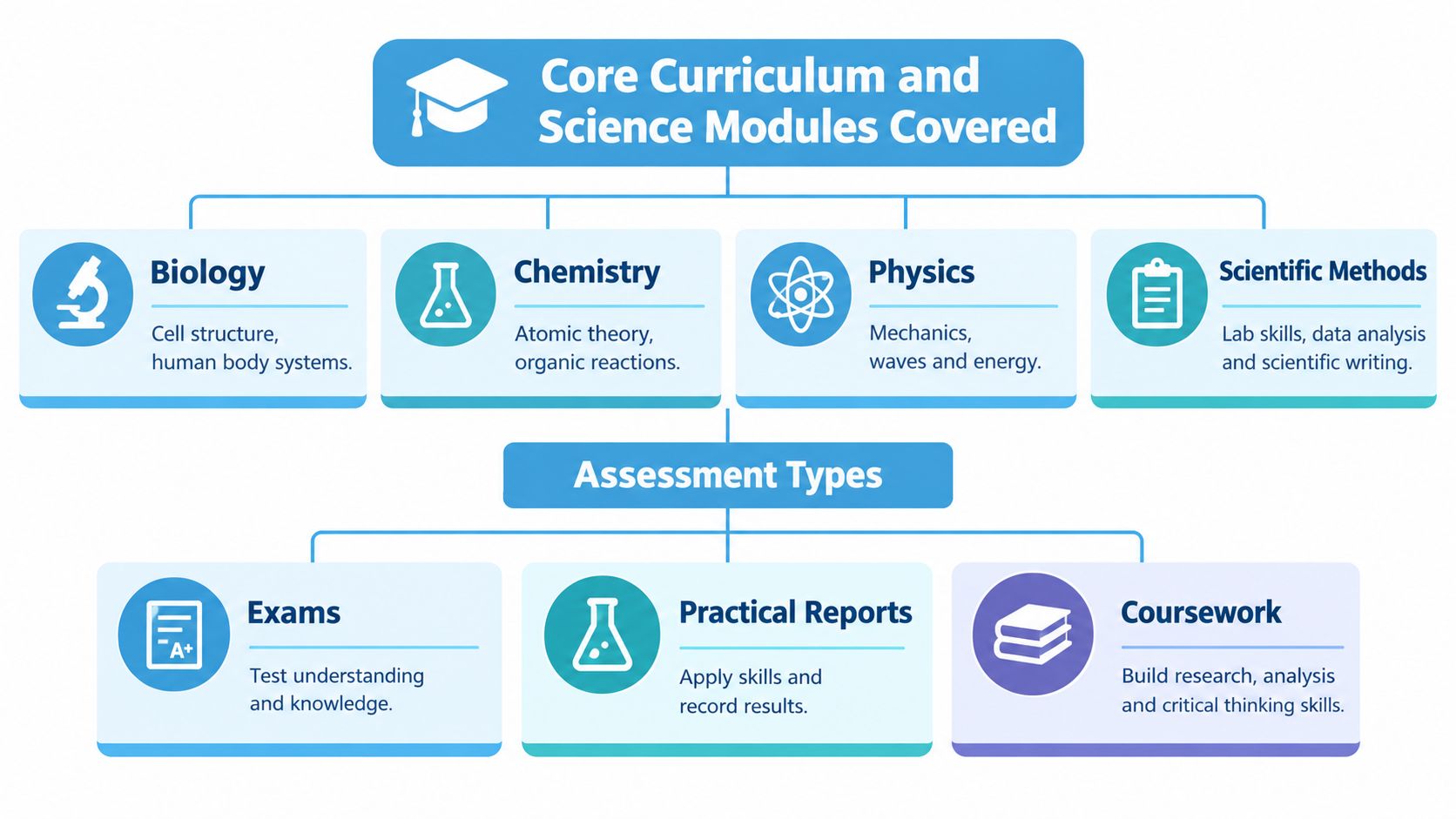
Core Curriculum and Science Modules Covered
Science study online works best when you understand what you're expected to do, rather than treating the course as a collection of recorded lessons. You'll usually encounter subject knowledge alongside academic skills, because university science degrees require you to interpret evidence, explain processes, handle information, and communicate conclusions clearly.
The subject areas
Biology may involve cell structure, human body systems, genetics, health, or biological processes. A written assignment could ask you to explain how a system works and support your explanation with appropriate sources. The important shift is from recalling definitions to showing how biological ideas connect.
Chemistry can introduce atomic theory, bonding, reactions, and organic chemistry. You might need to explain a reaction, interpret information, or apply chemical principles to a health or environmental context. Chemistry often exposes gaps in earlier maths or science knowledge, so regular practice matters more than last-minute revision.
Psychology may be relevant to learners progressing into health, social care, or related degrees. Work can involve comparing explanations of behaviour, evaluating evidence, and presenting a reasoned conclusion. You'll need to distinguish between describing a theory and assessing its strengths and limitations.
Physics or other science units may cover mechanics, waves, energy, or related concepts, depending on the provider and intended progression route. If your target degree has specific subject expectations, ask the provider which units are included before you apply.
The academic skills that hold everything together
Scientific methods and study skills are not filler modules. They help you plan research, use sources responsibly, interpret data, structure an argument, and write in an academic style. You may also encounter practical or simulated practical work, data analysis, laboratory-style reporting, and exam preparation.
Assessments can take different forms:
- Coursework: Develop an answer over time, use research, and respond to a detailed brief.
- Practical reports: Describe a method, present observations or results, and discuss what they mean.
- Exams or timed tasks: Recall key concepts, apply knowledge, and organise answers under time pressure.
A useful way to think about the course is to separate every assignment into four questions: What is the task asking? Which scientific concepts apply? What evidence supports the answer? How will the conclusion be communicated? This approach prevents a common problem, where a learner collects facts but never builds a clear explanation.
For a closer look at the qualification's subject focus, see the Access to Higher Education Diploma in Science. Before enrolling, request the current unit list and assessment plan. A course that sounds broadly scientific may not contain the exact preparation your preferred university course expects.
Entry Requirements and Regional Funding Rules
The most expensive mistake is assuming that every online course has the same entry rules and funding arrangements. Your existing qualifications and your UK region can affect whether you can enrol, how you pay, and what support you may need before the course begins.
Most providers usually expect GCSE English and maths at grade 4/C, or Functional Skills Level 2, before enrolment. Some also use English and maths assessments during the application process. These requirements aren't arbitrary. Science study involves reading complex information, writing structured assignments, interpreting data, and using mathematical ideas, so the provider needs evidence that you have the foundation to manage the work.
Use this checklist before applying
| Requirement Category | Specific Criteria | Alternative Options |
|---|---|---|
| Age | You'll normally need to be an adult learner aged 19 or over | Ask the provider whether your circumstances affect eligibility |
| English | GCSE English at grade 4/C or equivalent may be required | Functional Skills Level 2 or a provider assessment may be accepted |
| Maths | GCSE maths at grade 4/C or equivalent may be required | Functional Skills Level 2 or an approved assessment route may be available |
| Science preparation | Check the units and grading requirements for your intended degree | Ask the provider about subject suitability and university compatibility |
| Location | Funding conditions can vary across England, Scotland, Wales, and Northern Ireland | Check regional rules and whether self-funding or other support applies |
| Application evidence | Providers may ask for certificates, an interview, or entry assessments | Gather documents early and discuss gaps with admissions staff |
The regional funding question needs careful attention. Some online Access courses may be available under funding arrangements for eligible learners living in England. Learners in Scotland, Wales, or Northern Ireland may need to self-fund, depending on the provider and their circumstances. Don't rely on a general statement that an Access course is funded. Ask which funding body applies, whether your location qualifies, and what happens if you don't meet the eligibility conditions.
You can read more about the practical differences in Access to Higher Education funding, but you should still confirm the current position directly with the provider. Funding policies can change, and a course page may apply only to learners in a particular nation or region.
Treat baseline qualifications as preparation
If you don't yet hold the required English or maths qualification, that doesn't necessarily end your university plan. It may mean that you need to complete Functional Skills first, take an approved equivalency route, or choose a provider that offers an assessment and guidance process. What matters is finding out before you commit money or time.
Before you enrol, request written confirmation of the entry criteria, funding position, assessment format, and progression suitability for your intended degree.
Navigating the Digital Learning Environment
A classroom gives you visible routines. You travel to a lesson, see other students, and can ask a question as soon as you get stuck. Online science study gives you more control over your location and schedule, but it also makes you responsible for opening the platform, checking announcements, downloading materials, submitting work, and following up when something is unclear.
The government reports that 97% of adults were online in 2023, yet 7.9 million people lacked essential digital skills, and around 21 million couldn't complete the essential digital tasks needed for work. These figures come from the government's Digital Inclusion for Connection report. For an online science learner, the issue is not merely whether you can access the internet. You need enough confidence to work consistently inside a digital learning environment.
Online and classroom study require different habits
In a classroom, a tutor may notice confusion from your expression or a missed activity. Online, you may need to send a message, attend a virtual tutorial, or use a discussion area to request help. In-person students can sometimes rely on the timetable to create momentum. Online students must create that momentum themselves.
Before starting, test four practical areas:
- Device access: Make sure your laptop or desktop can open course materials, process documents, and upload assignments.
- Connection reliability: Check whether your broadband or mobile connection supports sustained study and video communication.
- File management: Practise naming, saving, finding, and backing up documents.
- Platform navigation: Learn how to locate units, deadlines, feedback, tutor messages, and submission links.
You don't need to be a technical specialist. You do need a repeatable routine. Log in on set days, record every deadline in one calendar, download materials before a busy period, and keep copies of submitted work and tutor feedback.
A provider or course team may also need a clear way to track enrollments and student progress, especially when learners study remotely and tutors need to identify missed submissions or delayed engagement. From the student's perspective, that kind of monitoring should support timely contact rather than replace it. Ask what happens when you miss a deadline or stop logging in.
The hidden challenge is often digital confidence, not lack of interest in science. If you're unsure about online forms, document formatting, video calls, or uploading files, practise before the course begins and ask whether the provider offers induction support.
Progression Routes to University Science Degrees
The diploma matters because it can turn a general ambition into a defined university application. Once you know the degree you want, you can work backwards from its entry requirements and select an Access route that develops the relevant science knowledge and academic skills.
Possible destinations include biomedical science, chemistry, physics, nursing, psychology, and allied health professions. The exact route depends on the university, the course specification, the Access units you complete, and the grades you achieve. Healthcare degrees may also include interviews, health checks, work experience expectations, or professional suitability requirements, so the diploma is one part of the application rather than the whole process.

Work backwards from the admissions page
Start with a shortlist of university courses. For each one, record the required Access diploma, subject units, grades, GCSE conditions, and any additional application steps. Don't assume that a course called “science” will automatically satisfy every biomedical science or nursing requirement.
Then contact admissions teams with specific questions. Ask whether the provider or diploma is accepted, whether particular modules are essential, and whether the university expects a minimum number of credits at specific grades. Keep the replies with your application notes.
The field of higher education is large. Official UK education data recorded 2.99 million higher education students in 2023/24, with 64% studying first degrees and 8% on other undergraduate courses, as reported through the Access to HE regulator's statistics. Those figures don't promise an outcome for an individual applicant, but they show that undergraduate entry is a mainstream target for learners using different routes.
Online progression can also help you build evidence of readiness. A carefully researched biology assignment can demonstrate academic writing. A chemistry report can show that you can interpret results. Consistent engagement with tutor feedback can help you improve before university begins.
Your personal statement should explain the connection between your experience, your chosen degree, and your future role. A career change from administration into nursing, for example, needs more than enthusiasm. It should show that you understand the demands of the profession and have taken deliberate steps to prepare.
The video below can provide another perspective on studying online and planning an education route.
Treat every university requirement as something to verify, not something to guess. Entry policies can differ even between similar degrees, and checking early gives you time to change your subject choices or complete a missing qualification.
Balancing Online Study with Work and Family Life
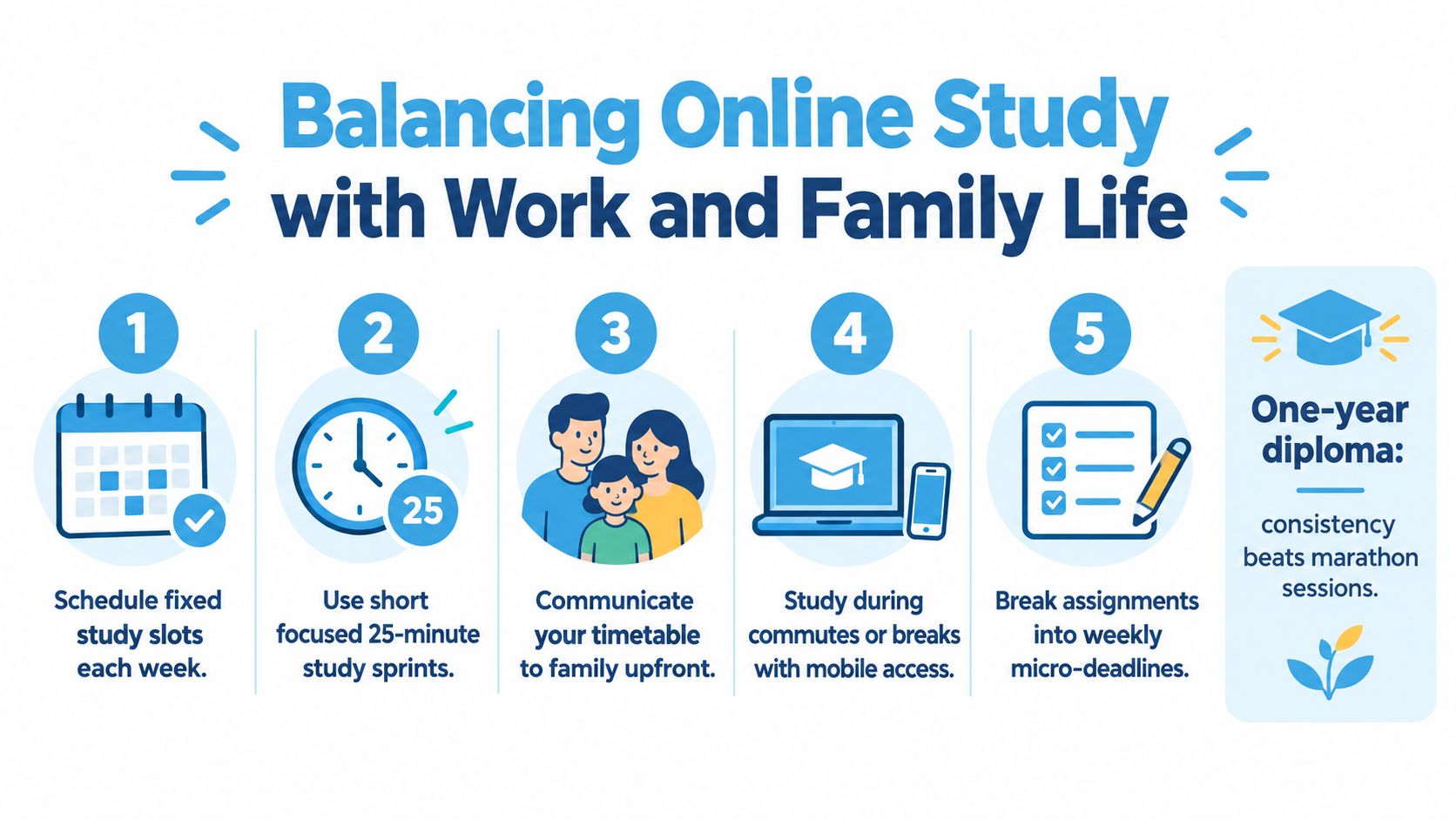
An online Access diploma can fit around responsibilities, but flexibility doesn't mean unlimited spare time. The course is usually intensive and completed over one year, so the main challenge is sustaining regular study rather than finding one large block of free time.
Start by mapping your fixed commitments. Mark work shifts, school runs, caring duties, medical appointments, travel, and sleep. Then place study into the spaces that are genuinely available. If you work irregular hours, use a repeating pattern based on your rota rather than pretending every week will look the same.
Build a week you can repeat
A workable plan might include a longer session for reading and assignment drafting, shorter sessions for revision, and a protected period for catching up with tutor feedback. The exact hours will depend on your course and circumstances. The principle is to create several dependable study opportunities rather than rely on weekend marathons.
Use a simple weekly cycle:
- Review the unit: At the beginning of the week, identify the learning outcomes, required reading, and submission dates.
- Divide the assignment: Turn the brief into research, notes, outline, first draft, editing, and final submission.
- Protect small sessions: Use focused periods during lunch breaks, after children are asleep, or before a shift, if those times are realistic.
- Reserve recovery space: Leave room for illness, unexpected work, and family needs instead of filling every available hour.
- Check progress: At the end of the week, note what is complete and tell your tutor early if a problem threatens a deadline.
Communicate your timetable at home. Family members don't need to understand every scientific topic, but they do need to know when you're unavailable and when you can help. A visible calendar can make study time easier to protect.
Work can be more complicated. If your shift changes, contact the tutor before the deadline becomes urgent. Ask whether guidance, recorded materials, or an agreed adjustment is available under the provider's policy. Don't disappear because you're embarrassed about falling behind. Online courses still depend on communication.
Consistency beats heroic catch-up sessions. A modest routine protects your attention and gives tutors a chance to help before a small delay becomes a serious problem.
Keep your study environment uncomplicated. Store course files in clearly labelled folders, maintain a running list of questions, and make a note of feedback you need to apply to the next assignment. These small systems reduce the mental load of returning to work after a busy day.
Taking the First Step Towards Your Science Career
Choosing an online Access to HE Science route is a practical decision, not a test of whether you feel confident today. You'll be asking yourself to learn scientific content, develop academic habits, use digital systems, and manage deadlines while continuing with work or family responsibilities. Those demands deserve an honest plan.
The route may suit you if you're an adult without traditional university entry qualifications, you're ready for intensive Level 3 study, and you have a clear interest in a science or healthcare degree. It may not be the right immediate step if you haven't yet met the English and maths requirements, cannot protect regular study time, or haven't checked whether the course matches your intended university application.
Use this order of action:
- Name the destination: Choose a small group of university degrees and read their current entry requirements.
- Check your foundation: Locate your GCSE English and maths certificates, or investigate Functional Skills and approved alternatives.
- Confirm the region: Ask how funding works where you live, particularly if you're outside England.
- Test the technology: Check your device, connection, document skills, and ability to use an online learning platform.
- Speak to providers: Request the unit list, assessment details, start arrangements, tutor support information, and progression guidance.
Access Courses Online offers accredited online Access to Higher Education Diploma courses, including a Science route, with tutor support and guidance for adults preparing for university. Visit Access Courses Online to review the course information, check your options, and ask for advice about entry requirements and funding.
Access Courses Online can help you examine whether an online Science diploma fits your qualifications, location, and intended degree. Visit Access Courses Online to take the next step with a provider that offers online Access to HE courses and personalised guidance.