
Is a return to education your next big step?
If you're thinking about university or a new career but don't have the usual qualifications, the old advice often misses the core issue. It assumes you can fit your life around education. Most adults can't. You've got work, children, bills, caring responsibilities, or a long gap since you last studied.
That's why the benefits of home education matter so much for adult learners. They're not only about learning from home. They're about control, flexibility, confidence, and a route back into education that doesn't ask you to put the rest of your life on hold. For many people, an online Access to HE Diploma is the practical version of home education that leads somewhere concrete: university entry and a credible career change.
Demand for home-based learning has grown sharply. In England, elective home education reached 126,000 children in the autumn 2025 census, with regional rates ranging from 0.8% in the North East to 1.3% in the South West, according to the autumn 2025 elective home education statistics. Adults are asking a similar question for themselves: can education work better when it's more flexible, more personal, and less tied to a physical classroom?
It often can. And when that flexibility is paired with accredited online study through Access Courses Online, it becomes more than a convenience. It becomes a route to university that fits around real life.
1. Flexible Learning Around Work and Family Commitments
For most adult learners, flexibility isn't a bonus. It's the condition that makes study possible in the first place.
Traditional timetables work well if your week is predictable. Many adult lives aren't. Shift changes, school runs, overtime, caring duties, and plain exhaustion all get in the way. Home education solves a lot of that because you can study when your schedule allows, not when a campus calendar says you should.
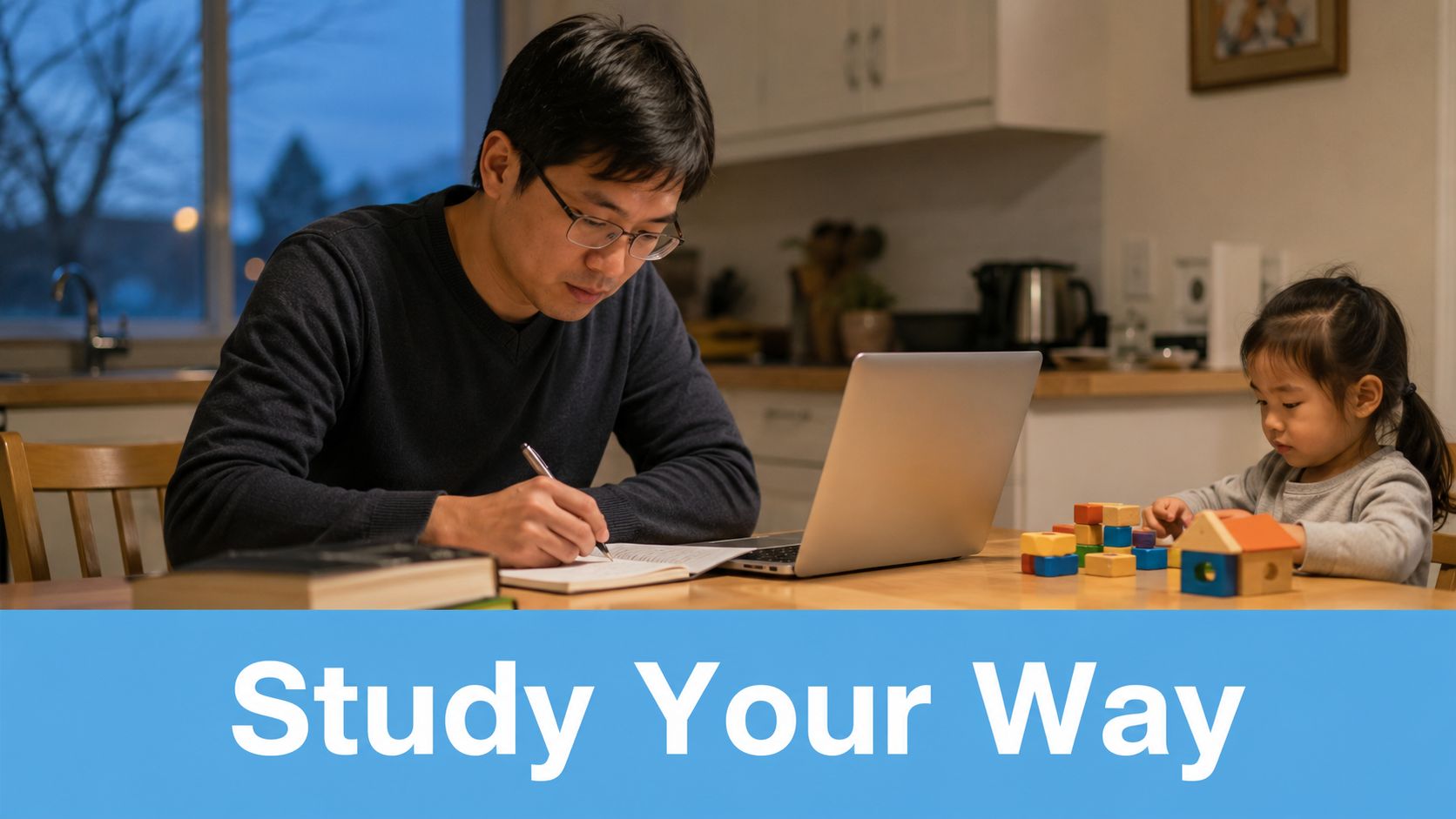
With Access Courses Online, that flexibility shows up in practical ways. You can access course materials at any time, work through units at a pace that suits you, and contact tutors through channels that fit normal adult life better than fixed classroom sessions. That's what makes home-based study realistic for parents, full-time workers, and people returning to education after years away.
What works in practice
Flexible study works best when you treat it like an appointment with yourself. A few regular study windows each week usually beat waiting for a completely free day that never arrives.
Here's where adult learners often do well with online home education:
- Study around your existing routine: Early mornings, lunch breaks, evenings, and weekends can all become usable study time.
- Keep your income while retraining: You don't have to leave work just to gain university entry qualifications.
- Reduce wasted time: No commute means more energy for actual learning.
- Pause and restart more realistically: Life interruptions happen. Flexible online learning copes with them better than fixed attendance models.
Practical rule: Build a repeatable weekly rhythm before you worry about perfect motivation.
There is a trade-off. Flexibility can slide into procrastination if you don't create structure. Some learners also miss the built-in momentum of turning up to a classroom. If that sounds familiar, a written plan helps more than vague good intentions. This guide on how to create a study plan is a good starting point.
The core advantage is simple. Home education lets your course fit your life, which is often the only reason adults can begin at all.
2. Cost-Effective Education with Affordable Payment Plans
Cost stops plenty of capable adults before they even apply.
One of the biggest benefits of home education is that it strips out many of the expenses tied to campus-based study. You're not paying for travel several days a week. You're not budgeting for relocation, accommodation, or the general cost of organising your life around a physical site. For adults who need to keep working, that difference matters.
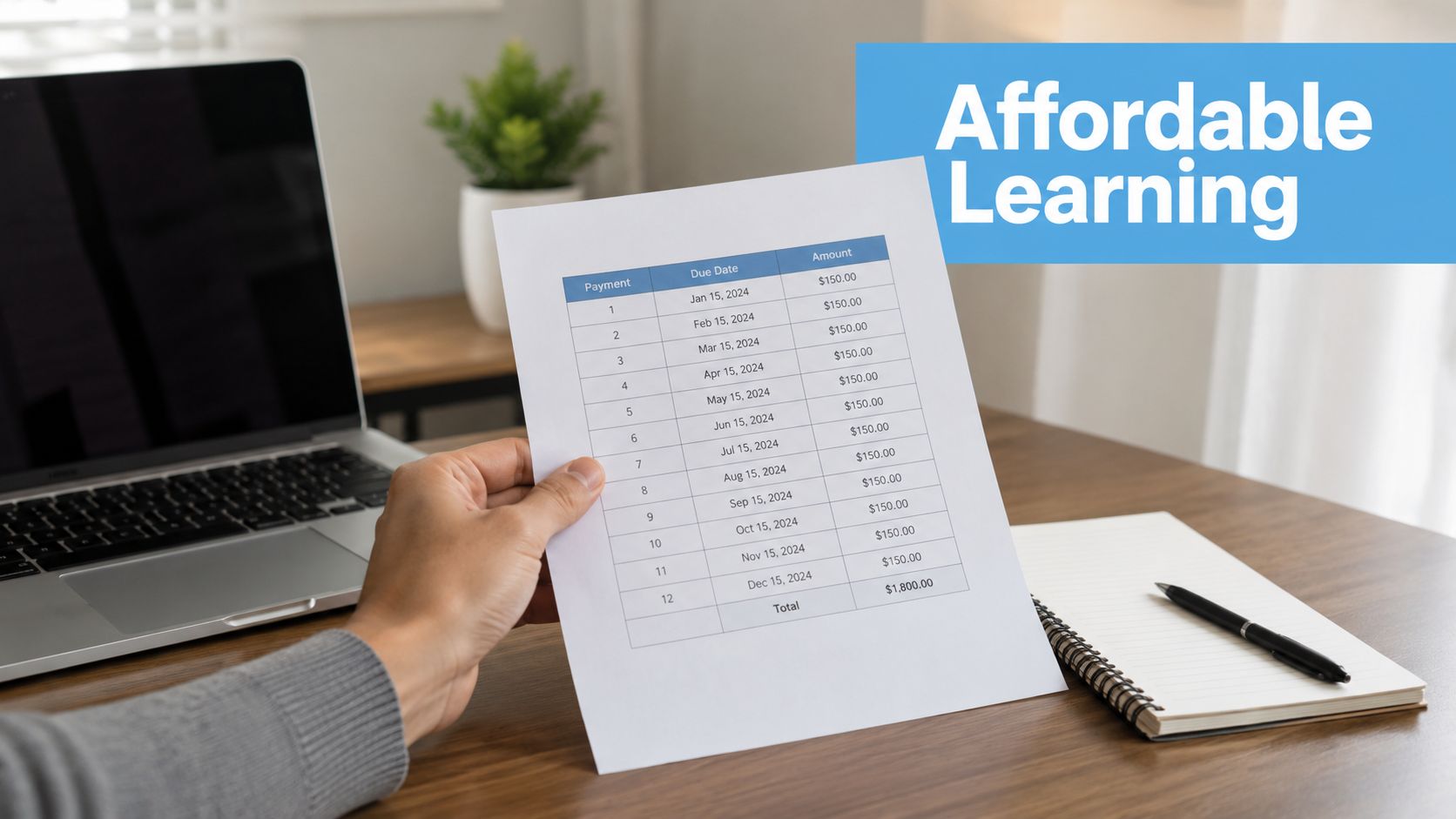
That's why online Access to HE study is often the more realistic route into higher education. At Access Courses Online, the model is built for adults who need affordability as well as flexibility. Interest-free payment plans over 12 months can make the step back into education feel manageable instead of financially reckless.
Where the savings actually show up
The value isn't only in tuition. It's in the total cost of participation.
- No commuting costs: You study from home, so travel doesn't drain your budget.
- No relocation pressure: You can stay where you are and still access an accredited route to university.
- Payment spread over time: Monthly instalments are often easier to absorb than one large upfront cost.
- Continue earning while studying: Flexible online learning makes it easier to keep your current job.
There are limits, and it's better to say that plainly. Even affordable study still requires commitment. Monthly payments need planning, especially if your income changes. Some learners also need help understanding which funding route makes most sense for their circumstances.
Paying less only helps if the course still leads somewhere recognised. For adult learners, low cost without progression value is a false economy.
If you want to look at the practical options, Access to Higher Education funding guidance can help you compare what's feasible before you enrol.
For many adults, cost-effective home education doesn't mean “cheap”. It means the path is finally workable.
3. Personalised Learning Pathways and One-to-One Tutor Support
Do you learn best when someone can spot the exact point where you got stuck and help you fix it quickly?
For many adults, that is the difference between dropping out again and finally making steady progress. A structured Access to HE course works best when it gives you a clear route, useful feedback, and a tutor who understands that you are not starting from the same place as an 18-year-old college student.

Adult learners rarely need more information; they need the right explanation at the right time. If you have been out of education for years, one confusing unit can knock your confidence faster than people expect. Personal tutor support helps you correct problems early, improve assignment technique, and keep your university goal in view.
In practice, personalised online study usually helps in four concrete ways:
- Feedback that tells you what to do next: You need comments you can act on, not vague praise or a mark with no direction.
- Course pacing that fits your starting point: Some learners need to rebuild essay writing first. Others need help with subject knowledge or academic referencing.
- Guidance linked to your progression plan: A future midwife, social worker, or business student needs different academic emphasis and advice.
- Direct contact with a real tutor: Quick answers by message or email can stop a small issue becoming a missed deadline.
That level of support is one of the strongest advantages of accredited online home education for adults. Access Courses Online is not giving you course materials to work through alone. The value is in the structure around the material, including tutor input, progress guidance, and a study path built for university entry.
There is a trade-off, and it is worth being plain about it. One-to-one tutor support does not give you the same peer discussion you would get in a physical classroom. If you learn mainly by talking ideas through with other students, you may need to create that yourself through study groups or wider support networks. Learners who also struggle with classroom pressure or communication anxiety often find private tutor contact easier to handle, especially alongside practical social anxiety self-help strategies.
Good personalised support does not remove academic standards. It makes them clearer. You still have deadlines, assignments, and independent study to manage. What changes is that you are not left guessing whether you are on the right track. For adults changing career or returning to education after a long gap, that kind of clarity can make home education feel realistic rather than risky.
4. Confidence Building for Non-Traditional Learners
A lot of adults don't return to education because they doubt their ability. They return despite doubting it.
That's why confidence is one of the most overlooked benefits of home education. Studying from home gives you room to rebuild academic habits privately. You can make mistakes, correct them, and improve without the social pressure that many people still associate with school or college.
Research focused on UK home educators found that 89% reported higher self-confidence and self-esteem as a benefit, according to these UK home education findings. For adults who left education disappointed, anxious, or convinced they “weren't academic”, that point lands hard.
A quieter environment can unlock progress
Confidence doesn't usually return through motivational slogans. It returns when you complete work, understand what you're doing, and start trusting yourself again.
Home education helps with that because it allows:
- Private practice: You can struggle with a topic without feeling watched.
- Gradual wins: Small successes build momentum better than one high-pressure leap.
- Less comparison: You focus on your progress, not on who seems ahead.
- Safer restart conditions: If school was a bad experience, a home-based setting often feels more manageable.
If classroom anxiety has been one of your biggest barriers, studying privately can remove enough pressure for real learning to begin.
There is a limitation. University won't always feel as sheltered as home study. Deadlines, formal assessment, and competitive entry can still feel intense later on. But confidence built through successful online study is still far more useful than waiting to feel “ready” before you begin.
Some learners also benefit from broader coping tools when anxiety is part of the picture. These social anxiety self-help strategies may be useful alongside academic support, especially if fear of judgement has kept you out of education for years.
For non-traditional learners, confidence isn't fluff. It's infrastructure.
5. Access to University and Graduate-Level Career Progression
At this point, home education stops being a lifestyle preference and becomes a serious progression route.
If you don't have A-levels or you've been out of education for a long time, an online Access to HE Diploma gives you a recognised path into university. That's the practical advantage many adults need most. You're not studying for the sake of self-improvement alone. You're working towards entry into a degree and, after that, a profession with better long-term options.
At Access Courses Online, the course range is tied to clear higher education routes. Adult learners can prepare for degrees in areas such as Nursing, Midwifery, Health Professions, Computer Science, Science, Social Science, Business and Management, and more. That specificity matters. It helps you choose a course that aligns with the future you want.
What this route does well
An Access to HE Diploma works best when you want a direct bridge to degree-level study, not a vague return to learning.
Key strengths include:
- Recognised progression: The qualification is designed to support university application.
- Subject alignment: You can choose a route that fits the degree area you're aiming for.
- Adult-focused entry point: It's built for learners who may not have followed the standard school-to-university path.
- Career relevance: The end goal is often a regulated profession or graduate-level role.
The trade-offs are real too. You still need to meet the requirements for your chosen university and course. Some universities are more specific than others about which Access diplomas they accept and what grades they expect. Planning early helps avoid unpleasant surprises. If you're exploring that route, this guide on how to get into university without A-levels is worth reading.
The best part of this benefit is clarity. Home education, in the form of an accredited Access course, can turn “I wish I could go to university” into a sequence of steps you can follow.
6. Development of Essential Digital and Study Skills
Studying from home teaches more than the subject itself. It changes how you work.
When you complete an online Access course, you're constantly practising the habits that degree study and modern workplaces expect. You learn how to manage files, communicate clearly online, keep track of deadlines, organise independent study, and solve routine problems without waiting for someone to stand at the front of the room and tell you what to do.
That's one of the quieter benefits of home education. It builds competence through repetition. By the time you progress to university, using online systems, submitting work digitally, and managing remote communication won't feel new.
Skills that transfer beyond the course
These are the capabilities adult learners often develop naturally in online study:
- Platform confidence: Logging into course systems, finding materials, and tracking progress become routine.
- Digital communication: You get used to asking useful questions by email or message, which matters in both university and work.
- Information handling: Research, note organisation, and document management improve with use.
- Self-management: Independent study trains you to plan, prioritise, and recover when a week goes off course.
A practical warning is necessary here. Home education assumes you have reliable access to the internet, a device that can handle your course, and a usable study environment. Technology problems can interrupt momentum very quickly. If your setup is fragile, fix that early.
The learners who cope best online aren't always the most academic. They're often the ones who build dependable routines for small administrative tasks.
This skill-building has long-term value. Even if your main goal is university entry, the process of studying online prepares you for the digital reality of higher education and many graduate jobs.
7. Clear, Achievable Progression Routes and Goal-Setting
Adults often do better when the path is visible.
One reason home education works well in an Access to HE format is that the route is easier to understand than many people expect. You enrol on a recognised course, complete the required units, apply to university, and move towards degree-level study. That clarity can be motivating if you've spent years feeling that education was something other people knew how to manage.
At Access Courses Online, that structure is one of the strongest practical benefits. The provider isn't selling vague self-development. It's offering a route with defined outcomes, supported by tutors and advisers who understand where the qualification can lead.
Why clear milestones matter
A visible path helps in two ways. First, it makes the workload feel purposeful. Second, it helps you recover from setbacks because you can still see where you're heading.
This is especially useful when your motivation fluctuates. On hard weeks, abstract ambition isn't enough. A concrete next step is.
- Course completion becomes meaningful: You're not just finishing assignments. You're moving towards university entry.
- Goals can be broken down: One module, one deadline, one application task at a time.
- Progress becomes easier to judge: You can see whether you're on track rather than guessing.
- Career change feels less remote: The route connects today's study to a future role.
There is a risk of becoming too rigid. Life changes. Health, finances, childcare, and work can all disrupt a neatly planned timeline. Good goal-setting leaves room for that. A strong progression route should guide you, not trap you.
The practical advantage remains. Structured home education gives many adult learners the first educational path that feels both ambitious and realistic.
8. Inclusive Learning for Diverse Circumstances and Accessibility Needs
What if the main reason study has not worked for you before was not your ability, but the setting?
For many adults, that is a significant issue. Campus-based education can bring fixed timetables, travel, sensory strain, attendance pressures, and environments that are hard to manage alongside illness, disability, anxiety, or caring duties. A structured online Access to HE course changes those conditions without lowering the standard you are working towards.
That matters because accessibility is not a bonus feature. It affects whether you can start, keep going, and finish.
For families choosing home education more broadly, wellbeing is often part of the decision. Recent reporting on UK homeschooling statistics and family wellbeing trends points to mental health as one reason some households choose to learn at home. Adult learners face a related question. If your study environment regularly drains your energy or limits your attendance, the format is working against you.
Accessibility is practical, not theoretical
With online Access study, you can adjust more of the learning conditions around your actual life.
That can include:
- Studying from home or any suitable location: You are not restricted by commuting distance or local college options.
- Working around fluctuating health: You can plan study time around treatment, fatigue, pain levels, or recovery periods.
- Reducing physical and logistical strain: Regular travel, waiting time, and campus movement are removed from the routine.
- Controlling your study environment: Lighting, noise, breaks, seating, and pace are easier to manage at home.
- Following an accredited route to university: You still work towards a recognised qualification with clear academic expectations.
In practice, this is one of the strongest advantages of Access Courses Online for adults who need a realistic route back into education. The structure is there, but you can work through it in conditions that are more manageable. That combination matters. Too little structure leaves learners isolated. Too little flexibility shuts them out.
There are trade-offs. Online study is not automatically accessible for everyone. Some learners need assistive technology, alternative formats, extra tutor contact, or stronger accountability to stay on track. Reliable internet and a usable device also matter. These are real barriers, not minor details.
Even so, many adults find that a structured online Access course is the first model that fits their circumstances well enough to make progress possible. If traditional education has excluded you in practice, home-based study can give you a fairer starting point and a credible route to university or a new career.
Home Education: 8-Point Benefits Comparison
| Item | 🔄 Implementation Complexity | ⚡ Resource Requirements & Speed | 📊 Expected Outcomes ⭐ | Ideal Use Cases | 💡 Tips & Insights |
|---|---|---|---|---|---|
| Flexible Learning Around Work and Family Commitments | 🔄 Low–Medium, learner-managed schedules | ⚡ Moderate, reliable internet & workspace; high scheduling flexibility | 📊 Increased adult participation and completion (flexibility cited by 63%); ⭐⭐⭐⭐ | Working adults, parents, shift workers, carers | 💡 Create a dedicated study space; set consistent weekly goals; use calendars; inform family |
| Cost-Effective Education with Affordable Payment Plans | 🔄 Low, straightforward enrolment and payment setup | ⚡ Low physical cost; requires steady income for monthly plans; faster access vs traditional routes | 📊 Reduced total cost barrier; interest-free plans improve affordability; ⭐⭐⭐⭐ | Lower-income adults, those ineligible for loans, part-time workers | 💡 Request funding guidance; budget for 12 months; check employer support or bursaries |
| Personalised Learning Pathways and One-to-One Tutor Support | 🔄 Medium, scheduling and tailoring required | ⚡ Higher tutor time per learner; needs reliable comms channels; can accelerate learning | 📊 Stronger confidence and completion (research: ~34% higher completion); ⭐⭐⭐⭐ | Learners with knowledge gaps, career-changers, those needing confidence | 💡 Schedule regular check-ins; prepare focused questions; use multiple communication channels |
| Confidence Building for Non-Traditional Learners | 🔄 Low–Medium, milestone design and tutor encouragement | ⚡ Moderate, tutor support and scaffolded tasks; steady pace encouraged | 📊 Improved self-efficacy and readiness for university; gradual, sustainable gains; ⭐⭐⭐ | Adults returning after long breaks, learners with prior negative schooling | 💡 Start with one module; keep a learning journal; celebrate small wins; request tutor encouragement |
| Access to University and Graduate-Level Career Progression | 🔄 Medium, meets accreditation and entry requirements | ⚡ Moderate, accredited curriculum and progression support; typically faster than A-levels (≈1 year) | 📊 Direct pathways to degree study and graduate roles; recognised by universities and employers; ⭐⭐⭐⭐ | Adults without A-levels seeking degree entry (Nursing, Tech, Business) | 💡 Research university acceptance of specific diplomas; aim for strong grades; apply early |
| Development of Essential Digital and Study Skills | 🔄 Low, skills embedded in online delivery | ⚡ Moderate, device + internet required; rapid transferable skill development | 📊 Increased digital literacy and self-management; employer-relevant competencies; ⭐⭐⭐⭐ | Learners needing workplace digital skills or hybrid study readiness | 💡 Complete digital orientation; practise professional email; organise digital files; consider Functional Skills |
| Clear, Achievable Progression Routes and Goal-Setting | 🔄 Low, predefined pathways and milestones | ⚡ Low, requires tutor/advisor input and tracking tools; supports steady progress | 📊 Greater motivation, persistence and clearer career trajectories; ⭐⭐⭐⭐ | Learners needing structure, direction and measurable goals | 💡 Set milestones with tutors; review progress regularly; celebrate each milestone |
| Inclusive Learning for Diverse Circumstances and Accessibility Needs | 🔄 Medium, individual assessments and adjustments needed | ⚡ Moderate, assistive tech and tailored support; removes commuting time but demands tech access | 📊 Broader access for disabled, chronically ill, rural learners; improved inclusion when supported; ⭐⭐⭐⭐ | Disabled learners, neurodivergent students, carers, rural and health-impaired learners | 💡 Disclose needs early; request accessibility assessment; use assistive tech; plan breaks for health management |
Your Future Starts with a Single, Flexible Step
What would change if the next step towards university fit your life?
For many adults, the appeal of home education is simple. You can study around work, family responsibilities, health needs, and the realities of a busy week. The challenge is turning that flexibility into a qualification that universities recognise and employers respect. An online Access to HE Diploma does that job well. It gives you the freedom associated with studying from home, but with a clear academic standard, tutor support, and a defined route into higher education.
As noted earlier, evidence on home-based learning is encouraging. For adult learners, the bigger point is practical rather than theoretical. People tend to make better progress when the course structure matches how they live and study. That is one reason accredited online Access courses work so well for career changers, parents, carers, and anyone returning to education after a long gap.
Structure matters.
Flexible study only works when you can see where you are heading and what to do next. A strong online Access course gives you deadlines that are realistic, feedback you can use, and milestones that keep you moving even when life gets interrupted. That balance of independence and support is what many adults need. You are not left to piece everything together on your own, and you are not forced into a timetable that ignores the rest of your life.
I have seen many adult learners assume university is no longer an option because school was difficult, their confidence took a hit, or full-time classroom study is unrealistic now. In practice, the issue is often not ability. It is fit. A course designed for adult learners can make the route back into education feel manageable again, because it meets you where you are and points clearly towards what comes next.
Access Courses Online is a practical option for exactly that reason. The courses are designed around adult responsibilities, recognised entry routes, and steady progress. You can study from home, work towards a qualification with a clear purpose, and build towards university without putting the rest of your life on hold.
Big changes rarely start with a dramatic reset. They usually start with one credible decision, followed by consistent work. For many adults, an online Access to HE Diploma is that decision.