
You might be looking at university prospectuses or job adverts and thinking the same thing many adult learners think: “I'm motivated, but I don't have the right background.” Maybe your qualifications are old. Maybe you've been raising a family, working in a different sector, or trying to figure out how to start again without starting from zero.
That feeling is real. It can make the next step seem much bigger than it is.
Work experience often looks like something built for school leavers or students with connections. In practice, it can be one of the most useful tools for adults changing direction. It gives you evidence. It gives you stories to tell. It helps admissions tutors and employers see more than your past results. They start to see your potential, your commitment, and your readiness to move into a new field.
If you're studying flexibly through an Access course, that matters even more. Online study gives you room to build experience around real life, rather than waiting for the “perfect” moment. You don't need a flawless CV to begin. You need a realistic plan and the confidence to take the first step.
Why Work Experience Is Your Secret Weapon for Change
When adults return to learning, they often focus on what they lack. No recent study. No traditional A levels. No direct experience in the profession they want to enter. That's understandable, but it misses a powerful truth. Work experience helps close the gap between where you are now and where you want to be.

A qualification shows that you can learn. Experience shows that you can apply what you've learned in a real setting. Together, those two things are much stronger than either one on its own.
For adult learners, the benefits of work experience go beyond employability. It can help you test whether a career change fits your strengths, values, and daily life. A person considering nursing may realise they thrive in patient-facing environments. Someone exploring business may discover they enjoy organising systems more than sales. Someone moving into computing may find they prefer building projects independently rather than working on live support tickets.
Why adults often underestimate their starting point
Many people already have useful experience, even if it doesn't look academic or professional on paper. Managing rotas, handling difficult conversations, supporting vulnerable people, solving problems under pressure, using spreadsheets, or training new colleagues all count. Work experience gives you a way to connect those existing strengths to your future direction.
A career change rarely starts with a perfect profile. It starts with one credible step that proves you're serious.
That's why practical exposure matters so much. It turns a hope into a track record.
Experience changes how others read your application
Admissions tutors and employers don't only look for polished candidates. They look for applicants who understand what the role or course involves. Relevant experience tells them you've done more than admire the idea of a profession from a distance. You've stepped into it, observed it, contributed to it, and reflected on what you learned.
That shift is important for confidence too. Once you've spent time in a relevant setting, you stop feeling like someone asking for a chance and start sounding like someone preparing for the next stage.
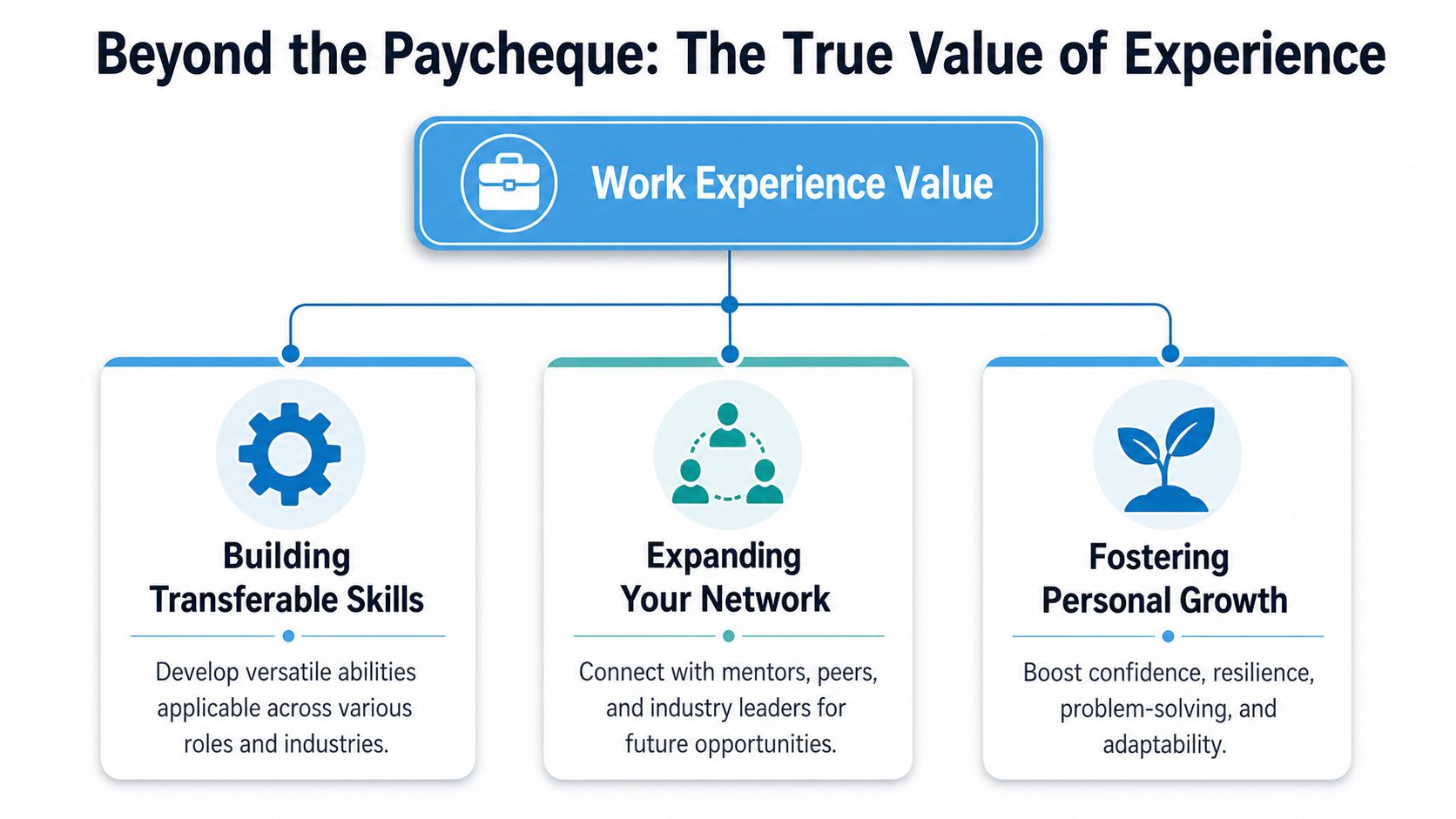
Beyond the Paycheque The True Value of Experience
The biggest benefits of work experience often have nothing to do with money. Even when a placement is unpaid, the return can still be substantial because you're building assets that stay with you long after the placement ends.
Building skills you can carry anywhere
Think of transferable skills as a career passport. They travel with you from one setting to another. If you volunteer in a community project, you might develop communication, reliability, teamwork, record-keeping, and problem-solving. If you help in an office, you might improve organisation, professional writing, and confidence with systems and processes.
These skills matter because adult learners are often moving across sectors, not just climbing within one. A future healthcare student may bring calmness under pressure from retail. A future business student may bring customer insight from care work. A future computing student may bring persistence and self-direction from years of balancing work and family commitments.
According to UK Government data on work experience and training opportunities, around 75% of participants reported gaining new skills and enhanced confidence, and 95% of students identified increased confidence as a key benefit.
Confidence that comes from doing, not just hoping
Confidence grows differently when it comes from action. Reading about a profession helps. Watching videos helps. Talking to others helps. But confidence becomes more solid when you've shown up, spoken to people in the field, followed instructions, handled small setbacks, and seen yourself cope.
That matters for adult learners because many are carrying some version of imposter syndrome. They worry they'll be the oldest person on the course, the least experienced person in the room, or the one who asks the “basic” question. Experience softens that fear. You begin to realise that professionalism isn't about having all the answers. It's about showing willingness, judgement, and steadiness.
Practical rule: Confidence usually arrives after repeated action, not before it.
Career insight before a bigger commitment
Work experience also acts as a test drive. It helps you understand the texture of a role. You learn what the pace feels like, how teams communicate, what tasks repeat, and what pressures come with the work. That can save you from choosing a course based only on a title.
A short comparison shows how this works:
| What you think before experience | What you learn during experience |
|---|---|
| “Healthcare is just about being caring” | Patient care also involves boundaries, communication, routine, and resilience |
| “Business is mostly numbers” | Many business roles depend on people skills, systems, and decision-making |
| “Computing is just coding” | The field also involves testing, documenting, problem-solving, and collaboration |
Networks grow from small conversations
Not every opportunity leads straight to a job, but many lead to something else useful: a reference, a recommendation, a clearer goal, or a contact who tells you where to look next. Adult learners sometimes assume networking means attending formal events and making polished introductions. Often it starts with simpler moments. Asking thoughtful questions. Turning up on time. Being remembered as reliable.
That's part of the true value too. Experience doesn't just improve your CV. It helps other people place you in the professional world you want to enter.
Turning Experience into University and Job Offers
A selection panel often makes its first decision before you speak to anyone. They look at your application and ask a simple question: has this person already spent time close to the work or subject they say they want?
For adult learners, that question can feel uncomfortable. You may be building a new direction later than expected. You may be studying online because life leaves no room for a traditional route. You may also worry that without A-levels, recent schooling, or a polished CV, you will be judged more harshly.
Work experience helps close that gap.
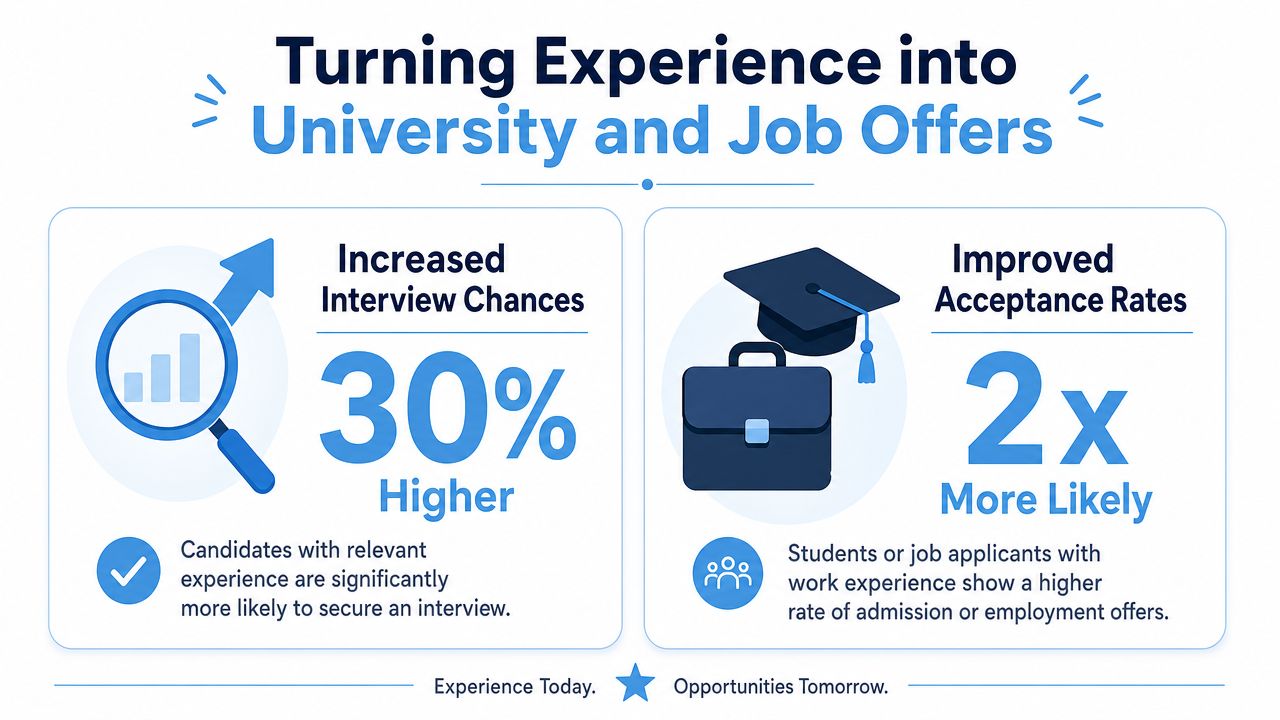
It gives admissions tutors and employers something concrete to work with. Instead of only seeing potential on paper, they can see evidence of follow-through. That matters if your confidence is still catching up with your ambition.
What admissions tutors and employers are really reading
A short placement, volunteer role, shadowing day, or part-time job is rarely judged only by its title. The reader is usually scanning for signs underneath it.
They are asking questions such as these:
- Did you take initiative without waiting for perfect conditions?
- Have you encountered the demands of this field?
- Can you balance study with responsibility?
- Do you reflect on what you learn and apply it?
That is why a small amount of relevant experience can carry real weight. One regular commitment, described clearly, often does more for your application than broad claims about passion or motivation.
For adults studying an Access Course online, this is especially useful. Flexible study gives you room to build evidence alongside your course, and that evidence can help explain your story. You are not only saying, “I want this change.” You are showing that you have already started it.
Why experience strengthens applications
Admissions tutors want signs that you understand the course beyond the prospectus. Employers want signs that you can contribute, learn quickly, and behave professionally. Experience speaks to both.
It works a bit like showing your working in a maths problem. Your final answer matters, but the steps matter too. Relevant experience shows the steps you have already taken toward your goal.
This can be particularly helpful if your background is unconventional. If you left education years ago, changed industries, or are returning after caring responsibilities, experience helps connect the dots. It gives context to your application and makes your next step look planned rather than hopeful.
Turn experience into proof, not just a list
Value does not come from writing down where you were. It comes from explaining what the experience shows.
A simple four-part structure works well:
- Name the setting
- Describe your responsibilities
- Explain what you learned
- Connect it to the course or role
For example: “While studying online, I volunteered one afternoon a week in a residential care home. I supported activities and observed how staff communicated with residents and relatives. That experience helped me understand the emotional and practical demands of care work, and it confirmed my decision to apply for a health-related degree.”
That kind of explanation gives the reader something solid. It shows action, reflection, and direction.
Use every part of your background
Adult learners often underestimate what counts. Paid work, volunteering, caring responsibilities, freelance tasks, community roles, and informal project work can all support an application if they are relevant and well explained.
You may also have previous study or professional learning that still has value. If that applies to you, it is worth understanding recognition for prior learning, because earlier achievements may support your progression and strengthen how you present your experience now.
If you are preparing for interviews as well as applications, review a clear modern job interview guide and practise turning your experiences into short examples with a clear beginning, middle, and result.
A good application does not require a perfect past. It requires evidence that you are already doing the work of becoming ready.
How to Gain Experience While Studying Your Access Course
The hardest question for many adult learners isn't why experience matters. It's how to fit it into a life that already includes work, family, study, travel, and bills. The good news is that work experience doesn't have to mean a full-time internship in a city office. It can be built in smaller, flexible ways.
Start with what is realistic, not what looks impressive
A sustainable placement beats an ideal one you can't manage. If you can offer one morning a week, start there. If evenings suit you better, look for remote or community-based options. If weekends are your only free time, focus on organisations that operate then.
Useful formats include:
- Volunteering: Good for healthcare, social care, community work, youth work, and administration.
- Part-time paid roles: Helpful when you need income and experience at the same time.
- Job shadowing: Useful when you need exposure before committing to a longer role.
- Project-based work: Especially practical for computing, business, digital marketing, and creative subjects.
- Remote support work: Strong option for learners studying online and balancing family commitments.
Field-specific ideas that fit around study
Some examples are easier to picture than others, so it helps to get concrete.
Healthcare and allied health
If you want to progress into nursing, midwifery, or another health profession, look for roles where you support people directly and learn how care settings operate. That might include volunteering in a care home, helping at a hospice charity shop with patient-facing awareness work, or applying for entry-level support roles such as healthcare assistant positions when appropriate.
Focus on what you can observe and practise: communication, empathy, confidentiality, teamwork, punctuality, and responding calmly to instruction.
Computing and digital pathways
Computing experience doesn't have to begin with formal employment. You can build a portfolio through small, visible projects. Create a simple website, solve coding challenges, contribute to open-source tasks where possible, or help a local group with basic digital improvements such as a booking form, spreadsheet workflow, or page updates.
A well-organised online portfolio can help you present this work clearly. If you need a starting point, this guide to student portfolios gives practical ideas for structuring your projects and showing your progress.
Business and management
Business experience often grows from helping organisations run smoothly. You could support a local charity with admin, social media scheduling, stock organisation, event planning, customer communication, or basic bookkeeping support under supervision. Small businesses often need practical help and may value reliability more than formal credentials.
The hidden barrier of self-finding placements
One challenge rarely gets enough attention. Education and Employers' research on work experience delivery found that 50% of UK work placements are found through personal networks, not schools. That matters because adult learners may not have those networks. If you're changing sector, returning to education later in life, or lacking traditional qualifications, you may have to create opportunity more actively.
That doesn't mean you're shut out. It means your search needs structure.
Don't wait to “know someone”. Start by becoming known as someone serious, polite, and prepared.
A practical way to self-source opportunities
Use a simple weekly routine instead of relying on confidence or luck.
| Weekly action | What to do |
|---|---|
| Identify targets | Choose 5 local organisations or employers linked to your goal |
| Make contact | Send a short message asking about shadowing, volunteering, or project help |
| Follow up | If there's no reply, check back politely after a few days |
| Track progress | Keep a spreadsheet of contacts, dates, and responses |
| Reflect | Note what each conversation teaches you about the field |
Keep your message short. Say who you are, what you're studying, what kind of opportunity you're looking for, and what time you can realistically offer. Specific requests work better than broad ones.
If you need more ideas for getting started, this practical guide on how to get work experience gives useful next steps for building opportunities in a manageable way.
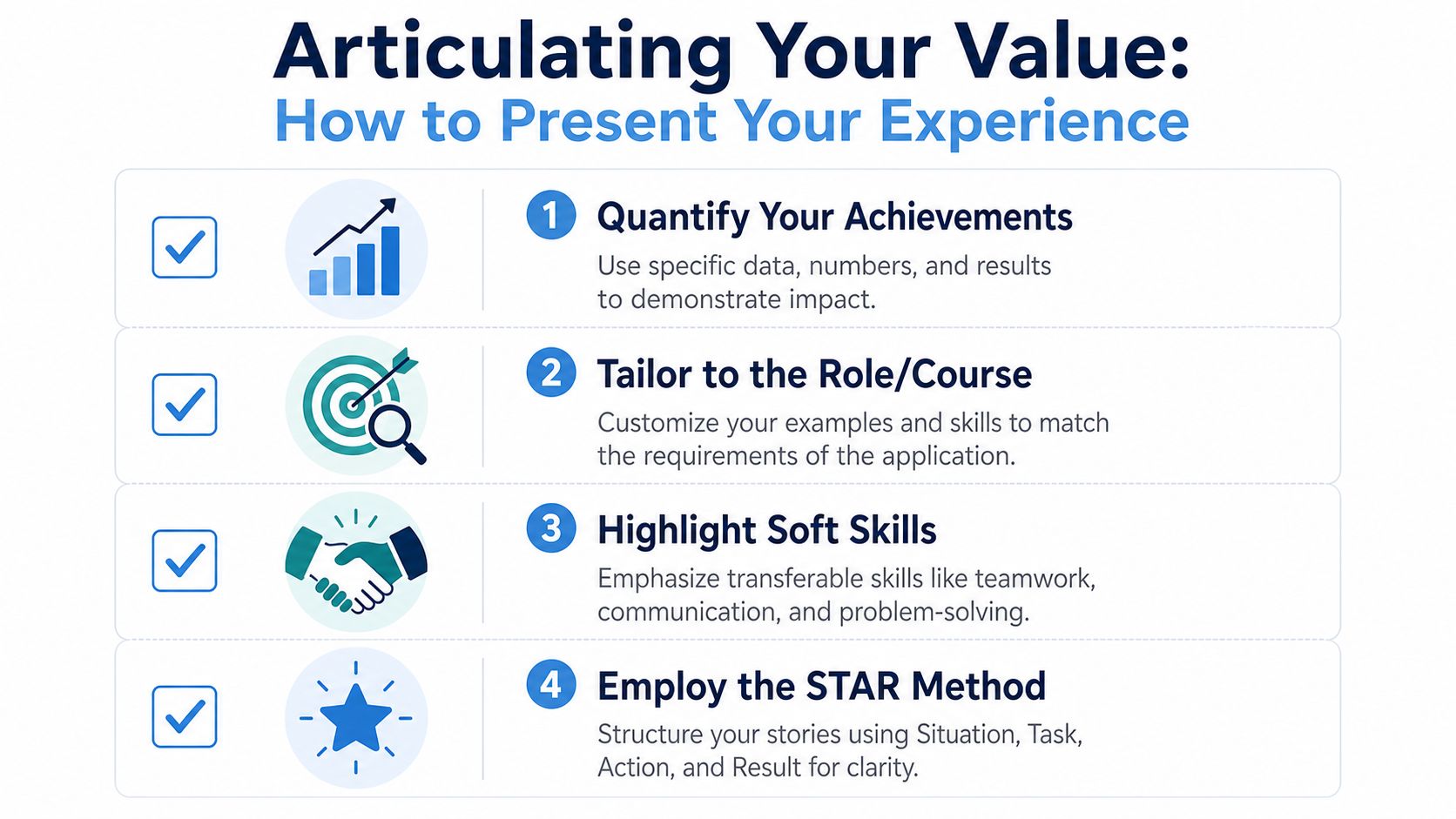
Articulating Your Value How to Present Your Experience
Experience helps most when you can explain it well. Many adult learners undersell themselves here. They list tasks, but they don't show what those tasks prove. Admissions teams and employers need help making the connection.
Move from duties to evidence
Compare these two versions:
- Before: Volunteered at a care home.
- After: Supported residents with daily activities and observed how clear communication and patience contribute to dignified care, which strengthened my commitment to a healthcare career.
Or:
- Before: Helped a small business with admin.
- After: Organised bookings, updated records, and communicated with customers, which improved my confidence with professional systems and confirmed my interest in business operations.
The second version works better because it shows action, skill, and relevance.
Use STAR to tell the story clearly
The STAR method gives you a simple structure for applications and interviews.
- Situation: Where were you?
- Task: What needed to be done?
- Action: What did you do?
- Result: What changed or what did you learn?
You don't always need a dramatic result. For adult learners, the result may be improved confidence, stronger communication, or clearer career direction. That still counts if you express it well.
Where to place experience in your application
A strong personal statement or CV usually uses experience in three ways:
-
To prove commitment
Show that you've explored the field in a practical setting. -
To demonstrate transferable skills
Connect past or current responsibilities to your intended course or role. -
To explain growth
Show how the experience helped you mature, clarify your aims, or prepare for the demands ahead.
There's also a strong real-world argument for doing this well. According to UK Government research on the benefits of work experience, young people who took part in a government-backed placement were 16% more likely to be off benefits 21 weeks later than comparable non-participants. That makes work experience more than a nice extra. It's evidence of movement towards employment that you can reference in your own narrative as a practical step towards your goal.
A good application doesn't say “I'm hardworking” and stop there. It shows where that quality appeared, what you did, and why it matters now.
If you freeze when trying to organise your thoughts, borrow a technique from public speaking. These tips for creating engaging presentations are useful because they teach you how to choose clear examples, structure ideas, and keep your message focused. The same skills help with personal statements and interviews. For more direct support with university applications, this guide on how to write a personal statement can help you turn experience into stronger written evidence.
Your Action Plan for Career-Defining Experience
You finish an evening study session, look at the course page, and then the doubt starts. How am I supposed to get experience if nobody is handing me a placement? That question stops many adult learners before they start. The good news is that work experience does not need to begin with a formal programme. It can begin with one small, deliberate step that fits around your real life.
A useful plan has three parts. Pick a direction, choose a manageable format, and keep a simple record of what you learn. That sounds basic, but it works for the same reason a sat nav works. You only need your destination, your current position, and the next turn.
Pick the direction
Start narrow. Choose the course or role you want to move towards, then ask, what would let me see this work up close?
If you want nursing, that might mean volunteering in a care setting. If you want social work, it could mean supporting a community project. If you want teaching, it may be helping at a youth club, tutoring online, or assisting with after-school activities. You are not trying to collect impressive titles. You are trying to gather relevant evidence.
That matters if you do not have traditional qualifications. Experience helps admissions tutors and employers see your commitment in practice, not just in theory.
Choose a format that fits your life
Adult learners often assume experience only counts if it is formal, full days, and arranged by somebody else. In reality, the best option is often the one you can keep doing.
A two-hour weekly volunteer shift, a short remote project, shadowing someone you know, helping in a local setting, or taking on extra responsibility in your current job can all be useful. Online study gives you flexibility, and that flexibility can become your advantage. You can build experience in smaller blocks without putting the rest of your life on hold.
If self-finding a placement feels intimidating, make it smaller. Do not start by asking for a long placement. Start by asking for a conversation, a visit, or a chance to help once a week. One clear message to a local organisation is often more effective than waiting for confidence to appear first.
Practise explaining what it means
Experience only helps you later if you can explain it clearly.
After each shift, task, or project, write down three things. What did I do? What skill did I use? What did I learn about this field? This habit turns a blur of activity into evidence you can use in applications and interviews.
For example, “I volunteered at a community centre” is vague. “I supported adults with form filling, explained instructions clearly, and learned how patience and confidentiality matter in frontline support” gives a university tutor or employer something solid to work with.
As noted earlier in the article, research in this area shows that work experience is strongly linked with better employment outcomes. For an adult learner, the practical meaning is simple. Time spent gaining relevant experience is not time lost. It is part of how you build a believable route into university and a new career.
The strongest route does not have to look traditional. It has to make sense. If you study flexibly, gain experience in steady, realistic steps, and keep track of what that experience is teaching you, you create a profile that is credible, thoughtful, and grounded in real effort.
If you're ready to retrain, Access Courses Online offers flexible online Access to HE Diplomas designed for adults who need a realistic route into university. You can study around work and family life, build confidence at your own pace, and start creating the qualification and experience profile that supports a genuine career change.