

If two courses both say Business and Administration Level 2, are you really comparing the same qualification?
Not necessarily. The level tells you about the difficulty of the learning, but it doesn't tell you the course's size, assessment method, funding eligibility or destination. Before choosing, separate the qualification itself from the apprenticeship route and the job you eventually want.
What a Level 2 Business and Administration Course Covers
What would you learn on a Level 2 Business and Administration course? Usually, the focus is on practical skills for junior administrative work, such as handling documents, using digital systems and communicating with colleagues or customers. The level indicates the difficulty of the learning, broadly comparable to GCSE-level study. It does not mean training to manage a department.
Qualification levels work like steps on a staircase. At Level 2, you build on introductory learning and practise contributing to routine office work. Higher-level study generally involves more independence, judgement and responsibility. The qualification title alone, however, does not tell you which tasks or assessments a course includes.
The level isn't the whole qualification
Courses at the same regulated level can have different purposes. One may focus on business knowledge, another on demonstrating workplace competence, and a third may combine both. A certificate and an occupational diploma can therefore sit at Level 2 without covering the same units or asking for the same evidence.
For example, the government qualification register lists the Highfield Level 2 Diploma in Business Administration as an occupational qualification. It also identifies funding approval for learners aged 16–19 and local flexibilities through 31 July 2027. This approval does not guarantee that every applicant will receive funding, so check your own eligibility.
Before comparing course prices, look at:
- Exact title: A certificate and a diploma are different qualifications.
- Awarding organisation: Check who awards the qualification, not only who teaches the course.
- Qualification number: Use it to distinguish the regulated award from a provider's course title.
- Specification: Review the required and optional units, along with how your work will be assessed.

What that means in practice
Suppose a training centre needs someone to book appointments, update learner records and send joining instructions. A relevant course should help you complete those tasks accurately, understand why procedures matter and know when to ask a colleague for help. The qualification level sets the learning standard; its units and assessments show what you will practise.
Practical rule: Compare the qualification specification, not just the words on the enrolment page.
Searching for “business and administration level 2” is a useful first step, but it does not identify one particular course. Check the exact award and whether its content and assessment match the administrative work you want to learn.
Who a Level 2 Course Suits Best
Business administration is a substantial employment pathway, not a niche subject. In England, government apprenticeship statistics recorded 90,740 starts and 48,210 achievements in Business, Administration and Law during the 2022–23 academic year.
Those figures cover a broad apprenticeship subject area, not just this qualification. They shouldn't be read as a course pass rate, because starts and achievements can involve different learners.
When it's a sensible starting point
This route is particularly useful for:
- Returners to work: Rebuild confidence with office software, professional correspondence and organised routines after a career break.
- Career changers: Translate experience from retail, hospitality or care into evidence of customer communication, accurate records and teamwork.
- Younger vocational learners: Develop practical workplace habits rather than choosing a purely academic programme.
- Existing support staff: Gain formal recognition for administrative tasks you're already carrying out.
You don't need to regard your previous work as irrelevant. Handling a difficult customer, recording a booking accurately or organising a shift handover can give you useful examples to develop during assessment.
When another route fits better
If your immediate target is accountancy, finance or management, investigate the relevant specialist qualification. General administration can provide useful foundations, but it doesn't replace occupational training.
Similarly, if a university course requires a higher-level entry qualification, don't assume an introductory office course will satisfy admissions requirements.
Ask yourself:
- Job goal: Do I want an office-support role soon?
- Learning commitment: Can I make time to practise tasks, receive feedback and submit evidence?
If both answers are yes, the course deserves a closer look.
Typical Modules and the Skills You Build
Module names differ between awarding organisations. The useful comparison is what you'll practise and what you'll have to produce, rather than whether a provider uses a heading such as office procedures or administrative support.
Northern Ireland's Business and administration apprenticeship framework combines competence and underpinning knowledge with essential skills or recognised equivalents in communication and application of number, with assessment verified through the relevant awarding body. It lists diplomas from City & Guilds, Highfield, iCQ, Pearson BTEC and OCN NI.
Typical Level 2 business and administration module areas
These are common curriculum areas and illustrative evidence, not a promise that every award includes every task. The final column shows the skill connection; it doesn't mean each row carries a separate essential-skills qualification.
| Module area | What you practise | Evidence you produce | Essential skill linked |
|---|---|---|---|
| Workplace communication | Business emails, memos, short reports, telephone manners | Sample correspondence and a written report | English communication |
| Administrative systems and processes | Filing, record keeping, diary and meeting scheduling | Maintained record log and a scheduled calendar | Organisation of information |
| Digital office tools | Word processing, spreadsheets, presentations, email management | Finished document and spreadsheet | Digital skills |
| Numerical and financial tasks | Invoices, expense sheets, basic calculations, petty cash | Accurately processed figures with a checked total | Application of number |
| Customer service | Handling enquiries, complaints and bookings | Logged or role-played customer interactions | English communication |
| Teamwork and organisation | Prioritising tasks, meeting deadlines, supporting colleagues | Task planner or weekly work log | Problem solving |
| Business awareness | Organisational structure, roles, data protection and confidentiality | Short written responses or case notes | Application of knowledge |
Evidence matters more than software familiarity
Knowing where Excel's formula button sits isn't the same as producing an accurate expense sheet. You need to enter figures consistently, choose the right calculation, check the result and explain any discrepancy.
Similarly, a polished email isn't sufficient if you've attached the wrong document or disclosed confidential information. Good assessment connects the finished product with the decisions behind it.
For online study, ask whether tasks use simulations, your own workplace or another approved setting. If workplace evidence is necessary, establish how you'll obtain it before enrolling, especially if you aren't employed in administration.
Check the curriculum against your goal
Use this process when a provider sends its unit list:
- Match the units: Place each unit against the relevant table row.
- Flag missing practice: Look particularly for digital tools, numerical tasks and business awareness.
- Clarify essential skills: Ask how communication and number skills are assessed, or how existing equivalents are recognised.
- Request assessment guidance: Find out who authenticates your work and how feedback and resubmissions operate.
Keep suitable examples for future applications, with confidential information removed and permission where necessary. DashApply's guide to organizing technical and soft skills can help you distinguish software capabilities from communication and teamwork, then support each with evidence rather than a bare list of claims.
How Level 2 Compares With Access and Level 3 Courses
Which route fits your destination: a Level 2 qualification, an Access to Higher Education Diploma, or a Level 3 apprenticeship? The level label describes the demand of the learning, not the qualification type, job title or funding available. These routes serve different purposes, so compare their requirements and outcomes rather than judging them by title alone.
Compare the route, not just the title
| Feature | Level 2 business and administration | Access to HE Diploma | Level 3 Business Administrator apprenticeship |
|---|---|---|---|
| Level | Intermediate occupational study | Level 3 study preparing learners for higher education | More advanced occupational study |
| Main purpose | Build initial office and administrative skills | Prepare for university study | Demonstrate occupational competence in administration |
| Typical learner | New entrants, returners and career changers | Adults seeking a route towards a degree | Employees learning through administrative work |
| Typical length | Varies by award and provider | Varies by full-time or part-time study | 18 months |
| Maximum funding | Depends on qualification approval and personal eligibility | Depends on the course and learner's eligibility | £5,000 |
| Assessment | Practical tasks and knowledge, as specified | Assignments and assessment set by the diploma | Workplace learning followed by end-point assessment |
A standalone Level 2 qualification and an Access diploma do not have one universal duration or funding amount. Ask the provider about the specific award or course, and check current funding rules. A published example should not be treated as a national standard.
Skills England's apprenticeship listings give the Level 3 Business Administrator apprenticeship an expected duration of 18 months and maximum funding of £5,000. The separate Level 2 Administration Assistant apprenticeship is scheduled for approval from 1 August 2026, with a 12-month duration and maximum funding of £4,000. Scheduled approval does not mean a provider has a place available, and maximum funding is not a cash payment to the learner.
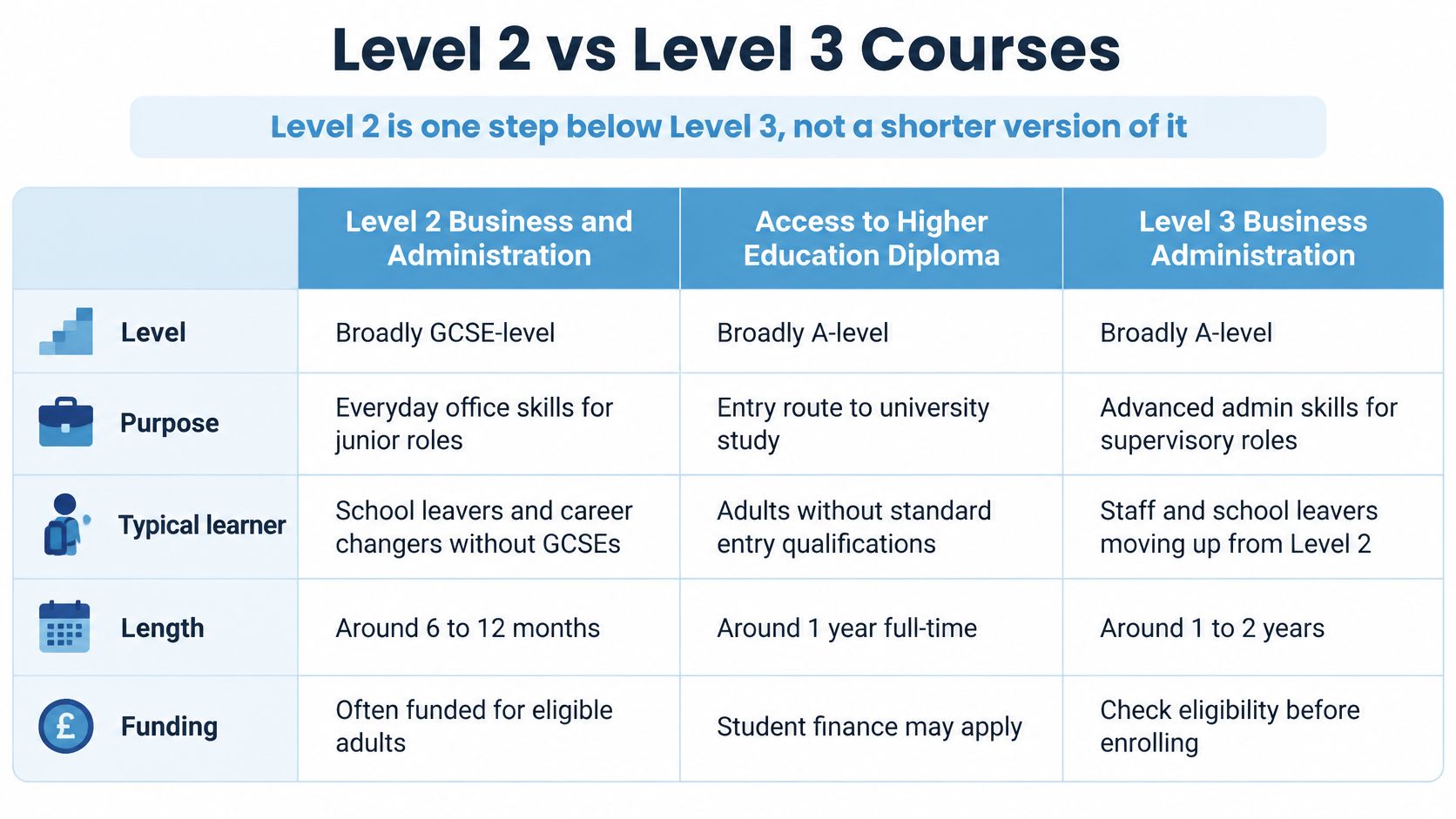
The chart gives a broad comparison. Use its indicative timings and funding descriptions to frame questions for a provider, then confirm the terms for the programme you are considering.
Choose according to your destination
For a first office job, a practical Level 2 qualification may suit your starting point. If your aim is university, explore an Access to Higher Education business route and check the subject and entry requirements of your intended university.
An apprenticeship combines learning with employment. If you already work in administration or are applying for an apprenticeship vacancy, check that the duties provide enough responsibility to demonstrate the occupational standard. Having a job alone may not provide the right evidence for assessment.
A qualification level describes the learning demand. It does not automatically give you a particular job title or supervisory authority. Employers set requirements for individual vacancies, so read the duties and person specification before deciding which route fits.
Where Level 2 Can Take You Next
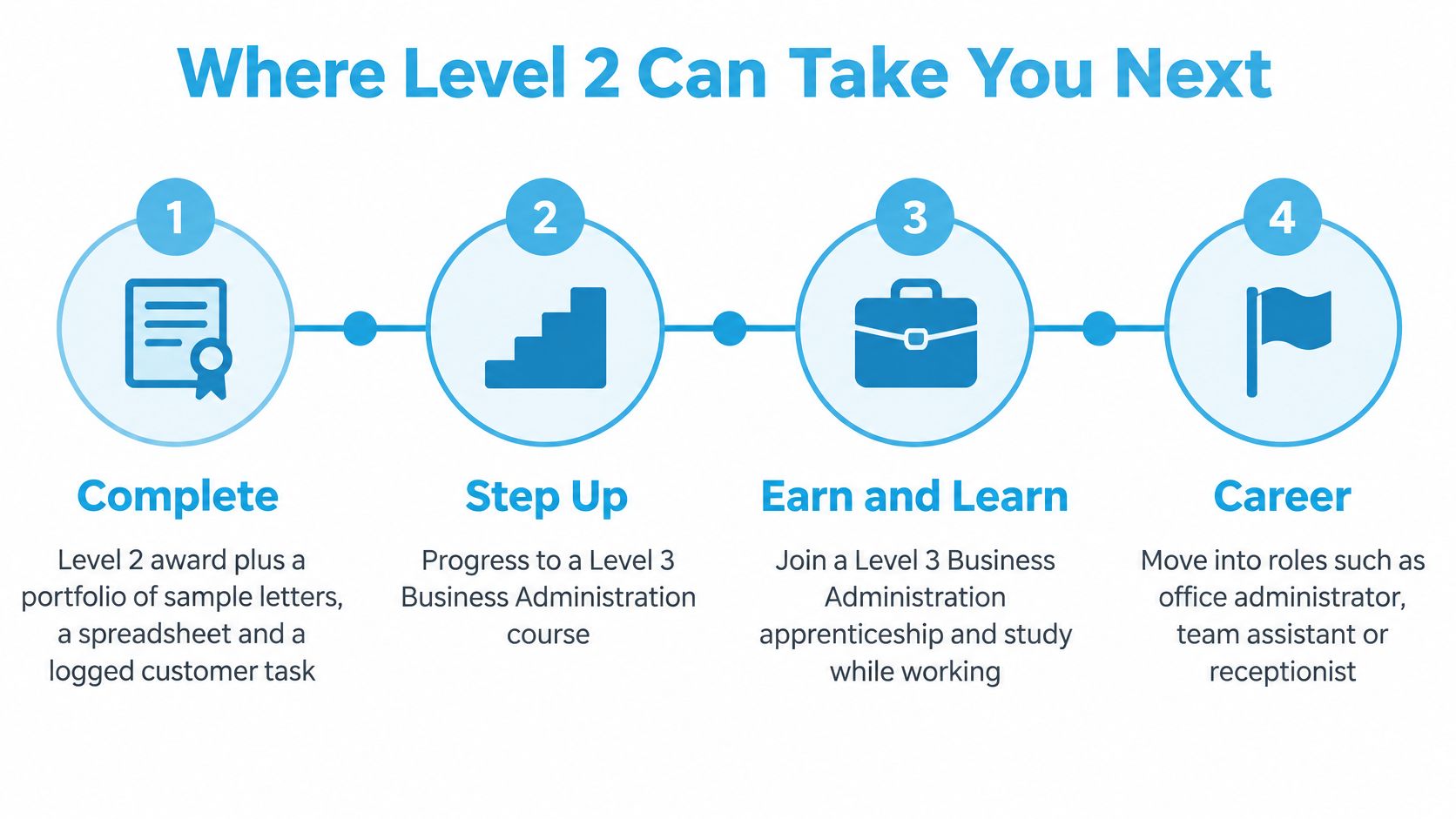
Progression is better understood as a sequence of decisions than a fixed calendar. You may enter employment first, continue studying first, or combine both when a suitable opportunity becomes available.
The progression graphic illustrates possible connections, rather than a compulsory order.
From completion to your first role
Complete with usable evidence. Keep an organised portfolio containing permitted examples such as sample letters, a spreadsheet and a logged customer task. Be ready to explain what you checked, what you corrected and how you followed instructions.
Apply for appropriate vacancies. Administration assistant, receptionist, customer-service administrator and junior office support are sensible search terms. Compare each vacancy with your evidence and identify gaps, such as using a booking system or managing incoming calls.
If location or caring responsibilities affect your search, Remote First Jobs lists remote jobs with direct company applications. Check experience requirements carefully: remote work can require more independent problem-solving, not less.
From experience to greater responsibility
Build experience or continue learning. Seek duties that develop judgement, such as resolving diary clashes or improving a record-checking process. When considering an NVQ Level 3 business administration route, check the current qualification title and evidence requirements rather than assuming every similarly named programme works alike.
Choose your longer-term destination. Senior administrative and supervisory work usually requires experience of taking responsibility, not just completing an introductory award. A degree route calls for a separate admissions check and, where appropriate, an Access diploma.
There's no reliable universal timetable for promotion. Ask prospective employers what experience, systems knowledge and qualifications they expect.
Use the accompanying video as an additional starting point for questions about study and work.
Funding Rules and Entry Requirements to Check
The decisive affordability question isn't whether a course is advertised as free. It's whether you qualify for funding for that exact qualification, through that provider and funding arrangement.
England's Adult Skills Fund rules for 2025–26 allow full funding for eligible 19- to 23-year-olds without a previous full Level 2 when the qualification appears on the legal-entitlement list, and include five GCSEs at grade 4 or above among the benchmarks for a full Level 2. These are year-specific rules for England, not a blanket UK entitlement.
Funding position by learner situation
| Your situation | Likely funding position | What to check first |
|---|---|---|
| Within the entitlement age group, without a full qualification at this level | Full funding may be available for a listed qualification | Confirm the exact qualification's legal-entitlement approval |
| Within that age group, already meeting the GCSE benchmark | The first-full-qualification entitlement won't normally apply | Have the provider assess your results certificates |
| School-age learner entering post-school study | Check study-programme funding rather than adult entitlement | Confirm the qualification's relevant funding approval |
| Older adult outside the entitlement age group | Other funding may be available under applicable arrangements | Ask which local funding rules apply to your circumstances |
| Employed learner | Employment alone doesn't establish eligibility | Establish whether you're applying for an apprenticeship or a standalone award |
| Holds an equivalent non-GCSE qualification | Prior attainment needs checking before entitlement is confirmed | Request a written equivalence assessment |
A regulated qualification has recognised status. An approved-for-funding qualification also meets the requirements of a particular funding scheme; those aren't interchangeable descriptions.
Get an individual funding decision
Residency, previous attainment, employment status and local arrangements can affect the answer. If you hold an overseas qualification or an older vocational award, don't decide for yourself that it does or doesn't count.
Providers also calculate funding through guided learning hours and subject-sector-area bands, rather than applying a universal payment to every course. Ask what you'll personally have to pay, including any registration, assessment or resubmission charges.
Before paying: Request written confirmation of both your eligibility and any costs that remain your responsibility.
Prepare your previous results certificates, proof of age and address, employment details and records of earlier funded learning. Ask the provider which additional residency documents it needs.
A general guide to funding for courses can help you prepare questions, but the provider must assess your actual circumstances. Funding rules change between academic years, so ask which current rules support its decision.
Confirm the Right Course Before You Enrol
Entry requirements aren't identical across providers. An introductory award may accept learners without traditional qualifications, but the provider can still check English, maths, digital confidence and whether you can access the required assessment setting.
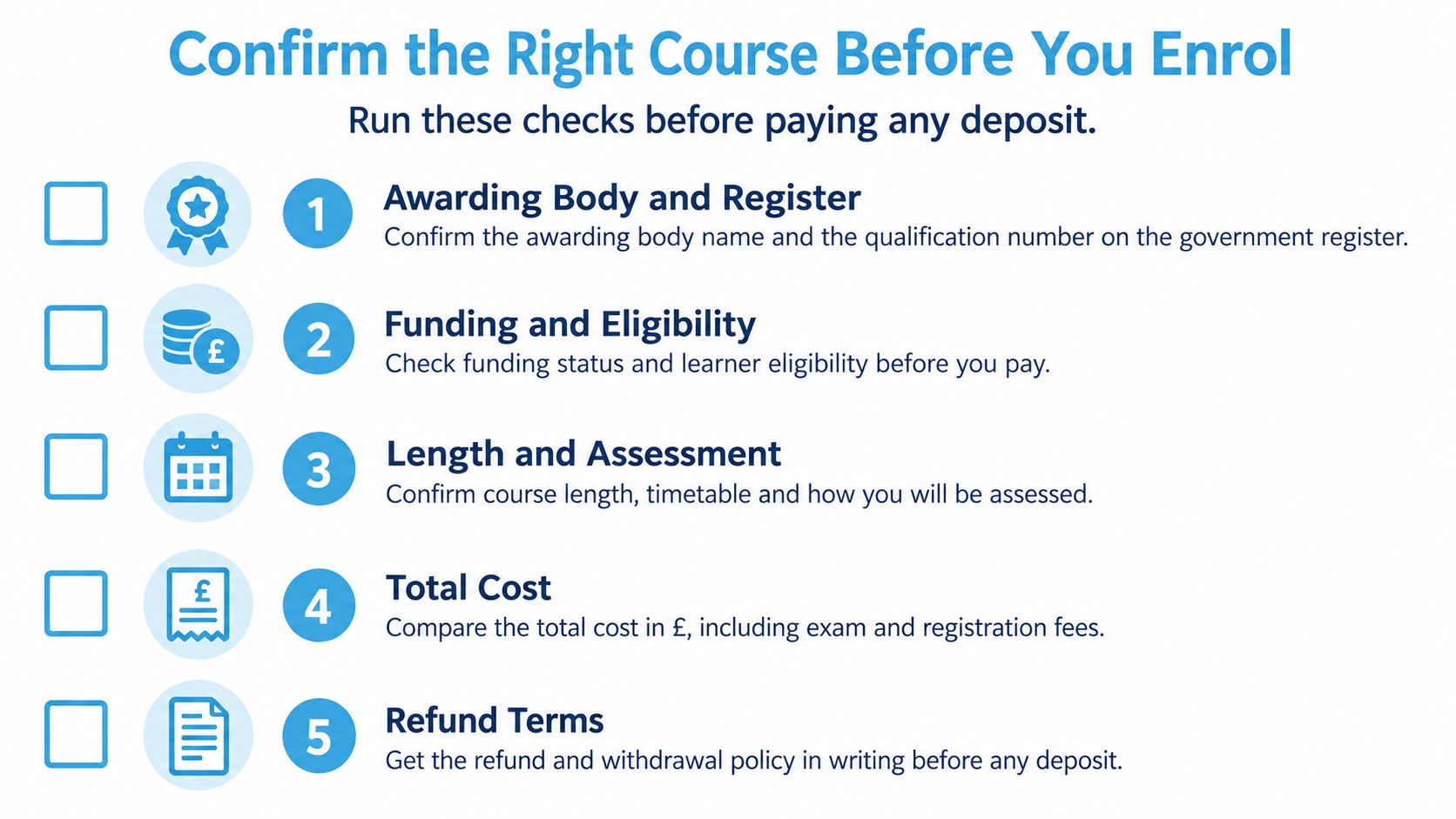
Use this checklist before paying a deposit.
Get the important details in writing
- Identity and approval: Obtain the awarding organisation, registered qualification number and specification.
- Eligibility and costs: Confirm funding, remaining fees and withdrawal or refund terms.
- Assessment arrangements: Check for observable tasks, how evidence is authenticated and whether workplace access is necessary.
- English and maths: Establish whether essential skills are included, separately assessed or recognised through equivalents.
- Study arrangements: Request the delivery mode, expected weekly commitment, start arrangements and tutor-support process.
Be cautious about guaranteed-employment promises. Although it concerns a different training market, Blockchain Jobs' guide to spot bootcamp guarantee red flags offers useful questions about conditions attached to job guarantees.
A provider should explain what happens if you need help, miss an assessment or discover the course isn't suitable. Clear answers are more useful than a persuasive enrolment call.
Your next action is straightforward: shortlist providers, request their qualification details and specifications in writing, and book a taster or funding conversation before committing.
Access Courses Online offers an online Access to Higher Education Diploma in Business and Management for adults preparing for university study. If your aim extends beyond entry-level administration towards a business-related degree, visit Access Courses Online to discuss the course, entry requirements and how it fits your intended university pathway.