
You might be reading this after another long day at work, with a browser full of tabs and a quiet thought you haven't said out loud to many people yet. You want a different future. Maybe nursing. Maybe midwifery. Maybe computing, business, or a degree you once assumed had passed you by.
The problem usually isn't motivation. It's logistics. You may be juggling shifts, children, bills, school memories that still sting, or the worry that universities only welcome people who took the standard route. That's why a good distance learning centre review matters. You're not just comparing websites. You're deciding whether a provider can help you rebuild confidence, gain a recognised qualification, and move towards university without turning your whole life upside down.
Distance learning has become far more mainstream in the UK. The number of students in online and distance education at UK universities grew by 8% from 2022 to 2023, reaching 576,705 students, according to analysis of the latest Department for Education TNE data shared by Neil Mosley's review of the 2022 to 2023 UK online and distance learning figures. That matters because it tells you this route isn't fringe or experimental. It's established, expanding, and supported by universities.
Your Guide to Choosing a Path to University
A lot of adults start in the same place. They know they want change, but they don't know what the first practical step looks like.
Maybe you've looked at university entry requirements and felt your stomach drop because you don't have traditional A Levels. Maybe you left education years ago and can't imagine fitting study around your current life. Those feelings are common. They also don't mean you're out of options.

Why distance learning appeals to adults
Distance learning works because it meets people where they are. You study from home, build routines around work and family, and move forward without needing to relocate your life to a campus timetable. For many adults, that's the difference between education feeling impossible and education feeling doable.
If you're new to the idea of Access to HE study, this guide to what an Access course is gives a useful introduction to how these diplomas help adults qualify for university entry.
A distance learning centre review should never focus only on course titles or a polished homepage. It should ask a more personal question. Will this provider support someone who's rusty, busy, and serious about changing direction?
Returning to education isn't only an academic decision. It's often a life decision, tied to identity, confidence, and the hope that the next decade can look different from the last one.
What makes this choice feel hard
Adult learners often worry about four things at once:
- Being "too late" to start again
- Not being academic enough for university-level work
- Choosing the wrong provider and wasting time or money
- Studying alone without enough support
Those fears are reasonable. They also make it even more important to look beyond marketing claims. A strong provider should make the route clear, explain the support accurately, and help you understand what studying will really feel like week to week.
That practical clarity is what turns a hopeful idea into a real plan.
The Hallmarks of a Great Distance Learning Centre
Before you trust any provider, use a checklist. A proper distance learning centre review should look for evidence, not buzzwords.
Recognition and quality safeguards
Start with legitimacy. A provider should be transparent about the framework it operates within and how its courses connect to recognised progression routes. The UKPRN system matters here because it sits within a broader quality assurance environment. The ICDE Quality Network report notes that the UK Government's Register of Learning Providers framework mandates quality assurance and stakeholder satisfaction measurement, which is one reason many adult learners check whether a provider is listed before they enrol. You can see that context in the ICDE Quality Network report.
You don't need to become a compliance expert. You just need to know whether the provider is open about recognition, standards, and progression.
Tutor support that feels human
The value of many reviews becomes evident. A polished portal means very little if students can't get help when they're stuck.
One useful benchmark comes from another UK provider. Distance Learning Centre reports that 94% of its students rated their studies as "very good" or "excellent", linking that outcome to 1:1 expert tutor support and a student community in its Trustpilot reviews for Distance Learning Centre. You shouldn't treat one provider's feedback as proof about the whole sector, but it does show a pattern: personalised guidance matters.
Practical rule: If a provider is vague about tutor access, response expectations, or how feedback works, treat that as a warning sign.
Flexibility that works in real life
Flexibility isn't just "study anytime". It means the structure suits adults with complicated schedules.
Look for signs such as:
- Start dates that aren't overly restrictive so you don't have to wait around for a single annual intake
- Materials designed for self-paced study rather than content that assumes you're free every weekday
- Payment options explained clearly so affordability doesn't become a nasty surprise
- Support channels that match adult life such as email, phone, or messaging rather than one narrow contact route
For ideas on what good online study habits look like from a teaching perspective, the Whisper AI blog for educators on online learning best practices is a thoughtful resource.
You can also compare how specialist providers present their learner support by reading the Access Courses Online distance learning centre page.
Clear progression, not vague promises
The final hallmark is directness. A good provider should help you understand what the qualification is for, which degree routes it supports, and what extra requirements might still apply. If a course is meant to help adults progress to university, the provider should say so plainly and explain the likely path.
That's what separates a life-changing route from a confusing one.
A Deep Dive into Access Courses Online
When adults compare providers, they often want reassurance on three points first. Is it legitimate? Does it offer the right subject areas? Can I afford it without wrecking my monthly budget?
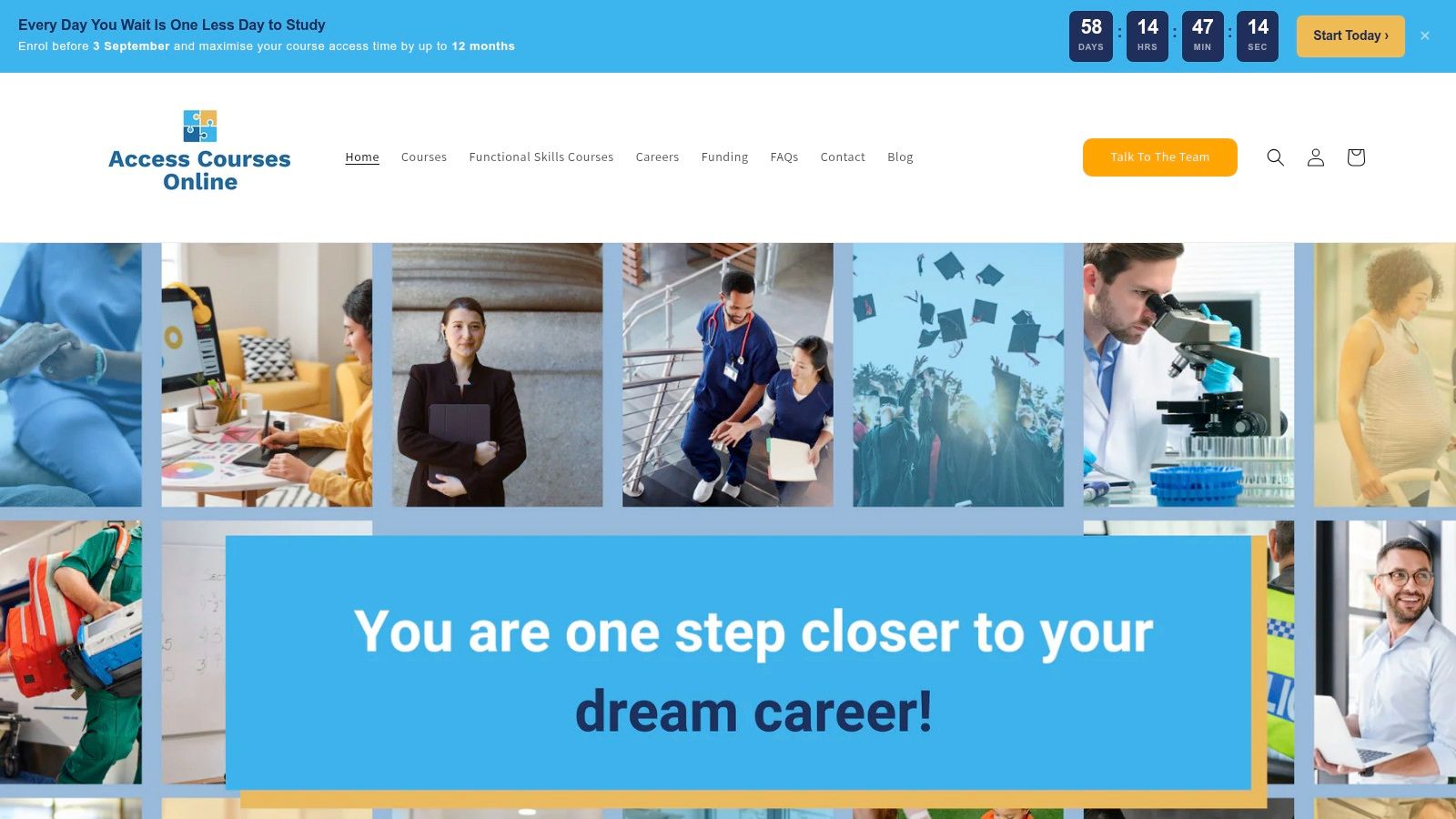
Access Courses Online is a specialist provider focused on online Access to Higher Education study for adults aiming to progress into degree-level routes such as healthcare, science, computing, social science, business, and related fields.
Legitimacy and provider status
One of the clearest practical checks is whether a provider is registered and open about its standing. Access Courses Online operates under UKPRN 10033485, which places it within the UK Government's Register of Learning Providers framework. That matters because, as noted earlier in the sector guidance, this framework is tied to quality assurance and stakeholder satisfaction expectations rather than a free-for-all model.
For an adult learner, that doesn't guarantee a perfect experience, but it does mean you're looking at a provider that isn't hiding from formal accountability.
Subject range and who it's for
The course range is aimed at adults who need a university entry route without going back to a physical college full time. That includes people targeting degrees in areas such as nursing, midwifery, health professions, computer science, science, social science, business and management, and music technology.
This matters more than it first appears. A specialist provider tends to speak directly to the concerns adult learners have, such as missing qualifications, confidence after a long break, and fitting study around other commitments. Generic online learning platforms often offer lots of content but very little guidance on how a course leads to university.
Affordability and payment structure
Cost is often the point where enthusiasm meets reality. According to Ward Training's summary of UK online education growth, online courses in the UK can range from £2,500 to £11,000 annually, with online study often being more affordable than in-person options because learners don't carry accommodation and travel costs.
Against that background, interest-free payment plans matter because they change whether study feels possible this month, not just in theory. Access Courses Online highlights staged payment options, which is often exactly what adult learners need when they are balancing study with rent, childcare, or household costs.
Here is a short overview of what many adults look for when analysing this provider:
| Area | What to check with Access Courses Online | Why it matters |
|---|---|---|
| Recognition | UKPRN listing and transparent provider details | Helps confirm legitimacy |
| Course fit | Subject-specific Access to HE routes | Keeps study aligned with your degree goal |
| Study model | Fully online and flexible pacing | Suits work and family life |
| Payment | Interest-free monthly plans | Makes budgeting more realistic |
| Guidance | Advice before and during enrolment | Reduces confusion early on |
Later in your research, it's worth hearing how online Access study is explained in the provider's own words:
Where this provider seems strongest
The strongest aspect of Access Courses Online is that it appears built around a very specific learner. Not a school leaver with a clear sixth-form route, but an adult who needs flexibility, guidance, and a direct bridge to higher education.
That focus is important. In a distance learning centre review, specialist intent usually matters more than flashy branding. Adults returning to education don't need endless options. They need the right route, clearly explained, with support that feels reachable.
The Learning Experience and Tutor Support
This is the part many people worry about most. Not the qualification itself, but the day-to-day experience of doing it.
Online learning can feel liberating when it's organised well. It can also feel lonely when it isn't. That's why tutor support, marking clarity, and communication standards matter so much.
Why communication shapes the whole experience
Adult learners rarely complain because study is challenging. They usually complain when they're left in the dark.
One widely discussed issue in provider feedback is communication quality. In discussions about online Access courses, 30% of negative feedback cited slow marking and unresponsive staff, according to the Mature Students UK discussion on online Access course experiences. That doesn't mean every provider has the same problem. It does mean you should ask direct questions before you enrol.
Ask things like:
- How do I contact my tutor?
- What kind of feedback should I expect on assignments?
- Is there guidance if I fall behind?
- Are marking times explained clearly anywhere in writing?
Fast replies feel reassuring, but useful replies matter more. Good feedback should help you improve, not just move you through the next task.
What support should feel like in practice
A quality provider should make online study feel connected. That doesn't mean you need constant live sessions. It means you should know who is teaching you, how to ask for help, and what happens when you get stuck.
Access-related study often attracts adults returning after years away from formal education, so the emotional side matters too. Students need tutors who explain expectations plainly, correct work constructively, and don't assume prior confidence.
For a helpful look at how healthcare tutors talk about supporting adults back into education, this piece on healthcare tutors and how Access courses shaped their own careers gives a good sense of what supportive teaching can look like.
Staying steady when life gets noisy
Most adult learners don't need motivation speeches. They need routines that survive real life.
If concentration is one of your worries, this science-backed focus techniques guide offers practical study strategies you can use around work and family commitments.
The best providers understand this. They don't assume your week is calm. They build systems that help you keep going when your schedule isn't.
Progression Routes and Real Student Outcomes
A course only matters if it leads somewhere meaningful. For most adults considering this route, the core question is simple. Will this help me get into university and move towards the job I want?
That answer depends on choosing a provider and subject route that line up with your degree goal. Access to HE study is often strongest when it's purposeful. A future nurse chooses a healthcare route. A future software student chooses computing. A future manager or entrepreneur chooses business.
What progression really looks like
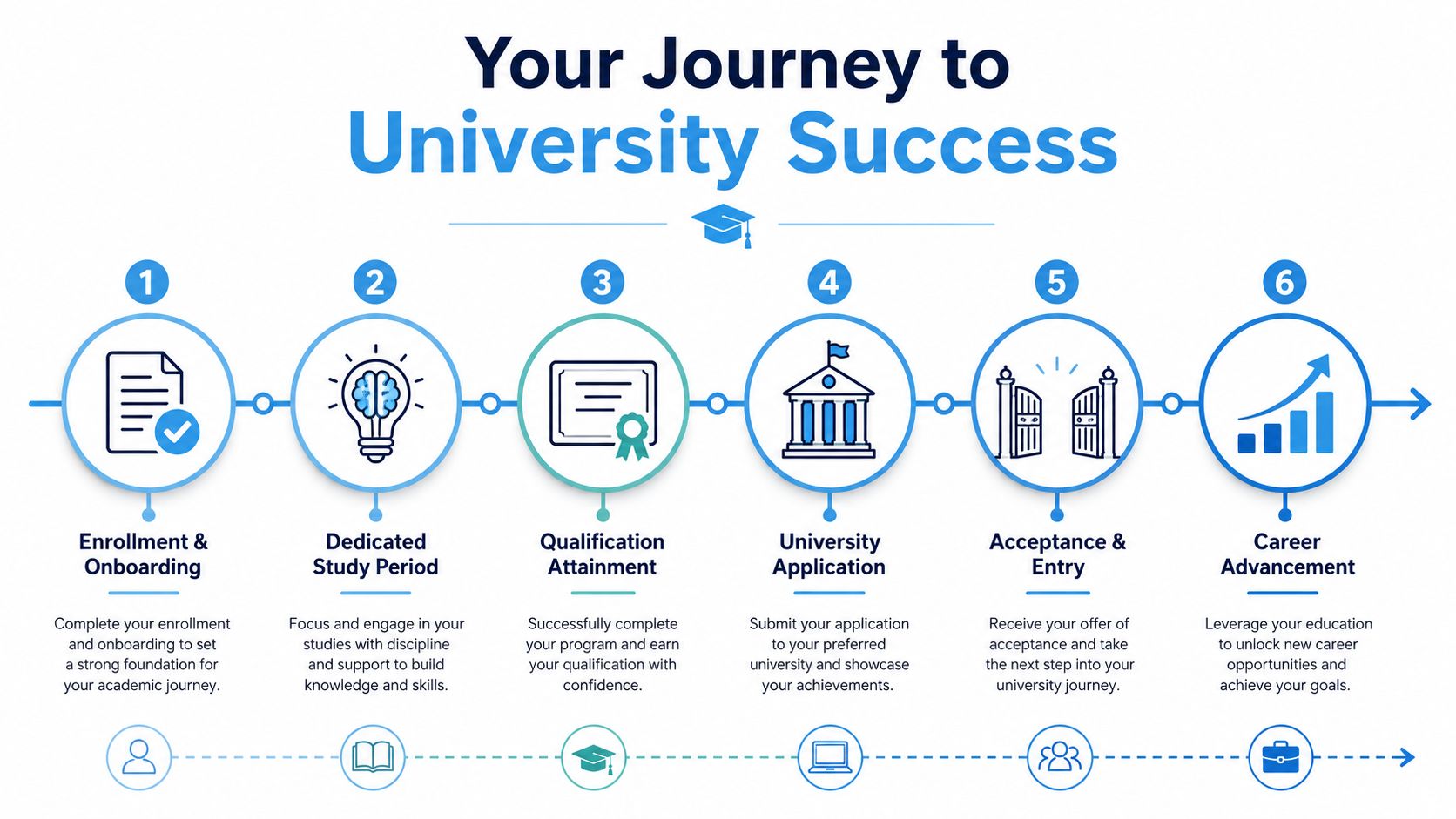
For adult learners, progression is rarely one dramatic leap. It's usually a chain of smaller wins:
- Enrolling despite doubts
- Learning how to study again
- Completing assignments consistently
- Applying to university with evidence of current ability
- Starting a degree with more confidence than you expected
That journey matters because many adults are not only gaining qualifications. They're rewriting an old story about themselves.
The outcomes that matter most
The most useful outcomes aren't always flashy. They're practical.
- A parent gains a route into nursing study
- A worker in an office role retrains towards computing
- Someone who struggled at school proves they can thrive with better structure and support
- A learner builds enough confidence to apply for university for the first time
A good result isn't only passing a course. It's becoming the kind of person who can picture themselves at university and believe they belong there.
The strongest providers understand that adult learners need both academic preparation and psychological reassurance. That's why progression guidance matters so much. You want a provider that treats university entry as an intended destination, not an optional extra.
When reading any distance learning centre review, look for signs that former students didn't just enjoy the platform. Look for signs that they moved on, applied confidently, and used the course as a real bridge to higher education.
How Access Courses Online Compares to Alternatives
You might be sitting at your kitchen table after work, looking at three tabs on your laptop. One is an online Access course. One is a local college offering A Levels. One is a general online learning platform with low-cost courses in almost every subject.
All three involve study. Only one may fit the life you have now.
That is the comparison that matters for adult learners. A good provider is not merely selling lessons. It is giving you a realistic route from your current responsibilities to a university place, with support that fits around work, children, finances, and the nerves that often come with returning to education.
Education pathways for university entry compared
| Feature | Access to HE Diploma (Online) | Traditional A-Levels (College) | General Online Courses (MOOCs) |
|---|---|---|---|
| Main purpose | Direct route for adults preparing for higher education | Standard academic route often associated with younger students | Skill-building or interest-based study |
| Flexibility | Usually built around online independent study with set guidance and deadlines | Timetabled attendance with less room for changing schedules | Highly flexible |
| Suitability for career changers | Strong, especially when linked to a target degree | Can work, but may feel slower or less suited to adult returners | Often weak for formal university entry |
| Tutor support | Usually focused on adult learners who need academic re-entry support | Varies by college, class size, and timetable | Often limited or less personal |
| Progression clarity | Usually centred on getting learners ready for higher education | Recognised route, but not built specifically for adult retraining | Often unclear for degree admissions |
| Learning style | Structured independent study with support | Classroom-based | Mostly standalone content |
A Levels still suit some learners well. If you prefer face-to-face teaching, want a more familiar classroom rhythm, and can attend on a fixed timetable, they may be a good match.
MOOCs also have a place. They work well as a low-pressure way to explore psychology, health, business, or computing before committing to a formal qualification. They are less useful if your main question is, "Will this help me qualify for university entry?"
That is where Access Courses Online becomes a helpful case study. Its value is not only that it delivers course materials online. The stronger point is that the whole setup is closer to the problem adult learners are trying to solve. You need a recognised route, clear expectations, and support that understands you may be rebuilding study habits after years away from education.
A useful comparison is this. A MOOC is often like reading around a subject. An A Level can be like returning to a school-style structure. An online Access course is usually much closer to a bridge built for adults who already know where they want to go next.
That does not make it the right choice for everyone.
It does mean you should judge alternatives by fit, not by reputation alone. A provider can look polished and still be wrong for your circumstances. If your goal is a degree in nursing, midwifery, social work, law, or another profession with clear entry expectations, the better option is often the one that gives you a direct, well-supported route rather than one focused on study in a broad sense.
So when you compare Access Courses Online with alternatives, ask a practical question. Which route is most likely to carry you from "I hope I can do this" to "I have a credible plan for university"? For many adult learners, that is the standard that matters most.
Frequently Asked Questions
Are online Access to HE diplomas respected by universities
They can be, provided the qualification and progression route are recognised and appropriate for the degree you want to study. Always check the specific university and course entry requirements, because admissions teams decide based on their own criteria. A reputable provider should help you understand that before you enrol.
Can I study if I don't feel confident academically
Yes. Many adults begin with low confidence, especially if school didn't go well. The important question isn't whether you feel academic right now. It's whether the provider offers structure, feedback, and guidance that help you rebuild those skills.
How much study time should I really expect
This is one of the biggest areas of confusion. In one learner discussion source, some people assumed 10 days per 3-credit unit, but around 35% reported needing 15 to 20 days, which shows why realistic planning matters. You can see that discussion in the Paramedicwanabees Facebook post about study time expectations.
That doesn't give you a perfect timetable, but it does give you a useful warning. If you're returning to education, build in more time than you think you'll need at first.
What should I ask before enrolling
Use these questions:
- Is this course suitable for the degree I want?
- What support do tutors provide when I'm stuck?
- How is feedback given, and how clearly are marking expectations explained?
- What extra requirements might universities still ask for?
- What does a realistic weekly routine look like for someone with my commitments?
What's the next sensible step
Shortlist one or two providers and speak to them directly. Ask specific questions, not just "Is this course good?" The quality of their answers often tells you as much as the website does.
If you're ready to turn "maybe one day" into a clear plan, Access Courses Online is worth exploring. You can look at course options, ask practical questions about university progression, and find out whether an online Access route fits your goals, budget, and current life.