

You're probably here because English is the one box still left unticked.
Maybe you need it for university. Maybe an employer, apprenticeship provider, or training course has asked for Level 2. Maybe you've put this off for years because life got busy, school wasn't a great experience, or the idea of sitting an exam again makes your stomach tighten.
That's more common than many admit. Adults often come back to learning while working, parenting, caring for someone, or trying to change direction completely. The good news is that Functional Skills English Level 2 online is built for practical use, and online study can work well when you understand what you're signing up for.
What Functional Skills English Level 2 Online Really Means
You enrol online after work, open your laptop expecting one straightforward English test, and then discover there are separate parts for reading, writing, and speaking and listening. That moment catches many adults off guard. Once you understand how the qualification is built, the whole process feels far more manageable.

Functional Skills English at Level 2 in England is a regulated qualification designed around practical communication for work, study, and everyday life. It is not about writing academic essays for the sake of sounding formal. The government subject content sets out that learners must show reading, writing, speaking, listening, and communication skills in realistic contexts, with reformed content published in February 2018 and updated guidance applying to learners registered on or after 1 September 2019 in the official subject content guidance.
That distinction matters.
Many adults worry they are stepping back into the kind of school English that focused on literary analysis, obscure terminology, or trying to guess what the teacher wanted. Functional Skills works more like a toolbox. You are asked to read information carefully, pick out meaning, compare viewpoints, write for a clear purpose, and communicate in ways that make sense in everyday work and study situations.
If you want the wider context first, this guide on what Functional Skills qualifications are gives a useful overview before you get into the detail of Level 2 English online.
Online means three assessed parts, not one
This is the point many learners need spelling out clearly. Functional Skills English Level 2 online usually involves three separate components:
- Reading, where you read texts on screen and answer questions that test understanding, comparison, and interpretation
- Writing, where you produce your own written responses for a purpose, audience, and format
- Speaking, Listening and Communicating, where you take part in a discussion, presentation, or structured task set by the provider or awarding organisation
A simple way to picture it is this. Reading checks how well you take information in. Writing checks how clearly you put information out. Speaking and listening checks how you handle communication with other people. They are linked, but they are not the same skill, so they are assessed separately.
What “online” usually looks like in practice
Online delivery often works better for adults than paper because the preparation matches the assessment more closely. You study on a screen, practise on a screen, and for reading and writing, you will usually be assessed on a screen too. That reduces the jump between revision and exam day.
It also gives you practical advantages:
- Flexible study times, so revision can fit around shifts, childcare, and other responsibilities
- Repeatable practice, which helps if you need to revisit punctuation, tone, or reading techniques more than once
- Typed writing practice, which suits many adults better than handwritten exam answers
- Clearer preparation for each component, especially when providers explain that speaking and listening is a separate assessed part
For many learners, this feels more natural than travelling to a classroom every week with a folder of paper worksheets. You can pause, rewatch, redo, and build confidence at your own pace.
Why adults choose Level 2
Level 2 is often the standard needed for progression into further study, apprenticeships, and many job routes. Adults also choose it because it proves something practical. You can read information accurately, write clearly for a purpose, and take part in professional communication with a reasonable level of confidence.
A helpful mindset shift is to treat the qualification as evidence of usable English, not perfect English.
If you are returning to learning after years away, that matters more than it may seem. Plenty of capable adults can do the job itself but feel rusty with test conditions, formal writing, or speaking tasks. Understanding the three-part structure early helps you prepare properly for each one, and online study often makes that preparation easier because it mirrors how communication already happens in modern work and study.
How to Choose the Right Online Course and Provider
Some providers make everything sound simple. Enrol today. Study online. Sit the exam. Done.
What often gets missed is whether the provider explains the full assessment journey clearly, especially the separate speaking, listening and communicating part. If that's glossed over at the start, learners can feel caught out later.
Two common online study routes
Most adults end up choosing between two broad models.
| Course type | Usually suits | Watch out for |
|---|---|---|
| Self-paced online course | Confident independent learners who like working alone | Limited feedback, easy to drift, less accountability |
| Tutor-supported online course | Adults who want guidance, marking, and help with weak areas | Need to check response times, assessment support, and booking process |
Neither route is automatically right or wrong. A self-paced course can work brilliantly if you're organised and already reasonably confident with English. Tutor-supported study is often better if you haven't written formally in years, freeze in assessments, or want someone to tell you exactly what needs improving.
For learners exploring different study formats, this overview of Functional Skills English online gives a useful sense of how remote learning is typically set up.
What to check before you enrol
Use this checklist before paying for anything.
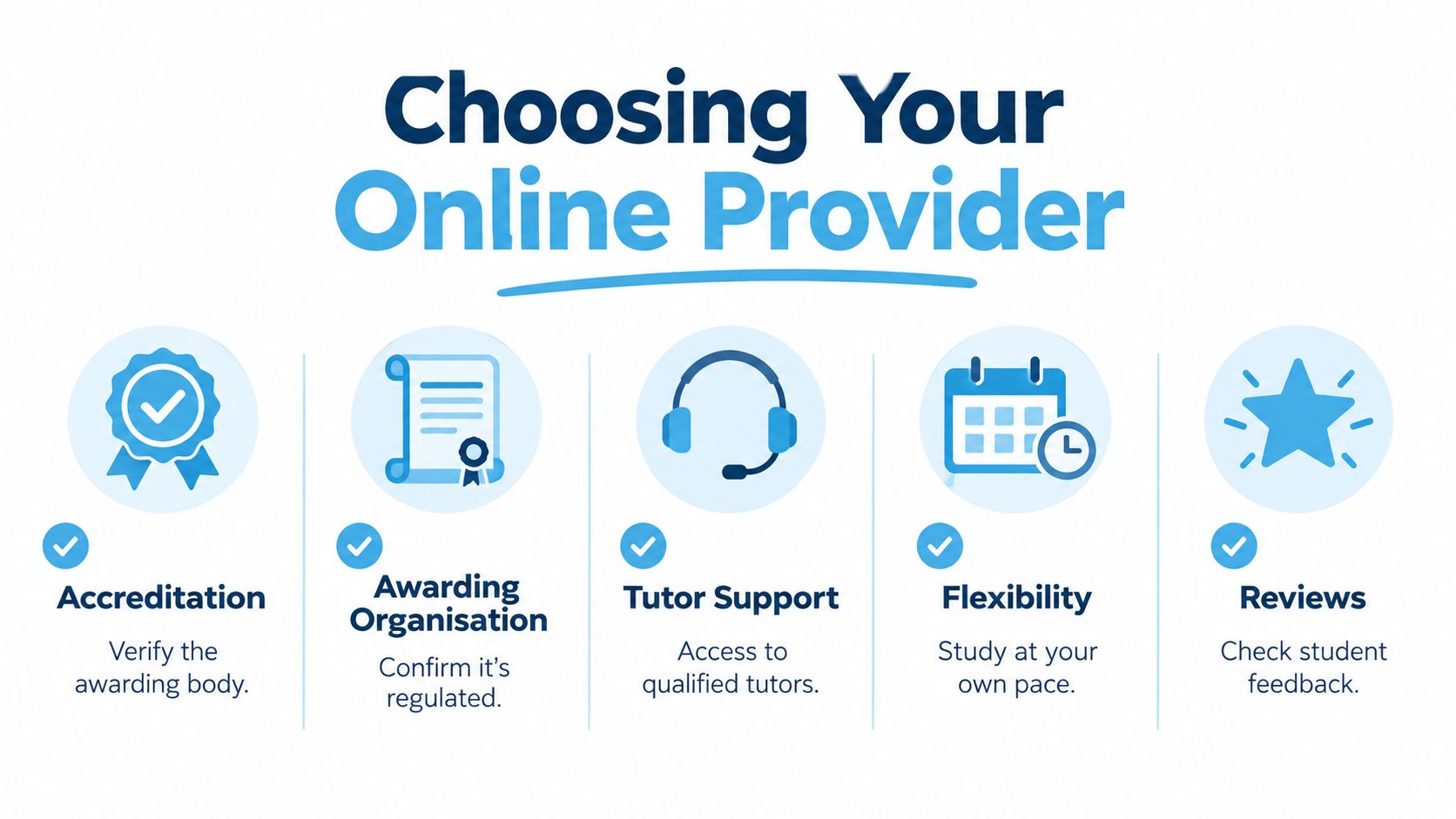
- Awarding organisation: Make sure the qualification is regulated and the provider is clear about which awarding organisation is involved.
- Assessment explanation: Check that the provider clearly mentions Reading, Writing, and Speaking, Listening and Communicating. If one of these is missing from the sales page, ask questions.
- Tutor access: Find out whether you can send work for marking, ask questions, and get feedback before the exam.
- Practice materials: Strong providers usually offer onscreen practice so you can get used to the format you'll use in assessment.
- Remote arrangements: Ask how online assessment works in practice, including booking, ID checks, and remote invigilation where relevant.
- Flexibility: Adults need realistic start dates and pacing. Look for study that fits around work and family rather than a rigid classroom timetable.
A quick provider comparison mindset
Don't choose on price alone. Choose on friction.
If a course is cheap but gives you no clear route to practise writing under timed conditions, no explanation of the speaking component, and no support when you get stuck, it can cost more in stress and delay.
One example in this space is Access Courses Online, which offers an NCFE Level 2 Functional Skills English course with fully online study at your own pace and dedicated tutor support. That kind of setup can suit adults who want flexibility without learning completely alone.
A good provider doesn't just sell “online”. They explain how online study connects to a regulated assessment process.
If you finish browsing and still feel confused, that's useful information. Clear providers make the route feel clearer, not murkier.
Your Flexible Study Plan That Fits Around Work and Family
Adults rarely fail because they're incapable. More often, they try to study in a way that doesn't match real life.
A workable plan is better than an ambitious one you abandon by week two. If you work full time, have children, or juggle changing shifts, short regular sessions usually beat long heroic bursts.
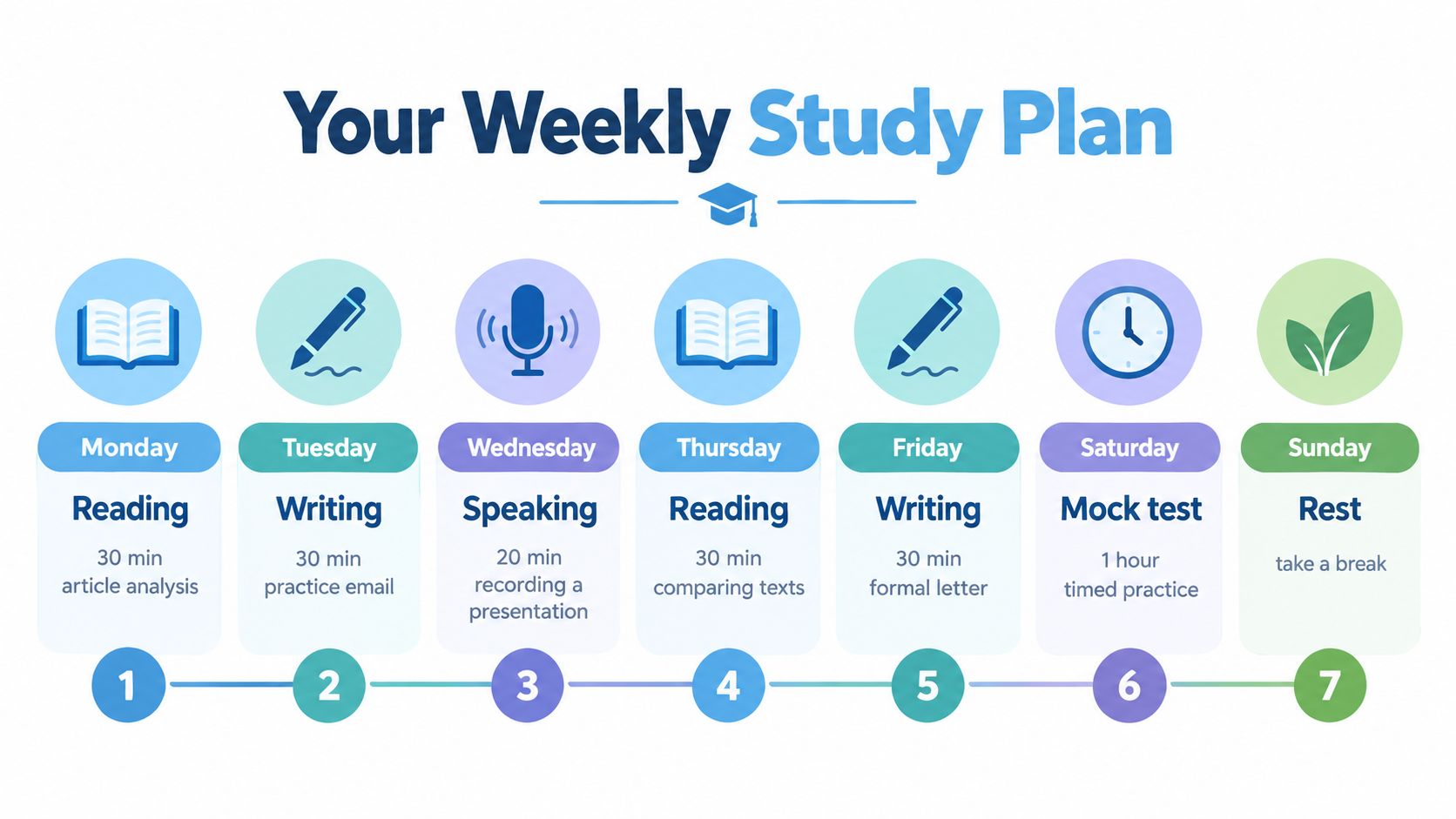
A realistic weekly rhythm
Try this pattern and adjust it to your life:
- Two short reading sessions: Use these to practise picking out key points, tone, purpose, and comparisons between texts.
- Two short writing sessions: Focus on one task at a time, such as an email, letter, article, or response.
- One speaking session: Record yourself answering a prompt or discussing a topic aloud.
- One longer weekend block: Use this for a timed practice or review of tutor feedback.
- One light day or rest day: Rest counts. Tired learners don't absorb much.
If you need help building a routine you'll stick to, this guide on how to create a study plan is a useful companion.
Split your time by component
Don't spend all your time on the part you already like.
Some learners read well but avoid writing. Others can talk confidently but struggle to compare written sources. Strong preparation gives each component its own space.
A simple way to understand it:
-
Reading practice
Use workplace notices, online articles, public information pages, or charity websites. Read with a pen nearby and ask, “What is this trying to say? Who is it for? What's the writer's viewpoint?” -
Writing practice
Set a timer and respond to practical tasks. Write an email to raise a concern. Draft a short article giving advice. Write a letter with a clear purpose and audience. -
Speaking and listening practice
Speak your answer aloud rather than only thinking it. If possible, practise with another person. If not, record yourself and listen back for clarity, pace, and structure.
You do not need huge blocks of free time. You need repeatable sessions that happen even on ordinary weeks.
What actually helps adults improve
A few habits make a noticeable difference.
- Keep one notebook or digital document: Put new vocabulary, common corrections, and useful sentence starters in one place.
- Track weak spots weekly: Maybe punctuation keeps slipping, or you rush reading questions. Naming the issue makes it fixable.
- Use tutor feedback properly: Don't just read comments. Rewrite the task using the advice.
- Practise on screen: If your course provides digital practice, use it. Typing under time pressure feels different from writing in a notebook.
A simple confidence rule
Confidence doesn't appear before action. It usually appears after a few weeks of steady action.
Some days your progress will feel invisible. Then you'll notice you can spot the purpose of a text faster, or organise a written response more clearly, or speak without losing your thread halfway through. That's how adults rebuild study confidence. Then all at once.
Understanding Assessment Formats Pass Marks and Booking Your Exam
Many learners get mixed up. Functional Skills English Level 2 online isn't one single test.
It has three separate components. You must prepare for all of them, and you must understand how they're assessed before you book anything.
The three parts you need to pass
The qualification includes:
- Reading
- Writing
- Speaking, Listening and Communicating
The regulatory requirements state that learners must achieve Pass in all three components at the same level, and awarding organisations must set separate pass marks for Reading and Writing versions. The same regulatory framework also states that at Levels 1 and 2 the pass mark range is 40 to 45 per cent in the Functional Skills English conditions and requirements.
That single rule clears up a lot of confusion. Passing reading alone doesn't complete the qualification. Passing writing alone doesn't complete it either. The speaking and listening element is not an optional extra.
Why online assessment matters
The practical question isn't just “Can I take it online?”
A better question is, “Which mode gives me the strongest chance if I prepare for it properly?” Provider data points in a clear direction here. NCFE reports that online assessments consistently achieve higher pass rates than paper-based assessments across Level 2 English and maths, and Pearson's 2024/25 summary says onscreen tests are slightly higher than paper-based at Level 2. In the English Level 2 data, Pearson reports 67% first-time and 60% overall for paper Reading, compared with 74% first-time and 71% overall onscreen, and 60% first-time and 49% overall for paper Writing, compared with 76% first-time and 71% overall onscreen in NCFE's Functional Skills pass rates summary.
Online vs Paper Pass Rates at Level 2
| Component | Paper First Time | Paper Overall | Onscreen First Time | Onscreen Overall |
|---|---|---|---|---|
| Reading | 67% | 60% | 74% | 71% |
| Writing | 60% | 49% | 76% | 71% |
That doesn't mean online is magically easy. It means learners who take onscreen assessments are, in these reported figures, doing better. For many adults, that makes sense. They already read on phones and laptops, type more often than they handwrite, and feel more at ease editing text digitally.
Booking insight: If you plan to sit onscreen, revise onscreen. The format itself is part of the skill.
What booking and exam day usually involve
Providers vary, but the process often includes these steps:
-
Eligibility or initial assessment
Some providers want to make sure Level 2 is the right starting point. -
Course enrolment and preparation
You study first, often using digital resources and practice tasks. -
Assessment booking
Reading and Writing are usually booked as external assessments. Speaking, Listening and Communicating may be arranged separately. -
Remote invigilation and tech checks
If your assessment is online, expect ID checks, device requirements, and rules about the room you use. -
Assessment day
You log in, follow the instructions, complete the paper or onscreen task, and submit in the required way.
One commonly overlooked point is that many public explanations focus only on “taking the exam online”, while the qualification includes Reading, Writing, and Speaking, Listening and Communicating, plus the practical need for remote invigilation. NCFE's delivery support also notes that online assessment, including live online assessment, is part of the current environment, and that online outcomes outperform paper-based ones at Level 2 in the reported data in NCFE's guidance on Functional Skills pass rates and delivery support.
If you know that before booking, you're far less likely to be surprised.
Proven Tips to Prepare for Each Test and Handle Resits
Preparation works best when it's specific. “Revise English” is too vague to help you after a tiring day at work.
A better approach is to prepare for the exact moves each component demands. That keeps revision focused and makes resits, if you need one, much easier to handle.
Reading tips that save marks
In Level 2 reading tasks, learners often lose marks by rushing.
Use this sequence:
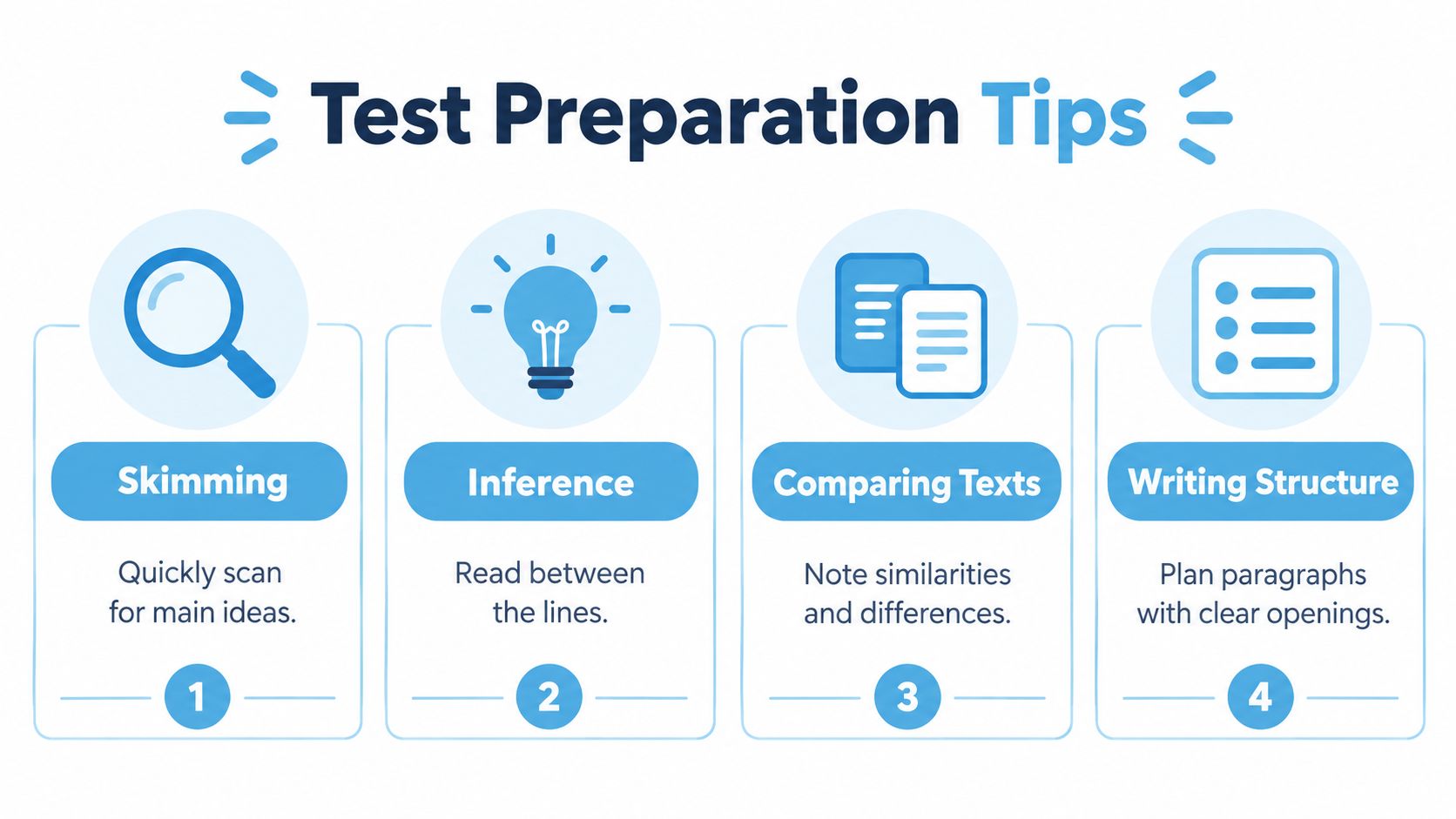
- Skim first: Read quickly to get the main point before diving into details.
- Underline key words in the question: This stops you answering the wrong thing.
- Look for viewpoint and purpose: Ask what the writer wants the reader to think, feel, or do.
- Compare actively: If you have two texts, note similarities and differences as you read rather than at the end.
Common mistake: copying chunks from the text without answering the question.
A stronger habit is to put the answer into your own words unless the task clearly needs a quotation or direct reference.
Writing tips that make your work clearer
Writing marks usually improve when learners slow down for one minute before they start.
Try this routine:
- Jot down purpose, audience, and tone.
- Plan a simple opening, middle, and ending.
- Leave time to proofread.
- Check basic errors last, especially full stops, capital letters, and sentence sense.
If you type during practice, get used to spotting errors on screen. Many adults can see mistakes instantly on paper but miss them on a laptop because they scroll too fast.
Speaking and listening tips for nervous learners
This part worries learners who say, “I'm not good at public speaking.” In practice, you don't need to sound polished or dramatic. You need to communicate clearly, stay relevant, and respond to others appropriately.
Useful habits include:
- Use a simple structure: point, reason, example, conclusion.
- Practise aloud: silent revision doesn't prepare your voice.
- Listen actively: respond to what was said, not just what you planned to say.
- Keep your pace steady: fast speech often sounds less confident, not more.
If speaking confidence is your weakest area, some learners find it helpful to build speaking confidence with ChatPal by using low-pressure prompts before moving into formal assessment practice.
A calm, organised answer usually scores better than a clever answer delivered in a panic.
If you need a resit
Needing a resit doesn't mean you've failed overall as a learner. It usually means one component needs more targeted work.
The key point is practical. You only retake the component you did not pass. That means your revision should narrow down sharply after results. If reading went well but writing didn't, don't spend the next month revising everything equally.
Use this resit checklist:
- Find the pattern: Was it timing, misunderstanding the task, weak proofreading, or nerves?
- Practise in the same format: If you'll resit onscreen, keep working onscreen.
- Redo similar tasks: One weak area repeated several times helps more than constant variety.
- Ask for focused feedback: “What cost me marks most often?” is a better question than “How do I improve?”
Learners often come back stronger in a resit because the process is no longer unfamiliar. They know what the assessment feels like, and that alone lowers stress.
Next Steps Funding Options and Moving Forward with Confidence
If you've made it this far, you already know more than many learners do when they first start. You know that Functional Skills English Level 2 online is practical, regulated, and made up of three parts. You know online delivery can be a smart choice when you prepare for the digital format properly. You know what to ask before enrolling.
There's also a wider picture worth keeping in mind. This isn't a niche qualification. AQA's June 2024 exam statistics recorded 2,847 entries for English Level 2, a 42.2% pass rate, and 8,362 total entries across Functional Skills English and Maths Level 1 and 2 in that series. The same source also notes funding approval for the referenced qualification listing for learners aged 14 to 16 and 16 to 19 from 1 September 2019 through 31 July 2026, with onscreen practice assessments reflecting how digital delivery is built into the current system in AQA's exam statistics report.
For adult learners, funding and eligibility can vary, so it's worth checking current rules with your provider before enrolling. Some adults can access funded support depending on their circumstances, previous qualifications, and study route. If your longer-term goal is university, Level 2 English can also support progression onto an Access to Higher Education Diploma and then into degree routes such as Nursing, Midwifery, Health, Business, and other subject areas.
Your next-step checklist
- Confirm the provider: Make sure they explain all three components clearly.
- Choose your study model: Independent, tutor-supported, or a blend.
- Create a weekly routine: Keep it realistic enough to survive busy weeks.
- Practise onscreen if that's your exam mode: Match revision to delivery.
- Book only when you're ready: Especially for writing and speaking tasks.
You don't need a perfect academic past to do this. You need a clear route, steady preparation, and a provider that tells you the truth about how the qualification works.
If you want a flexible route that fits around work and family, Access Courses Online offers online study options for adults building the qualifications they need for university and career change. You can explore practical progression routes, get guidance on study and funding, and choose a pace that works in real life rather than trying to force your life around a rigid timetable.