

You might be looking at a university course page right now, feeling ready for a new direction, then hitting the same line again and again: GCSEs required. A-levels preferred. For many adults, that wording feels less like guidance and more like a locked gate.
Maybe you left school years ago. Maybe you have GCSEs, but not the right ones. Maybe you did well in work but never had the chance to build the qualifications universities expect. That can make the whole UK system feel confusing, especially when people talk about GCSEs and A-levels as if everyone already knows the rules.
You're not behind. You're just approaching the system from a different starting point.
Your Guide to UK University Qualifications
Take a common situation. Someone works in care, enjoys supporting people, and wants to train as a nurse. They check university entry requirements and see English, Maths, sometimes Science, then A-levels or equivalent. Another person wants to move into business, social work, or computing and finds the same problem. The goal feels clear, but the route doesn't.
That's where a lot of adults get stuck. They assume GCSEs and A-levels are the only acceptable path because that's the route most teenagers follow. In practice, they're the traditional route, not the only one.
If you're planning ahead, it can help to look beyond first-degree entry too. Seeing where study can eventually lead, including specialist postgraduate options such as Model Diplomat's master's programs, often makes the first step feel more worthwhile.
Why the terms feel confusing
Part of the problem is that GCSEs and A-levels do different jobs.
- GCSEs usually prove basic subject knowledge and general academic readiness.
- A-levels are more advanced and are widely used for university entry.
- Adult learners often need more than either label suggests. They need a route that fits work, family, confidence, and study habits.
You don't need to know the whole education system before you begin. You only need to know which route matches your goal now.
What matters most for adult learners
Adults often ask the wrong first question. They ask, “What grades am I missing?” A better question is, “What route gets me ready for university study in a realistic way?”
That shift matters. Qualifications open doors, but study skills keep you in the room once the course starts.
Understanding GCSEs The Foundation of UK Education
A common adult learner scenario goes like this. You find a university course you want, scroll to the entry requirements, and see “GCSE English and Maths” staring back at you. If you left school years ago, that line can feel small but loaded. It raises bigger questions about what GCSEs are, whether old grades still count, and whether you need to go back and rebuild everything from scratch.
GCSE stands for General Certificate of Secondary Education. In the UK system, these are the standard school qualifications most learners take at the end of secondary education. GCSEs provide broad academic evidence across subjects, and in England they are still used at very large scale. In the summer 2025 examination series, 5,661,970 GCSE results were issued in England, according to the official government results publication.

How GCSE grading works
England now uses a 9 to 1 grading scale for reformed GCSEs. Grade 9 is the highest, and grade 1 is the lowest. Adults returning to study often hear both numbers and old letter grades in conversation, which can make course requirements sound more confusing than they are.
If you want a clear translation of the system, this guide on how GCSE grades work explains what colleges and universities usually mean when they ask for specific passes.
The practical version is simpler:
- Higher grades show stronger subject performance.
- A pass in English and Maths is often the part admissions teams and employers focus on first.
- Subject-specific GCSEs may matter for some routes, but many adult learners mainly need to confirm whether English, Maths, or Science are required.
Why GCSEs can feel harder for adults than expected
For many adults, the challenge is not understanding what a GCSE is. The harder part is fitting GCSE study around real life.
Reformed GCSEs rely heavily on final exams. That means learning content over time, revising in a structured way, and recalling it under pressure. Teenagers are usually taught inside a school timetable that builds those habits around them. Adults often have to create that structure themselves while balancing work, childcare, and long gaps since formal study.
That gap in study routine matters. A GCSE can look like a simple box-ticking step on paper, but it often asks for consistent revision, exam technique, and self-management.
Practical rule: If a university or college course asks for GCSE English and Maths, check that requirement early. It is much easier to plan around it at the start than to discover it late in the application process.
What GCSEs are really designed to do
GCSEs are broad qualifications. A school-age student might take English, Maths, Science, History, Art, or a language, building a wide base before choosing a narrower direction later.
That design makes sense for teenagers. It can feel indirect for adults with a clear goal.
If you already know you want to move into Nursing, Midwifery, Business, Social Work, or another specific field, GCSEs may only be one part of the picture. They prove baseline knowledge. They do not usually teach the independent reading, assignment planning, note-making, and deadline management that higher education expects. That is why adult learners often need to ask two separate questions. First, “Do I need GCSEs for entry?” Second, “What route will also help me rebuild the habit of studying at university level?”
Seeing GCSEs in that way helps. They are a foundation qualification. They are not the whole path.
Understanding A-Levels The Traditional University Pathway
If GCSEs are the foundation, A-levels are the next storey. They're more advanced, more specialised, and much more closely linked to university entry.
Most learners who take A-levels focus on a small number of subjects and study them in depth. That depth is the main difference. GCSEs ask for breadth across many subjects. A-levels ask for stronger analysis and more detailed subject knowledge in far fewer areas.
In 2025, 313,190 students received A-level results, and 9.4% achieved the top A grade*, according to Statista's summary of UK A-level results. That helps explain their status. A-levels are selective, and universities use them heavily when making offers.
Why universities rely on A-levels
A-levels are widely treated as the standard academic route into higher education. Admissions teams use them because they show how a student performs in advanced subject study, not just general school learning.
That's also why grade conversion matters. If you've seen course requirements discussed in points as well as grades, this overview of A-level grades to UCAS points can help make those offer terms easier to read.
What makes A-level study harder
A-levels don't just increase content difficulty. They also change how students are expected to learn.
Common differences include:
- More independent reading than many learners are used to at GCSE
- Longer written answers that reward argument, evidence, and structure
- Higher stakes assessment, because results play a direct role in university entry
- Subject commitment, since choosing the wrong subjects can limit future degree options
A-levels don't simply ask, “Can you remember this?” They more often ask, “Can you explain it, evaluate it, and use it well under pressure?”
For school-leavers, that shift usually happens within a familiar college environment. For adults, especially those returning after years away from formal education, the step can feel much steeper.
GCSE vs A-Level A Direct Comparison
Many adults hear GCSE and A-level used together and assume they are versions of the same thing. They aren't. They sit at different levels, serve different purposes, and ask learners to work in different ways.
The quickest way to understand gcse and a level is to compare them side by side.
GCSE vs A-Level at a Glance
| Aspect | GCSE (General Certificate of Secondary Education) | A-Level (Advanced Level) |
|---|---|---|
| Main purpose | Builds broad academic foundation | Prepares learners for advanced study and university entry |
| Typical study style | Wider range of subjects | Fewer subjects studied in more depth |
| Level of study | Foundational | Advanced |
| Assessment feel | Tests core knowledge and skills across subjects | Tests deeper analysis, interpretation, and subject mastery |
| Best known use | Progression to further study, training, or work | Progression to university |
| Typical learner profile | School students finishing compulsory education | Students continuing academic study after GCSEs |
| Adult learner challenge | May involve retaking subjects that aren't directly linked to a career goal | Requires confidence with independent study and sustained academic writing |
The real difference isn't just difficulty
People often say A-levels are “harder”, which is true but incomplete. The bigger difference is how they're harder.
GCSEs usually reward solid preparation across a broad syllabus. A-levels expect learners to follow ideas further, compare interpretations, write more analytically, and manage their own study more confidently. That's why an adult can be perfectly capable, highly motivated, and still find the leap uncomfortable.
Why this comparison matters for adults
For a teenager moving through school, GCSE then A-level is a familiar staircase. Teachers, timetables, and classmates help hold it together.
For an adult, it can look more like this:
- Work out which old qualifications still count.
- Identify missing subjects.
- Decide whether to retake GCSEs.
- Check whether the chosen A-level subjects match the degree goal.
- Build study habits at the same time.
That's a lot of moving parts.
The most helpful question isn't “Which qualification sounds more impressive?” It's “Which route gets me accepted and prepared?”
That's where many adult learners begin to realise that the traditional path and the practical path aren't always the same thing.
The Challenge for Adults The Qualification Gap
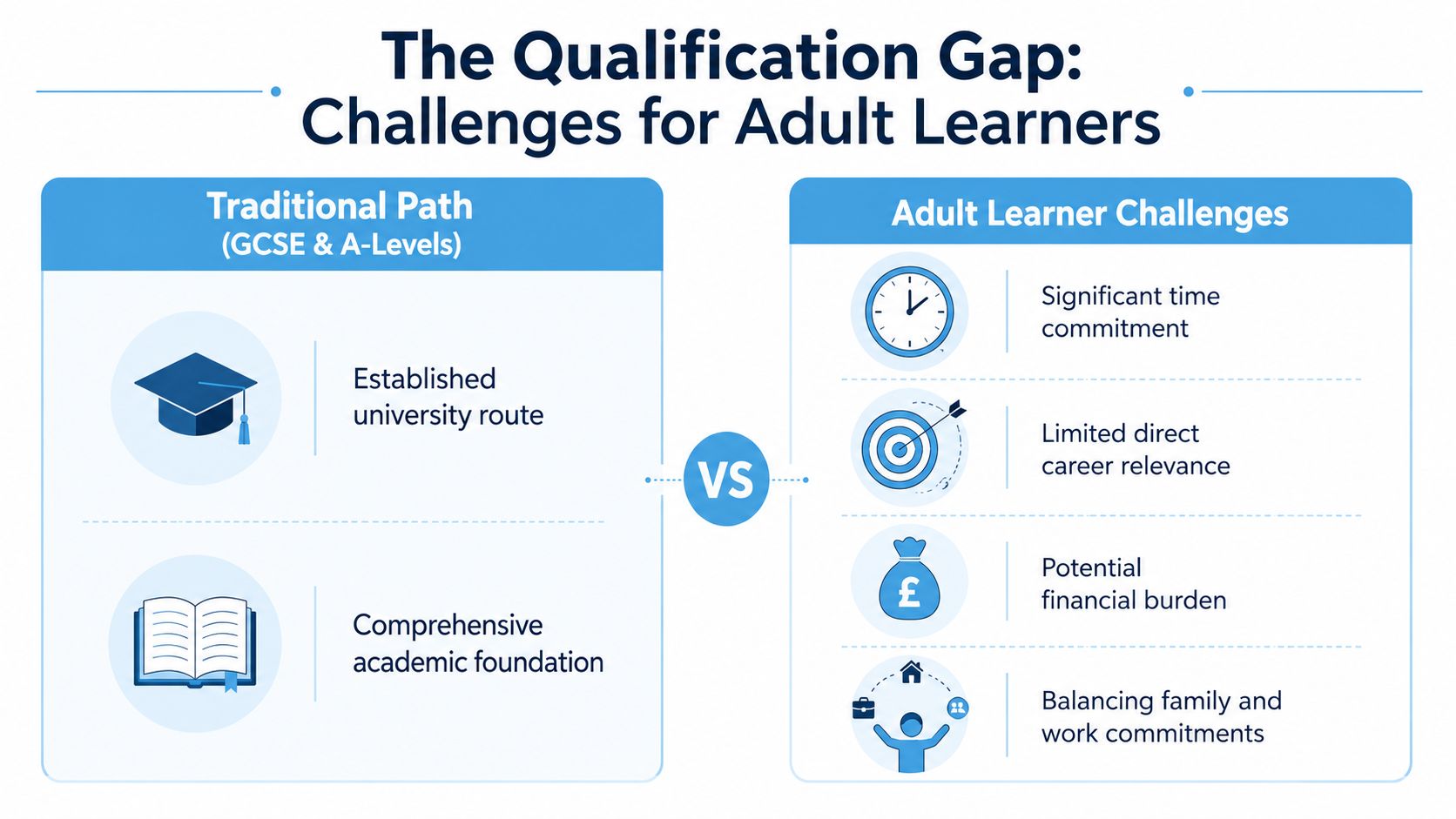
The standard school route makes sense if you're sixteen, in full-time education, and progressing with your year group. It often makes far less sense if you're thirty-two, working shifts, and trying to study after the kids are asleep.
That's the first part of the qualification gap. Adult learners don't just need the right certificates. They need a route that fits real life.
The obvious barriers
Some challenges are easy to spot.
- Time pressure. Adults often study around jobs, caring responsibilities, and commuting.
- Financial pressure. A long route can feel risky if income and household costs are already tight.
- Motivation strain. It's hard to stay focused when the route looks long and disconnected from your end goal.
Those are real issues, but they aren't the whole story.
The hidden barrier most adults don't hear about
Research on the GCSE to A-level transition highlights a major independent study leap, where learners often struggle because they lack independent learning techniques and time management skills, as discussed in this article on GCSE vs A-levels. For adults returning to education, that problem can be even sharper because formal study may be far in the past.
This catches people off guard. They think the main issue is content. In reality, the issue is often method.
You might understand the topic well enough. But can you plan a week of study without someone setting every task? Can you read a text, pick out the argument, take notes, and turn that into a structured answer? Can you recover when life interrupts your timetable?
Why A-levels can feel harder for adults than expected
Adults often bring strengths that younger learners don't have. They're motivated, disciplined, and clear about why they're studying. But A-levels still assume certain habits that school and sixth form usually build over time.
Those habits include:
- Working independently without waiting for constant direction
- Managing deadlines across multiple pieces of study
- Writing academically rather than informally
- Revising strategically instead of only reacting to upcoming tests
Missing qualifications can be fixed. Missing study habits take more care, because they affect everything you do once the course begins.
That's why many adults don't need a route that exclusively recreates school. They need one that teaches them how to learn at university level while they earn the entry qualification.
Your Modern Route to University The Access to HE Diploma
For many adults, the most practical alternative to the full traditional school route is the Access to Higher Education Diploma. It's designed for people who want to go to university but don't have the standard qualifications they need from school.
Unlike the broad school pathway, Access courses are usually built around a clear destination. Instead of trying to cover everything, they focus on a university subject area such as Nursing, Health Professions, Business, Social Science, or Computing.

Why this route suits adult learners better
One overlooked problem for adults is strategic subject choice. Research highlighted by the Nuffield Foundation on GCSE subject choices and inequality shows that learners from less advantaged backgrounds often choose GCSE subjects that narrow later A-level options. For adults returning years later, that can create a confusing maze. They may retake English and Maths, then discover they still don't have the right subject combination for the next step.
An Access to HE Diploma solves that in a different way. It bypasses much of the subject-choice maze by giving learners a focused route tied to a university progression goal.
If you want a plain-English explanation of the qualification itself, this guide on what an Access to Higher Education course is is a helpful starting point.
What adults gain beyond the qualification
This is the part many people underestimate. A good Access course doesn't only help you meet entry requirements. It helps you practise the habits university will expect from day one.
That usually means developing skills such as:
- Essay writing, where structure matters as much as knowledge
- Research, including how to use sources well
- Critical thinking, which means weighing ideas rather than repeating them
- Study planning, so you can work consistently around life commitments
In other words, it tackles the exact gap that often makes the leap from GCSE-level study to advanced study feel so hard.
Access to HE is often a better fit for adults because it teaches both destination knowledge and the way of working that higher education expects.
A more direct route for specific goals
The traditional school path is broad first, specialised later. Adult learners often need the reverse. They already know the direction they want to go.
If your aim is healthcare, a healthcare-focused Access course makes more sense than building a patchwork of unrelated qualifications and hoping they line up. The same applies to business, social sciences, and other degree routes. The course content is closer to the degree context, so the work feels more relevant and easier to stay committed to.
A quick explainer can make the format easier to visualise:
What about English and Maths
Some adults still need GCSE English or Maths, or an accepted equivalent, depending on the university and degree subject. That's common. It doesn't mean the wider traditional route is the best option. It usually means you should check those two subjects early and handle them alongside your main progression plan.
The key point is simple. If your goal is university, you need more than a list of missing grades. You need a route that gets you accepted and gets you ready.
Frequently Asked Questions From Adult Learners
Are Access to HE Diplomas accepted by universities
Many universities accept Access to HE Diplomas for adult applicants. Acceptance depends on the university, the course, and sometimes the units studied within the diploma. The safest approach is to check the exact entry requirements for your chosen degree and confirm them before you enrol.
Do I still need GCSE English and Maths
Often, yes. Many degree courses, especially in healthcare and education, ask for English and Maths separately even if they accept an Access diploma for the main entry qualification. Some universities also accept recognised equivalents in certain cases. Always read the admissions page carefully and ask if anything is unclear.
How do I choose the right course
Start with your intended degree, not with the qualification name. Look at the university course you want, note the subjects they ask for, then choose a route that matches that destination. If you're undecided between two careers, compare degree entry requirements side by side before committing.
I've been out of education for years. Can I still succeed
Yes. Adults often do well because they bring focus, life experience, and a clear reason for studying. The main adjustment is usually rebuilding confidence and learning how to study independently again.
What should I do first
Keep it simple:
- Choose the degree or career goal you want to move towards.
- Check entry requirements for two or three universities.
- Identify missing English, Maths, or subject requirements.
- Pick the route that prepares you for university study, not just the route that looks familiar.
You don't need a perfect academic past to build a strong academic future. You need the right next step.
If you're ready to turn a career goal into a realistic study plan, Access Courses Online offers accredited online Access to HE Diplomas built for adult learners. You can study flexibly around work and family, explore degree pathways in areas such as Nursing, Business, Science, Social Science, and Computing, and get guidance on entry requirements, funding, and next steps without going back to the full traditional school route.