

You've opened your course handbook, seen the words Pass, Merit and Distinction, and immediately wondered whether one disappointing assignment could ruin your university plans. Perhaps you're returning to education after years away, balancing work or family, and you're imagining a single final exam where everything depends on one stressful day.
That isn't how an Access to Higher Education Diploma works. Your progress is built through individual units and assessments, creating a grade profile rather than one overall average. Each graded piece gives you a clear opportunity to show what you know, how you apply it and how effectively you use academic skills.
Understanding the system early can make the course feel much more manageable. You'll know which credits contribute to your graded outcome, what tutors look for, why numerical percentages aren't the focus and how universities interpret your results. You'll also be better placed to plan your workload, ask useful questions and respond constructively to feedback.
The simplest way to think about it is as a journey made from building blocks. You complete units, demonstrate the required learning outcomes and then show the quality of your work against shared standards. Your final Diploma presents that pattern of achievement to admissions teams.
Whether you're aiming for nursing, midwifery, health professions, computer science, science, business or another degree, the basic grading principles remain consistent. Let's take them one step at a time.
Introduction to How Access Courses Are Graded
Your course is a series of achievable stages
Suppose you submit a health assignment and receive a Pass. That result doesn't mean you've failed the course or that your university ambition has ended. It means you've achieved the required standard for that unit, while later assessments give you further chances to demonstrate stronger analysis, subject knowledge or independence.
A different learner might receive a Merit in one unit and a Distinction in another. Neither result stands alone as a final verdict. Together, the grades form a profile that shows how the learner performed across the graded part of the Diploma.
A useful change in perspective: You're not trying to win one enormous final exam. You're collecting evidence of achievement across your course.
This approach often helps nervous returners. You still need to take every assessment seriously, but you can focus on the task in front of you instead of treating the entire year as one high-pressure event. Your tutor can use feedback from earlier work to help you improve in later units, which makes study a process rather than a one-off performance.
What admissions teams see
Access grading is designed to communicate your academic performance clearly. There's no single composite Diploma grade that hides the detail. Instead, universities can see the grades attached to your graded units and consider whether your profile meets the conditions for your chosen degree.
That means a Pass is still meaningful. It records successful achievement of the required learning outcomes. Merit and Distinction results show increasing strength in areas such as application, analysis, critical thinking and independent work, depending on the assessment criteria for the unit.
The framework also avoids asking you to convert your work into percentages. You're judged against defined standards, not against a points total that might make one small marking difference feel decisive.
By the end of this guide, you'll understand the structure of the 60-credit Diploma, the difference between earning credit and earning a grade, the three grading standards, how tutors assess different types of work, and how the resulting profile supports university progression.
How the Access to Higher Education Diploma Is Structured
Start with one number: an Access to Higher Education Diploma contains 60 credits. The Access to Higher Education Diploma structure is easier to understand when you treat those credits like parts of a carefully assembled course rather than marks added to a single score.
Of the total, 45 credits must come from graded Level 3 units, while 15 credits come from ungraded Level 2 or Level 3 units. The Quality Assurance Agency describes the 45 graded credits as the academic subject-content core, while the remaining credits support the wider structure of the Diploma. You can check the official QAA Access to HE grading scheme for the framework behind this arrangement.
The building-block analogy
Think of the Diploma as a building.
- The 45 graded Level 3 credits are the main academic structure. They show your subject knowledge and the quality of your work through Pass, Merit or Distinction outcomes.
- The 15 ungraded credits are supporting blocks. They're still part of the qualification and may help you develop preparation, study or broader programme skills, but they don't add a Pass, Merit or Distinction to the graded profile.
Every successful graded Level 3 unit receives one of three outcomes: Pass, Merit or Distinction. The QAA confirms that there is no overall composite grade for the whole Diploma. Your result is therefore read unit by unit, not as one final average.
Why the split matters
A common misunderstanding is that every task on the course contributes directly to a final Diploma grade. That's not quite right. The ungraded credits matter because they form part of the qualification, but they don't determine whether your graded subject work is recorded as Pass, Merit or Distinction.
The graded credits are assessed under the same broad grading scheme across Access subjects. This gives the framework consistency, even though a science report, a social science essay and a health-related presentation may look very different.
Your provider will explain the units, assessments and local submission requirements. The national framework sets the grading principles, while your course materials show how those principles apply to your particular subject.
Understanding the Three Grading Standards and Dual Threshold
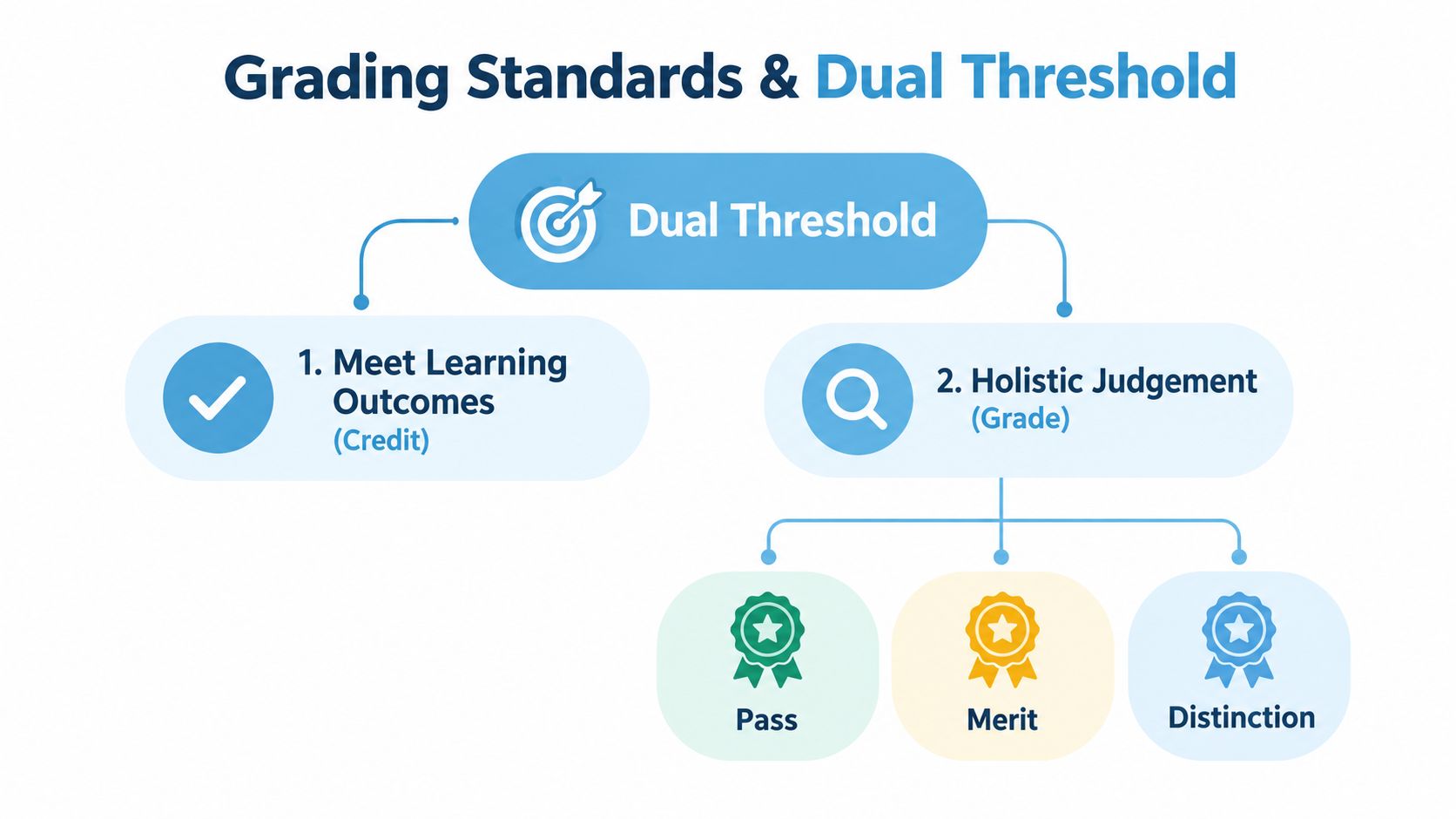
Access grading uses a dual threshold. You must first meet the learning outcomes for the unit to earn the credit. Only after that does the tutor judge the quality of your achievement to decide whether the result is Pass, Merit or Distinction.
The QAA guidance on assessment and grading states that, from 1 August 2024, the three grading standards are Knowledge and Understanding, Subject Specific Skills, and Transferable Skills. These standards apply equally to every graded unit and to each piece of assessment within that unit.
Stage one, meeting the learning outcomes
Learning outcomes describe what you're expected to know or do by the end of a unit. An outcome might require you to explain a concept, apply a method, interpret information or communicate a reasoned answer.
If your work doesn't meet the required learning outcomes, you haven't yet demonstrated the credit requirement. Your tutor's feedback should identify what's missing and what you need to address.
Meeting the outcomes gets you through the first threshold. It doesn't automatically make the work a Merit or Distinction.
Stage two, judging the quality of the work
Once you've met the outcomes, your work is considered against the three standards.
Knowledge and Understanding concerns the accuracy, relevance and depth of what you know. A Pass may show secure knowledge of the required material. Stronger work may connect ideas more effectively or demonstrate a deeper grasp of the subject.
Subject Specific Skills relates to the practical or academic abilities used in your discipline. Depending on the course, that could involve interpreting evidence, applying scientific ideas, analysing sources, carrying out calculations or using a professional framework.
Transferable Skills covers abilities that matter beyond one unit, such as communication, organisation, problem-solving, research and the use of evidence. Clear structure and appropriate referencing may support your communication and research skills, for example.
The judgement is criterion-based, not points-based. The framework deliberately avoids numerical marks and percentage conversions, so you shouldn't try to reverse-engineer a grade from an imaginary percentage boundary.
A useful example is an essay that answers the question and uses relevant evidence. It may meet the learning outcomes and achieve a Pass. If it then develops a stronger line of reasoning, applies ideas accurately and evaluates evidence rather than merely describing it, the same type of assignment may reach Merit or Distinction territory.
How Tutors Mark Coursework and Exams on Your Access Course
Tutors don't use one universal method for every assessment. An essay, practical task, presentation, report and timed exam may require different evidence, but the underlying grading standards remain consistent.

What happens to an assignment
Your tutor starts with the assessment requirements and learning outcomes. They read your work against the relevant criteria, checking whether you've demonstrated the required knowledge, subject skills and transferable skills.
A health science report might be judged on how accurately you explain a condition, how well you apply biological knowledge and how clearly you interpret evidence. A timed exam may test your ability to recall and apply knowledge under controlled conditions. The format changes, but the question stays similar: what evidence have you provided, and how well does it meet the standard?
If a unit includes several assessments, tutors consider the evidence across those assessments when deciding the unit outcome. Your provider will explain how individual tasks contribute to the unit's assessment process.
Clear criteria are important because they show what the tutor expects before you submit. Reviewing rubric design strategies can also help you understand why assessment criteria need to be specific, observable and connected to learning outcomes.
Feedback is part of the learning process
Feedback should tell you more than whether an answer was right or wrong. It can identify where your explanation needs greater detail, where your analysis becomes descriptive, or where your sources don't support the conclusion you've drawn.
Read comments alongside the criteria. Highlight one or two improvements you can carry into your next assessment rather than trying to correct everything at once. A small, repeated improvement in structure, evidence or analysis can make later work more confident.
For a clearer explanation of how assessment formats may appear on an Access course, see whether Access courses have exams.
The video below offers another way to think about assessment and grading practice.
You're not expected to guess what excellence looks like. Use the assignment brief, marking criteria, tutor guidance and feedback as working tools. If something remains unclear, ask your tutor before the submission date.
What Pass Merit and Distinction Really Mean
The three outcomes describe different levels of achievement after you've met the learning outcomes. They aren't three points on a percentage scale. They're descriptions of the quality, strength and independence shown in your work.
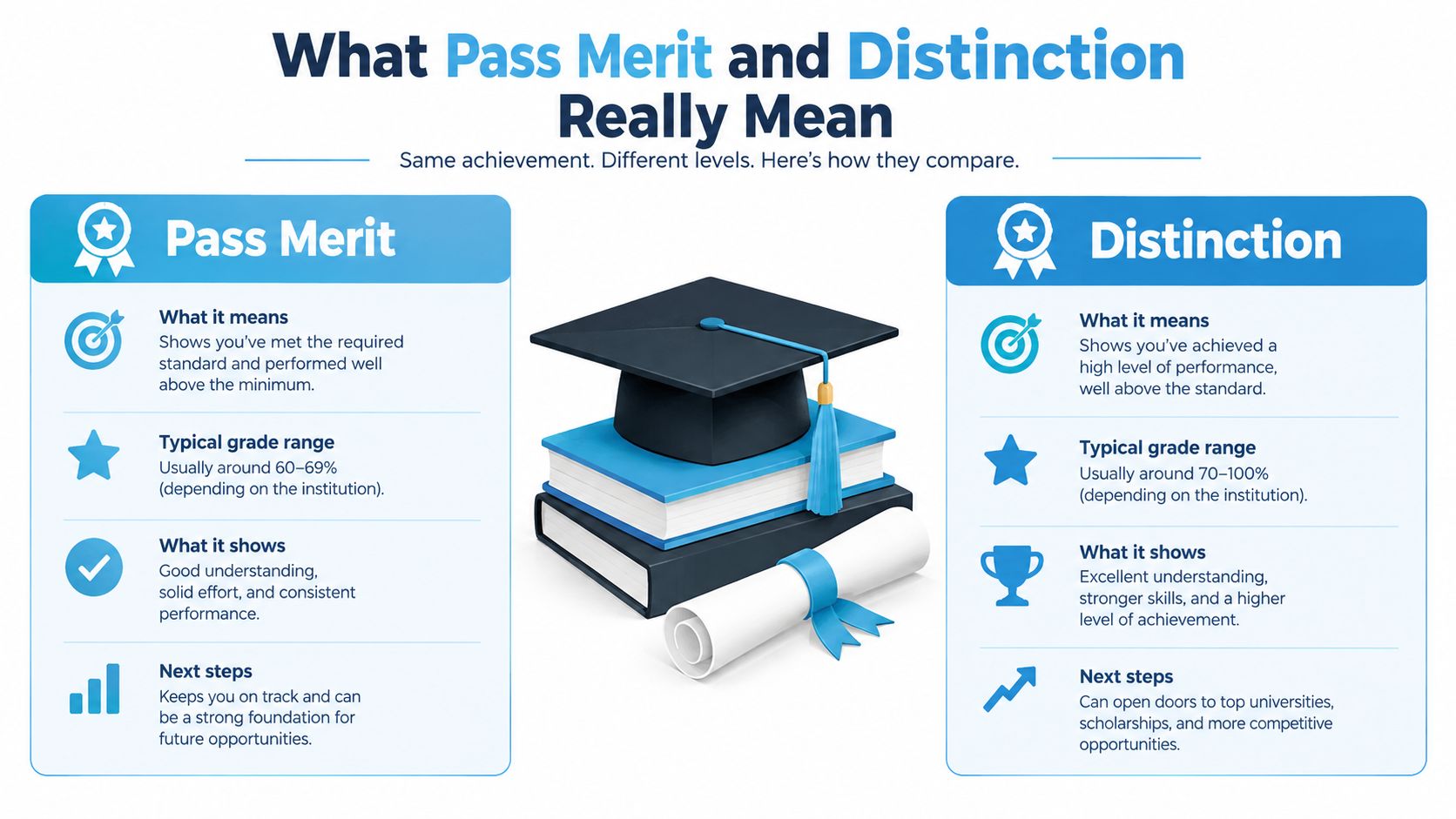
| Grade | What It Shows | Typical Evidence |
|---|---|---|
| Pass | Secure achievement of the learning outcomes | Relevant knowledge, appropriate subject skills and clear communication |
| Merit | Strong application, analysis and understanding | Developed reasoning, accurate application and effective use of evidence |
| Distinction | Exceptional, critical and independent work | Sophisticated judgement, well-supported insight and confident independence |
Pass is a successful outcome
A Pass means you've met the required learning outcomes and demonstrated the necessary standard. It isn't a consolation result. It confirms that you've achieved the unit's essential academic requirements.
A Pass answer may explain relevant ideas accurately, address the task and use suitable evidence. It might not develop the depth, critical evaluation or independence expected at a higher grade, but it has done what the unit requires.
Merit shows development and stronger thinking
Merit-level work goes beyond secure completion. You're likely to apply concepts effectively, analyse information rather than repeat it and build a clearer connection between evidence and conclusions.
For example, a Pass response might describe factors affecting health. A Merit response could compare those factors, explain how they interact and use evidence to support a reasoned interpretation.
Distinction reflects sophistication and independence
Distinction work demonstrates a particularly strong command of the task. It may question assumptions, evaluate competing explanations, make precise connections and reach a conclusion that follows convincingly from the evidence.
You don't need to use unnecessarily complicated words to achieve a Distinction. Clear, controlled writing is often more effective than jargon. What matters is the quality of your thinking and how independently you demonstrate it.
Your profile across the 45 graded credits gives admissions teams a fuller picture than one isolated result. A pattern containing Merits and Distinctions can show sustained readiness for higher-level study, while a Pass in one unit doesn't erase stronger achievement elsewhere.
Moderation Resits Appeals and Functional Skills Explained
Fairness doesn't depend only on the first tutor who reads your work. Providers use quality-assurance processes to check that assessment decisions are consistent with the Access grading framework. These processes can include internal review, second marking and external moderation, depending on the provider's arrangements.
The QAA provides the national framework for the grading scheme, including the requirement that the grading standards apply equally across graded units and assessments. Your provider remains responsible for explaining its own marking, moderation and appeals procedures.
What moderation is designed to do
Moderation checks whether tutors are applying the criteria consistently. A reviewer may examine assignments, feedback and decisions to see whether the recorded outcome is supported by the evidence.
This protects learners from inconsistent decisions and helps providers maintain a common standard. It also means a grade may be reviewed as part of the normal quality process before the final profile is confirmed.
Practical rule: Keep your assignment brief, feedback and submitted work together. If you need to ask about a decision, those documents give you a clear starting point.
If you don't pass a unit
Speak to your tutor as soon as you receive the decision. They can explain which learning outcomes weren't demonstrated and whether your course rules allow a resubmission, reassessment or another form of further attempt.
A resubmission isn't an invitation to rewrite blindly. Start by turning the feedback into a short action list. Address the missing outcome, improve the evidence and check the revised work against the original criteria before submitting it.
An appeal is different from asking for more feedback. It normally involves a formal concern about how the assessment or procedure was handled, so follow your provider's published process and deadlines.
Functional Skills and GCSE requirements
Functional Skills or GCSE English and Maths may sit alongside the Diploma rather than inside the 60-credit graded profile. They don't receive Access Pass, Merit or Distinction outcomes, but a university or professional course may still require evidence of English or Maths competence for entry.
Check the requirements for the degree you want before enrolling. Your provider can help you understand whether you need an additional qualification and how it fits around your Access study.
How Your Access Grades Support University Progression
Universities read your Access results as a profile of unit-level achievement. An offer might specify a particular combination of graded credits, such as 30 credits at Distinction and 15 credits at Merit, rather than asking for one overall Diploma percentage. That example reflects how universities can set conditions using the profile, not a composite grade. Always check the exact wording for your chosen course.
This makes target-setting more practical. Instead of telling yourself that you must be perfect everywhere, identify the grade pattern your university asks for and discuss how your current units contribute to it. Your tutor can help you recognise where you're already working securely and where feedback points towards improvement.
Build your profile deliberately
Use your assignment calendar to plan around the units that contribute to university conditions. Keep a simple record of:
- Unit requirements: Note the learning outcomes and assessment types.
- Feedback themes: Track repeated advice about analysis, evidence, structure or subject skills.
- Target outcomes: Discuss realistic Pass, Merit or Distinction goals with your tutor.
- Entry requirements: Recheck the university's current conditions before submitting your application.
Your Access results may also connect with UCAS points, but the exact interpretation depends on the Diploma grade profile and the course requirements. The Access to HE Diploma and UCAS points page can help you understand that relationship, while the university itself remains the right place to confirm entry conditions.
The most important habit is steady progress. A nervous returner doesn't need to become an academic writer overnight. You need to understand the criteria, use feedback, ask for help early and keep producing evidence of what you can do.
Access Courses Online provides fully online Access to Higher Education Diploma study for adults preparing for university in areas including Nursing, Midwifery, Health Professions, Computer Science, Science, Social Science, Business and Management, and Music Technology. Visit Access Courses Online to review available courses, discuss entry requirements and get guidance on choosing a route that fits your work, family and university plans.