

You've had the same browser tab open for a fortnight. It's the paramedic job profile, and every time you read it you get three lines in, hit the entry requirements and close it again.
Maybe you left school with a handful of GCSEs and nothing since. Maybe you have a degree in history and twelve years in an office, and you're wondering whether any of that counts for anything. Or you've been an emergency care assistant for four years and you watch newly qualified paramedics arrive on station with skills you'd like to have yourself.
Those pages rarely say plainly that the UK route into paramedic work is regulated, written down, and open to adults without A levels, provided you match your starting point to the right entry route and confirm the programme is approved. Get those two things right early, and the rest becomes a sequence of steps rather than a maze.
Choose the Right Route into Paramedic Work
A route that fits your qualifications may still be wrong for your circumstances if it leaves you without an income. There are four main ways to work towards paramedic practice, and they differ in study time, entry requirements and whether you earn while training.
| Route | Typical length | Entry requirement | Paid while studying |
|---|---|---|---|
| Full-time BSc (Hons) paramedic science | 3 years full-time | Set by each university; A levels, BTEC, T levels or an Access Diploma may be accepted | No, usually funded by student finance |
| Level 6 degree apprenticeship | 36 months, excluding the end-point assessment | Set by the employing ambulance trust | Yes, employed while you train |
| Access to HE Diploma, then BSc (Hons) | 1 year full-time or 2 years part-time, then 3 years | Adults aged 19 or over; the university then sets its own degree entry | No, both stages are study rather than employment |
| Ambulance support role, then progression | Set by the trust, with no national fixed length | Set by the ambulance trust | Yes, paid in the support role |
Start by comparing the paid-study options with your financial needs. A full-time degree means studying without a salary, usually with student finance; an apprenticeship combines paid employment and training, but places depend on a trust recruiting. A support role also pays, though progression arrangements and timing are set locally.
Which route fits your circumstances
- A levels or a BTEC Extended Diploma in a science subject: Consider a full-time paramedic science degree. Apply through UCAS to courses you have checked for HCPC approval.
- You need a wage and can commute to a trust running an apprenticeship: Apply to the employer. The ambulance trust recruits, while the university delivers the degree.
- No Level 3 qualifications, or none from the last decade: An Access to Higher Education Diploma can provide a route to degree study. The university sets its own entry requirements.
- You want to test the work before committing to a degree: Consider an ambulance support or emergency care role, then ask your trust about progression opportunities. Arrangements vary by area.
A levels are often presented as the default starting point, but they are not the only route. NHS Health Careers says approved paramedic science degrees may accept BTEC, HNC/HND, relevant T levels, relevant NVQs, or a science or health-based Access to Higher Education course. Universities set their own requirements, so a qualification accepted by one may not meet another university's criteria. Check admissions requirements and HCPC approval before applying.
All four routes are ways to work towards paramedic practice; none grants paramedic status on its own. To register with the HCPC, you need an approved honours degree and must meet its standards of proficiency. The HCPC consulted on raising the registration threshold to degree level, which is why paramedic training is degree-level from the start. Choose a route by weighing your qualifications, income needs and local opportunities, then check the relevant programme's approval before you apply.
Entry Requirements to Check Before You Apply
A course can look like the right route on paper and still have entry conditions you do not meet. Universities set their own rules, so check the requirements for the specific programme before applying. The table shows common checks and who they usually affect.
| Requirement | What it involves | Who needs it |
|---|---|---|
| GCSE English, maths and science | Grades set by each university, sometimes alongside other Level 3 qualifications | Applicants who need to confirm GCSE or equivalent qualifications |
| Access to HE Diploma | Level 3 credits graded to the university's threshold | Applicants using an Access Diploma to meet degree entry requirements |
| English language evidence | IELTS level 7, with no element below 6.5, unless an exemption applies | Applicants who qualified outside the UK and whose first language is not English |
| Health screening and occupational-health clearance | Checks completed before the programme or placements start | All applicants |
| Criminal-record check | Checked before placements and again for registration | All applicants |
GCSE requirements can catch out applicants who already hold a Level 3 qualification. A university may still ask for English, maths and science, because the course involves clinical records and drug-dose calculations during placements. If your GCSEs are old, missing or below the published grades, ask whether the university accepts an equivalency test. Confirm the accepted subjects and grades rather than assuming your Level 3 qualification covers them.
Health screening and criminal-record checks also need early attention. They relate to placement access as well as enrolment, so a delay may affect when you can start. Ask the university what paperwork is needed as soon as you accept an offer.
Approved paramedic provision has been expanding, which makes checking each programme's approval status especially important. The HCPC standards of proficiency set the English language requirement for applicants who qualified outside the UK at IELTS level 7, with no individual element below 6.5, unless an exemption applies (HCPC standards of proficiency for paramedics). Check the exact course as well as its admissions criteria. Approval and entry requirements answer different questions: one concerns whether the programme supports the route to registration, the other whether you meet that university's conditions.
What to do about each requirement
Email admissions with your qualifications, including grades and subjects, and ask whether they meet the requirements for the specific course. A clear question is easier to answer than a general enquiry, and a written reply gives you something to refer to later.
The email to send: I hold [your qualifications, with grades and subjects]. Would these meet your GCSE equivalency and subject requirements for your BSc Paramedic Science, and is there anything else I should complete before I apply?
An Access course or strong BTEC can help you meet degree entry requirements, but neither guarantees a place. If your grades are near the required threshold, ask how the university assesses the rest of your application, including the personal statement and interview. That helps you focus preparation on the parts the course considers.
How to Become a Paramedic Step by Step
Five steps sit between where you are now and an entry on the Register. The order matters, and so does the reason behind each one.
The full sequence at a glance looks like this.
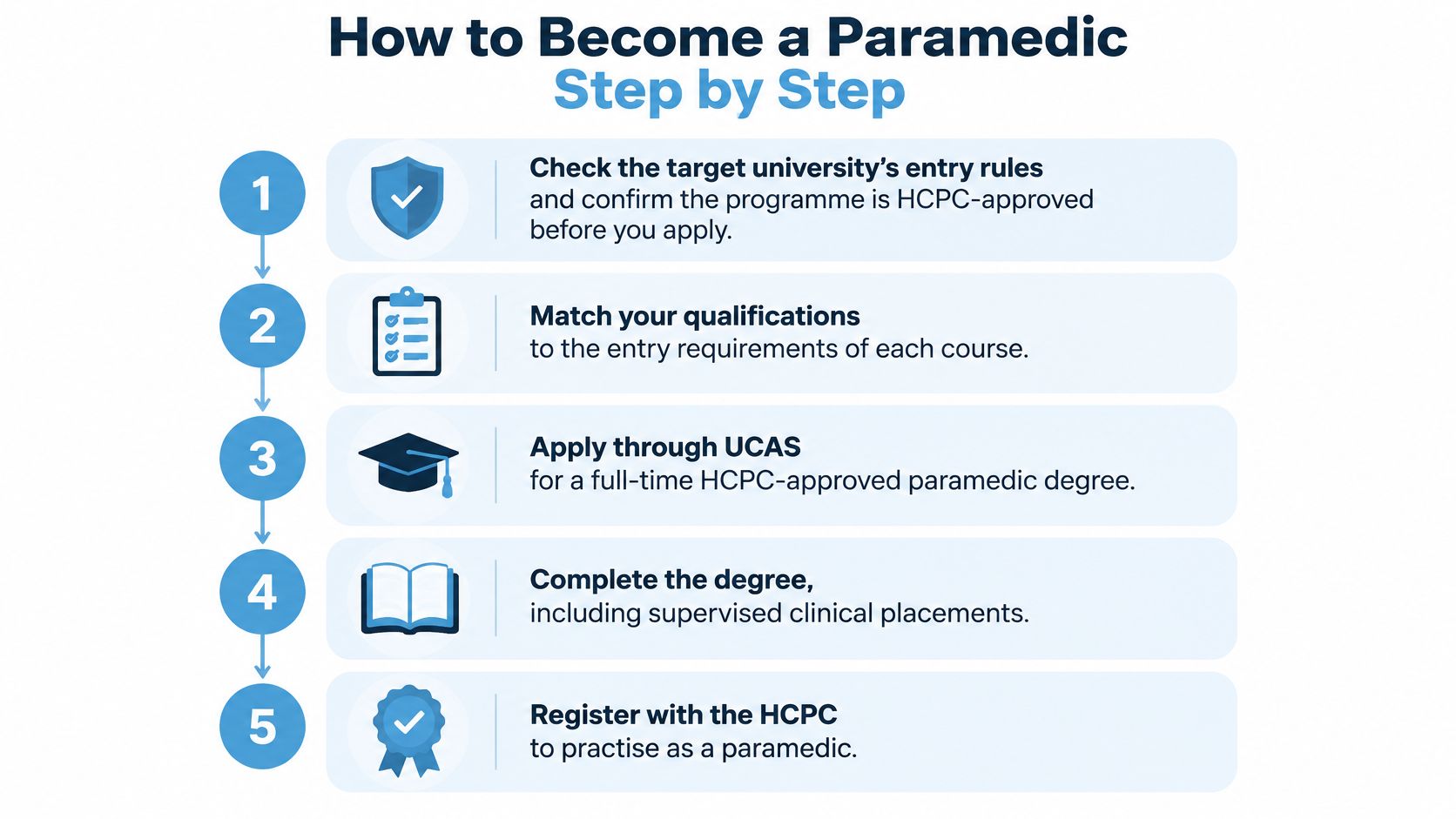
- Check the programme's approval before anything else. Verify the course on the HCPC's list of approved programmes, not by reading the course title. An unapproved course can teach you plenty and still leave you unable to register, which is an expensive way to find out.
- Apply to an approved pre-registration degree, normally a BSc (Hons). The HCPC raised the registration threshold from Certificate of Higher Education level to bachelor's degree with honours, and new sub-degree paramedic programmes haven't been accepted for approval since (HCPC education standards for paramedics). The usual mistake is applying to a diploma or foundation degree in the belief it's a faster version of the same thing.
- Treat placement as assessed learning rather than attendance. The standards require a programme's structure, duration and range of practice-based learning to support the learning outcomes you'll be signed off against. Keep a running record from your first shift: what you assessed, what you decided, what happened next.
- Build an evidence portfolio and audit it against the standards. Cover patient assessment, clinical reasoning, communication, safeguarding, medicines, emergency care and reflective practice, then map each one to the standard it satisfies. The most common gap at the end of the degree is thin evidence on anatomy and physiology, or on forming a differential assessment and justifying a management plan.
- Join the Register, then apply for posts. Registration comes first, because ambulance services shortlist on it. Once your PIN is live, apply to trusts directly and expect scenario-based interview questions rather than a general chat about your motivation.
What a ready applicant looks like
A ready applicant isn't just someone who finished a course. It's someone holding an approved honours degree, able to point at evidence for every standard of proficiency, with placement records showing supervised competence across the full scope of practice. That's the benchmark the HCPC applies and the one employers assume.
If you're currently weighing up courses, ask yourself one question about each: would completing this leave me able to evidence the standards, or only to describe the experience?
Using an Access Course to Reach Degree Entry
An Access to Higher Education Diploma is built for adults who don't hold A levels, haven't studied recently, and need a Level 3 qualification universities will accept. It's the route most career changers end up taking, and it's worth understanding precisely what it does and doesn't do.
The structure is fixed across providers: 60 credits in total, of which 45 are graded at Level 3 as pass, merit or distinction, and 15 are ungraded at Level 2 or Level 3. Full time it takes a year; part time, two. You can enrol without applying to a university first, and there are no formal entry requirements apart from being over 19, though tutors will check you have the skills and personal qualities to cope with the workload.

What to do during the course
Choose the units that do the heavy lifting for a paramedic degree: biology, human physiology, study skills and mathematics, graded to the thresholds your target university publishes. Those four subjects map directly onto the knowledge the HCPC paramedic standards assume at registration, from human structure and function to the numeracy behind drug calculation.
Build one habit alongside the coursework: write a structured case analysis each week using an assessment framework, differential diagnoses, red flags, escalation decisions and safety-netting. Then compare it with the feedback from your tutor or a placement mentor and rewrite the weak part. It's the closest thing to the clinical reasoning you'll be assessed on later. Our guide to the Access to Paramedic Science route sets out how the diploma feeds into degree applications.
Two pitfalls catch capable adults. The first is underestimating academic writing, which is assessed as heavily as subject knowledge and improves only with feedback. The second is assuming that attendance at a caring or placement setting equals competence; assessors want your reasoning, not your hours.
Before you commit a year, get written confirmation from each university that your Access diploma, your planned units and your predicted grades satisfy their entry rules. An email you can forward beats a conversation you remember differently.
What the Degree Involves and How Placements Work
Three years full time is the standard. The UK National Careers Service states that becoming a paramedic typically requires a full-time HCPC-approved paramedic science degree lasting 3 years (National Careers Service paramedic profile).
The content is broader than most applicants expect. You'll study human structure and function, disease and dysfunction across the lifespan, assessment of injury or illness, differential diagnosis, management planning and the scientific enquiry needed to judge whether a treatment works. That breadth is exactly why the qualification sits at honours level and why the regulator moved the threshold there.
Placements carry the competence the HCPC checks at registration, so the quality of placement design matters more than the campus or the brochure. Ask about it before you enrol, while you still have a choice.
Three questions to ask before you enrol
How many supervised placement hours are guaranteed, and where? A promise of "placements arranged for you" isn't the same as a number and a setting. Ask whether hours are with an ambulance trust, in an emergency department, or in a mixture.
How are failed competencies remediated? Everyone struggles with something in practice. What matters is whether the programme has a documented process with a second attempt, extra supervision and a clear timetable, or whether you're signed off late.
Is non-ambulance practice-based learning included? The HCPC recognises learning in other settings as valuable but doesn't mandate one model for every programme, so provision varies between universities. On our Science and Healthcare Access courses we introduce students to a number of different health service professionals so they can hear about careers beyond the ambulance before they choose.
Practical rule: judge a programme on its placement guarantee and its remediation process, not on its open-day hospitality.
For your first semester, do three things. Confirm your placement schedule in writing, set up your evidence record before your first shift rather than after your tenth, and track each competency as a tick-box list you review monthly. Students who leave the portfolio until final year always regret it.
How a Paramedic Degree Apprenticeship Works
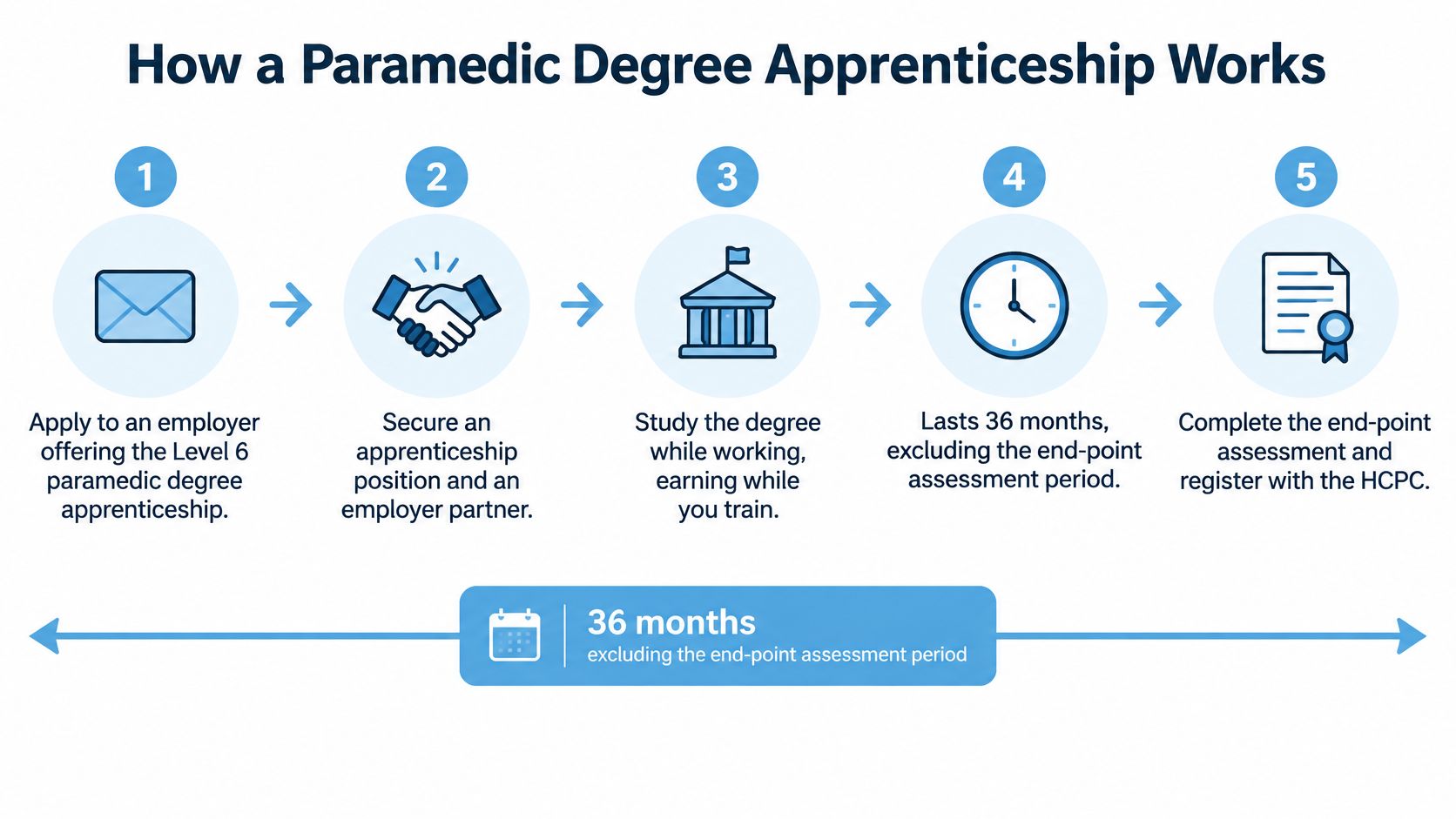
Say you're 31, you have a BTEC in applied science, a mortgage and no appetite for three unpaid years. The Level 6 paramedic degree apprenticeship is designed for exactly that position, and Skills England lists its typical duration as 36 months, excluding the assessment period (Skills England paramedic degree apprenticeship standard).
The sequence runs like this. You apply to an ambulance trust or other employer that offers the standard, not to the university, because the employer recruits and holds the vacancy. Selection follows, often with numeracy and literacy checks, an interview and sometimes a fitness or driving requirement. Year one combines academic study with supervised placement, and the middle years build practice on the road and in other settings under a practice assessor. The final stage is the end-point assessment, which comes after the 36 months rather than inside it.
How the apprenticeship compares with the full-time degree
You take on employment and everything that comes with it: annual leave agreed around a rota, mandatory training, appraisal, and the expectation that you behave like a colleague from week one. In exchange you avoid tuition fee debt, earn a salary throughout, and reach registration with three years of supervised practice behind you.
The trade-off is flexibility. Apprenticeship places are competitive and tied to one trust's requirements, so the same standard can carry different entry rules in different areas.
Contact the trust's recruitment team directly and ask three things: which apprenticeship standard they run, what their entry rules are for your qualifications, and how the end-point assessment period is organised around shifts.
Mistakes to Avoid and Your First Week
A strong application can still be undermined by overlooking safeguarding and mental-health scenarios. You may be asked how you would respond to a child at risk, a patient disclosing self-harm, or a colleague who is struggling. Prepare brief notes for each situation: identify who you would inform, in what order, and how you would escalate concerns. This gives you a clear framework to draw on under pressure.
Choose a course by checking its route to registration, not just its convenience. Confirm that the degree is HCPC-approved and includes supervised placements. Without approved education, you cannot register as a paramedic, however flexible the timetable may be.
Check the working pattern before accepting an offer. Ambulance rotas typically mix nights, earlies and lates, but patterns vary by trust. Ask the trust for its rota so you understand the schedule you would be joining. The shift rotation rules for nurses concern nursing, so use the ambulance trust's own information for paramedic rota details.
Your plan for this week
- Shortlist three HCPC-approved degrees and two trusts that run the apprenticeship. Check each degree's approval status with the regulator before comparing course details.
- Contact admissions teams and recruitment offices. Give them your actual qualifications and ask about GCSE equivalencies and placement arrangements.
- If you need a Level 3 qualification first, consider the Access to Higher Education Diploma (Health Professions). It costs £1,499.00. Confirm the course's entry conditions and check that your target universities accept it before enrolling.
- Write a structured case analysis. Use the assessment framework, possible diagnoses and escalation decisions you have studied. Ask a tutor or mentor to read it, then use their feedback to improve your reasoning.
Turning Prior Experience Into a Competitive Application
Universities compare applicants on more than grades, and adults changing careers usually have more usable evidence than they realise. The work is in translating it.
List every role that involved other people in difficulty. Retail management, care work, volunteering, parenting through a health crisis, military service, customer service under pressure. For each, write the patient-facing or person-facing tasks you carried out, not the job title.
Map those tasks to the standards. Communication with a distressed person, teamwork under time pressure, safeguarding a vulnerable adult, making a decision with incomplete information. Those are the behaviours assessors score, and they map onto what the regulator expects of registrants.
Check whether your alternative qualifications count before you cite them. If you hold Functional Skills or another Level 3 qualification, use it in your application only when your target university lists it as accepted, and confirm that in writing. Our guide to how to get work experience covers how to find relevant settings when you have no healthcare background.
Write one concrete example per paragraph. A personal statement built on general enthusiasm reads like every other one. A paragraph describing a specific situation, what you did and what you learned reads like a colleague.
Prepare for the interview as a scenario test. Practise a structured answer to a patient who refuses treatment, covering assessment, capacity, risk, escalation and what you'd document. Where grades are borderline, this is what decides the offer.
Lead with your most recent relevant role and spend one sentence explaining why you're moving into healthcare. Adults who explain the move clearly sound decided, and decided applicants are easier to teach.
If you're weighing up an Access year before applying, Access Courses Online delivers the Access to Higher Education Diploma (Health Professions) online, with tutor support that fits around shifts and a route designed for adults without traditional qualifications. Our tutors will talk through your circumstances and the entry rules at your target universities before you commit a year to study. Visit Access Courses Online to see the course, the payment plans and the next start date.