
You're working a full day, looking after family, and still finding time to think about a future in nursing, midwifery, healthcare, computer science or another degree subject. Then you see the cost of an Access to HE Diploma and wonder how you could possibly pay it upfront without using a loan or putting everything on a credit card.
That worry is understandable. Returning to education is a major decision, but the payment arrangement shouldn't make the decision feel impossible. Interest free payment plans can divide a course fee into regular instalments, helping you connect your education costs with the monthly budget you already manage.
This guide is for UK adults who want a clear explanation before they apply. You'll learn what “interest free” means, how a 12-month structure works, what to check before agreeing, and how to test a payment against your household finances. If you're comparing different ways to fund study, you can also review this guide to funding for courses.
A payment plan won't remove the need to budget. It can, however, turn one large upfront commitment into a sequence of smaller decisions. Simple habits, such as learning how to save money automatically, may also help you create more room for study costs over time.
Introduction to Interest Free Payment Plans for Adult Learners
Consider a parent who has spent years putting everyone else first. Their working hours are fixed, childcare costs have to be considered, and university feels like a realistic route to a new career, but only if the first step fits around existing responsibilities. An Access to HE Diploma could provide that step, yet paying the full course fee at once might compete with rent, food, transport and family needs.
An interest free payment plan changes the timing of the payment, not the value of the education. Rather than paying the entire fee immediately, the learner makes agreed monthly payments over a set period. If the arrangement carries no interest and the learner meets the terms, the total paid remains the course fee rather than increasing through interest charges.
This approach may feel familiar because many UK adults already understand instalment payments. The Financial Conduct Authority reported that 27% of UK adults, about 14 million people, had used Buy Now, Pay Later at least once in the six months before January 2023, compared with 17% in the 12 months to May 2022, as stated in its BNPL customer protection update. Education payment plans need careful checking, but the basic idea of spreading a cost is no longer unfamiliar.
A useful starting point: affordability means the monthly payment fits your real life, not just an optimistic version of it.
By the end, you should be able to ask useful questions, compare a plan with other funding routes, and decide whether beginning an Access to HE Diploma now is practical. The aim isn't to encourage borrowing without thought. It's to make the language and maths clear enough for you to make a confident choice.
What Interest Free Payment Plans Mean and How They Work
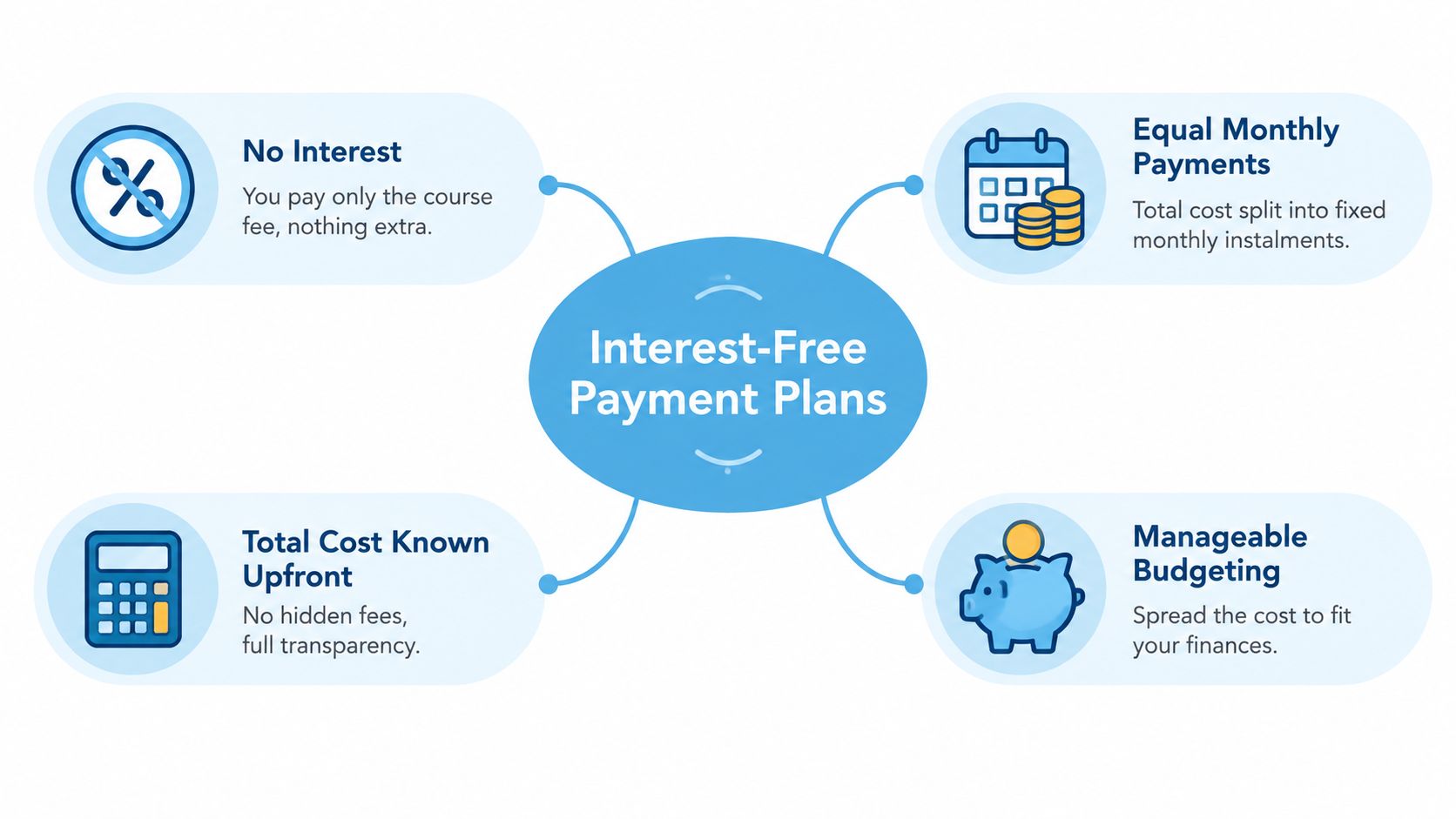
Suppose you are working, caring for family and preparing for an Access to HE Diploma. Paying the whole course fee at once may put pressure on the same budget used for rent, food and transport. An interest free payment plan spreads that fee across agreed instalments, so the education costs the same overall while the timing becomes easier to manage.
The process follows five practical steps:
- Confirm the total fee. Check the full course price and any charges listed in the provider's terms.
- Check the repayment period. Find out how many payments are due and on which dates.
- Divide the total. The provider allocates the course fee across the agreed instalments.
- Make each payment on time. Read the rules for missed or failed payments, because the plan's conditions still apply.
- Complete the schedule. After the final instalment, the agreed course fee has been paid.
For example, a £1,200 course divided into 12 equal instalments works out at £100 per month. This calculation gives you a figure to compare with dependable income and essential outgoings before you commit. A payment plan is like separating one large household bill into labelled envelopes. The total stays visible, while each month has a clearer task.
Interest free is not the same as cheap credit
Traditional credit can add interest, increasing the amount repaid beyond the original price. An interest free arrangement should state the total cost clearly and explain whether administration fees, penalties or other charges may apply.
“Pay later” products do not all follow identical rules. The FCA describes Deferred Payment Credit as interest-free credit repayable in 12 or fewer instalments within 12 months or less. This definition provides a useful comparison point for a 12-month study plan. Read the FCA's guidance on Buy Now, Pay Later and deferred payment credit before agreeing to any arrangement.
Credit checks and payment reporting can differ between products. If you are reviewing your wider finances, credit score tips from Superior Credit Repair may help explain why the provider's terms, not just the monthly figure, deserve attention.
Typical Terms Eligibility and the 12 Month Structure
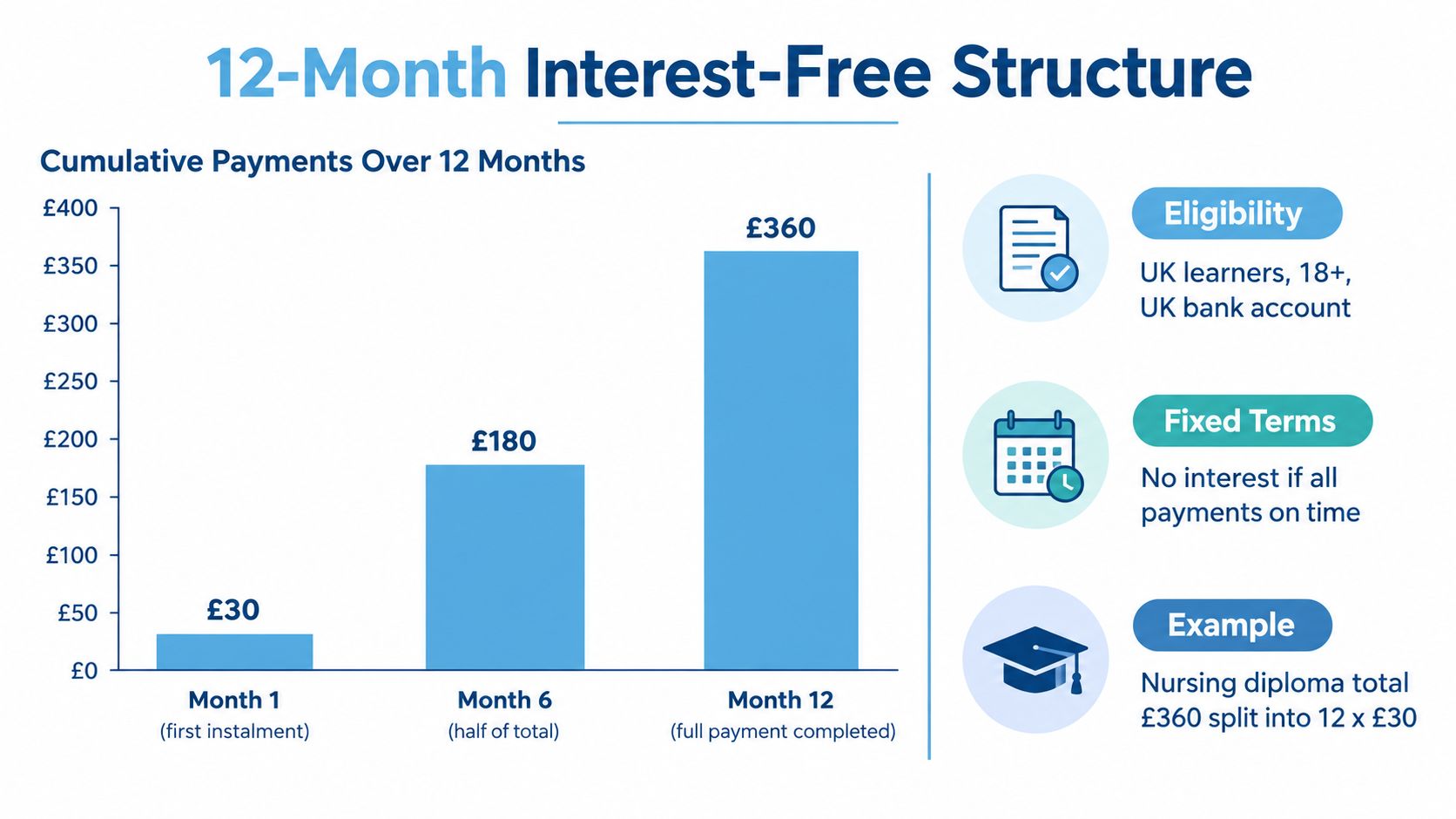
A 12-month plan gives you a full year to distribute the course fee across regular payments. The UK regulatory definition of Deferred Payment Credit refers to 12 or fewer instalments over 12 months or less, so a 12-month structure is directly relevant when you're assessing interest free study finance.
The exact eligibility rules belong to the provider or finance partner. You may be asked for personal details, payment information and evidence that you can meet the schedule. Some arrangements may require a UK bank account or other conditions, but you should never treat an example checklist as a guarantee. Ask the provider to confirm the requirements before applying.
Read the schedule as carefully as the headline
A payment plan should make several points easy to find:
- Total amount: Check the complete course fee and whether any separate administration or assessment charges apply.
- Instalment amount: Confirm the exact amount taken each month.
- Payment dates: Look for the first collection date and the regular date that follows.
- Missed payment rules: Find out whether a failed payment leads to a fee, account action, or another consequence.
- Cancellation terms: Understand what happens if your circumstances change or you decide not to continue.
- Support route: Keep the provider's contact details so you can ask for help before a payment is missed.
Suppose the course fee is £1,200. Dividing it into 12 equal payments gives £100 per month. That figure needs to sit alongside your household budget, not outside it. List your dependable monthly income, essential bills, food, travel, existing commitments and a realistic allowance for irregular costs. The remaining amount shows whether the plan is comfortable, tight or unsuitable.
Why missed payments need attention
“No interest” doesn't mean “no responsibility”. A missed payment can trigger consequences under the agreement, and the provider should explain them in plain language. Contact the provider promptly if your income changes or a payment is at risk, rather than waiting for the problem to grow.
The FCA's recent research found that 20% of UK adults, or 10.9 million people, had used unregulated BNPL at least once in the 12 months to May 2024, while 1.9 million used it frequently during that period. The same update reported that 2% of UK adults, about 1.1 million people, had £500 or more of outstanding BNPL debt. These figures concern unregulated BNPL, not every education plan, but they show why several monthly commitments should be considered together. The findings appear in the FCA's consumer protection update on BNPL borrowing.
Benefits and Drawbacks You Should Weigh Before Choosing
An interest free plan can make education feel more reachable, but it isn't automatically suitable for every household. The right question is not just, “Can I make the first payment?” It's, “Can I maintain the full schedule while my work, family and essential costs continue?”
The case for spreading the cost
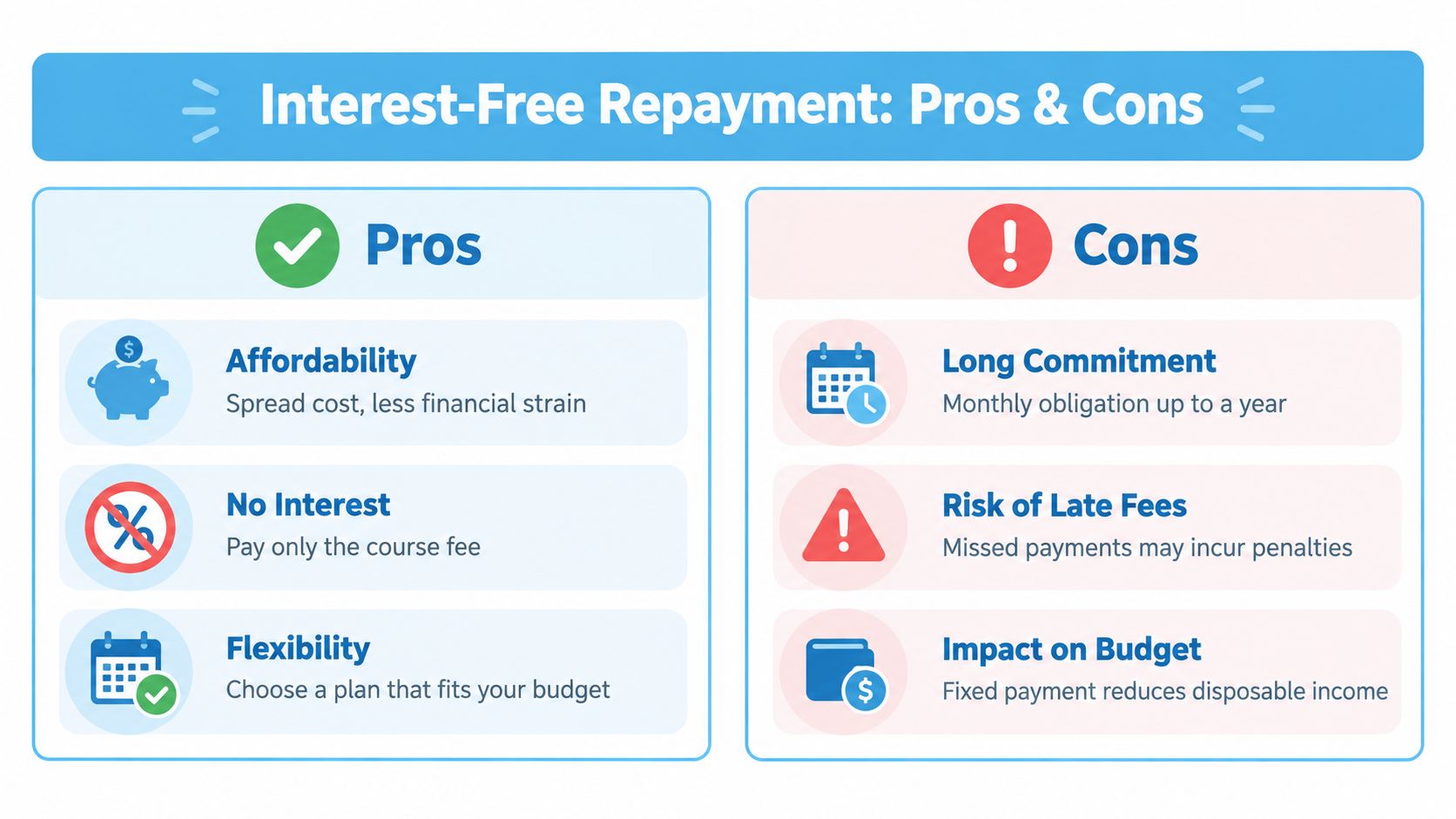
The clearest benefit is cash-flow control. You keep more of your available money for immediate household needs instead of paying the whole course fee at once. Fixed instalments can also make the education cost easier to place in a monthly budget.
There's a second benefit for adults who want to start building momentum. If the payment arrangement allows you to enrol without waiting to save the entire fee, you may be able to begin studying while continuing to work. Flexible online learning can make that choice more realistic, especially when attending a physical centre every day isn't possible.
The absence of interest is another important advantage. When the agreement contains no interest and you meet its terms, the course fee doesn't grow because you've chosen monthly payments. That gives you a clearer target.
The responsibilities to take seriously
Monthly payments become a fixed commitment. A busy month, unexpected repair or change in working hours doesn't automatically remove the instalment, so you need enough flexibility in your budget to cope with ordinary surprises.
Potential disadvantages include:
- Budget pressure: The payment reduces what remains for discretionary spending each month.
- Late-payment consequences: The agreement may include fees or other action if an instalment fails.
- Longer commitment: A plan can continue for up to a year, even if your circumstances change.
- Less room for other commitments: Several instalment arrangements can become difficult to manage together.
Before agreeing: Write the payment into a full household budget for every month of the schedule. If the plan only works when nothing unexpected happens, it may be too tight.
An interest free plan also isn't free education. You still commit money, time and effort, and you should check the course's entry requirements, assessment approach, progression route and cancellation terms. Compare the arrangement with saving first, available funding support or other suitable options rather than focusing on the monthly figure alone.
How Interest Free Payment Plans Work for Access to HE Courses Online
The practical journey begins with choosing a subject that matches your intended degree. An adult learner might explore an Access to HE Diploma linked to Nursing, Midwifery, Health Professions, Computer Science, Science, Social Science, Business and Management, Music Technology or another pathway. The right choice depends on the university progression requirements and the career direction you're considering.
Once you've selected a course, ask for the full fee and the available payment arrangements. If a 12-month interest free option is offered, request the written schedule, confirm the monthly amount, and check the rules for failed payments, cancellation and changes in circumstances. You can also learn more about Access to HE courses online before deciding whether the study model suits you.

A manageable enrolment sequence
The payment itself is only one part of the learner experience:
- Ask questions first. Discuss the subject, course requirements, study expectations and payment terms.
- Confirm your route. Make sure the Diploma supports the degree direction you're exploring.
- Review the agreement. Check the total cost, instalments, dates and missed-payment conditions.
- Set up a reliable payment method. Use an account that will have enough money on the agreed dates.
- Begin your online study. Work through materials at a pace that fits around employment and family commitments.
- Use available support. Contact tutors or the provider's support team when you need help with academic tasks or practical questions.
Flexible study doesn't mean studying without guidance. Access Courses Online provides tutor guidance and support through email, phone and WhatsApp, alongside online learning designed for adults who may be balancing several responsibilities. You can start at a time that suits your circumstances and organise study around your existing routine.
The following video offers another way to think about online learning and the experience of returning to education:
Payment support removes one barrier, but it doesn't replace course research. Ask about accreditation, assessment deadlines, tutor access, expected study time and progression guidance before you enrol. Clear answers help you choose with confidence.
Budgeting Smartly While You Study and Pay Monthly
A good budget gives the payment a proper place in your life. Start with income you can reasonably rely on, then list essential costs such as housing, utilities, food, travel, childcare and existing repayments. Add the course instalment only after you've recorded those commitments, so you can see what the payment leaves available for everyday living.
Use a simple three-part test:
- Can I pay it now? Check the amount remaining after essential bills.
- Can I pay it during a difficult month? Consider reduced hours, seasonal costs or an unexpected household expense.
- Can I protect the payment date? Set a reminder and keep the money available before the collection date.
You don't need a complicated spreadsheet. A notes app, paper planner or basic banking budget can work if it shows the full payment period clearly. Create a line for each month and mark the instalment before adding optional spending.
Make the plan easier to maintain
Separate predictable costs from occasional ones. If annual insurance, school expenses or repairs arrive at particular times, set aside a small amount regularly rather than treating them as surprises. Review the budget when your working hours, household income or essential bills change.
Avoid counting uncertain income as though it's guaranteed. A payment that depends on overtime may look manageable on paper but become stressful if overtime disappears. If the calculation is close, ask the course provider whether another funding route or start date could be more appropriate.
Budgeting principle: A sustainable plan protects both the payment and your ability to live normally while studying.
Adults considering advanced study may also encounter different forms of student finance. Read the guidance on advanced learner loan repayment so you can compare the structure and future obligations of other options without assuming they work like an interest free plan.
Your Next Steps to Starting With Confidence
After a busy workday and family responsibilities, a single course fee can feel out of reach. A 12-month interest free plan changes the shape of that cost. Instead of paying everything at once or relying on a loan or credit card, you can divide an Access to HE Diploma into agreed monthly instalments, provided the arrangement suits your circumstances.
Start by writing down the full course fee and the proposed payment dates. Check that each instalment fits after rent, food, travel, childcare and other regular bills. Then read the agreement carefully, including cancellation terms, failed-payment consequences and any conditions attached to eligibility.
The 12-month structure still needs attention. Confirm who provides the finance, whether the arrangement is described as interest free credit, and how many instalments are required. The FCA's consumer information on Buy Now, Pay Later explains why learners should check the provider's permissions and the terms governing the agreement. A payment plan is only useful when you understand both its cost and your responsibilities.
Use this practical checklist:
- Choose your intended degree direction. Consider whether Nursing, Midwifery, Health Professions, Computer Science, Science, Social Science, Business or another subject matches your plans.
- Request personalised course information. Confirm entry requirements, progression guidance, study expectations and assessment arrangements.
- Ask for payment terms in writing. Check the total fee, instalment dates, cancellation conditions and what happens after a missed payment.
- Test the monthly amount against your household budget. Check both an ordinary month and a month affected by reduced work hours or unexpected costs.
- Explore support before enrolling. Ask about taster days, funding guidance and academic support.
- Choose a realistic start point. Your study schedule should fit around work, family care and recovery time.
You do not need traditional qualifications to explore a new direction, and you do not have to decide everything in one evening. Clear terms and a workable monthly amount can make returning to education feel manageable.
Access Courses Online offers fully online Access to HE Diplomas, tutor guidance and 12-month interest free payment plans for eligible learners. Visit Access Courses Online to explore course pathways, request personalised advice and check whether monthly payments fit your route back into education.