

You're preparing for university, but the reading list already feels like a test you haven't agreed to take. Perhaps you read a page several times, lose the thread in a long paragraph, or know what you want to say but can't organise it into an assignment. These difficulties can feel especially confusing when you've managed work, family responsibilities and everyday life for years.
An assessment can help you understand why studying feels harder than it should, what type of difficulty may be involved and which forms of support are likely to help. It isn't a pass or fail test, and it doesn't decide whether you belong in higher education. It gives you clearer evidence for practical decisions, from choosing an Access to HE Diploma to discussing adjustments with a university.
Starting the Journey Back to Education
Anya was thirty-two when she decided to apply for university. She'd spent the previous decade working in retail, where she'd become good at solving problems quickly, remembering customer preferences and training new colleagues. Studying felt different. An online preparation module asked her to read several pages, identify the main argument and write a short response. Anya understood each sentence, yet reached the end without being able to explain what she'd just read.
She opened an old folder of school reports. One teacher had described her as bright but disorganised. Another had mentioned that she worked slowly and needed encouragement to complete written tasks. At school, Anya had assumed she was careless. Now, with a university application in front of her, those comments looked like clues.
As she searched for explanations, she came across dyslexia, dyscalculia, ADHD and learning disability. Some descriptions sounded familiar. She read slowly, lost her place in dense text and found long written instructions difficult to break into manageable actions. Numbers were manageable at work, but maths word problems often became confusing because she couldn't identify which information mattered.
Anya's experience is common among adults returning to education. A mature student may have developed effective workarounds without ever receiving a formal explanation. The meaning of being a mature student can include returning to learning with responsibilities and experiences that weren't present during school years, but that experience doesn't remove the need for appropriate support.
A useful starting point: Notice patterns rather than judging yourself. Slow reading, missed details and difficulty planning written work may reflect a learning profile, not a lack of effort.
Anya began asking what an assessment could offer. Would it confirm dyslexia, identify another difficulty or show that anxiety and unfamiliar academic tasks were affecting her concentration? She also had to consider the practical questions, including who could assess her, what evidence a provider would accept and whether the cost and time would be worthwhile. Those questions form the basis of a sensible next step.
Understanding Learning Disability Assessment
A learning disability assessment is a formal evaluation carried out by a suitably qualified professional. It examines learning, thinking, communication and functional performance to identify whether a specific learning difficulty or broader learning disability is present, and to explain how the profile affects everyday tasks.
The phrase “learning disability” can cause confusion because UK services use it in a clinical sense. A learning disability involves lower intellectual ability, significant difficulty with social or adaptive functioning, and onset during childhood. The NICE guidance on challenging behaviour and learning disabilities makes clear that assessment shouldn't rely on IQ alone. An assessor should also consider developmental history, adaptive functioning and current impact.
A learning difficulty is a wider everyday term. It may describe a barrier to learning without identifying one specific clinical condition. A specific learning difficulty, often called an SpLD, affects particular processes. Dyslexia may affect accurate or fluent reading, spelling and written language. Dyscalculia may affect number sense and mathematical reasoning. ADHD can affect attention and executive functioning, although it isn't the same as dyslexia or a learning disability.
Labels need context
A person who confuses letters such as b and d may be experiencing a reading or spelling difficulty, but that single example doesn't establish dyslexia. Someone who loses track of a maths word problem may need support with language processing, working memory, attention or numerical reasoning. The assessor considers the wider pattern, including persistence, educational history and functional impact.
The purpose isn't to produce a simple yes-or-no result. A useful report should describe strengths, areas of difficulty, diagnostic conclusions where appropriate and recommendations. It may explain why Anya can discuss a topic confidently but struggles to turn that knowledge into a structured essay, then suggest tools or strategies that address the specific barrier.
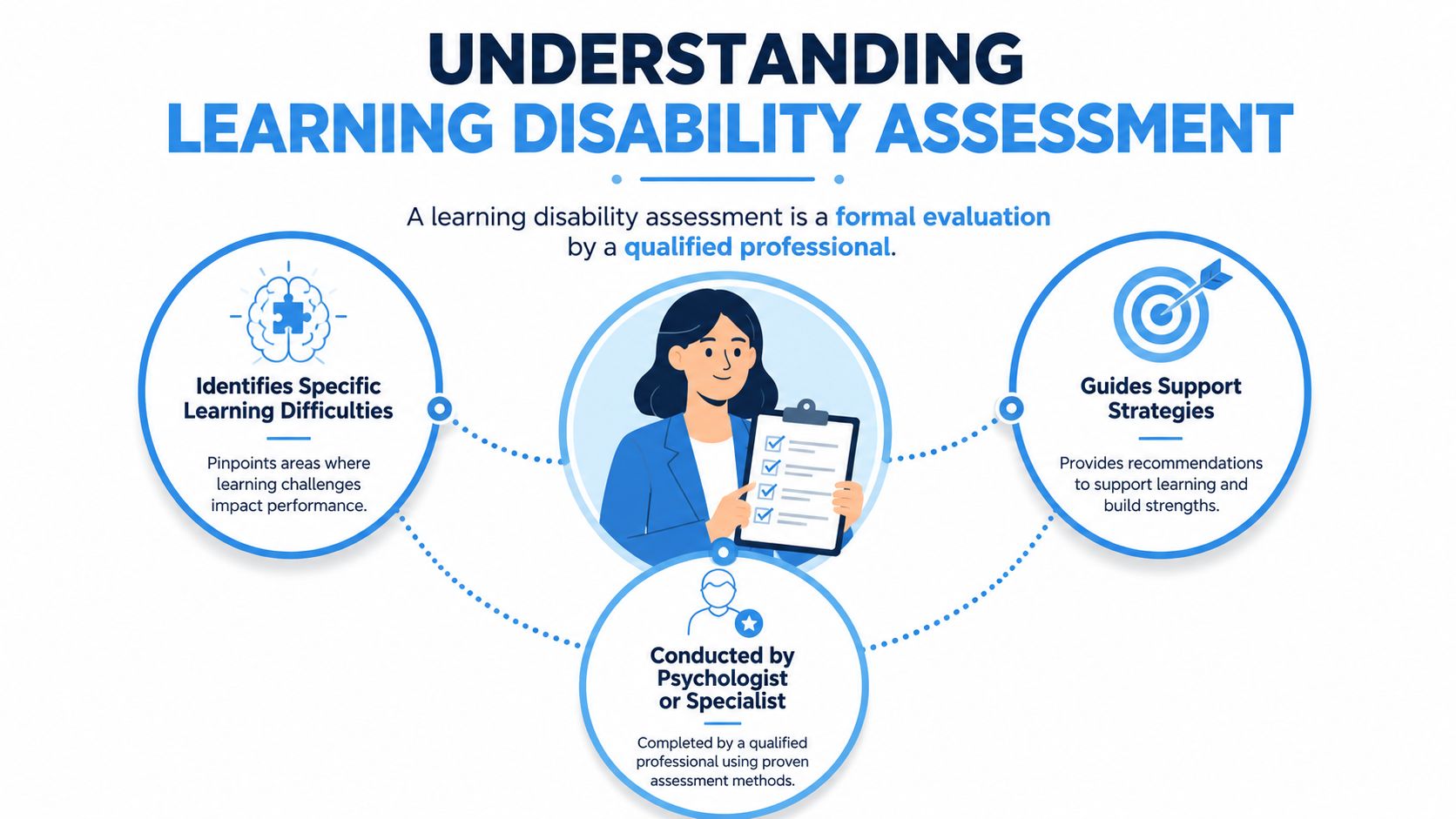
England has an estimated approximately 1.3 million people with a learning disability, including over 950,000 adults aged 18 or over, according to the UK government's learning disabilities guidance. That population estimate shows why clear assessment routes matter across health, education and social care. It doesn't mean every adult who struggles with reading or organisation has a learning disability. Many adults need assessment for a specific learning difficulty or another condition instead.
Who Conducts the Assessment
The right professional depends on the question you need answered. An educational or chartered psychologist may assess cognitive abilities, attainment, learning patterns and functional impact. A specialist teacher with an appropriate assessment qualification may assess specific learning difficulties such as dyslexia, particularly when the report is intended for educational support.
An occupational therapist may contribute where the main concern involves functional cognition, sensory processing or everyday participation, although they won't automatically provide the same diagnostic evidence as a psychologist or specialist assessor. A GP can discuss concerns and may refer into NHS pathways, but a referral usually starts a route rather than guaranteeing a rapid diagnostic appointment.
University disability services often arrange or guide needs assessments after an offer or enrolment. Independent clinics may offer adult assessments directly, while local authority teams, NHS services and charities can provide information or screening. Organisations such as the British Dyslexia Association can help adults understand available routes, but a short online screener or tutor checklist isn't a full assessment.
For a straightforward explanation of the psychologist's role, this resource on learning disabilities psychologist explained can help separate professional assessment from informal screening.
| Professional or Service | Typical Role in Assessment | Where They Usually Work |
|---|---|---|
| Educational or chartered psychologist | Evaluates cognitive and educational profiles, interprets functional impact and writes recommendations | Independent clinics, education services and university-linked services |
| Specialist teacher assessor | Assesses specific learning difficulties and recommends educational strategies | Independent practices, schools and specialist services |
| Occupational therapist | Explores functional cognition, participation and practical barriers | NHS services, clinics and community teams |
| GP or NHS pathway | Discusses concerns, records relevant history and may make a referral | General practice and NHS services |
| University disability service | Advises on evidence, needs assessments and reasonable adjustments | Colleges and universities |
| Charity or screening service | Offers information, preliminary screening or signposting | National charities and community services |
Funding can involve several organisations. A university may use a needs assessment to inform Disabled Students' Allowances, while an employer may explore support through Access to Work. Ask the provider exactly what qualification the assessor holds, what the report can be used for and whether the university or funding body accepts that format.
What the Assessment Process Involves
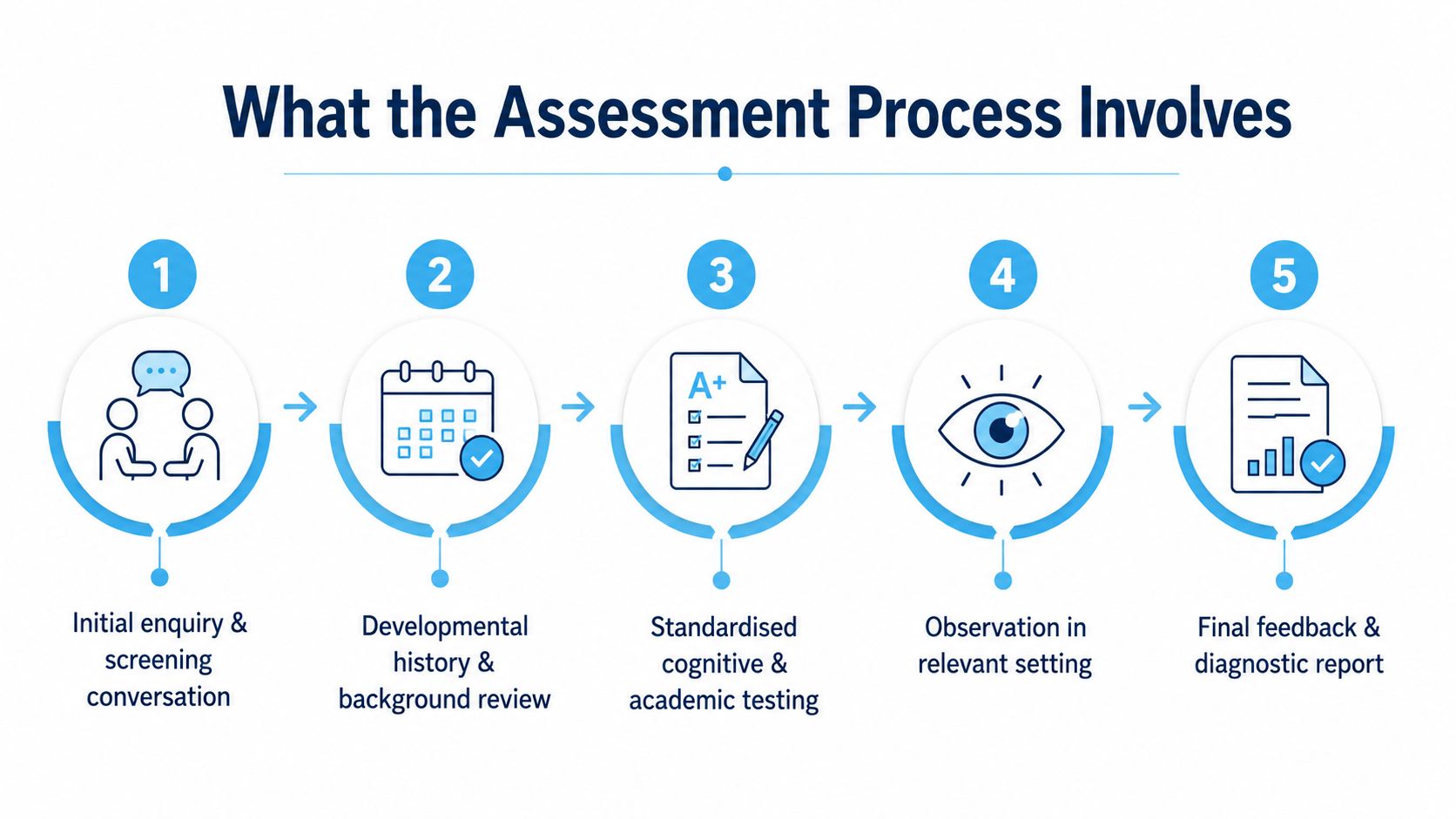
An adult assessment usually begins with an enquiry or screening conversation. The assessor will ask what has prompted you to seek help, which tasks are difficult now and what happened during earlier education. You may be asked about family history, developmental milestones, school reports, previous support, work demands and current study.
Bring anything that helps establish a pattern. Old reports, exam records, examples of written work and notes from tutors or employers can be useful, but a lack of childhood paperwork doesn't automatically prevent assessment. Your account of persistent difficulties matters because adult assessment connects past experiences with present functional impact.
A typical appointment
The main assessment is usually completed through one-to-one sessions. Some providers use a single extended appointment, while others divide the work across visits. Activities may examine:
- Reading and spelling: The assessor may look at accuracy, fluency, decoding and written spelling.
- Writing: You may complete tasks that show how you organise, express and review ideas.
- Memory and processing: Activities can explore how you hold information in mind and work with it.
- Reasoning: Verbal, visual or numerical reasoning tasks can reveal different strengths.
- Attention and executive skills: The assessor may consider planning, organisation and sustained focus.
Formal tests use standardised tools, which allow the assessor to interpret performance against appropriate reference groups. Informal observation is different. The assessor may notice how you approach instructions, respond to unfamiliar tasks, manage time or recover after an error. Interview questions add context that test scores can't provide on their own.
The assessor is looking for a consistent profile of difficulty, not one disappointing result. They'll consider whether other factors, such as hearing or sight problems, language background, interrupted education, mental health difficulties or physical health conditions, may affect performance. Co-occurring conditions can be relevant, and they may require additional assessment rather than being treated as evidence of one diagnosis.
Feedback and timing
After testing, the professional analyses the information and prepares a report. It should explain conclusions in plain language, identify strengths and barriers, and recommend practical support for study or work. Ask whether feedback is provided verbally, whether you can query the report and how long the written version will take.
Waiting times vary widely. An independent provider may have different availability from an NHS or university route, and funding arrangements can affect scheduling. Ask before booking about the expected timescale, appointment length, total fee, cancellation terms and whether the final report meets your intended university or funding requirement.
This video may help you understand how assessment conversations and recommendations can fit into a wider support process:
Gathering Evidence for Educational Support
Universities and Access course providers need evidence that connects an identified condition with current study needs. A document can be genuine and still be unsuitable if it lacks functional detail, is too old for the provider's policy or comes from someone without the required qualification.
A full diagnostic report from a registered psychologist or suitably qualified specialist assessor is usually the strongest starting point for a specific learning difficulty. It should identify the assessment methods, explain the findings and translate them into practical recommendations. A short screening report can flag a concern, but it may not establish enough detail for formal support decisions.
Compare the evidence before you rely on it
| Evidence Type | Typical Use | Strengths and Limits |
|---|---|---|
| Full diagnostic report | University disability support, DSA-related evidence and formal adjustment discussions | Detailed and personalised, but check the assessor's credentials and the provider's requirements |
| Needs assessment report | Recommending practical study support and equipment | Focuses on functional support, but may not diagnose a condition |
| Educational psychologist statement | Explaining learning needs and suggested strategies | Can provide helpful professional context, but acceptance depends on content and authority |
| EHCP or school paperwork | Showing earlier educational history | Useful background, but it may not describe adult higher education needs |
| Tutor or employer letter | Confirming current difficulties in study or work | Adds real-world evidence, but doesn't replace formal assessment |
| Screening result | Deciding whether further enquiry is sensible | Helpful as an initial indicator, but insufficient on its own for many formal decisions |
Providers often ask for recent evidence, sometimes covering the current stage of adult study. Don't assume an old school plan will automatically translate into university adjustments. Ask the intended provider what it accepts before paying for a new report.
Your own evidence can make the picture clearer. Keep a short timeline of difficulties, save examples of assignments that show the barrier and ask a tutor or employer to describe the task affected. The important detail is functional: “I understand the discussion but can't organise the written response without support” is more useful than “I'm bad at essays”.
Practical rule: Ask, “What decision will this report support?” before arranging an assessment. The answer should guide the professional you choose and the evidence you collect.
This approach can also help with a Disabled Students' Allowances application or a university support plan. A report names and explains the profile, while current examples show how that profile affects your actual course tasks.
Using Assessment Results at University
An assessment report becomes useful when you share it with the right team and discuss how the recommendations apply to your course. Contact disability services as early as possible, ideally before enrolment, because the team may need time to review evidence, arrange a needs assessment or coordinate support with teaching staff.
Possible adjustments include:
- Accessible materials: Lecture slides, reading materials or handouts may be provided in an alternative format.
- Assistive technology: Text-to-speech, speech-to-text, screen-reading or planning tools may reduce barriers.
- Study skills support: Specialist sessions can address planning, note-taking, reading strategies and assignment structure.
- Assessment arrangements: Depending on individual need, arrangements may include rest breaks, a separate room or additional time.
- Course communication: Staff may clarify instructions, provide structure or explain how resources should be used.
These are examples, not automatic entitlements. Under the Equality Act 2010, a university considers whether a learner is disabled within the legal definition and what reasonable adjustment is appropriate in the circumstances. Disabled Students' Allowances can fund support linked to disability or specific learning difficulty, but evidence must show impairment and educational impact. The university or relevant funding process makes an individual decision, and one report doesn't guarantee every recommendation will be approved.
Share information strategically
You don't need to disclose your whole personal history to every lecturer. Start with the disability or inclusion team, explain the tasks that create barriers and ask how the report will be used. You can then agree what information teaching staff need in order to provide adjustments.
Keep your report in a secure place. You may need it for an Access to HE application, a DSA process, a future course or a workplace request. Guidance on learning disabilities support can also help you think through the practical difference between identifying a need and arranging support.
Review arrangements when your course changes. A strategy that helps with short weekly tasks may not be enough for a dissertation, placement or timed examination. Tell disability services when the demands change rather than waiting until difficulties become overwhelming.
Planning an Accessible Route into Higher Education
An assessment doesn't have to determine whether you study. It can help you choose how you study, what preparation you need and which questions to ask before enrolling.
An Access to HE Diploma can provide a structured route into higher education for adults who don't hold traditional entry qualifications. Course work may develop academic writing, research, subject knowledge, study organisation and numeracy. That preparation can build confidence while giving you a chance to test strategies in a supported learning environment.
An Access course isn't a clinical assessment and can't replace one. Tutors may notice patterns, offer helpful strategies and encourage you to seek professional advice, but they can't turn classroom observation into a diagnostic report. It also doesn't guarantee university entry. Entry requirements and credit or progression policies vary by institution, so check the destination university's expectations early.
A practical route
- Review your pattern: Write down the tasks that cause difficulty, the strategies you already use and the situations where you work well.
- Request evidence: Collect school records, current examples and professional reports. Ask the intended provider what it accepts.
- Choose a route: Compare direct university entry with an Access to HE Diploma, considering your qualifications, subject requirements and confidence.
- Contact support teams: Speak with admissions and disability services before enrolment. Ask about evidence, adjustments, course delivery and application deadlines.
- Use recommendations: Apply the report's strategies during the Access course or degree, then review them when course demands change.
Flexible learning may also require specific accessibility questions. For example, ask whether recorded teaching includes accurate captions, whether reading materials work with text-to-speech and whether online platforms are easy to use. A practical guide to VideoLearningAI branded_anchor_1 offers useful context on captions as an accessibility feature, although caption quality should always be checked for your own needs.
The guide to the Access to Higher Education Diploma can help you compare preparation options. The strongest route is the one that combines realistic academic preparation with evidence-based support, rather than expecting either an assessment or a course to solve every barrier alone.
Common Questions About Adult Assessment
I've never been diagnosed. Where do I begin?
Start with your intended university or course provider and ask what evidence it accepts. You can also contact an independent qualified assessor, speak with your GP about relevant NHS routes or seek information from a specialist charity. An employer may have an occupational health or assistance route, particularly if the same difficulty affects work, but workplace screening isn't always sufficient for university support.
What documents will a university accept?
Requirements vary. A diagnostic report, needs assessment or professional supporting letter may be useful, while a tutor statement can explain current functional impact. An EHCP or school report may provide valuable background but might not contain the information required for adult higher education. Ask the disability service before arranging an assessment, especially if you're paying privately.
What if I also have ADHD, anxiety or autism?
Tell the assessor about all relevant conditions and how they affect study. Some assessments consider overlapping features, while others require separate referrals to a professional with the right expertise. Anxiety, attention difficulties and communication needs can influence performance, so the report should explain what was considered rather than attributing every problem to one label.
Who should I contact at university?
Admissions can answer entry and application questions. Disability or inclusion services can discuss evidence, reasonable adjustments and needs assessments. Wellbeing services may help with emotional support, but they don't necessarily arrange diagnostic assessments. You can ask questions before applying without formally disclosing a condition, then discuss disclosure and support arrangements after an offer or enrolment.
If you're ready to explore an Access to HE route, Access Courses Online offers flexible online diplomas designed for adults balancing work, family and a return to study. Visit the site to review subject pathways, ask about support and find a practical starting point for your university plans.