
So, what exactly is a midwife access course? Think of it as your dedicated pathway to university, built specifically for aspiring midwives who don't have the usual A-Levels. It’s a nationally recognised Level 3 qualification that acts as a bridge, giving you the precise knowledge and academic skills you'll need to get a place on a competitive midwifery degree.
Your Bridge to a Midwifery Degree
Imagine you want to get to the other side of a river. Your destination is a university midwifery degree. The main bridge everyone talks about is built from A-Levels, but what if that bridge isn't an option for you? You need a different route, one designed just for this purpose.
That’s exactly what the Access to Higher Education Diploma (Midwifery) is. It’s your specialised, purpose-built bridge. This isn't some generic, one-size-fits-all qualification; every single module is crafted to get you ready for the real-world demands of studying midwifery at university.
This course is made for adults coming back to education. Maybe you're switching careers, you're a parent who's ready to chase a lifelong dream, or you just didn't get the qualifications you needed back in school. The diploma values your life experience and helps you channel it into a formal, academic structure. It’s an official and widely respected alternative route that universities all over the UK recognise.
Who Is This Course Perfect For?
The midwife access course is a fantastic fit for anyone who is passionate about supporting families through pregnancy, birth, and early parenthood but doesn't have the specific qualifications universities ask for. It's especially well-suited for:
- Career Changers: Professionals from totally different fields who feel a true calling to midwifery and need a focused qualification to make the leap.
- Parents Returning to Education: People who have been out of the classroom for a few years (or more!) and need a flexible way to study that fits around family life.
- Aspiring Midwives without A-Levels: Anyone who took a different path after leaving school but now has their heart set on becoming a midwife.
Put simply, if your ambition is crystal clear but your academic transcript isn't, this course was designed with you in mind. For a bit more background, our guide on what is an access course breaks down how these qualifications work as a key to unlocking university.
Building Confidence and University-Ready Skills
One of the biggest hurdles for adult learners isn't ability—it's often a lack of academic confidence. An Access to HE Diploma tackles this head-on. It does more than just teach you about human biology and health; it teaches you how to be a university student.
The course is structured to gently ease you back into academic life. It focuses on building core skills like critical thinking, solid research, and how to write a great essay. This means you’ll arrive at university not just with a qualification, but genuinely prepared to hit the ground running and succeed.
The curriculum is carefully put together to match what midwifery degrees demand. You'll dive into the foundational subjects that give you the scientific and social context for midwifery, making sure you have the core knowledge that admissions tutors are looking for. Beyond the standard university route, you might also be curious about other pathways, like how to become a Direct Entry Midwife. This diploma solidifies your understanding and proves your commitment, making your university application so much stronger.
Understanding Your Eligibility and Entry Requirements
One of the biggest myths that stops talented people from pursuing a career in midwifery is the idea that you need a perfect set of A-Levels from your school days. Let’s be clear: that’s not true.
The Access to HE Diploma (Midwifery) was created specifically for people who don't have those traditional qualifications. It’s designed for adults returning to education, valuing your life experience and passion far more than old exam results. The hurdles are realistic, relevant, and built to get you where you want to go.
So, let's break down exactly what you do and don't need to get started.
The Core Academic Requirements
While you don’t need A-Levels, universities still have some essential requirements to make sure you’re ready for degree-level study.
Typically, you'll need GCSEs in English and Maths at a grade C/4 or above. These are non-negotiable because they prove you have the foundational literacy and numeracy skills for everything from writing assignments to calculating drug dosages.
But what if you don't have them? Don’t let that put you off. Many providers, including us, allow you to study for Functional Skills Level 2 or GCSE qualifications at the same time as your Access course. This means you can get everything sorted in one go, creating a seamless path to your university application.
This simple flowchart shows how the Access course bridges the gap between where you are now and that coveted university spot.
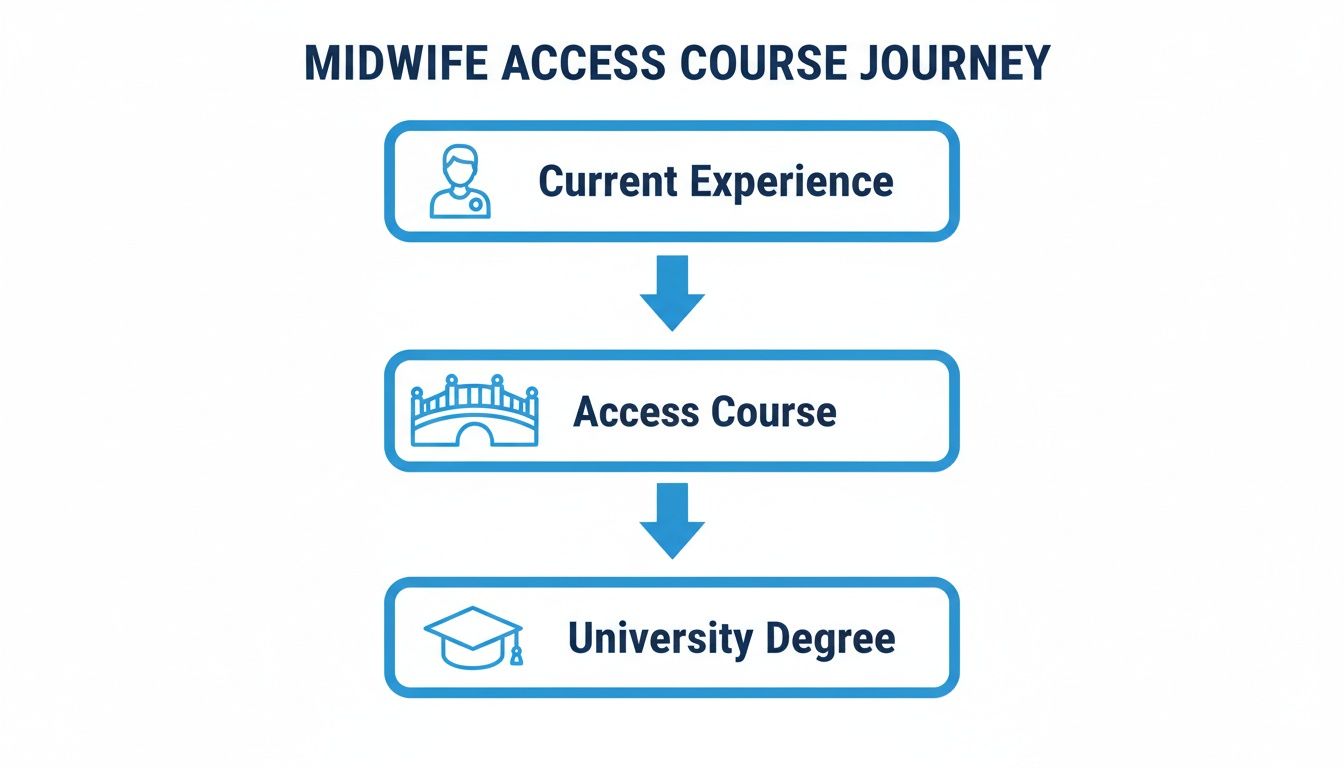
As you can see, it's a clear, straightforward journey that turns your ambition and experience into the formal qualification universities are looking for.
Beyond Grades: Personal Qualities That Matter
Grades only tell half the story. Midwifery is a deeply human-centred profession, and university admissions tutors are looking for key personal qualities. This is your chance to shine.
Successful aspiring midwives often have:
- Compassion and Empathy: A genuine ability to connect with and support people during one of the most intense and emotional times of their lives.
- Resilience and Calmness Under Pressure: The strength to handle demanding situations—both emotionally and physically—with a level head.
- Strong Communication Skills: The ability to listen properly, explain things clearly, and be a strong advocate for your patients.
- A Genuine Interest in Midwifery: A clear passion for the role, backed up by research into what a midwife actually does and the core values of the NHS.
Your life experience is a huge asset. Whether you’ve raised a family, cared for a relative, or worked in a customer-facing role, you have developed transferable skills that are highly relevant to midwifery. Don't underestimate their value.
Pathway to a Midwifery Degree: A Comparison
To really see why this route is so popular with adult learners, it helps to compare it directly to the traditional A-Level path.
The table below breaks down the key differences.
| Requirement | Midwife Access Course Pathway | Traditional A-Level Pathway |
|---|---|---|
| Primary Qualification | Access to HE Diploma (Midwifery) | 2-3 A-Levels, typically including a science |
| Typical Timescale | 9-12 months of flexible online study | 2 years of full-time college/sixth form |
| Target Learner | Adults (19+) returning to education | School leavers (16-18 years old) |
| GCSE Requirements | English & Maths (C/4 or above) | 5 GCSEs (including English, Maths, Science) |
| Focus of Study | Highly specific to midwifery and healthcare | Broad academic subjects |
As you can see, the Access course is a much faster and more focused route designed to fit around your life, not the other way around.
What You'll Actually Study: A Look at Core Modules and Assessments
Jumping into a midwife access course isn’t about just ticking boxes; it's about building a solid foundation for your future midwifery degree. Every single module has been carefully selected to give you the scientific, psychological, and social understanding you’ll need to thrive.
Think of it as your pre-degree toolkit. You wouldn't start building a house without a blueprint and the right materials, would you? This diploma gives you exactly that—the intellectual blueprint and academic tools to walk into your first day of university feeling confident and ready, not just qualified.
The Scientific and Health Foundations
The science and health modules are the absolute heart of the course. These are the cornerstones that support every aspect of clinical midwifery, giving you the essential knowledge to understand the incredible physiological journey of pregnancy and birth.
You’ll typically cover modules like:
- Human Biology: This is where you’ll dive into the fundamental systems of the body, from cells all the way up to anatomy and physiology. It explains the how and why behind the changes a body goes through during pregnancy, giving you a solid scientific base.
- Health Studies: Here, you’ll look at the bigger picture of health, illness, and wellbeing in our society. It helps you grasp public health principles and understand the social factors that can shape someone’s pregnancy journey.
- Human Reproduction and Development: This module gets right into the specifics of conception, foetal development, and the stages of childbirth. It’s a core component that directly prepares you for the clinical side of your degree.
These science-focused units are your way into the clinical world. They demystify the medical jargon and processes you'll come across, making those complex university lectures feel much more manageable.
Understanding the Human Side of Midwifery
Midwifery is as much an art as it is a science. Supporting expectant parents calls for real empathy and a solid grasp of human behaviour, which is why social science modules are just as crucial.
A great midwife supports the person, not just the pregnancy. The psychology and sociology modules on a midwife access course are designed to build this exact skill set, helping you understand the emotional, social, and cultural contexts of childbirth.
Modules in this area often include:
- Psychology: This helps you understand the profound emotional and mental journey of pregnancy. You’ll learn about attachment, postnatal depression, and how to support parents through the huge psychological shifts they experience.
- Sociology: This module looks at things like family structures, social inequality in healthcare, and cultural diversity. It gives you the tools to provide compassionate, non-judgemental care to people from all walks of life.
The demand for skilled, empathetic midwives is definitely on the rise. Recent UCAS data showed that midwifery acceptances went up by 3% in the last cycle, with a massive 10% increase among 18-24-year-olds. It’s clear that interest in this vital profession is growing. You can explore the full nursing and midwifery student statistics to see these trends for yourself.
How You'll Be Assessed
Let's be honest, for many people returning to education, the idea of sitting a scary, timed exam is enough to put them off entirely. The good news? The Access to HE Diploma does things differently.
The assessment method is based almost entirely on coursework. This isn't about testing your memory under pressure; it’s about helping you develop and demonstrate your understanding over time. It’s a much better fit for adult learners and also happens to be how you’ll be assessed at university.
Typical assessments include things like:
- Essays and Written Reports: Perfect for honing your research, critical thinking, and academic writing skills.
- Presentations: A great way to build your confidence in communicating complex ideas clearly.
- Case Studies: These let you apply what you've learned to real-world scenarios you might face as a midwife.
This continuous assessment model means you get regular feedback from your tutor, helping you improve with every assignment. It builds your academic skills step-by-step, making sure you are totally prepared for degree-level study without all the stress of final exams.
How Online Courses Make Midwifery More Accessible
Let's be honest, the dream of becoming a midwife can often feel a million miles away, especially when you're juggling a job, family, or other commitments. The thought of going back to a rigid, campus-based timetable just isn't realistic for most people. This is where online learning completely changes the game, knocking down old barriers and making a career in midwifery more achievable than ever.
A flexible online midwife access course puts you firmly in control of your education. Imagine being able to study after the kids are asleep, on your lunch break, or on a quiet weekend morning. There are no lectures to race to or campuses to commute to.
This whole approach is built for the realities of adult life. You study when it suits you, fitting your learning around your schedule – not the other way around.
Your Virtual Learning Environment
The idea of stepping into an online course might seem a bit daunting at first, but the whole setup is designed to be completely intuitive. Think of it as your own personal digital campus, one that's open 24/7. Everything you could possibly need is right there in one place, making your learning journey feel smooth and organised from day one.
Inside your online hub, you'll find:
- Course Materials: All your modules, notes, and learning resources are ready and waiting with a single click.
- Assignment Submissions: A straightforward online portal where you upload your work and get detailed, personal feedback from your tutor.
- Progress Tracking: Handy tools that show you exactly how far you've come and what's next on your to-do list.
This structure gets rid of all the logistical headaches that come with traditional education. It lets you focus entirely on what actually matters—learning the skills to get you into university. Our guide on whether you can do an Access to Higher Education course online dives deeper into how this flexible model really works.
Unmatched Flexibility and Support
One of the biggest wins of studying an Access to HE Diploma online is the freedom to enrol and start whenever you're ready. Unlike colleges with their strict September start dates, most online providers let you sign up all year round. That means you don't have to put your dreams on hold.
This flexibility isn't just about timing; it’s about finances, too. Many providers offer practical solutions like interest-free payment plans, letting you spread the cost of your course over a period that feels manageable. It makes that initial investment far less of a hurdle.
You are never alone on your online learning journey. Dedicated personal tutors are there to support you via email, phone, and even WhatsApp, offering guidance and feedback whenever you need it. This personalised support ensures you feel connected and confident from your first day to your last assignment.
This model has been truly instrumental in opening doors for aspiring healthcare professionals. In the UK, Access to HE Diplomas are a vital route for adult learners, with 77% of entrants being female. What's more, a significant 24% of these students come from disadvantaged areas—double the rate of other qualifications—proving how flexible online learning is widening access to education for everyone.
Ultimately, an online midwife access course dismantles the old obstacles. It proves that with the right structure, support, and flexibility, a rewarding career in midwifery isn't just a dream. It's a completely realistic and achievable goal for anyone with the passion to make it happen.
Navigating Your University Application and Interview
Finishing your midwife access course is a massive achievement, but it’s the launchpad, not the final destination. Now for the next crucial step: turning that diploma into a place at university. This part of the journey is all about putting together a compelling UCAS application and walking into your university interview with confidence.
Think of your UCAS application as telling the story of why you’re ready to become a student midwife. Your Access to HE Diploma provides the academic proof, but your personal statement is where you bring your personality, drive, and real-life experience to the forefront. It’s your chance to really connect with admissions tutors and show them the person behind the qualifications.
This is where you go from being just a name on a form to a passionate, capable, and committed candidate they can genuinely picture thriving on their midwifery degree.
Crafting a Standout Personal Statement
Your personal statement is, without a doubt, one of the most important parts of your UCAS application. You have 4,000 characters to showcase your passion for midwifery, your skills, and your understanding of what the profession truly involves. The real magic happens when you connect what you’ve learned on the Access course with your own life experiences.
Admissions tutors are looking for more than just good grades; they want to see the core qualities of a great midwife shining through.
- Demonstrate Your Motivation: Why midwifery? Dig deeper than just "I want to help people." Was there a specific moment that ignited this passion? Show them, don't just tell them.
- Translate Your Life Experience: This is where adult learners really shine. Raising children, managing a household, working in a busy shop, or caring for a relative has given you incredible skills. Frame these experiences in professional terms—empathy, time management, communication under pressure, and resilience.
- Show Your Understanding of the Role: Do your homework. What does a midwife actually do day-to-day? Talk about the challenges as well as the joys. It’s always a good idea to mention the NHS Core Values (the "6 Cs") and explain how your own values line up with them.
Your personal statement isn't just a list of achievements; it's a reflective piece of writing that connects your past experiences to your future aspirations. Think of it as answering the question: "Why should we invest three years of training in you?"
For a more detailed walkthrough, our complete guide on how to apply to university after an access course breaks down the entire UCAS process from start to finish.
Preparing to Ace Your Midwifery Interview
Getting an interview invitation is a huge win—it means your application has already made a fantastic impression. The interview is your chance to bring your personal statement to life and show them, face-to-face, why you’re right for the profession. Preparation is everything.
Universities often use a mix of question styles, from scenario-based questions to Multiple Mini Interviews (MMIs), where you move through several short "stations."
Here are a few common questions you should definitely prepare for:
- "Why do you want to be a midwife, and why at this university specifically?"
- "What do you understand about the role and responsibilities of a midwife?"
- "Can you give an example of a time you worked well in a team?"
- "How would you handle a stressful or emotionally difficult situation?"
Your answers should be thoughtful and, wherever possible, backed up with real examples from your life or work. Always try to link your skills back to the qualities needed in midwifery, like compassion, advocacy, and professionalism.
This whole period of applications and interviews can feel intense. It’s so important to look after your own well-being during this time; you can learn more about how to find a therapist for support if you feel like you need someone to talk to. Remember, taking care of yourself is the first step in being able to care for others.
From writing that first draft to practising interview questions with a friend, every step you take is bringing you closer. Your midwife access course has given you the academic key; now it’s time to unlock that university door.
Got Questions About the Midwife Access Course? We've Got Answers.
Stepping onto a new career path always brings up a few questions. It’s completely natural. We hear from aspiring midwives just like you every day, so we’ve gathered the most common queries right here. Our goal is to give you clear, straightforward answers so you can feel confident about taking this brilliant next step.
Let's get into the practical details that will shape your journey.
How Long Does the Course Take to Complete?
One of the best things about an online midwife access course is its sheer flexibility. You’re not locked into a rigid, term-time-only calendar like you would be at a traditional college.
While we give you a generous two-year window to complete your studies, most of our students find a good rhythm and earn their diploma in just 9 to 12 months.
This puts you firmly in control. You can power through your studies when life is calmer or take your foot off the gas during busier times. It’s all about making your education fit around your life, not the other way around.
Do Universities Actually Accept Online Access Courses?
Yes, absolutely. This is a really important question, and we can answer it with total confidence. The Access to Higher Education Diploma is a nationally recognised qualification, fully regulated by the Quality Assurance Agency (QAA).
This means it carries the exact same weight and UCAS points whether you study online from your kitchen table or in a physical classroom. Universities across the UK not only accept the diploma but respect it as a solid entry qualification for competitive degrees like midwifery.
The bottom line is this: how you study doesn’t change the value of your qualification. Your diploma proves you have the academic chops to succeed, no matter how you got there. That said, it’s always smart to double-check the specific entry requirements for your top university choices.
What’s the Cost and Is There Any Funding?
Money is, of course, a huge consideration. The cost of a midwife access course can vary, but there are some great ways to make it manageable.
Many online providers, including us, offer interest-free payment plans. This lets you spread the cost of your tuition over 12 months, making that initial investment much less daunting.
For students in England aged 19 or over, the Advanced Learner Loan is a fantastic government-backed option. Here’s the deal:
- It Covers Your Fees: The loan pays for your course upfront, so you don’t have to find the cash while you’re busy studying.
- Repayments Are Fair: You only start paying it back once you’re earning over a certain amount of money each year.
- It Gets Written Off: This is the best bit. Once you finish a higher education course (like your midwifery degree), Student Finance England will completely write off whatever is left of your Advanced Learner Loan.
Essentially, for students who go on to complete their degree, the Access to HE Diploma becomes free.
What Kind of Support Will I Get Studying Online?
The thought of online study can sometimes feel a bit lonely, but a good provider will have a fantastic support network ready for you. You get all the freedom of learning from home without ever feeling like you’re going it alone.
Support is built in at every level to keep you motivated and on track. Here’s what you can expect:
- Your Own Personal Tutor: This is your go-to person. They’re an expert in the field who will mark your work, give you detailed feedback, and be on hand to help via email, phone, or even WhatsApp.
- A Dedicated Support Team: Got a technical issue or an admin question? A friendly support team is there to help you sort it out quickly so you can get back to your studies.
- A Community of Students: Many courses have online forums or private social media groups. They’re a great place to connect with others on the same journey, share tips, and ask for advice.
This blend of professional guidance and peer support means you have a solid team behind you, cheering you on all the way to the finish line.
Your dream of becoming a midwife is closer than you think. At Access Courses Online, we provide the flexible, supportive, and accredited pathway you need to get into university and start your new career.
Explore our Access to HE Diploma (Midwifery) course today and take the first step.