
You might be reading this because you want more from a healthcare career. Maybe you're working in care already and want a role with more responsibility. Maybe you're planning a fresh start and trying to understand where nursing, midwifery, pharmacy, paramedicine, or allied health could eventually take you.
One of the most rewarding long-term goals in modern UK healthcare is non medical prescribing. It means a qualified healthcare professional who isn't a doctor can prescribe medicines within the rules of their role and competence. That can sound far away when you're still thinking about university entry, Access courses, or your first professional registration. It isn't.
The path is longer than a single course, but it's clear. You build your academic foundation, qualify in a healthcare profession, gain clinical experience, complete approved prescribing training, and register that qualification. If you understand the route early, you can make smarter choices now.
What Is Non Medical Prescribing and Why Does It Matter
A simple way to think about non medical prescribing is this. It gives certain healthcare professionals the authority to make medicine decisions as part of the care they already provide.
That changes what patient care looks like in practice. A nurse managing a long-term condition, a pharmacist reviewing medicines, or a paramedic working in an urgent care setting may be able to assess the person in front of them, decide what treatment is needed, and prescribe appropriately within their competence. The patient gets joined-up care instead of being sent elsewhere just for a prescription.
For someone starting out, that matters because it shows how far a healthcare career can grow. You might begin with a goal like becoming a nurse or paramedic. Years later, you could be the clinician who not only identifies the problem but also puts the treatment plan into action.
Why patients notice the difference
Think about a patient with an ongoing condition who needs regular medicine reviews. If the clinician already managing that person's care can also prescribe, the process is usually more direct. There's less handoff between professionals, fewer repeated explanations from the patient, and a clearer line of accountability.
That's one reason prescribing rights have become so important across the NHS. According to the Nuffield Trust's review of independent prescribing, as of April 2025, the UK had more than 98,000 independent prescribers, representing 24% of the total qualified prescribing workforce within the NHS.
Big picture: Non medical prescribing isn't a niche add-on. It's now a normal part of how UK healthcare works.
Why it matters for your career
If you're ambitious, this role signals a future with more autonomy and deeper clinical responsibility.
It also changes the way many people see non-doctor healthcare roles. Prescribing shows that modern healthcare isn't built around one professional group doing everything. It depends on skilled teams, with different clinicians taking lead responsibility in different parts of patient care.
That's encouraging if you're at the beginning. You don't need to be born into medicine or come from a traditional academic background to aim high. You need a realistic plan, the right qualifications, and the willingness to keep building your skills.
Understanding the Types of Non Medical Prescribers
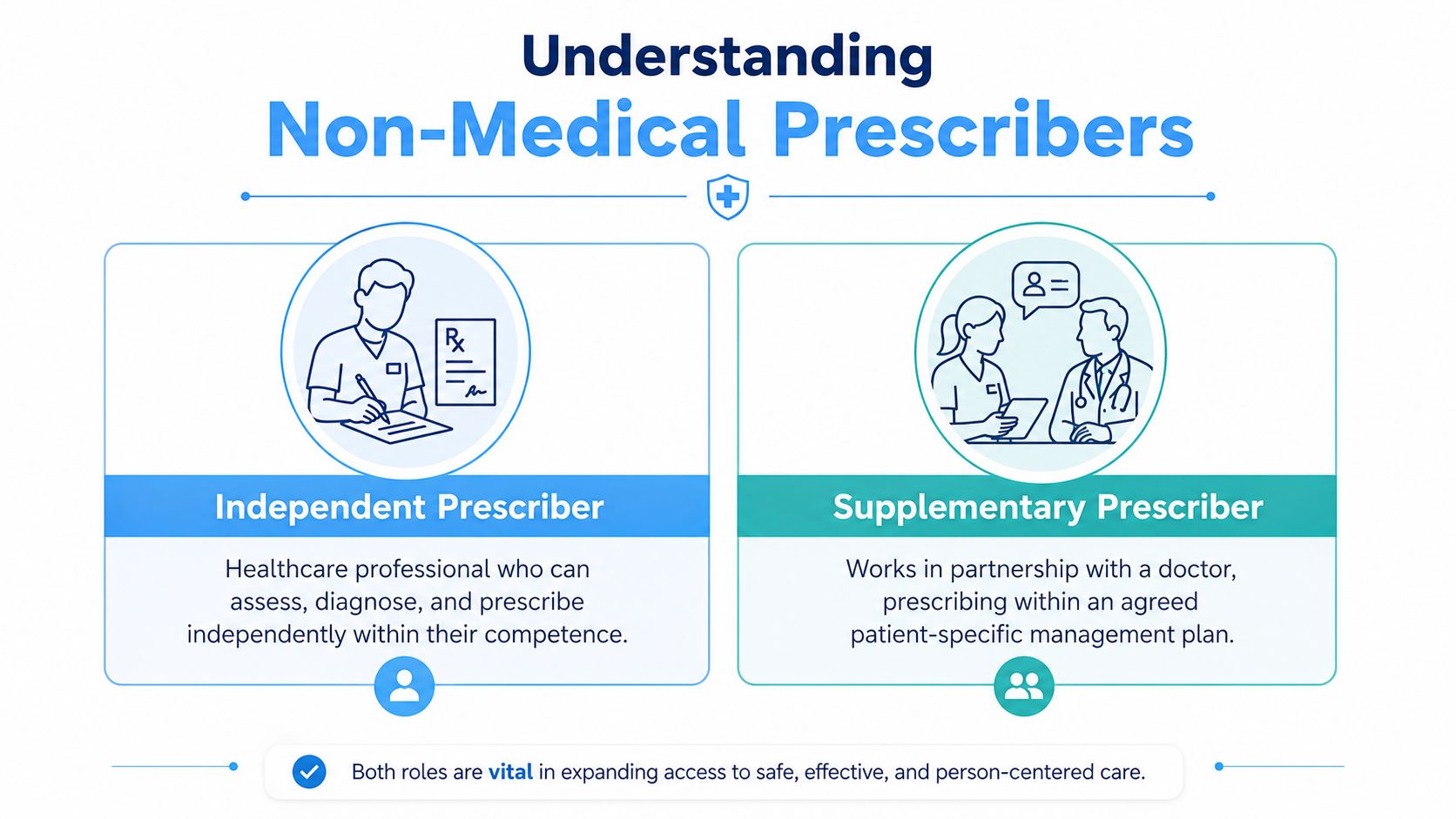
The phrase non medical prescribing can feel confusing because it includes more than one model of practice. The two key terms you'll see are independent prescribing and supplementary prescribing.
If you get those two clear in your mind early, the rest makes much more sense.
Independent prescribing
An independent prescriber works a bit like the lead clinician for that prescribing decision. They assess the patient, consider the options, decide on treatment, and prescribe within their own scope of competence.
A good everyday analogy is a lead chef who designs and cooks the dish, rather than following someone else's exact instructions. The responsibility sits with them.
In practice, that means the prescriber must be able to:
- Assess safely: Gather the right history, check symptoms, and recognise risk.
- Make decisions: Choose whether medicine is needed, what kind, and under what conditions.
- Monitor outcomes: Review whether the treatment is working and whether it should continue, change, or stop.
Independent prescribing is the model many aspiring clinicians picture when they think about advanced practice. It brings real autonomy, but also real accountability.
Supplementary prescribing
A supplementary prescriber works differently. This role is collaborative and based on a patient-specific clinical management plan agreed with an independent prescriber, usually a doctor.
A useful comparison is a specialist chef working from an agreed menu. There's still skill and judgement involved, but the framework has already been set.
This model can work well when care is ongoing and clearly planned. It supports continuity while keeping everyone aligned around an agreed treatment approach.
The practical difference
Here's the simplest comparison:
| Type | How it works | Level of autonomy |
|---|---|---|
| Independent prescriber | Assesses, decides, and prescribes within their competence | Higher |
| Supplementary prescriber | Prescribes within an agreed patient-specific plan | More structured |
Independent prescribing usually feels more autonomous. Supplementary prescribing usually feels more shared.
For many readers at the start of their journey, the key takeaway is this. These roles aren't about “being allowed to hand out medicines”. They're advanced clinical functions built on assessment, reasoning, communication, and professional judgement.
If that sounds challenging, that's a good sign. It should.
Which Professions Can Become Non Medical Prescribers
Not every healthcare role leads to prescribing rights, so it helps to know the likely destinations before you choose your first qualification.
In the UK, professions commonly associated with non medical prescribing include nurses, midwives, pharmacists, paramedics, physiotherapists, podiatrists, and therapeutic radiographers. Different regulators and course providers set the detailed requirements, but these are the kinds of registered professions people usually move through on the way to prescribing status.

What prescribing can look like in real roles
The same qualification doesn't look identical in every profession. The work changes with the setting.
- Nurses: Often use prescribing in primary care, community services, long-term condition management, urgent care, and advanced practice roles.
- Pharmacists: May prescribe after detailed medication reviews, in clinics, GP surgeries, or specialist services where medicine expertise is central.
- Paramedics: Can use prescribing as part of urgent and unscheduled care, especially in roles with greater assessment responsibility.
- Physiotherapists and podiatrists: May prescribe in musculoskeletal services, rehabilitation, pain management, or foot health pathways where medicines form part of a wider treatment plan.
- Midwives: Their route and responsibilities sit within a distinct professional framework, so if midwifery is your goal, Bornbir's guide to midwife credentials is a helpful starting point for understanding the qualification pathway.
How to use this information if you're starting from scratch
Don't read this list as a closed club. Read it as a map.
If you're not yet in a registered profession, your first question isn't “Can I prescribe next year?” It's “Which profession do I want to grow into?” Once you know that, you can work backwards from the eventual prescribing goal.
For example, if advanced nursing interests you, it helps to understand the wider pathway into higher-level nursing roles. This guide on how to become a nurse practitioner gives a useful picture of how clinical progression can develop over time.
Career planning rule: Choose the professional identity first. Prescribing usually comes later as an advanced extension of that role.
That mindset saves a lot of confusion. Non medical prescribing is rarely the first step. It's a later milestone in a profession you've already entered and developed within.
The Legal and Professional Framework for Prescribers
Prescribing sounds exciting because it is. It also comes with legal responsibility, ethical judgement, and close professional scrutiny.
A prescriber isn't just someone who knows drug names. They're a registered clinician trusted to make decisions that can help, harm, or seriously alter a patient's treatment. That's why the legal framework matters so much.
What the law allows
In the UK, independent prescribers have broad authority. Under the rules reflected in GOV.UK guidance on non-medical prescribing in substance misuse treatment, Independent Prescribers are legally authorised to prescribe any medicine, including most controlled drugs in Schedules 2 to 5, for any medical condition within their clinical competence, except for a few specific drugs for addiction treatment.
That sentence is powerful, but one phrase matters more than all the others: within their clinical competence.
The law doesn't say, “If you hold the qualification, prescribe anything you like.” It says that authority sits inside the boundaries of your knowledge, skill, training, and role. A prescriber must know when to act and when to refer.
Why competence matters more than confidence
Many new readers often misunderstand this point. Prescribing isn't about feeling senior. It's about being safe.
A professional might be highly experienced in one setting and still avoid prescribing in another if they don't have the right background for that patient group. Good prescribers don't stretch their competence to impress anyone.
Here is a simple perspective:
| Area | What a safe prescriber does |
|---|---|
| Knowledge | Understands the medicine, risks, interactions, and alternatives |
| Assessment | Checks whether the diagnosis and treatment choice fit the patient |
| Decision-making | Prescribes only when the situation sits within their competence |
| Documentation | Records the reasoning clearly and completely |
If you're interested in the thinking behind safe clinical decisions, this overview of evidence-based practice in nursing is useful background because prescribing depends heavily on evidence, judgement, and patient-centred care.
Mental capacity and consent
Another major part of prescribing is consent. Before prescribing, the clinician must consider whether the patient can understand and make the decision in front of them.
Guidance for non-medical prescribers states that training must cover the Mental Capacity Act 2005 and the two-stage test for capacity, as outlined in this prescribing guidance document. In the same source, failure to document capacity assessments or best-interest decisions for patients lacking consent is linked to 23% higher audit failure rates in medication governance reviews.
A prescribing qualification gives freedom, but it also places your judgement on record.
That's why professional habits matter so much. Careful notes. Clear rationale. Honest limits.
If you're curious how medicines governance connects to pharmacy standards in day-to-day practice, a look at a Registered pharmacy can help make the wider medicines system feel more concrete.
How to Qualify as a Non Medical Prescriber
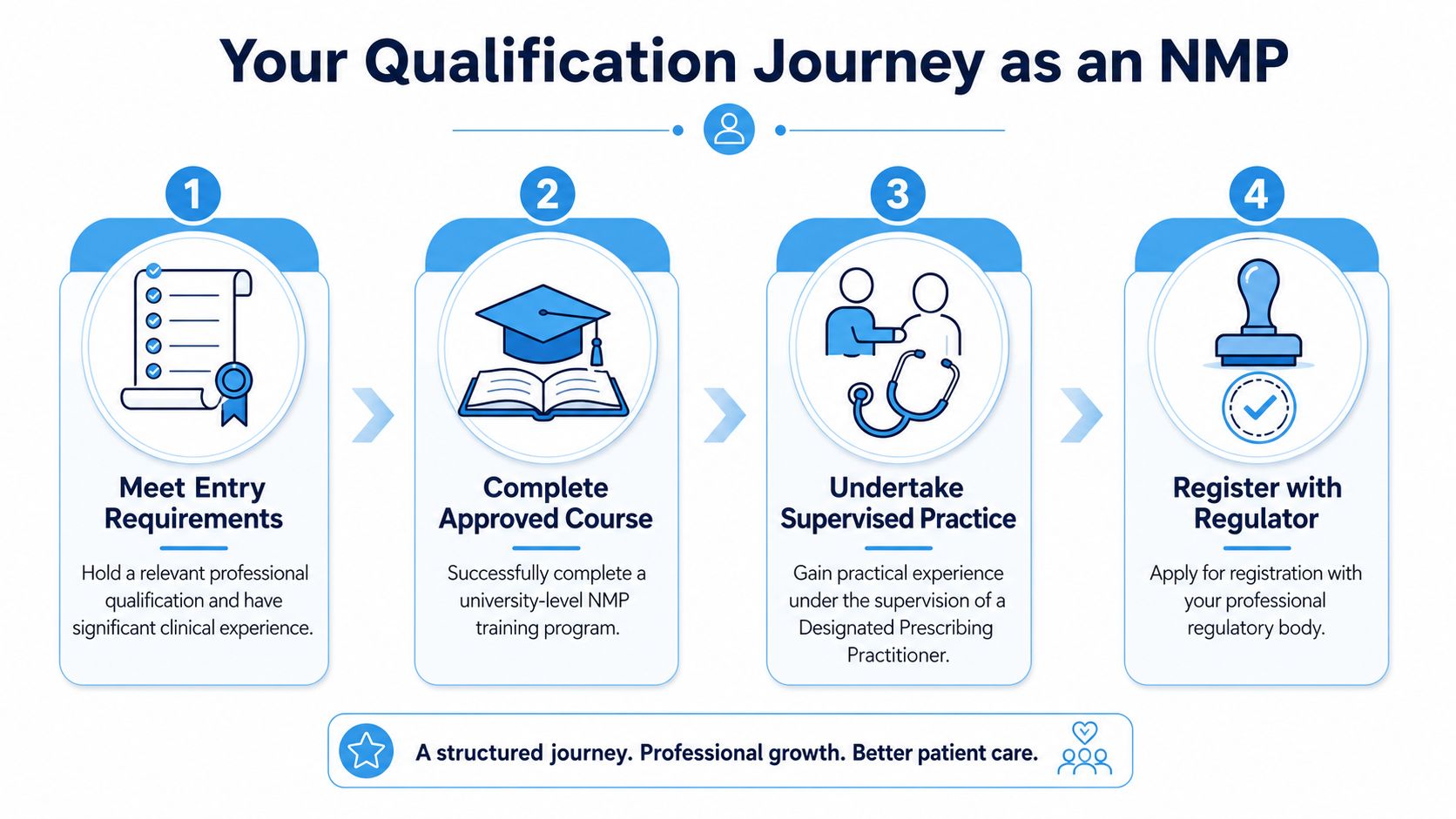
By the time someone starts a prescribing course, they're usually not a beginner in healthcare. They're already a registered professional who has built experience in practice and is ready for a more advanced clinical role.
That's important to understand early, especially if you're just beginning your journey. The prescribing course is not the first staircase. It's several floors up.
What entry usually looks like
Course requirements vary, but most providers expect applicants to be:
- Professionally registered: You'll usually need to be registered in an eligible healthcare profession.
- Clinically active: Providers often want evidence that you're working in a role where prescribing is relevant.
- Supported in practice: You'll generally need supervision from an appropriate prescribing practitioner during training.
- Ready academically and professionally: Universities expect you to cope with degree-level or postgraduate study, clinical reasoning, and medicines-focused assessment.
If you're still at the point of getting into healthcare training, your priority is building the foundation that can later support this route. For many adults, an Access to Nursing course is one of the practical starting points into university-level healthcare education.
What the training involves
Prescribing programmes usually combine university study with supervised learning in practice. You won't only learn about drugs. You'll also study assessment, consultation, legal accountability, prescribing governance, and safe decision-making.
A typical programme includes:
- Classroom or online academic learning on pharmacology, law, ethics, and prescribing theory.
- Practice-based supervision with a designated prescribing practitioner or equivalent supervisor.
- Assessment tasks such as written work, exams, case discussions, portfolios, and observed practice.
- Regulatory recording so your prescribing qualification is recognised by your professional body.
A short explainer can help bring the training pathway to life:
Time and cost
This step takes planning. According to the RCN overview of non-medical prescribers, the transition to Independent Prescriber status typically involves a 6 to 12 month training course with fees ranging from £2,500 to £4,000.
For some people, employers contribute to funding. For others, the decision needs careful budgeting and timing around work, childcare, and placement support.
Practical advice: Don't only ask, “Can I get onto the course?” Also ask, “Will my current role give me enough supervised prescribing experience to use it properly afterwards?”
That question protects you from treating the qualification as a badge instead of a tool. The best time to train is when your workplace, supervision, and patient group align with the skills you're learning.
Career Impact and the Future of Prescribing
Prescribing rights can change the shape of a healthcare career. They often move a clinician from carrying out parts of a treatment plan to owning a larger share of the patient's journey.
That can open doors to more advanced roles, especially in services where assessment, diagnosis, medicines management, and follow-up sit closely together. In practical terms, prescribing can make someone more useful to a team, more autonomous in clinic, and better placed for specialist or advanced practice posts.
Why demand is growing
The strongest reason this matters isn't fashion. It's service need.
In Wales, a long-term analysis published on PubMed Central found that the volume of medicine items prescribed by non-medical prescribers in primary care surged by 430% between 2011 and 2021, rising from around 417,000 items to 2.2 million annually. That's a striking sign that these roles are becoming more embedded, not less.
When prescribing activity grows at that pace, employers, universities, and healthcare systems start treating the qualification as part of mainstream workforce development. For ambitious clinicians, that matters.
What this can mean for your working life
The appeal of non medical prescribing is rarely just status. It's usually about the kind of clinician you want to become.
You may find that prescribing supports:
- Greater continuity of care: You can assess, treat, and review in a more joined-up way.
- A more senior scope of practice: Many advanced roles rely on stronger clinical decision-making.
- Specialist identity: Prescribing can strengthen your place within a focused clinical area.
- Professional satisfaction: Many clinicians value being able to solve more of the patient's problem in one encounter.
A sensible way to think about the future
Prescribing isn't a shortcut to seniority. It works best when it sits on top of strong assessment skills, professional maturity, and regular continuing professional development.
That's why the future of prescribing belongs to clinicians who keep learning. Medicines change. Guidance changes. Patient complexity changes. A safe prescriber stays current, reflects on practice, and knows when to seek advice.
If you're planning a long-term healthcare career, this qualification isn't just an extra certificate. It can become one of the clearest signs that you've moved into advanced, trusted practice.
Your Pathway to a Prescribing Career Starts Here
If you don't yet have the qualifications for university, prescribing can feel distant. That's normal. Many individuals don't start their journey by talking about pharmacology, regulation, or prescribing authority. They start by asking a simpler question: how do I get into healthcare in the first place?
That first step matters more than people think. A strong start makes every later stage easier.

Start with the profession, not the end point
Non medical prescribing is usually something you work towards after becoming a registered healthcare professional and gaining clinical experience. So your immediate target should be one of the professions that can eventually lead there.
For many adults, that means choosing a realistic progression route such as:
- Nursing
- Midwifery
- Paramedicine
- Pharmacy
- Allied health professions
Once you know the broad direction, the next question is whether you already meet university entry requirements. If you don't, you're not shut out. You just need the right bridge into higher education.
Why an Access course can be the launchpad
Adult learners often regain momentum. An Access to Higher Education Diploma can help you build the academic knowledge, study habits, and confidence needed for university application and degree-level study.
That matters if you left school without the usual qualifications, changed direction after years in work, or need a flexible route around family and employment. The point isn't to rush. It's to create a credible path.
A sensible long-term pathway can look like this:
- Complete an Access to HE Diploma in a relevant subject area.
- Progress to university for your chosen healthcare profession.
- Register and practise in that profession.
- Build experience and clinical judgement in an appropriate setting.
- Apply for non medical prescribing training when the role and timing make sense.
You don't have to stand at the final stage to start moving towards it.
What to remember if you're feeling behind
Many adult learners assume they've missed their chance because they didn't take a traditional route at eighteen. Healthcare education is full of people who arrived later, changed careers, or rebuilt confidence step by step.
Prescribing is a high-responsibility goal, but it's still reachable through ordinary, structured progress. One qualification leads to another. One clinical role opens the door to the next. Over time, the distance shrinks.
If you're serious about a healthcare career with room to grow, don't judge yourself by where advanced prescribers are now. Judge yourself by whether you're willing to take the first practical step.
If you're ready to begin that first step, Access Courses Online offers flexible online Access to HE Diplomas designed for adults who want a realistic route into university and professional healthcare training. Whether you're aiming for nursing, midwifery, or another health profession that could eventually lead to prescribing rights, their courses can help you build the qualifications and confidence to get there.