
You might be reading this late at night after work, after the children are asleep, or during a lunch break where you're trying to figure out whether university is still possible for you. Maybe you left school without the qualifications you needed. Maybe your career no longer fits the life you want. Maybe you've always wanted to become a nurse, move into business, study science, or prove to yourself that you can do more than your earlier education seemed to allow.
That feeling is more common than you think. Adults often come back to study carrying more than just books and deadlines. They bring jobs, rent, caring responsibilities, health needs, self-doubt, and the nagging worry that everyone else somehow understands the system better than they do.
That's where online access courses can change things. They are not just a workaround for missing qualifications. For many adults, they're the first realistic route back into education that fits around real life. You study from home, work towards a recognised qualification, and build the academic confidence needed for university.
If you're still unsure what this route really means, this guide to what Access to Higher Education is is a useful starting point. It helps turn a vague idea into something concrete and manageable.
Your Pathway to University Starts Here
A lot of adults assume they missed their chance.
They look at university entry requirements, see A-Levels listed, and stop there. It's easy to think the door is closed if your school experience was difficult, interrupted, or occurred a long time ago. Many people have the ability to succeed at degree level, but they don't yet have the right bridge to get there.
That bridge is often an online Access to HE Diploma. It's built for adults who want to move forward, not for teenagers following the usual school route. That matters. The course structure, pacing, and support are designed around the reality that adult learners are often studying alongside work, family life, and other commitments.
What that can look like in real life
You might be working in care and want to train as a nurse. You might be in admin but aiming for a business degree. You might be returning to study after years away and worrying whether you still remember how to write assignments. These are not signs that university isn't for you. They're usually signs that you need a more flexible route in.
Online access courses give you that route by combining academic preparation with practical flexibility. Instead of trying to fit your life around a rigid timetable, you fit study around the life you already have.
Online learning often works best when it doesn't ask you to become a different person first. It needs to work for the person you are now.
That's why this pathway feels life-changing for so many adults. You don't begin with perfection. You begin with a goal, a realistic plan, and a course that recognises your circumstances.
Why this route feels different
Traditional education can feel like a judgement on your past. Access study feels different because it focuses on your next step.
It asks a better question. Not “What should you have done at 18?” but “What do you want to do now, and what do you need to get there?”
For many learners, that shift alone changes everything. The course becomes more than a qualification. It becomes a structured way to rebuild confidence, create momentum, and move towards university with purpose.
Understanding Online Access to HE Diplomas
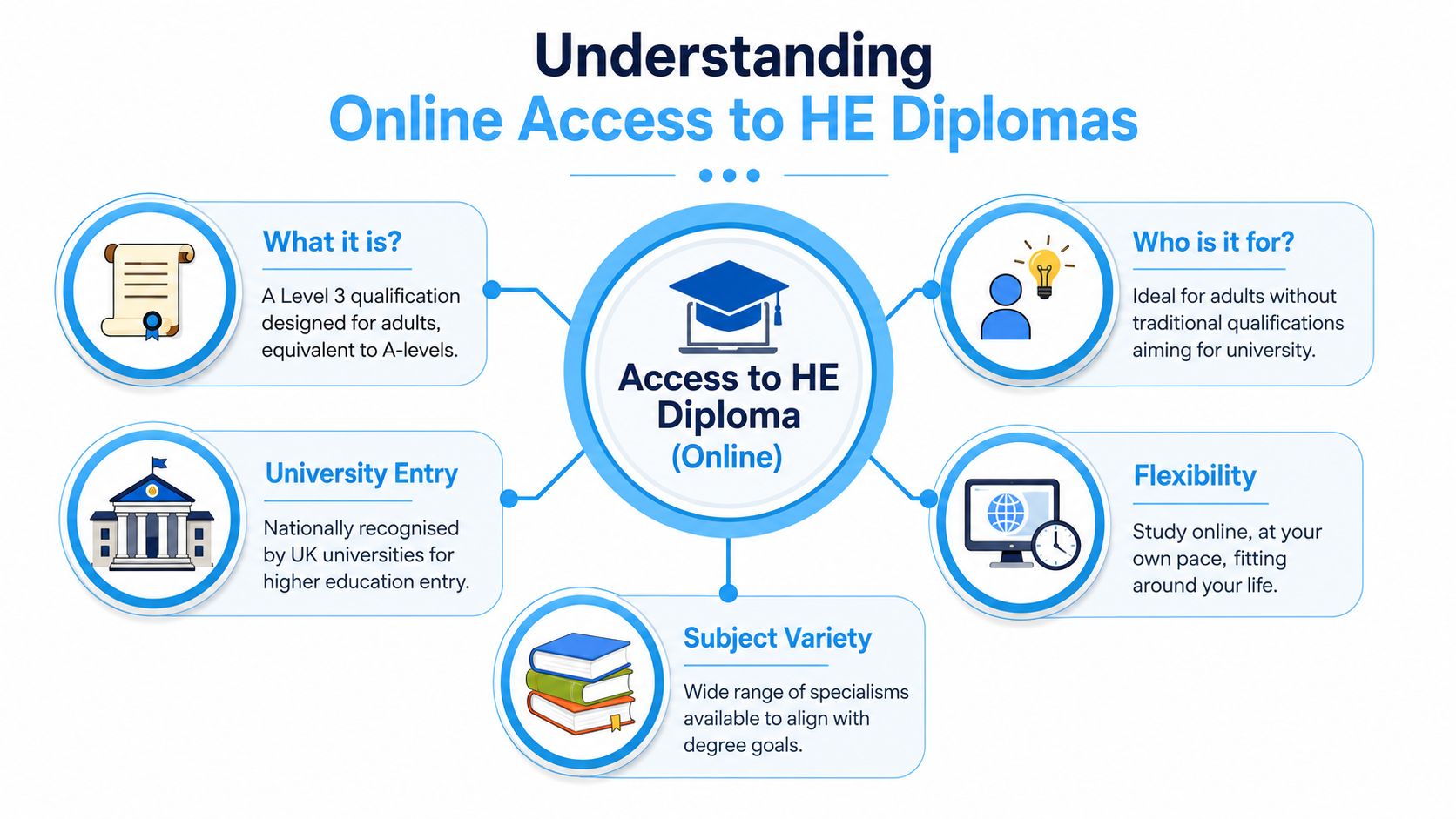
An Access to Higher Education Diploma is a nationally recognised Level 3 qualification equivalent to three A-Levels, and it provides an accepted route into UK universities for over 20,000 adult learners annually, with regulation by the Quality Assurance Agency (QAA) helping ensure recognition across the UK, as outlined in Stonebridge's explanation of the Access to HE Diploma.
A purpose-built bridge for adults
The simplest way to understand this diploma is to think of it as a purpose-built bridge to university.
A-Levels are one bridge. The Access to HE Diploma is another. Both can get you to higher education, but the Access route is specifically designed for adults who may not have the traditional qualifications universities usually ask for.
That design matters in practical ways:
- Adult-focused entry route means the qualification starts from the reality that many learners are returning after a break.
- University preparation means you won't just cover subject knowledge. You'll also develop the writing, reading, organisation, and study habits degree courses expect.
- Clear progression means you normally choose a pathway linked to your intended degree area, such as nursing, science, business, or social science.
If you're wondering whether this can really be done remotely, this overview of studying an Access to HE course online answers the practical side clearly.
What “online” actually changes
When people first hear about online access courses, they sometimes assume “online” means less rigorous. In practice, it usually means the delivery method is more flexible, not that the qualification is less valid.
You're still working towards a regulated diploma. What changes is how you engage with it. Instead of travelling to a classroom at fixed times, you typically work through learning materials, assignments, tutor guidance, and deadlines through an online platform.
That can make a huge difference if you're balancing:
- Employment
- Parenting or caring responsibilities
- Health needs or disability-related adjustments
- Travel or location barriers
Practical rule: Don't judge the value of a qualification by whether it happens in a classroom. Judge it by recognition, regulation, and whether it prepares you properly for the degree you want.
What universities see
Universities don't treat a genuine Access to HE Diploma as an informal short course. They see a regulated Level 3 qualification with a specific purpose. That's why it's widely used by adults progressing into degree study.
For you, the key point is simple. If your past qualifications don't match your ambition, this diploma can create a direct, recognised route forward.
Is an Online Access Course Right for You
Some people read about online access courses and immediately know the route fits them. Others need to see themselves in it first.
That's sensible. Adult study is a serious commitment. You need to know not only whether the course is valid, but whether it's designed for people living a life like yours.
In the 2021-22 academic year, 77% of students entering higher education with an Access to HE Diploma were female, and 26% had a disability, compared with 15% among students with other Level 3 qualifications, according to Skills and Education Group Access key statistics. Those figures tell an important story. This pathway is already helping people who don't always fit the conventional mould of a college leaver with uninterrupted study history.
Learners who often thrive on this route
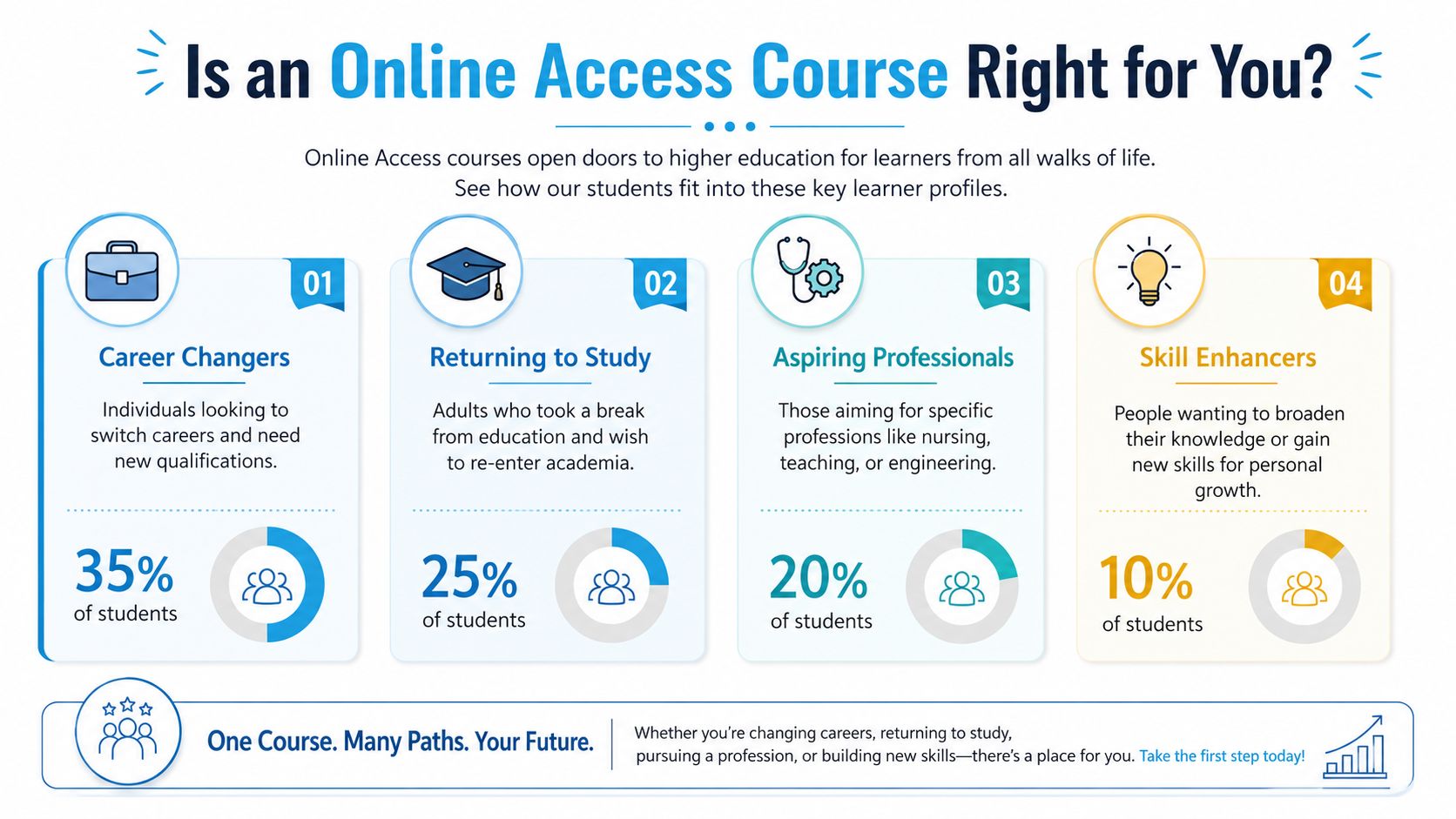
One common group is the career changer. These are adults who know where they want to go but need the academic route to get there. They might already have work experience, discipline, and motivation. What they need is a recognised qualification that opens the next door.
Another group is the returning learner. This might be someone who left education years ago and worries they've forgotten how to study. In reality, returning learners often bring focus that younger students are still developing. They tend to know why they're studying, which makes a big difference when work gets demanding.
A third group is the parent or carer. Online study can make education realistic where travel, fixed attendance, or daytime scheduling would make it impossible.
Disability support and flexibility
The higher proportion of learners with disabilities matters because it highlights something many course pages don't explain well enough. Flexibility isn't just convenient. For some students, it is the condition that makes learning possible.
If disability support is part of your decision, it helps to understand what good support can look like in practice. Resources on Insight Diagnostics student support can help you think through adjustments, learner needs, and the kinds of questions worth asking before you enrol.
Signs this route may suit you
You don't need to match a perfect profile. But online access courses often make sense if these points sound familiar:
- You have a clear goal and know the degree or career area you want to move towards.
- You need flexibility because your week already includes work, family, or health-related demands.
- You're motivated but rusty and want a structured way back into academic study.
- You need an alternative to A-Levels that universities recognise.
If your life is busy, that doesn't automatically make university unrealistic. It usually means you need a route designed with adult realities in mind.
If you're reading this and thinking, “This sounds like me,” that's a strong sign you're not looking at an unusual path. You're looking at one that was built for people in your position.
Exploring Your Subject and Career Pathways
Choosing a subject can feel harder than choosing to return to study.
Many adults know they want change, but they're less sure which Access pathway matches the degree they need. The easiest way to approach this is to work backwards. Start with the university course or profession you want, then choose the online Access course that supports that destination.
Think degree first, course second
If your aim is nursing, you'll usually need a health-focused pathway. If you want to move into computing, science, business, or social science, the same principle applies. The Access diploma should prepare you for the style of learning and subject knowledge used in that degree area.
This is why subject choice matters. A strong match makes your application clearer and your transition into university much smoother.
Common pathways adults consider
Some learners choose health-related routes because they want a profession with direct public impact. Others choose business or computing because they want wider career flexibility. Science and social science pathways often appeal to learners who enjoy analysis, research, or specialist progression.
Here's a simple way to think about it.
| Subject Pathway | Example University Degrees | Potential Career Fields |
|---|---|---|
| Nursing and Health Professions | Adult Nursing, Midwifery, Paramedic Science, Allied Health degrees | Nursing, midwifery, healthcare support, clinical professions |
| Science | Biomedical Science, Biology, Chemistry, Health Science | Laboratory work, healthcare science, research, environmental roles |
| Computing | Computer Science, Cyber Security, Software Engineering, IT | Software development, IT support, data-focused roles, cyber security |
| Business and Management | Business Management, Accounting, Marketing, Finance | Business operations, management, HR, marketing, administration |
| Social Science | Sociology, Psychology, Criminology, Social Policy | Community services, youth work, public sector roles, further specialist study |
| Humanities and Related Subjects | Education Studies, English, History, combined arts courses | Education support, communications, public service, postgraduate routes |
How to narrow your choice
If two pathways both look possible, ask yourself three practical questions:
- Which degree title appears most often in entry requirements? University course pages usually make this clear.
- Which subject will keep you engaged for months of study? Motivation matters when life gets busy.
- Which route gives you the broadest next step if your plans shift slightly? Some learners start focused on one profession and later discover a related degree suits them better.
Examples of matching ambition to pathway
A care assistant who wants to become a registered nurse will usually need a health-based route. A warehouse supervisor hoping to move into data or tech might look at computing. Someone returning after years at home who enjoys people, policy, and social issues may find social science a better fit than a pure science route.
These aren't rules. They're starting points.
Choose the pathway that supports the university application you want to make, not the one that merely sounds familiar.
Don't choose based on fear
Adults sometimes avoid the subject they really want because they worry it sounds too ambitious. They choose something they think is safer.
That usually backfires. If your real goal is healthcare, business, computing, or science, you're better served by choosing the route that lines up with it and then building the support around your study habits, confidence, and time management. The right course should stretch you, but it should also point clearly towards the future you're trying to build.
Navigating Fees Funding and Financial Support
Cost is one of the first things adults worry about, and rightly so. You may be budgeting around rent, bills, children, commuting, or reduced working hours. A course can be academically perfect and still feel out of reach if the payment side isn't clear.
The good news is that there are usually several ways to approach the cost. The less comfortable news is that funding rules can be confusing, especially during policy change.
The main ways adults usually fund study
Some learners choose to pay directly. This can work well if you want simplicity and have savings or steady income.
Others prefer monthly payment plans, especially where a provider offers interest-free instalments. That can make a big difference because it turns a large one-off cost into something you can comfortably fit into a household budget.
Then there's the Advanced Learner Loan, which often comes up in discussions about Access study for adults in England. If you're exploring that route, don't rely on a headline summary. Check eligibility carefully and ask how it applies to your chosen course and location.
The coming change in 2027
Current guidance notes the Advanced Learner Loan for those over 19, but also highlights an important uncertainty. The Lifelong Learning Entitlement (LLE) is due to replace the current loan system for courses starting after 1 January 2027, and prospective students need to understand how that may affect funding for online Access courses that can cost thousands, as explained in The Complete University Guide's overview of Access to HE Diplomas.
That means you should treat any funding conversation as time-sensitive. What applies to one intake may not apply in the same way later.
Questions worth asking before you enrol
Practical questions matter more than glossy promises. Ask the provider:
- What are the payment options? Monthly plans, deposit requirements, and deadlines all affect affordability.
- Is funding guidance included? You want clear answers, not vague signposting.
- What happens if policy changes while I'm planning? A serious provider should explain what's known and what isn't.
- Are there extra costs beyond tuition? You need the full picture before committing.
If you want a provider-specific overview of common options, this guide to Access to HE funding is a practical place to compare how the process is usually explained.
How to make the cost feel manageable
Don't look only at the course fee in isolation. Look at the fee in relation to the degree and career it helps enable. That doesn't mean ignoring financial pressure. It means assessing the course as part of a longer path.
A useful way to think about it is:
- Can I afford this month to month?
- Does the course clearly progress to the degree I need?
- Will the provider help me understand funding rather than leaving me to guess?
Funding check: If you don't fully understand how you'll pay before you enrol, pause and ask more questions. Financial clarity is part of choosing the right course, not an afterthought.
Don't let uncertainty stop all movement
Some adults freeze because they want every funding detail tied up before they take any step. That's understandable, but it can leave you stuck.
A better approach is to separate what you can confirm now from what you need to monitor. You can usually compare providers, ask about payment structures, identify likely eligibility routes, and map your intended university progression before every future policy detail is finalised. That keeps you moving without making rushed decisions.
Choosing a Reputable Online Access Course Provider
Not all providers offer the same learning experience, even when the qualification title sounds similar. For many adults, this point marks their most important decision. The course itself matters, but the support around it matters just as much.
A provider can offer flexibility on paper and still leave students isolated in practice.
What to check before you commit
Start with the essentials. You want a provider that can clearly explain accreditation, course structure, tutor support, deadlines, and progression routes. If those details are hard to find, treat that as useful information.
Here's a practical checklist:
- Recognition and regulation. Check that the course is presented clearly as an Access to HE route with proper oversight and a clear university progression purpose.
- Tutor access. Ask how often tutors respond, how feedback is given, and what happens if you get stuck.
- Real flexibility. Find out whether deadlines are fixed, negotiable, or paced around your circumstances.
- Application support. Ask whether the provider helps learners think about university choices and admissions.
- Communication quality. Notice whether answers are clear and direct before you enrol. That usually predicts the support you'll receive after payment too.
Ask the difficult question about completion
One of the biggest gaps in this market is transparency about who finishes. A useful caution from research referenced in this discussion of completion-rate transparency is that prospective students should ask providers directly about completion rates for online Access to HE courses, because flexibility alone doesn't tell you whether learners are being supported well enough to complete.
This matters more than many people realise. Adults often choose online study because they need flexibility. That same flexibility can become risky if a provider assumes independence but doesn't provide enough structure, follow-up, or tutor contact.
Questions that reveal a lot
When you speak to a provider, ask questions that go beyond price:
- What percentage of students complete the diploma?
- What support is in place if a learner falls behind?
- How do tutors give feedback on assignments?
- What kinds of learners tend to do well on this course?
- Can I study at a pace that fits work and family life?
A provider that answers clearly is showing you something important. They understand adult learners need detail, not just marketing language.
One example of what to look for
For example, Access Courses Online offers accredited online Access to HE Diploma courses, flexible study, tutor guidance, and subject routes including nursing, health professions, science, social science, computing, business, and more. That doesn't automatically make it the right fit for every learner, but it does illustrate the sort of specifics you should look for when comparing providers.
A serious student asks serious questions. Good providers won't be put off by that. They'll welcome it.
Trust what the details tell you
If a provider is vague about support, hard to reach, or evasive about student outcomes, listen to that signal. You are not buying a downloadable pack of worksheets. You are choosing the environment in which you'll try to change your future.
That decision deserves care.
Your Journey from Application to University
Once you've chosen the right route, the process becomes much less mysterious. It turns into a sequence of manageable steps. That matters, because adults often get overwhelmed by trying to picture the whole journey at once.
A more helpful way to think about it is to focus on the next task, then the next.
To make the pathway easier to picture, this visual lays out the overall flow.
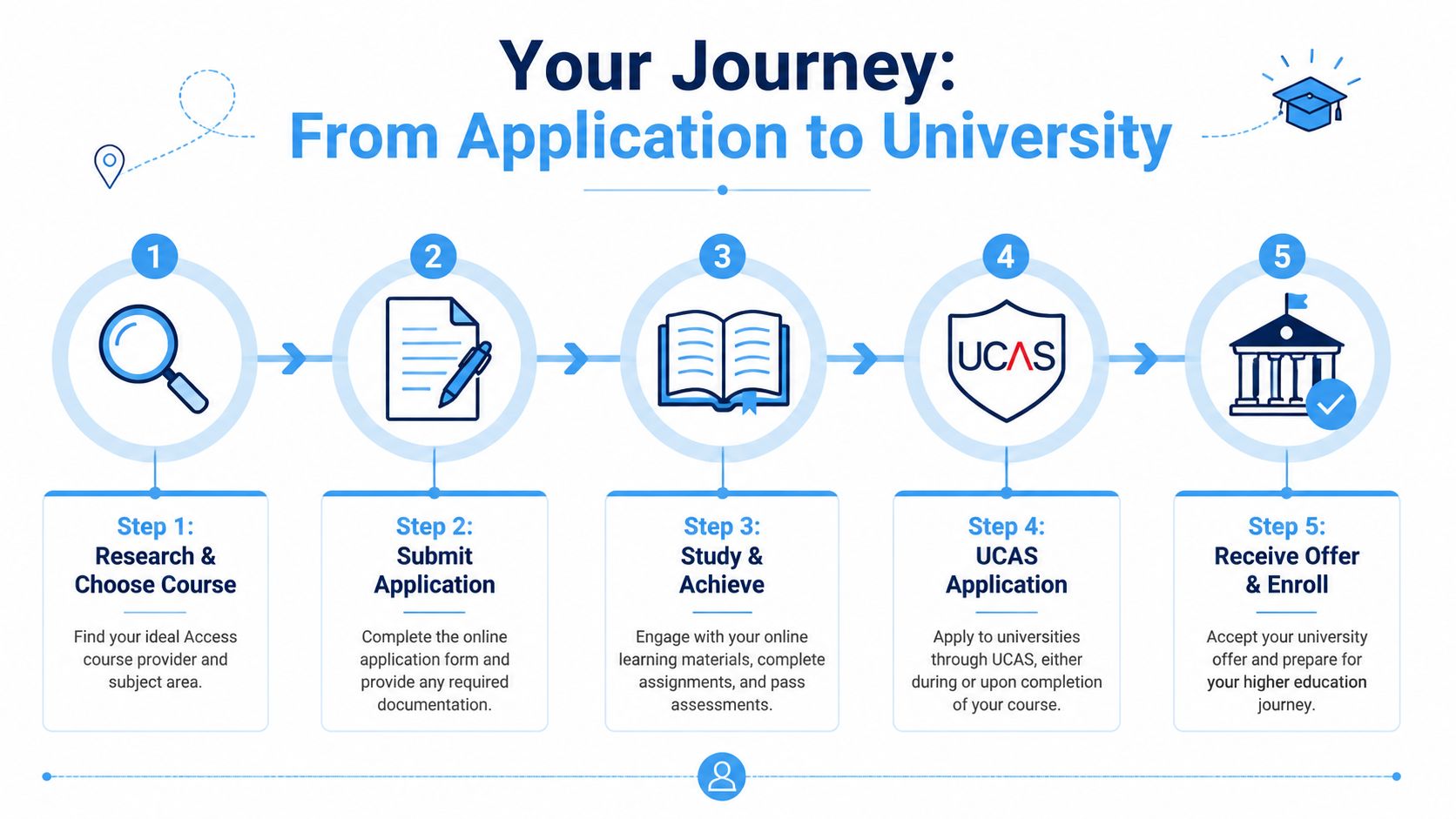
From enrolment to steady study
In the 2022-23 academic year, 38,220 students registered for Access to HE Diplomas, and the qualification carries 60 credits, with 45 graded at Level 3, giving it the same standing in the UCAS tariff as three A-Levels for undergraduate entry, according to official Access to HE key statistics for 2022-23.
That official structure is important because it gives universities something consistent to assess. For you, it means this isn't an informal stepping stone. It is a recognised and structured academic route.
When you begin, your first job is usually to establish a routine. Not a perfect routine. A realistic one. Adult learners do best when they set regular study windows, keep track of assignment dates, and ask for help early rather than waiting until they feel completely behind.
A simple way to stay on track
These habits make a real difference:
- Set fixed weekly study times that people around you can respect.
- Break assignments into smaller tasks so you're never starting from panic.
- Use tutor feedback actively rather than just reading the grade.
- Keep your university goal visible because motivation often dips in the middle, not the beginning.
Here's a useful video if you'd like a more visual sense of the route and what it can lead to.
Applying through UCAS
Many learners apply to university during the course or once they've progressed far enough to make a strong application. This is often the point where old doubt resurfaces. People start wondering whether they're aiming too high.
Try to bring the process back to facts. You are not asking universities to ignore your background. You are presenting a recognised qualification designed for adult entry to higher education.
Your application will usually make more sense if you can clearly explain:
- Why you're changing direction now
- Why your chosen degree fits your Access subject
- What studying as an adult has already taught you
- How your work or life experience supports your next step
University success starts before university
A lot of people think the goal is solely to get an offer. In reality, the course is doing something bigger. It's helping you become the kind of student who can cope when university starts.
That means learning how to read critically, meet deadlines, write academically, absorb feedback, and continue when your confidence dips. Those habits are part of the transformation, not just preparation for it.
The real milestone isn't only the university offer. It's the point where you start seeing yourself as someone who belongs there.
By the time you accept an offer, you won't be the same person who first wondered whether returning to education was even possible. You'll have evidence. Assignments completed. Skills rebuilt. A qualification earned. A next chapter opened.
If you're ready to take the next step, Access Courses Online offers accredited online Access to HE Diploma pathways for adults who want a flexible route into university. You can explore subject options, ask practical questions about study and funding, and find a course that fits the life you're living now while building towards the future you want.