
A part-time nursing degree provides a more flexible way to become a registered nurse. It’s designed for people who need to fit their studies around life's other big commitments, like work or family. The course covers the exact same professional curriculum and clinical training as a full-time degree, but spreads it out over a longer timeframe, usually four to six years.
Is a Part-Time Nursing Degree Right for You?
Are you trying to figure out how to balance your current life with your ambition to become a nurse? You're not alone. A part-time nursing degree was created to solve this exact problem, offering a realistic path into the profession without forcing you to press pause on everything else.
Think of it this way: a full-time degree is like a sprint—an intense, three-year race to the finish line. A part-time degree, on the other hand, is more of a marathon. You still cover the same ground and reach the same incredible destination—a BSc (Hons) in Nursing and registration with the Nursing and Midwifery Council (NMC)—but at a pace that actually works for you.
Finding the Right Pace for Your Journey
This flexibility is the number one reason why so many people choose the part-time route. It’s built for those who can’t afford to stop working, have young children, or are caring for family members. Instead of being on campus several days a week, your academic work might be condensed into one or two days, with online learning helping you fill in the gaps.
This approach means you can:
- Keep earning an income: For most adult learners, continuing to work isn't just an option—it's a necessity.
- Balance family and life: You can still manage school runs, personal appointments, and family time alongside your studies.
- Apply your learning instantly: If you’re already working as a Healthcare Assistant, this route allows you to bring what you learn in the classroom straight to your workplace.
To help you decide which path is best, the table below gives a quick snapshot of the main differences between part-time and full-time study.
Part-Time vs Full-Time Nursing at a Glance
| Factor | Part-Time Nursing Degree | Full-Time Nursing Degree |
|---|---|---|
| Typical Duration | 4–6 years | 3 years |
| Weekly Commitment | Fewer contact hours per week (e.g., 1–2 days) | Intensive, often 3–5 days per week |
| Flexibility | High – designed to fit around work and family | Low – requires a full-time commitment |
| Pace of Learning | Slower, more manageable pace | Fast-paced and demanding |
| Financial Impact | Easier to work and earn an income while studying | Difficult to maintain part-time work |
| Ideal for | Career changers, parents, carers, working adults | School leavers or those who can study full-time |
Ultimately, both paths lead to the same respected qualification. The right choice for you simply comes down to your personal circumstances.
The following infographic breaks these differences down even further to help you visualise which study mode aligns best with your life right now.
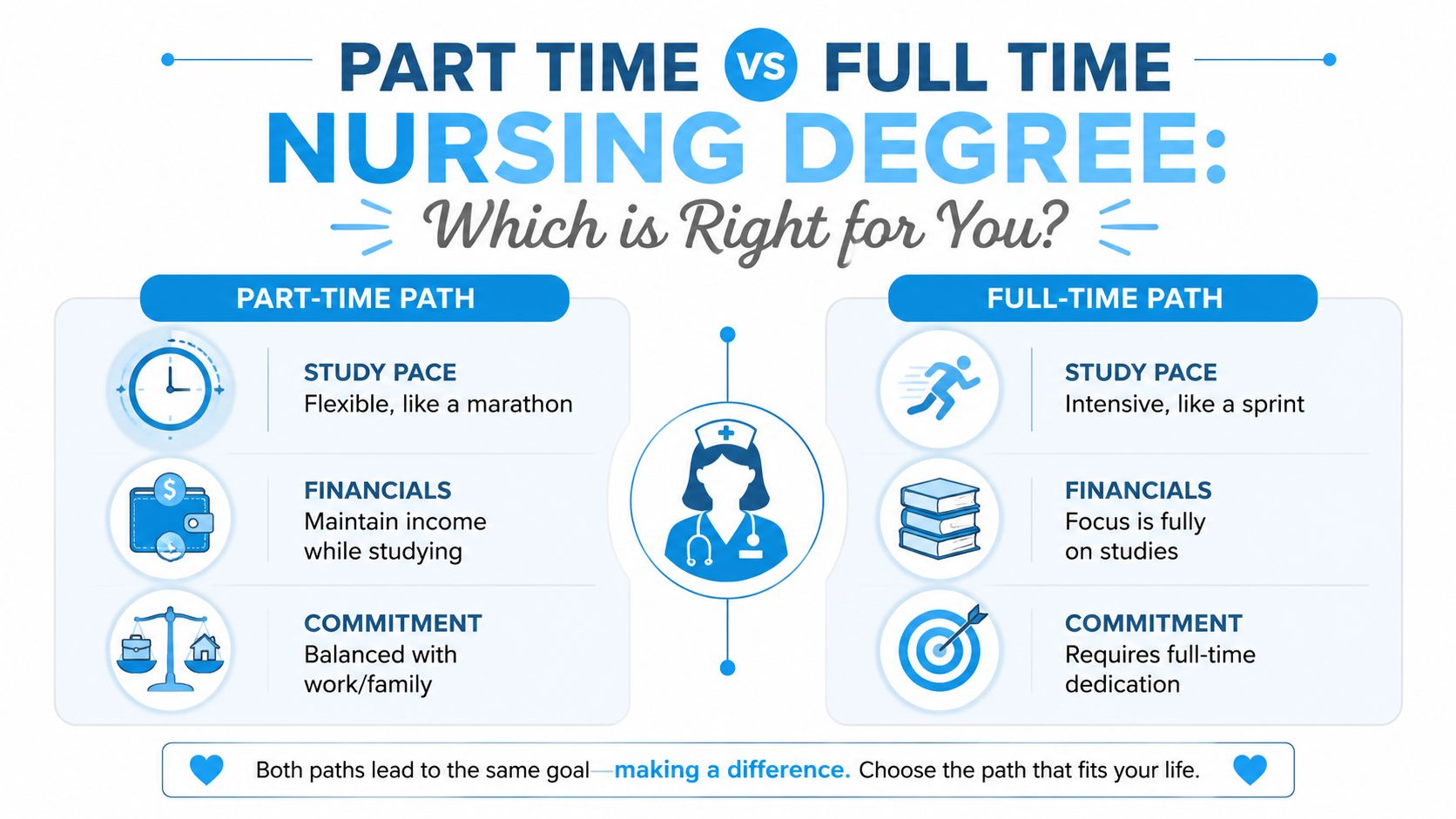
The bottom line is that your choice depends on a simple trade-off. Do you need the financial and personal flexibility that part-time study offers? Or are you in a position to dedicate yourself completely to an intensive, shorter period of study? Only you can answer that, but knowing both options exist is the first step.
Navigating Your Part-Time Study Options

So, you’ve decided that a flexible study route is the right path for you. That’s a huge first step! The next one is figuring out exactly what your options are. In the UK, a part-time nursing degree isn’t a single, one-size-fits-all course. Instead, you’ll find several distinct pathways designed to fit your unique circumstances and career goals.
The most familiar option is the BSc (Hons) in Nursing, which many universities offer on a part-time basis. This degree typically takes between four and six years to complete and covers the exact same core modules and clinical placements as the full-time version. The only real difference is the weekly schedule, which is spread out to be manageable alongside work and family life.
If you already have a degree in a related subject, you could fast-track your journey with a Postgraduate Diploma (PG Dip) in Nursing. This is an intensive, two-year programme that builds on your prior academic experience, helping you qualify as a nurse much more quickly.
Exploring the Degree Apprenticeship Route
One of the most popular and financially smart options is the Registered Nurse Degree Apprenticeship (RNDA). This incredible pathway lets you combine part-time study with paid, on-the-job training. As an apprentice, you’re employed—often by an NHS Trust—and your university tuition fees are completely covered.
You'll work in a role like a healthcare assistant, gaining priceless hands-on experience while you study for your degree at the same time.
The RNDA is a genuine game-changer, especially for anyone who can’t afford to stop working to study. It allows you to earn a full-time salary, avoid tuition fee debt, and graduate as a registered nurse. This model directly tackles the financial hurdles that once made nursing an impossible dream for many career changers.
The rise of apprenticeships is a direct response to the UK's critical need for more nurses. With over 40,000 nursing vacancies in England alone, there is massive support for flexible pathways like the RNDA. In fact, the number of students starting nursing apprenticeships has already doubled to over 2,000 in a single year, showing a clear shift towards these earn-while-you-learn models.
What Your Study Week Will Look Like
Whichever route you choose, your time will be split between academic study and practical clinical placements. Here’s a rough idea of what to expect:
- Academic Modules: You'll dive into core subjects like anatomy, physiology, pharmacology, and patient assessment. This is usually delivered through a blend of on-campus lectures, seminars, and online learning.
- Clinical Placements: This is where your learning comes to life. You’ll work in all sorts of healthcare settings—from busy hospitals to GP surgeries and community health centres—all under the watchful eye of experienced nurses. A part-time schedule means your placements are often arranged in blocks or on set days to fit around your studies.
Choosing the right path is a deeply personal decision that depends on your finances, previous qualifications, and how you like to learn. For a broader look at your options, you might find our general guide on part-time degrees helpful.
Meeting the Entry Requirements for Nursing School
Feeling a bit unsure if your qualifications are enough to get into university? That's a completely normal hurdle for many aspiring nurses. The great news is that the entry requirements for a part-time nursing degree are designed to welcome people from all walks of life, not just recent school leavers with a perfect set of A-Levels.
Universities are looking for a blend of academic potential and the right personal qualities.
Most will have a couple of non-negotiable foundations. You'll typically need GCSEs in Mathematics and English at Grade C or 4, or an equivalent like Functional Skills Level 2. Think of these as the essential building blocks, proving you have the core numeracy and literacy skills you’ll rely on every day, both in your studies and on the ward.
Beyond that, you’ll need to show you’re ready for the academic side of a degree. This is where your main qualifications come into play.
Proving You’re Ready to Learn
While A-Levels are the path most people think of, they're far from the only option. In fact, for many adults looking to get back into education, there's a much better-suited route. This is where the Access to Higher Education (HE) Diploma really comes into its own.
The Access to HE Diploma is specifically designed to be a 'second chance' for adults who don't have traditional qualifications. It’s a nationally recognised Level 3 qualification that UK universities widely accept as an alternative to A-Levels, making it one of the most popular ways for mature students to get into nursing.
This one-year course is incredibly focused, preparing you directly for the demands of a healthcare degree. It doesn't just get you a piece of paper; it gives you the study skills, academic writing abilities, and scientific knowledge you need to hit the ground running. You can explore all the details in our complete guide to nursing degree entry requirements.
Across the UK, there are currently around 20 part-time nursing degree programmes available, and the Access to HE Diploma is a fantastic key to unlock them. Universities usually look for 60 credits from an Access to HE Diploma in Nursing. This often includes a specific requirement of at least 45 credits at Level 3, made up of a mix of Distinction, Merit, and Pass grades.
By completing an Access to HE Diploma, you aren't just ticking a box. You're sending a clear message to university admissions tutors that you are committed, capable, and ready for the challenge and reward of becoming a nurse.
How to Fund Your Part-Time Nursing Degree
Worries about money are often the biggest barrier stopping aspiring nurses from chasing their dream. The good news is that a part-time nursing degree is a much more achievable investment than many people realise. Let’s walk through the financial support available to you in 2026 and get you on the path to your new career.
Most UK students on part-time degree courses are eligible for a Tuition Fee Loan from the government to cover their course costs. On top of that, many can apply for a Maintenance Loan to help with living expenses. The amount you get for this usually depends on your household income and how intensively you’re studying.
Exploring the NHS Learning Support Fund
A huge helping hand for nursing students in England is the NHS Learning Support Fund (LSF). This fund provides non-repayable grants to support you during your studies, and it’s open to both full-time and part-time learners.
The LSF offers several key benefits:
- Training Grant: A yearly payment of £5,000 for all eligible new and continuing nursing students.
- Parental Support: An extra £2,000 per academic year if you have at least one dependent child.
- Travel and Dual Accommodation Expenses: You can get back any excess costs you face while on your clinical placements.
The best part? This is a grant, not a loan, which means you don't have to pay it back. It’s designed to make a healthcare degree accessible to everyone, no matter their financial situation.
The Financial Power of Degree Apprenticeships
One of the smartest financial routes into nursing has to be the Registered Nurse Degree Apprenticeship (RNDA). This path completely removes the stress of tuition fees because your employer—usually an NHS Trust—covers the full cost. Even better, you earn a salary while you train.
A Degree Apprenticeship means you can become a registered nurse without accumulating any student debt. You're treated as a paid employee from day one, gaining practical experience and a degree simultaneously. This makes it an incredibly powerful option for career changers who cannot afford to stop working.
This "earn-while-you-learn" model is becoming more and more popular. We're seeing a growing interest in the profession, with 18,640 people accepting nursing degree offers recently. While home students typically pay around £9,535 per year for a full-time degree, the fully funded nature of apprenticeships makes a part-time nursing degree an increasingly sensible choice.
For those considering other routes, budgeting is also more manageable. Part-time courses often structure their fees on a per-module or per-credit basis, so you pay as you go rather than facing one large bill. This allows for much better financial planning. For more detailed information, check out our guide on funding for courses.
Crafting an Application That Gets You Noticed

This is it. Your application is where the dream starts to feel real. If you’re applying for a part-time nursing degree, remember that your life experience isn't just a small detail—it's your headline. Admissions tutors aren't just scanning for grades; they're looking for the very human qualities of resilience, empathy, and commitment. Chances are, you’ve been demonstrating these for years.
The trick is to weave all that experience into a story that they can’t ignore. Your application, and especially your personal statement, is your chance to connect the dots for them. It’s not about listing the jobs you’ve had; it's about explaining why those roles make you a brilliant candidate for nursing.
Writing a Personal Statement That Tells Your Story
Think of your personal statement as the story of you. Don't just state that you have great communication skills from your retail job. Instead, describe that specific time you calmed an angry customer or had to explain something complicated in simple, reassuring terms. That’s how you show, not just tell, them what you’re made of.
Here’s how to frame your unique background as a strength:
- Previous Careers: Did you work in a team, juggle deadlines, or handle sensitive information? These are all transferable skills that are absolutely vital on a busy hospital ward.
- Family and Caring Roles: Raising children or looking after a relative builds incredible patience, organisational skills, and deep compassion. These are core nursing values in action, every single day.
- Volunteering: Any time spent helping others clearly shows a commitment to your community. That’s exactly the kind of dedication universities want to see in their future nurses.
Your goal is to show how these experiences have prepared you for both the challenges and the incredible rewards of a part-time nursing degree.
Your personal statement shouldn’t read like a CV. It needs to answer the most important question: "Why you?" Let them see the person behind the qualifications and understand the empathy, strength, and insight you’ve gained from your life so far.
Preparing for Your University Interview
Getting an interview is a huge step forward, so well done! This is your opportunity to bring your personal statement to life. Universities want to see if your personality and values match the high standards of the nursing profession.
A fantastic way to prepare is to get to know the NHS Constitution. This document outlines the core values that every single person working in the health service lives by.
Be ready to answer questions using the 6 Cs:
- Care
- Compassion
- Competence
- Communication
- Courage
- Commitment
Try to structure your answers around these values. If you're asked about a tough situation you’ve faced, frame your response to show how you demonstrated courage or commitment. This gives your answers a solid foundation and proves you understand the professional ethos of nursing. More than anything, be yourself. Your authenticity is your greatest asset.
Balancing Your Studies with Real Life
Let's be honest: fitting a part-time nursing degree around work, family, and everything else life throws at you is a huge ask. It’s certainly a challenge, but it’s one you can absolutely overcome with the right approach. Your success won’t just come down to how well you know your anatomy; it’s about mastering your time and knowing who to lean on for support.
The first step is to get a clear, honest picture of your week. Sit down and map out all your non-negotiables—your work shifts, the school run, and your scheduled university classes. Once you see those blocks of time, you can start carving out dedicated slots for studying. Treat these study sessions like any other important appointment.
Building Your Support System
One of the most important things to remember is that you don’t have to do this alone. In fact, you shouldn’t even try. Your support system will be your greatest asset on this journey, whether that’s family and friends who can offer a listening ear or the support staff at your university.
Think of your university's student services as part of your core team. They offer everything from academic writing support and confidential counselling to financial advice. These services exist because they know students need them—don’t hesitate to use them.
Reaching out for help is a sign of strength, not a weakness. To help you get a handle on the academic workload and keep your personal life in balance, you might also find that resources like the top anatomy learning tools can make a real difference.
Practical Time Management Techniques
Getting your time management right is the secret to keeping all the plates spinning without burning out. Many successful student nurses swear by these simple but effective habits:
- Protect Your Downtime: Schedule your breaks and days off just as seriously as you schedule your study time. Remember, rest isn't a luxury; it's a crucial part of being productive.
- Be Realistic About Your Social Life: Things will have to change for a while, but your social life doesn't need to vanish completely. Just be upfront with your friends and family about what you can realistically commit to.
- Master 'Good Enough': Chasing perfection on every single assignment is a fast track to burnout. Learn to prioritise your energy and recognise when a piece of work is solid enough to be submitted.
A part-time nursing degree is definitely a marathon, not a sprint. The key is to pace yourself, build a brilliant support network, and most importantly, be kind to yourself along the way.
Common Questions About Part-Time Nursing Degrees
Thinking about a part-time nursing degree? It's a big step, and it’s completely natural to have a list of questions running through your mind. Getting clear, straightforward answers is the key to feeling confident as you move forward. Let’s tackle some of the most common queries we hear from aspiring nurses.

A big worry for many students is how employers will view their qualification. You can put that concern to rest. A part-time nursing degree leads to the exact same BSc (Hons) in Nursing and registration with the Nursing and Midwifery Council (NMC) as a full-time course.
Employers value the qualification itself, and many see the resilience and incredible time management skills you've demonstrated as a huge plus.
Another frequent question is about clinical hours. Yes, you absolutely will complete the same total number of placement hours as a full-time student. This is a strict NMC requirement to ensure every nurse is fully competent and ready for practice. The difference is that these hours will be spread out more flexibly, often in blocks or on set days that fit around your academic work.
Can I Switch from Part Time to Full Time?
Life happens, and sometimes your study plan needs to adapt. Whether you can switch from a part-time to a full-time course depends entirely on your university's policies and the availability of places on the full-time programme.
Many institutions are supportive, but you'll likely need to go through a formal application process and show that you can handle the increased workload. It’s always a good idea to discuss this with a course leader before you even enrol if you think it’s a switch you might want to make down the line.
The journey through a part time nursing degree is a marathon, not a sprint, and it demands exceptional organisation. For students looking to build these crucial skills, exploring different approaches like time management for neurodivergent learners can help you find a system that works for you.
Ultimately, these flexible programmes are designed to open up the nursing profession to more people, and universities want to see you succeed. Don’t let these common worries hold you back from chasing your goal.
Ready to take the first step towards university without the traditional qualifications? At Access Courses Online, we provide accredited online Access to HE Diplomas that are your proven path to a nursing degree. Explore our courses and start your journey today.