
You might be reading university psychology pages after a long shift, wondering whether your interest in people, behaviour and mental health could become a degree. Perhaps you left school without A-Levels, your qualifications are no longer recent, or work and family responsibilities have made traditional college study feel unrealistic. The ambition is clear, but the route can look confusing.
Psychology access courses are designed to make that route more understandable. They're structured bridges for adults returning to education, not shortcuts and not informal introductory classes. The challenge is working out whether the diploma, your existing English and maths qualifications, the funding rules where you live, and your preferred university all fit together.
This guide separates those decisions. You'll see what the qualification is, what you'll study, how online delivery works, where it can lead, and why funding cannot be treated as the same across the UK. You'll also find a practical way to judge whether this pathway is realistic for your circumstances.
Standing at the Crossroads of a New Chapter
After finishing a late shift as a healthcare assistant, you might open a university website and read about cognition, mental health or developmental psychology on your phone. The subject feels familiar because you've spent years listening to patients, noticing changes in behaviour and supporting people through difficult moments. Then the doubts arrive: can you study after so long away from education, will your family manage without your usual time, and what happens if the course leads nowhere?
Those questions aren't signs that you lack commitment. Mature learners often carry responsibilities that school-leavers don't, including paid work, caring duties, household costs and the pressure to make a careful decision. A psychology access course needs to fit around those realities rather than pretending they don't exist.
A bridge, not the destination
The formal route is usually an Access to Higher Education Diploma, a Level 3 qualification intended to prepare adults for university entry. The national scale of the pathway matters. The official statistics summarised by learndirect's psychology access course guide record 40,855 accepted applicants in 2021-22, including 19,320 full-time equivalent accepted applicants, while Psychology represented 990 accepted applicants, or 4%, in the 2022-23 release. Psychology therefore sits within an established adult-entry system, rather than being a niche route created by individual providers.
That doesn't mean the diploma guarantees a place. Universities can set their own conditions, and the diploma may expose a different problem from the one you first expected. You might need to strengthen GCSE English or maths, compare subject requirements, or confirm whether a particular degree accepts your planned credit profile.
Practical rule: Choose the target degree before choosing the access course, whenever possible.
The rest of your decision comes down to evidence and planning. You'll need to understand the qualification itself, the subject modules, the workload of online study, the routes beyond the diploma and the funding position in your nation. Once those pieces are visible, the decision becomes less about taking a leap and more about checking whether the bridge is strong enough for your next step.
What a Psychology Access Course Actually Is
An Access to HE Diploma is a Level 3 qualification for adults who want to progress to higher education but don't hold the traditional qualifications commonly used for university applications. It's built around credits and assessed units, so your progress comes from completing assignments and meeting learning outcomes rather than relying only on a final examination.
The exact specification varies by provider and subject pathway. One university model demonstrates how formal this preparation can be: the University of Aberdeen psychology access course specification describes an award of 15 credits at SCQF Level 7, which it equates with Advanced Higher level, and frames successful completion and assessment as a route into its undergraduate psychology programmes. That model shows why access study should be viewed as a recognised, credit-rated pathway rather than a casual preparation class.
How the credit system works
A typical Access Diploma is completed through a collection of subject and academic-skills units. Some units are graded, while others are assessed as completed or not completed. Graded work normally receives Pass, Merit or Distinction outcomes, allowing universities to assess both your subject understanding and your ability to work at the required level.
The qualification is designed to develop several capabilities at once:
- Subject knowledge: You study core psychology concepts and debates.
- Academic practice: You learn to read sources, reference them and construct arguments.
- Assessment confidence: You complete written work throughout the course rather than depending on one examination period.
- Progression readiness: You build evidence that you can manage university-style study.
Access study compared with A-Levels
A-Levels are usually subject-specific and examination-led. Access courses are broader, coursework-heavy and compressed into a shorter period, often around one academic year. That difference doesn't make one route superior. It means each route serves a different learner profile.
| Feature | Access to HE Diploma | A-Levels |
|---|---|---|
| Main audience | Adults returning to education | Often school or college learners |
| Assessment style | Unit-based assignments and graded work | Primarily examination-based |
| Subject design | A focused pathway with subject and study-skills units | Separate subject qualifications |
| Study pattern | Accelerated preparation for higher education | Usually spread over a longer study period |
| Progression purpose | University entry for learners without traditional qualifications | University entry through conventional qualifications |
A psychology access course is therefore both an academic qualification and a transition into degree-level habits. Before enrolling, ask which universities recognise the specific diploma and what grades or subject credits they request. Recognition is important, but admission remains a university decision, not an automatic entitlement attached to the course title.
Entry Requirements and the Modules You Will Study
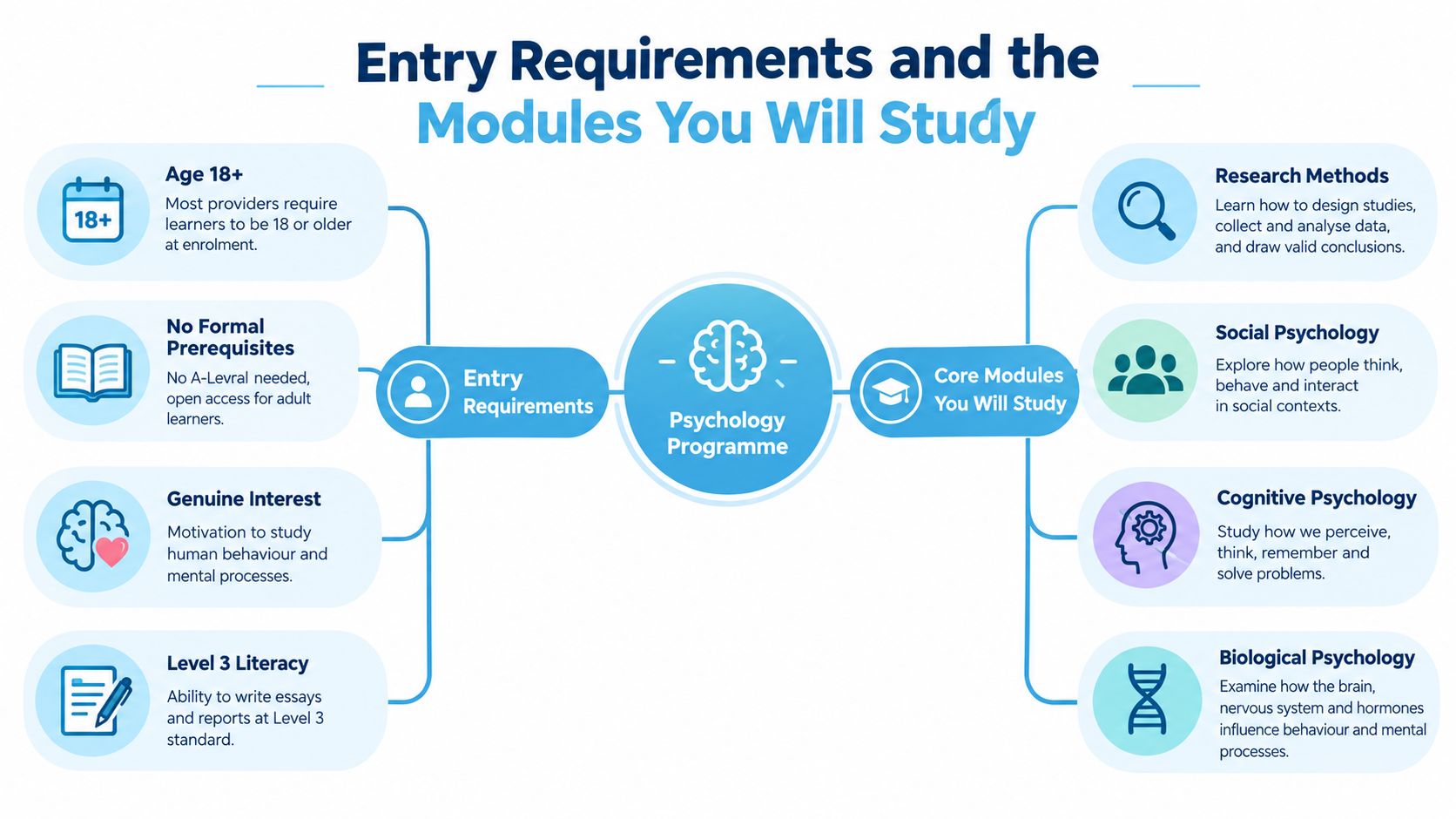
Most providers expect applicants to be adults, commonly 18 or older at enrolment, although the precise policy belongs to the provider. You generally don't need A-Levels, but you do need enough literacy to understand source material, write structured assignments and respond to feedback. Genuine interest matters because the course examines behaviour scientifically, rather than treating psychology as a collection of entertaining facts.
The most easily missed gateway is GCSE English and maths. Many psychology access listings require GCSE English and maths at grade 4/C or equivalent, as shown in the West London College online psychology access course information. If you don't hold those qualifications, a provider may accept Level 2 Functional Skills, but you must confirm both the access provider's policy and the university's conditions.
The subject units
The exact unit names differ, but psychology access courses commonly cover areas such as:
- Approaches in psychology: How major perspectives explain behaviour and mental processes.
- Research methods: How researchers design studies, consider evidence and evaluate conclusions.
- Biological psychology: How the brain, nervous system and biological processes relate to behaviour.
- Social psychology: How other people, groups and social contexts influence actions and beliefs.
- Cognitive psychology: How attention, memory, thinking and problem-solving operate.
- Psychological disorders: How different models understand distress, symptoms and treatment.
You'll normally study academic skills alongside these topics. That might include essay planning, critical analysis, referencing, source evaluation and presenting an evidence-based argument. The purpose is not to memorise theories. It's to practise the type of reading and writing expected on a psychology degree.
Assessment builds degree readiness
The course is assessment-heavy rather than centred on a final exam. Assignments may ask you to compare theories, evaluate research or apply a psychological concept to a carefully defined question. Graded units can contribute Pass, Merit or Distinction outcomes, while ungraded units give you opportunities to practise without every task carrying the same pressure.
Read the Access to HE Diploma Psychology course information closely for the provider's exact modules, assessment approach and entry conditions. A year of regular submissions can feel demanding, especially alongside employment, but it also gives tutors repeated opportunities to identify gaps before you reach university.
How Online Flexible Study Actually Works
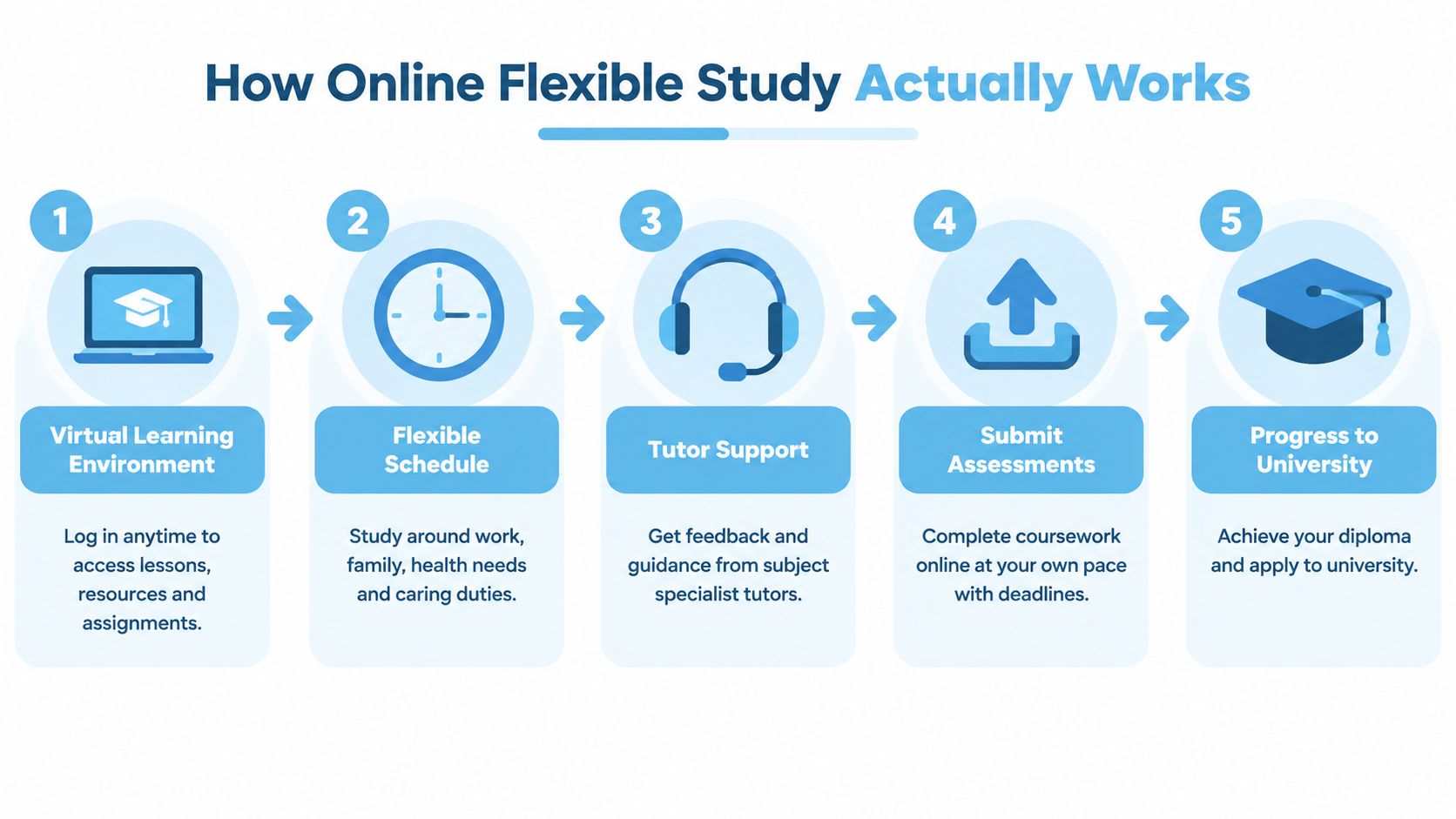
Online study works best when you treat flexibility as control over location and routine, not as the absence of deadlines. You'll usually log into a virtual learning environment containing lessons, reading materials, assignment briefs, discussion areas and tutor feedback. Some providers include recorded teaching, while others rely more heavily on written resources and guided tasks.
The qualification's content and academic expectations don't become easier because delivery is online. The format changes how you access teaching, submit work and ask for help. A course may be organised around weekly themes, with suggested study plans and set submission dates, or it may offer a more self-paced structure within an overall completion window.
What to check before enrolling
Ask providers specific questions rather than accepting “flexible” as a complete description:
- Live teaching: Are tutorials live, recorded or optional?
- Tutor access: When can you contact tutors, and how quickly do they normally respond?
- Submission rules: Are deadlines fixed, negotiable or organised around your own pace?
- Attendance: Do you need to attend online sessions, assessments or induction events?
- Technical requirements: Which device, software and internet connection will you need?
- University guidance: Will someone help you compare degree requirements and application documents?
A realistic routine might involve reserving several study sessions across the week, reading before work, and using one longer block for assignments. Starting an essay only when a deadline feels close creates avoidable pressure. Early contact with a tutor is usually more useful than waiting until you're already stuck.
Online flexibility should make study manageable, not invisible. Put it in your calendar as firmly as you would put a work shift.
Tutors may support academic writing, research methods, referencing, numeracy and assignment planning. You can also use this explanation of online Access to Higher Education courses to clarify how remote delivery differs from classroom attendance.
Before you commit, work out when you can study consistently. “I'll fit it in when I have time” is rarely a workable plan for assessment-based learning. A routine that protects study time, even when life remains busy, gives you a much stronger foundation.
Progression Routes Into Psychology and Beyond
The clearest progression route is an undergraduate psychology degree, either a BA or BSc depending on the university's curriculum. The diploma can demonstrate recent academic ability, subject engagement and commitment for applicants whose earlier qualifications don't show those qualities. University admissions teams still make individual decisions, so you'll need to compare the exact offer for each course.
Psychology degrees can lead towards further study in areas such as clinical, counselling or forensic psychology, but the access diploma is only the first stage. Practitioner roles normally require additional university study, supervised experience and professional requirements. A learner interested in forensic work might compare psychology degrees with criminology or social-science routes, while someone drawn to therapeutic work should check whether a counselling degree has placement or professional-practice conditions.
Where the diploma can help
| Potential degree route | How the diploma may help | What to verify |
|---|---|---|
| Psychology | Builds core subject knowledge and academic skills | Required grades, science or maths content and GCSE conditions |
| Forensic psychology | Provides a foundation for psychology or related social science | Whether the target degree leads to the later training route you want |
| Counselling | Supports progression into a people-focused academic pathway | Placement, professional and safeguarding requirements |
| Social work | Develops relevant study skills and subject awareness | Work experience, disclosure checks and professional standards |
| Sociology or criminology | Offers preparation for broader social-science study | Course-specific tariff and subject requirements |
Some universities accept Access Diplomas but ask for particular grades, a minimum number of credits in a subject area, an interview or evidence of recent study. Others may offer a foundation year instead. Request written confirmation from admissions teams, especially if the course page uses broad wording such as “equivalent qualifications”.
Prepare for academic pressure
University psychology involves more than caring about people. You'll read research, evaluate evidence and write under academic conventions. Learning to avoid common exam pitfalls can be useful as you develop a disciplined approach to revision and assessment, even though an Access Diploma itself is usually built around coursework.
Your personal statement should connect your experience with your academic reasons for choosing psychology. The psychology personal statement example can help you think about how to explain motivation without presenting personal experience as a substitute for subject understanding.
The key question isn't whether the diploma “gets you into university”. Ask which degree it supports, whether you meet the hidden conditions, and whether that degree leads towards the type of work you want.
Funding the Diploma Across the Four Nations
Funding depends on more than the course title. Your age, residence, prior Level 3 study, the exact diploma and the start date can all affect the answer. England, Scotland, Wales and Northern Ireland don't operate one uniform funding system, so advice written for one nation may mislead a learner living in another.
For England, government qualification records show that an Access to HE Diploma in Psychology and Criminology is funded through Advanced Learner Loans only until 01/07/2026, according to the official qualification record. This is a reminder to check the exact qualification reference and current eligibility rather than relying on a general statement that every psychology access course is funded.
The 2026 England position
For eligible learners aged 19 to 23, a first full Level 3 qualification may be available without tuition fees where it supports the learner's chosen career. Learners aged 24 or over on the first day of a course beginning on or after 1 January 2026 may use an Advanced Learner Loan if the particular course qualifies. The practical cutoff for the latter rule is therefore 31 December 2025, based on the stated start-date condition.
The loan isn't income-assessed. Government guidance says it can be written off when the course is completed and the loan entitlement is used to pay for an eligible higher-education course. Completion alone isn't the same as progression, and withdrawing or failing to complete will normally leave the balance repayable. Ask the provider to explain the position in writing before you accept a loan.
Nation-by-nation checks
| Nation | Key funding route to check | Important qualification point |
|---|---|---|
| England | Advanced Learner Loan eligibility and any applicable fee support | Confirm the exact qualification, start date, age and prior Level 3 status |
| Scotland | Residency-based and course-designation rules through the relevant funding body | Don't assume an English loan or remission rule applies |
| Wales | Welsh funding arrangements and provider eligibility | Check whether the diploma is designated for the support being discussed |
| Northern Ireland | Local student finance and provider-specific eligibility | Confirm residence, prior learning and qualification status |
Independent guidance linked from the qualification context notes that learners in England may receive fee remission or loan support, while learners in Scotland, Wales and Northern Ireland often need to self-fund, subject to their own circumstances. That makes a provider-written breakdown essential. Request tuition fees, registration or assessment charges, study materials and likely university costs, then confirm the current rules with the relevant funding body.
A separate issue is your Level 2 evidence. If you lack GCSE English or maths, you may need Functional Skills study before or alongside the diploma. Funding the diploma doesn't automatically remove that admissions condition.
Deciding If a Psychology Access Course Is Right for You
A psychology access course makes sense when it solves a specific progression problem. It can give you recent academic evidence and subject preparation, but it won't replace checking university conditions or planning around work and family. Use the following questions as a readiness check, answering yes, no or not yet.
Your practical decision points
- GCSE English and maths: Do you already have the required evidence, or have you confirmed that an accepted Functional Skills route is available?
- Target university: Have you identified at least one psychology or related degree and checked its Access Diploma requirements directly with admissions?
- Funding: Have you confirmed your nation, age, prior Level 3 qualifications, start date and the exact funding route for the diploma?
- Study routine: Can you protect regular time for reading, assignments, feedback and application work alongside your existing responsibilities?
- Long-term direction: Do you understand whether your aim is psychology, forensic psychology, counselling, social work, criminology or another social-science route?
A “not yet” answer isn't a rejection. It tells you what to resolve first. Missing GCSEs may mean starting with Level 2 study. Unclear funding may mean contacting the provider and your national funding body. An uncertain degree choice may mean speaking to university admissions before selecting modules.
Judge the bridge, not just the certificate
The qualification should connect your present circumstances with a realistic university application. That means matching your subject interests with the modules, your available time with the assessment schedule, and your budget with the complete cost of study. It also means accepting that progression rates have become less straightforward across the sector. The 2023/24 access and participation statistics report a fall in higher-education progression rates for almost all groups after the pandemic-era surge, so older promises about an uncomplicated route into university need careful scrutiny.
If you're still deciding, Access Courses Online offers a Psychology Access to HE Diploma with flexible online study, tutor support and guidance on progression, alongside routes for learners who need to address qualification gaps. Visit Access Courses Online to discuss your GCSE or Functional Skills position, compare course requirements and check whether your intended university route fits the diploma.