

You're on a university course page at ten at night, one tab open on the entry requirements and another on an Access to Higher Education Diploma. The page says 112 UCAS points, which sounds achievable. Then a line further down mentions Level 3 credits, physics modules and a minimum number of Distinctions, and the confidence drains out of the room.
That gap between the headline number and the small print is where most adult applicants stall. The total looks like a single bar to clear. Each radiography course hides a second bar inside it, about which science units you studied and which grades you earned in them, and that second bar is the one that decides offers.
What follows walks through radiography degree entry requirements in the order you meet them: the shared baseline, the course-specific thresholds, the Access route for adults, the apprenticeship alternative, and the checks that decide an application.
Typical Entry Requirements for Radiography Degrees
Find your qualification in the table first, because the route you already hold decides which of the later rules apply to you.
| Route | Typical requirement | Notes |
|---|---|---|
| Diagnostic radiography degree (A levels) | Two of three A levels, normally including physics, chemistry, biology or human biology | Plus five GCSEs at grades 4 to 9 or A* to C, including English, maths and science |
| Therapeutic radiography degree (A levels) | Two or three A levels including physics, chemistry or biology/human biology | Same five GCSEs at grades 4 to 9 or A* to C in English, maths and science |
| BTEC, HND or HNC | Qualifications containing science | Recognised as equivalents; confirm each university's acceptance |
| T Levels | Relevant T Level with science content | Named as an accepted route; check the course's specific subject list |
| NVQ | Science-based NVQ at an appropriate level | Explicitly recognised; confirm the level required by the course |
| Access to Higher Education (science or health) | Science-based Access diploma | Grades and science credits decide eligibility, not the total alone |
The shared baseline is spelled out by the NHS Careers guide to diagnostic radiography. It states that aspiring diagnostic radiographers must complete an approved diagnostic-radiography degree or master's programme before registering with the Health and Care Professions Council (HCPC), and that this registration is required before practising. The typical academic side is five GCSEs at grades 4 to 9 or A* to C, including English language, mathematics and science, plus two of three A levels, normally including physics, chemistry, biology or human biology.
Therapeutic radiography runs to a comparable pattern. The same source lists five GCSEs at grades 4 to 9 or A* to C in English, maths and science, together with two or three A levels that include physics, chemistry or biology/human biology.
Why the science subjects carry the most weight
Look at what those two lists test. The GCSE trio of English, maths and science checks literacy, numeracy and basic scientific grounding. The A level condition checks whether you can handle the subject matter of the degree itself: radiation physics, anatomy and physiology, exposure calculation, the behaviour of X-rays in tissue.
That's why a strong overall profile with a weak science base rarely gets through. The bar isn't "any qualification at university level". It's evidence that you can survive a curriculum built on physics and biology from the first week.
Read it as three separate tests: literacy, numeracy and science. Clearing one doesn't clear the others, and a good average elsewhere won't compensate for a missing science qualification.
The equivalents sit on the same footing, at least in principle. NHS Careers names BTEC, HND or HNC qualifications containing science, relevant T Levels, science-based NVQs and a science-based Access to Higher Education course as accepted routes into radiography. The operative word is science. A business BTEC with a distinction profile tells an admissions tutor nothing about your capacity for radiation physics.
Registration closes the loop. Whatever qualification you arrive with, the endpoint is an approved programme followed by HCPC registration, and individual universities add their own conditions on top: interviews, occupational-health checks, placement requirements. Those are where a near-miss in the science units can still cost you a place.
How Universities Set Their Own UCAS and Science Thresholds
Two applicants can present the same UCAS point total and still receive different decisions. The tariff works like a common currency: one numerical scale for the whole system. Each university then writes its own exchange rules, deciding which subjects the points come from and how the grades inside an Access diploma must be spread.
| Course or listing | Points or credit requirement | Science requirement |
|---|---|---|
| University of Plymouth, BSc Diagnostic Radiography (2025-26) | 112 UCAS points | Five GCSE passes at grade C/4 or above, including English Language, Mathematics and Science |
| University of Leicester, Diagnostic Radiography BSc (2025 entry) | Access to HE Diploma with 45 Level 3 credits | Physics modules required |
Start with a figure you can read on the course page. The University of Plymouth's BSc Diagnostic Radiography asks for 112 UCAS points for 2025-26 entry, with five GCSE passes at grade C/4 or above including English Language, Mathematics and Science. On points alone that looks like a moderate bar. It still does not say whether those points must come from physics, biology or a health diploma.
The University of Leicester's Diagnostic Radiography BSc places the condition inside the qualification. For 2025 entry it asks for an Access to Higher Education Diploma with 45 Level 3 credits, including Physics modules. Forty-five graded Level 3 credits is the standard graded portion of a 60-credit Access diploma, with the remaining 15 ungraded. The physics modules are the part that narrows who can apply.
What the totals hide
Read the two offers side by side. Plymouth leads with a points total and a GCSE science pass. Leicester leads with a credit count and named physics modules. A diploma that reaches 112 tariff points can still miss Leicester if the physics units are absent. A diploma full of physics can still miss Plymouth if English, maths or science at GCSE is short.
Same overall number, different science rule. That is the lookup to make before you apply.
The practical rule: find the science-unit clause before you find the points total. If the diploma you plan cannot satisfy the clause, the total is irrelevant.
Write down three lines from each course page: the points or credit total, the named science subjects, and any rule about how those credits are graded. Many programmes restate the same lines on their UCAS listing. Before you treat two diplomas as equal, check how Access to HE grades turn into UCAS points. A Distinction and a Pass do not carry the same tariff value, so the spread of grades inside the science units changes which offer you can meet.
For an adult applicant the useful conclusion is simple. Matching an overall number shows you can reach a number. Admissions tutors read the science units, and the grades inside them, before they treat that number as enough.
Access to HE Diplomas for Adults Without Traditional Qualifications
Say you left school at sixteen with a handful of GCSEs and went straight into work. Twelve years later you're in a hospital role, you've watched radiographers at work, and you want the job. There's no A level physics in your past and no way to manufacture one quickly.
The Access to Higher Education Diploma exists for that position. To study one, applicants must be aged 19 or over by 31 August in the year they wish to study, must be UK residents, and must be able to read, write and understand basic maths. Students can be accepted onto an Access to HE course without any GCSEs. That last point surprises people who assume the school qualifications are a locked gate.

The catch sits one step further along the road. Some universities still require GCSE English and maths or equivalent alongside the diploma, so check the target course page rather than assuming the diploma covers it.
Here's the walkthrough, including how the diploma is assessed and what tutors expect.
Build the diploma out of science units
Think of the Access diploma as a bridge assembled from individual planks. Each Level 3 unit is a plank, and radiography courses only walk across the science ones.
A radiography degree that names physics modules inside the diploma is asking a direct question: does the qualification you're planning contain them? A diploma assembled from health and social care units doesn't answer that question, however strong the grades. The same logic applies to the courses that count Distinctions within science units specifically, where a Merit in a science unit and a Distinction in an unrelated one are not interchangeable.
So the most useful decision you make on this route is the module choice, taken early, before enrolment rather than after. Pick the science pathway, take the physics unit even when it's harder, and treat the grades in those units as the ones that count. Everything else in the diploma is supporting material.
Degree Apprenticeships and Graduate-Entry Routes Compared
Two applicants can both be aiming at diagnostic radiography and still face four different calendars. One can study full time. One needs to keep a wage. One already holds a relevant degree. One can start only if a local NHS trust is hiring. The NHS comparison of health roles confirms that a degree apprenticeship in diagnostic radiography has been approved for delivery, and that apprenticeship routes also exist for therapeutic radiography. That same comparison describes standard radiography degrees as typically three or four years full time, with part-time study taking up to six years, while some relevant graduates may access a two-year graduate-entry route.
The destination is the same. The bar is not. A university sets the points total and the science condition for a degree. An employer sets the vacancy, the location and much of the apprenticeship timetable. Two offers can ask for a similar overall standard and still disagree on which science you must show. Read each course's published bar before you apply, or a match on points can hide a mismatch on science.
| Route | Typical length | Study pattern | Best suited to |
|---|---|---|---|
| Full-time undergraduate degree | Three or four years | Full time | Applicants able to study full time, including Access and A-level students |
| Part-time undergraduate degree | Up to six years | Part time | Applicants who must keep paid work |
| Degree apprenticeship (diagnostic radiography) | Typically three to four years, set by the employer | Employment-based with university study | Applicants who can secure an employer place; vacancies vary by location |
| Graduate-entry programme | Two years | Full time | Relevant graduates who already hold a degree |
What each route costs you in time and flexibility
An apprenticeship works like a paid training post with a degree attached. It eases the money problem and tightens the map. Requirements depend on the employer and the programme level. Vacancies are location-dependent. Applicants may need a level 3 qualification or relevant experience before an employer will take them on. You cannot enrol on your own. A trust has to be hiring.
A part-time degree keeps you nearer home and stretches the calendar. Six years is a long time to hold clinical placements alongside a job, and placement hours do not move to suit your rota.
The graduate-entry route is the shortest and the narrowest. It suits someone who already holds a relevant degree, not someone starting from an Access diploma.
An apprenticeship trades flexibility for a salary. A part-time degree trades time for flexibility. One fits your month. The other does not.
The endpoint stays put: an approved programme, then HCPC registration. Compare eligibility, whether you are employed while you study, the study pattern, competition for places and placement expectations. The route that fits usually shows up in that list.
Applying Through Access and What Admissions Teams Check
The application is where all the earlier detail either lines up or doesn't. Work through it in this order, checking each step against the thresholds your shortlisted courses publish.
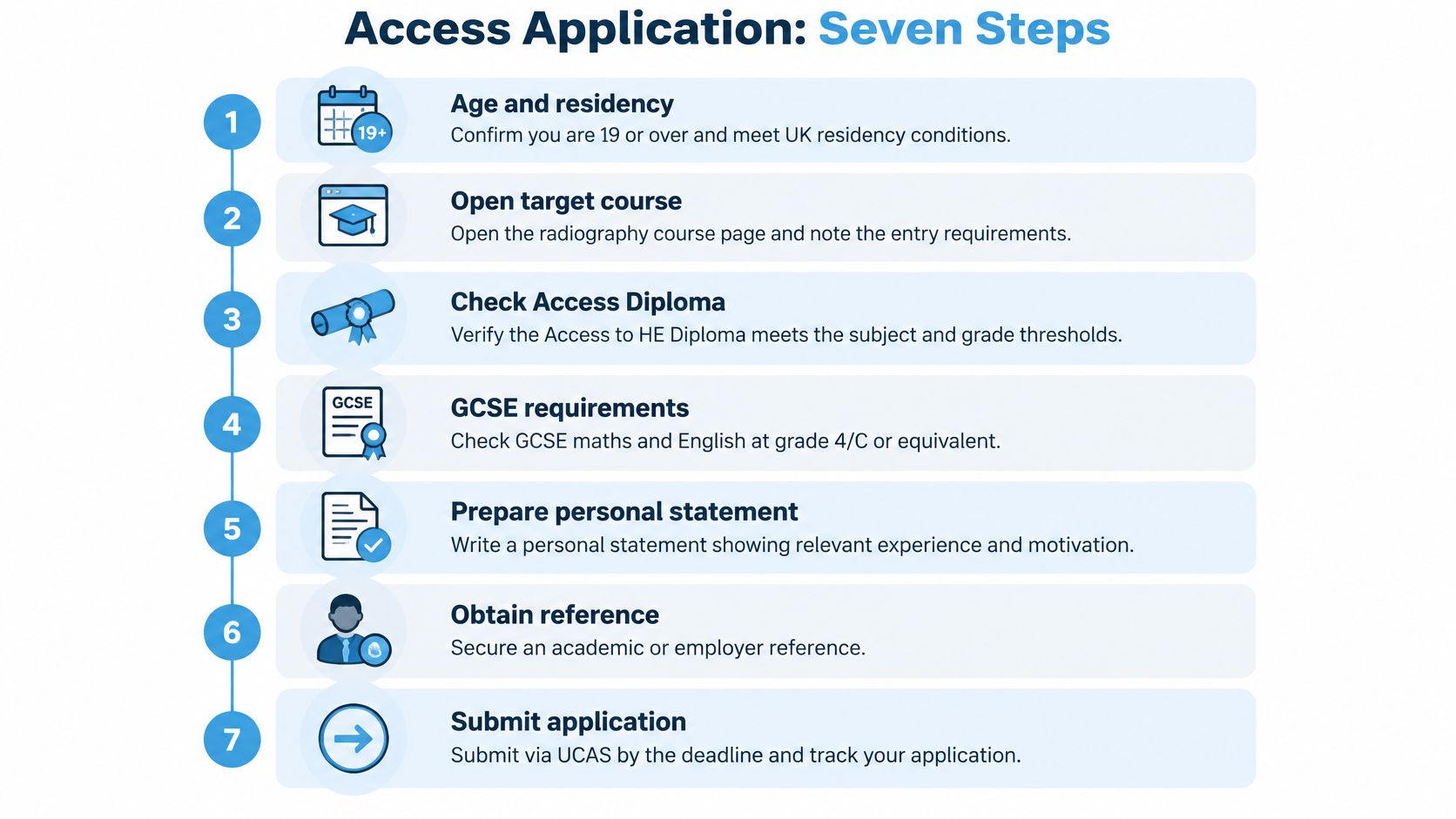
- Confirm age and residency first. The 19-plus rule and the UK residency condition are checked at enrolment, so establish them before you plan anything else. The usual mistake is assuming a course start date in September means an August birthday disqualifies you; the test is your age on 31 August, not on enrolment day.
- Open the target course page and read the whole requirements block. Note the points total, the science condition and the GCSE condition separately, because they're three different tests. The commonest slip is reading the points total, deciding it's reachable, and closing the tab.
- Match your Level 3 science credits and grades against the named requirement. If a course wants physics modules, or a set number of Distinctions from science units, count yours unit by unit. Applicants who fail at this stage usually fail because they counted total credits rather than science credits.
- Check the GCSE English and maths position. Some universities require them or an equivalent even from Access applicants, and evidence takes time to arrange. Sort it in the autumn rather than the week before the deadline.
- Map the further conditions. Interviews test motivation for the profession, occupational-health checks clear you for clinical work, and placements bring attendance, travel and clinical-readiness requirements. A university interview for a health course is usually a conversation about what you've seen of the job, not a test of physics. Ask about these conditions early rather than after an offer arrives.
- Email admissions with your diploma details. Send the unit list and predicted grades, and ask how they count your science units against their published requirement. Written answers resolve ambiguity that a prospectus can't.
- Apply through UCAS and track the conditions. Offers arrive with strings attached: specific grades, specific credits, sometimes a satisfactory health check. Read those conditions against your predicted results and respond before the deadline.
Ask early, in writing. Send admissions your diploma's unit list and ask how they count your science credits. An answer in an email is worth more than an assumption buried in a personal statement.
What admissions teams weigh beyond the totals
No qualification guarantees admission. Universities decide on the diploma studied, the results achieved, English-language ability and any additional course requirements, and those four things aren't a single score you can add up.
That's why a qualifying total never settles an application on its own. The strongest applications show science, communication and placement readiness together: a diploma built from the right units, a personal statement that reflects real time in a clinical environment, and arrangements for health checks already in motion.
Pick Your Route and Confirm Requirements Before You Apply
Three questions settle the decision. First, which qualification do you already hold or realistically add? Second, does your schedule suit full-time study, part-time study or an apprenticeship? Third, do the science rules at your target universities match the diploma you're planning?
Build a shortlist of two or three courses and compare each one's points, Level 3 science credits and GCSE conditions against the thresholds in the first table. Where a course leaves no margin, change your science modules now rather than hoping a near-miss gets waved through in the summer. Our Access to Higher Education Diploma (Health Professions) costs £1,499.00, and the units you choose matter more than the fee.
Then act in order:
- Confirm each shortlisted course's requirements on its own published page, not on an aggregator.
- Choose the Access science modules that satisfy the strictest requirement on your list.
- Contact admissions with your diploma details before you apply through UCAS.
We can review published entry requirements with you and contact admissions teams on your behalf, but the university makes the final admissions decision, so its published rules are the only reliable guide.
If you're weighing up an Access route into radiography, Access Courses Online offers an Access to Higher Education Diploma (Health Professions) studied fully online, with tutor guidance and interest-free payment plans over 12 months. We can review the published entry requirements for your shortlisted courses and contact admissions teams on your behalf, though the university always makes the final decision. Visit Access Courses Online to look at the radiography route and talk through your options before you apply.