

You're 34, you've been away from formal education for years, and you're considering an Access to Higher Education Diploma before applying for a degree. The course could open a route into nursing, computing or business, but it would also take time, money and attention away from work and family. The sensible question isn't whether education is valuable. It's whether the likely return justifies the investment in your particular situation.
Return on investment education gives you a practical way to answer that question. You compare what you put in, including fees, study time and lost earnings, with what you gain, such as higher pay, access to a new profession, better progression and greater career stability. The result won't predict your future perfectly, but it can make a difficult decision clearer.
What Return on Investment in Education Really Means
Educational ROI is the value you receive from learning compared with the resources you commit. The investment includes obvious costs, such as tuition and equipment, but mature learners also need to count less visible costs. These may include unpaid study hours, reduced overtime, travel, childcare and the mental effort of managing assignments alongside existing responsibilities.
The return can appear in several forms. A new qualification may lead to higher earnings, but it can also make you eligible for roles that were previously closed to you. It may give you a recognised progression route, professional registration, stronger confidence and the ability to continue into further study.
Practical rule: Don't judge a course by its fee alone. Judge it by the full cost of reaching the outcome you want.
A 34-year-old returning after a career break might compare an Access course with continuing in a familiar job. The immediate alternative may feel financially safer, especially if the current wage arrives every month. Yet staying put can also carry a cost if it limits progression, leaves skills underused or keeps the learner in work they no longer want.
Separate the investment from the return
Keep two lists before you make a decision.
Investment means everything required to complete the route:
- Fees: Tuition, assessment charges and any administration costs.
- Time: Scheduled lessons, independent study and travel.
- Cash-flow pressure: The months when money leaves your account before a new income arrives.
- Personal capacity: The effect on childcare, rest, family routines and existing work.
Return means what changes after successful completion:
- Income: A higher starting wage or better long-term earning potential.
- Access: Eligibility for a profession, degree or regulated role.
- Progression: A clearer path towards senior responsibilities.
- Resilience: More options if your current industry changes.
University entry can have substantial financial value, but it isn't uniform. A UK government review found a £102,563 net graduate premium for a representative degree in present value terms, with a 12.1% rate of return after taxes and qualification costs were considered (Office for Students higher-education returns review). That's a benchmark, not a promise for every student.
Your previous experience also matters. Mature learners often bring workplace judgement, communication skills and practical knowledge that can strengthen their studies. For a useful explanation of why crystallized intelligence keeps growing, consider how accumulated knowledge can support learning later in life.
How to Calculate Your Education ROI Step by Step
You can start with two simple calculations.
ROI percentage = (financial gain minus total cost) ÷ total cost × 100
Payback period = total cost ÷ annual net income uplift
Use estimates rather than pretending you know the future precisely. Your annual uplift should be the additional money you expect to keep after tax and other deductions, not the gross salary attached to a new role.
Example one, a short course
Suppose a short course costs £600 in fees and materials. You expect it to increase your annual net income by £400.
First, calculate the gain over a chosen period. If you use one year:
- Financial gain: £400
- Total cost: £600
- Net result: £400 minus £600, which is negative £200
- ROI: negative £200 divided by £600, multiplied by 100, which equals approximately negative 33.3%
The course hasn't paid for itself after one year. The payback calculation gives a second view:
- £600 divided by £400 equals 1.5 years
- That's roughly 18 months
After about 18 months, the additional income would have covered the original cost, assuming the uplift arrives and remains stable.
Example two, an Access route into university
Now suppose an adult learner estimates total education costs of £9,000, including fees, equipment and study-related expenses. They expect the completed route to create an annual net income uplift of £6,000.
Over five years:
- Financial gain: £6,000 multiplied by five, which equals £30,000
- Total cost: £9,000
- Net gain: £30,000 minus £9,000, which equals £21,000
- Five-year ROI: £21,000 divided by £9,000, multiplied by 100, which equals approximately 233.3%
The simple payback period is:
- £9,000 divided by £6,000 equals 1.5 years
- That's again roughly 18 months after the uplift begins
That last phrase matters. The calculation doesn't include the time spent completing the Access course or degree before the higher income starts. Add that period to your personal timeline, then test cautious, expected and optimistic income scenarios. If you want to explore the logic behind investment calculations in another context, you can calculate property investment returns using the same habit of listing costs, gains and timing.
A high percentage doesn't automatically mean a good decision. A slower return may still suit you if it offers professional security, flexible work or a route you genuinely want.
Comparing ROI Across Nursing, Computing and Business
Suppose you are choosing between three routes after an Access to HE Diploma. Nursing may offer a defined professional direction, computing may lead to several technical roles, and business may support progression across different commercial teams. ROI helps compare these options, provided you enter your own costs and realistic income estimates rather than treating a degree as an automatic pay rise.
Use the same calculation for each pathway:
Payback period in months = total education cost ÷ annual income uplift × 12
For a worked example, assume a nursing route costs £9,000 in total, takes 18 months of study, and raises annual net income by £5,500 after completion.
- Annual uplift: £5,500
- Monthly uplift: £5,500 ÷ 12, or about £458
- Payback: £9,000 ÷ £5,500 × 12, or about 19.6 months
- Five-year income uplift: £5,500 × 5, or £27,500
- Five-year net gain: £27,500 minus £9,000, or £18,500
- Five-year ROI: £18,500 ÷ £9,000 × 100, or about 205.6%
The 19.6-month payback begins when the higher income starts. It does not erase the 18 months spent studying, so the approximate time from enrolment to recovery is longer. Repeat the calculation with cautious, expected and optimistic uplift figures. A smaller uplift can extend payback even when the course cost stays unchanged.
For computing, include equipment, software, portfolio projects and time spent building current technical skills. Compare the likely role, not only the subject title. A route aimed at entry-level support work may produce a different uplift from one leading towards software development or data roles.
Business requires the same discipline. Its wider range can be useful, but you should name a target role, such as operations, sales, finance or management, before estimating the likely income change. Otherwise, an average figure may hide a weak match between the qualification and your intended work.
Match the pathway to your tolerance for uncertainty
Use this short checklist before choosing:
- Do you want a regulated profession with specific entry requirements? If yes, examine nursing requirements, placement hours and progression rules before comparing salaries.
- Can you keep earning while studying and manage extra training costs? If no, favour routes whose timetable, travel and equipment demands fit your household budget.
- Can you name a target role and the evidence employers expect? If no, investigate computing portfolios or business specialisms before enrolling.
The nursing salary guide can help identify salary figures to verify against current official and employer information.
Progression timing also affects cash flow. The Education Policy Institute access and participation analysis reports that 62% of Access students progressed to a degree programme within four years, compared with 79% of foundation-year students in the same analysis. It also reports that 47% entered degree-level study within one year, while a further 15% did so between two and four years later. Include possible delays when estimating when your uplift may begin, not only the advertised course duration.
Direct and Indirect Costs and Benefits to Plan For
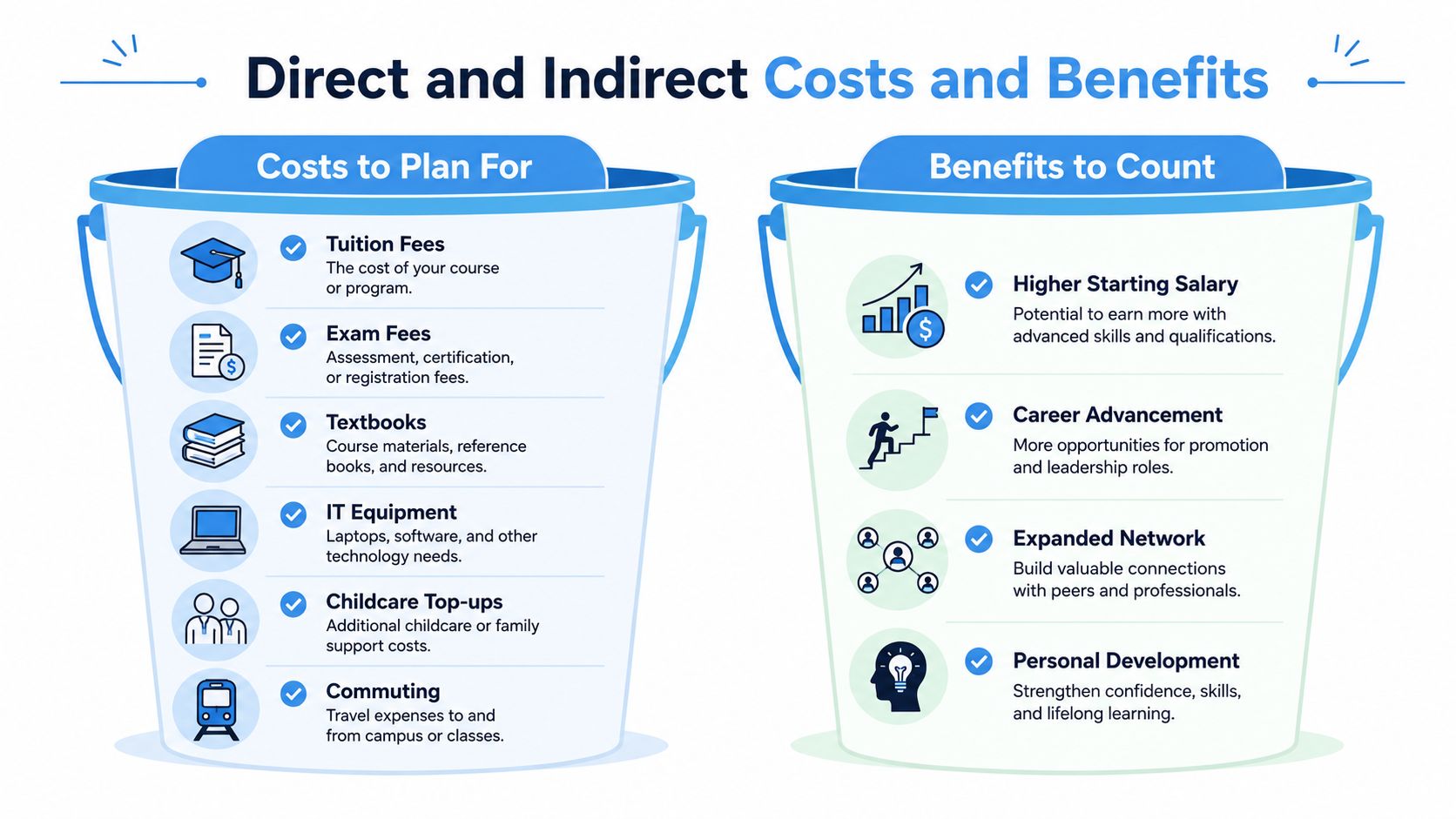
A realistic ROI calculation has two buckets. The first contains costs you can usually find on a provider's website. The second contains time and lifestyle effects that only you can estimate.
The parent returning to nursing
Consider a parent planning an Access route towards nursing. Tuition may be the most visible expense, but the learner might also need a reliable laptop, travel to teaching or placement locations, extra childcare during deadlines and replacement cover for work shifts.
The indirect cost is the income lost when study reduces availability for overtime. Fatigue matters too. A learner who works late, manages school routines and studies after the household is quiet may have less capacity for additional paid work.
The benefits extend beyond the first salary. Nursing can create access to a defined professional pathway, structured progression and further qualifications. The learner may also gain confidence in clinical communication, teamwork and decision-making. Those benefits belong in the notes even if you don't convert them into pounds.
The retail worker moving into computing
A retail worker moving towards computing may keep working while studying online. That can protect immediate income, but commuting to occasional sessions, buying equipment and creating portfolio projects still consume money and time.
The direct return may come from moving into an entry-level technical role. The indirect return may include a stronger professional network, evidence of applied skills and a clearer route towards later specialisation. If the learner only counts the course fee, the original ROI estimate will be too optimistic on the cost side and too narrow on the benefit side.
Use this checklist before committing:
- Record every payment: Include tuition, exams, books, software, equipment and travel.
- Estimate time carefully: Count lessons, assignments, commuting and revision.
- Ask about family costs: Include childcare, elder care and changes to household routines.
- Price the income gap: Note reduced shifts, overtime or unpaid leave.
- Define the outcome: Name the role, qualification or progression point you're targeting.
- Capture non-financial gains: Record confidence, job satisfaction, networks and future eligibility.
The wider UK evidence supports caution about averages. Longitudinal analysis using LEO data found average graduate lifetime gains of about £130,000 for men and £100,000 for women after taxes, student loan repayments and foregone earnings, while returns varied sharply by subject. The same analysis reported that the top 10% of graduates gained around half a million pounds in discounted present value terms, while some subjects, including law, economics and medicine, exceeded £250,000, and creative arts and languages could be close to zero or negative (Institute for Fiscal Studies analysis of undergraduate degrees and lifetime earnings).
Funding, Interest-Free Payment Plans and Cash Flow
A course can be affordable in total and still difficult to fund month by month. Adult learners should examine cash flow, meaning when money leaves the account, as well as the final amount paid.
Possible routes include an Advanced Learner Loan, employer sponsorship, personal savings and provider instalments. For eligible learners, an Advanced Learner Loan used for an Access to Higher Education Diploma can be written off when the learner progresses to higher education and completes an eligible course. Check the current rules and eligibility before relying on that outcome.
An interest-free plan changes timing rather than the underlying price. For example, a learner paying £75 each month for 12 months pays £900 in total, the same as paying £900 upfront, provided there are no administration charges. The instalment arrangement may be easier to fit around wages, but the learner still needs to confirm withdrawal terms, missed-payment rules and whether the provider adds fees.
| Funding route | Monthly payment | Total repaid | Interest paid | Impact on ROI |
|---|---|---|---|---|
| Interest-free instalments | £75 for 12 months | £900 | £0 | Preserves the planned ROI if no extra fees apply |
| Upfront payment | Not applicable | £900 | £0 | Same total cost, but greater immediate cash pressure |
| Credit-card funding | Depends on balance and terms | Higher than the original cost if interest applies | Depends on APR and repayment timing | Reduces ROI and extends payback |
Credit-card borrowing can be especially damaging when repayments continue after the course ends. The supplied plan refers to 7% to 9% APR, but the exact cost depends on the balance, repayment schedule and card terms. Don't use an illustrative interest figure as a promise. Ask for a written repayment total instead.
A short-term cash advance may appear convenient, but it's still borrowing and should be assessed by its full repayment cost, not just the amount received. For a broader overview of possible support, review this guide to funding for courses.
Cash-flow check: Set payment dates just after income arrives, then leave room for rent, bills, food and an emergency buffer.
Tips for Improving Your Education ROI and Measuring Outcomes
The strongest ROI decisions usually come from controlling the variables you can influence. You can't guarantee a particular salary, but you can choose a route with a clear progression structure, complete work consistently and build evidence that employers can assess.
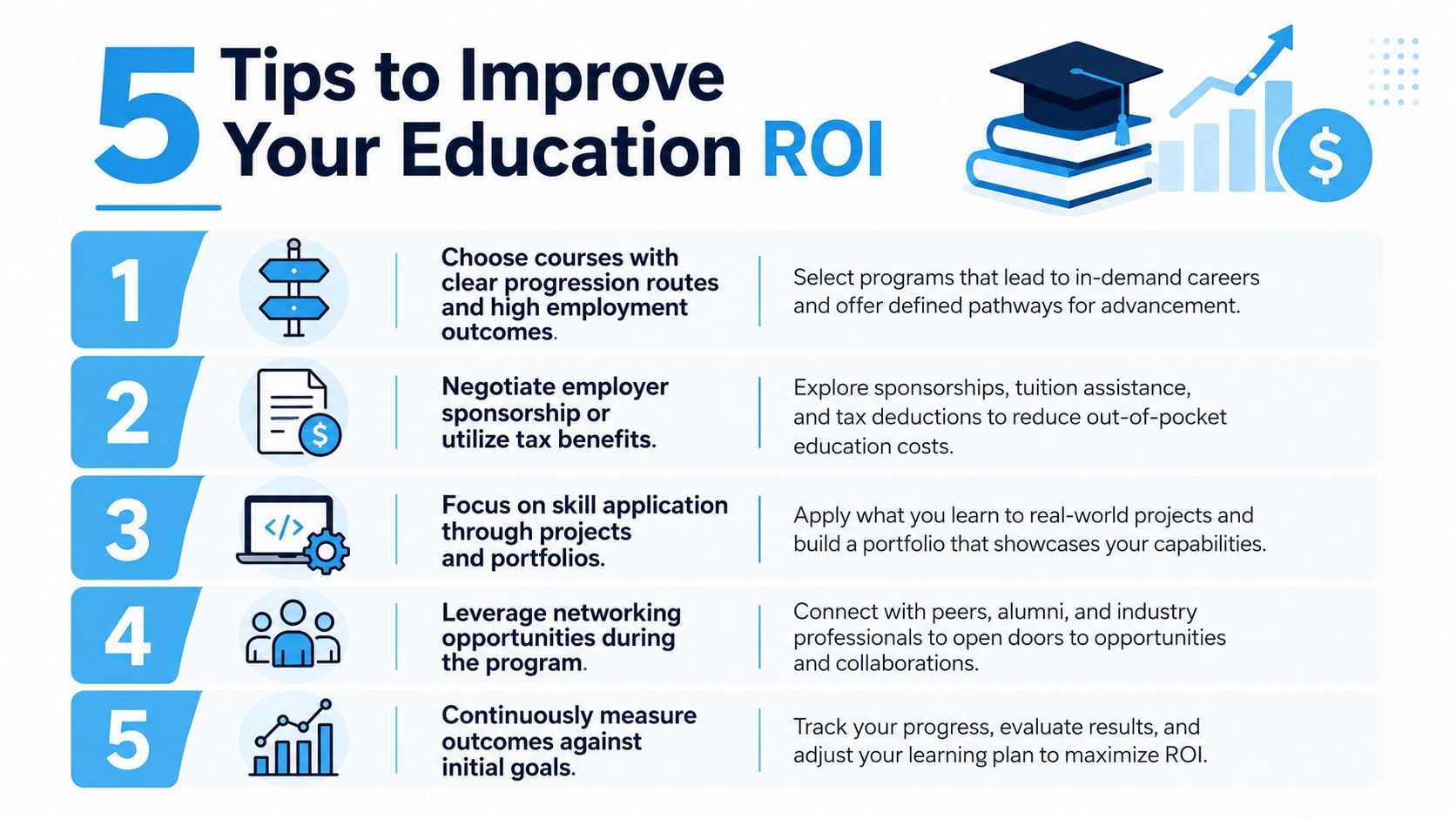
- Choose the destination first. Identify the role you want, then check whether the course leads directly towards its entry requirements. An Access route with no clear next step can create extra time and cost.
- Finish within the funded period. Delays may extend fees, reduce momentum and postpone the income uplift. Build a weekly study routine that fits your existing responsibilities rather than copying someone else's timetable.
- Turn learning into evidence. Short certifications, projects and portfolios can help you show what you can do, particularly in computing and business. A completed assignment becomes more valuable when you can explain the problem, your method and the result.
- Use your employer where possible. Ask about sponsorship, paid study time, internal vacancies and progression requirements. Employer support can reduce your personal cost and give you a clearer route from learning into application.
- Measure outcomes, not activity. Completing lessons matters, but your tracker should also record skills used, applications made, interviews, role changes and income movement.
Build a one-page ROI tracker
Record your baseline on the first day:
- Current role and net income
- Existing qualifications and skills
- Total expected course cost
- Weekly study time
- Target role and expected timing
Review progress at regular intervals. Log completed milestones, practical projects, employer conversations and changes in responsibility. At six and twelve months after completion, record applications, interviews, role changes and income. Review the full calculation annually, including non-financial gains such as confidence, flexibility and job satisfaction.
The UK evidence shows why personal tracking matters. Government-linked analysis found average graduate earnings about £10,500 above non-graduates over the last 16 years, while also warning that outcomes vary by age, subject and institution. At age 29, some graduates from lower-return institutions were still below similarly qualified non-graduates who hadn't attended university (Universities UK graduate employment outcomes pack). Average figures can inform your starting point, but they can't replace a course-specific plan.
Watch the video for another practical perspective on building employability alongside formal study.
You can strengthen the non-financial side of your plan by reviewing employability skills, then choosing assignments and projects that demonstrate them. Revisit your ROI after a promotion or role change. Education can create value over a career, not only in the first year after completion.
Access Courses Online offers flexible, accredited Access to Higher Education Diplomas designed for adults progressing towards university while balancing work and family. Visit Access Courses Online to explore progression routes, interest-free payment options and guidance for choosing a pathway that fits your education ROI plan.