

You finish a full shift, travel home, sort dinner and answer a few messages before opening your laptop. The course module is still waiting, but your attention has already been spent on work, commuting, family responsibilities and the ordinary decisions that fill an adult week. Studying while working full time can be realistic, but only when the plan accounts for energy, income and recovery, not just available hours.
UK evidence makes the case for a more honest approach. In the 2022/23 graduate outcomes cohort, 59% of graduates were in full-time employment 15 months after leaving higher education, 12% were in part-time employment, 6.6% were in further study, and 10.9% were working and studying at the same time, according to UK graduate outcomes data. Combining employment and learning is a normal route through education, but normal doesn't mean effortless.
What Studying While Working Full Time Really Looks Like in 2026
At 6pm, a warehouse shift ends. You've spent the day on your feet, travelled home and dealt with the practical demands of family life. At 9pm, the laptop opens, an Access to HE module is half-complete, and the remaining task requires concentration rather than passive viewing. The question isn't whether the course is technically online. It's whether your brain has enough capacity left to use it properly.
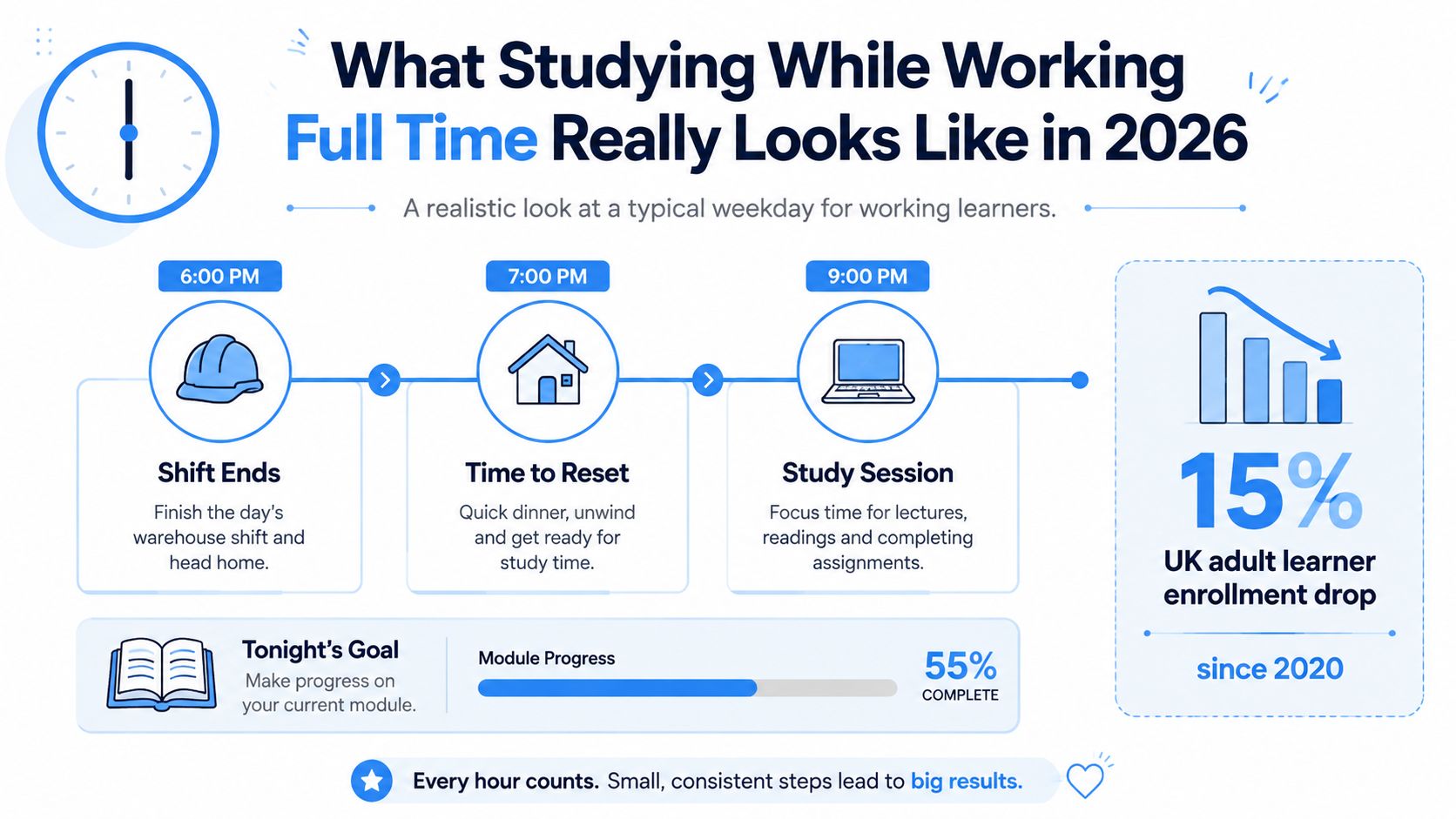
The phrase “study whenever you like” can sound liberating, but it often hides the friction. A commute can remove the quiet part of the evening. Childcare can make a planned session impossible. Overtime can arrive with little notice, while a second job can consume the weekend you expected to reserve for assignments.
That pressure is visible in UK participation data. In 2025, 50% of people employed full time reported participating in learning during the previous three years, down from 65% in 2024, according to Learning and Work Institute analysis of the Adult Participation in Learning survey. The same source reports that only 21% of adults in work were currently learning at work, compared with 28% in 2024, and that workers earning over £52,200 were almost twice as likely to have learned in the previous three years as those earning under £26,099, 33% compared with 17%.
The real constraint is energy
Most advice starts with a calendar. Practical support for adult learners has to start with an energy budget. A 35-hour week with a short commute and no caring duties creates a different study plan from a 48-hour working week with rotating shifts, travel and dependants.
A 2024 HEPI survey reported that 56% of full-time UK undergraduates were employed part time, working an average of 14.5 hours per week. Once paid work, lectures, classes and study-related activity were combined, working students averaged 48-hour working weeks during term time, with some reaching 56 hours, as reported by The Guardian's coverage of the survey.
Practical rule: Your study plan must survive your worst ordinary week, not just your most motivated Monday.
In 2026, flexible online learning is particularly relevant to adults preparing for routes such as nursing, health professions, science, business and technology retraining. The qualification may open a new direction, but the route still depends on consistent work completed after the novelty has gone.
Treat study as a protected weekly commitment, not spare-time entertainment. That means deciding what will be reduced, delayed or shared at home before you enrol. The rest of your plan should follow that constraint.
Building a Realistic Weekly Schedule and Time-Blocking Template
A useful schedule protects study hours instead of pretending you'll discover spare time at the end of each day. Heroic plans based on rising before dawn often fail because they depend on perfect sleep, perfect motivation and no unexpected disruption. Build something repeatable first, then increase it only when the routine has proved itself.
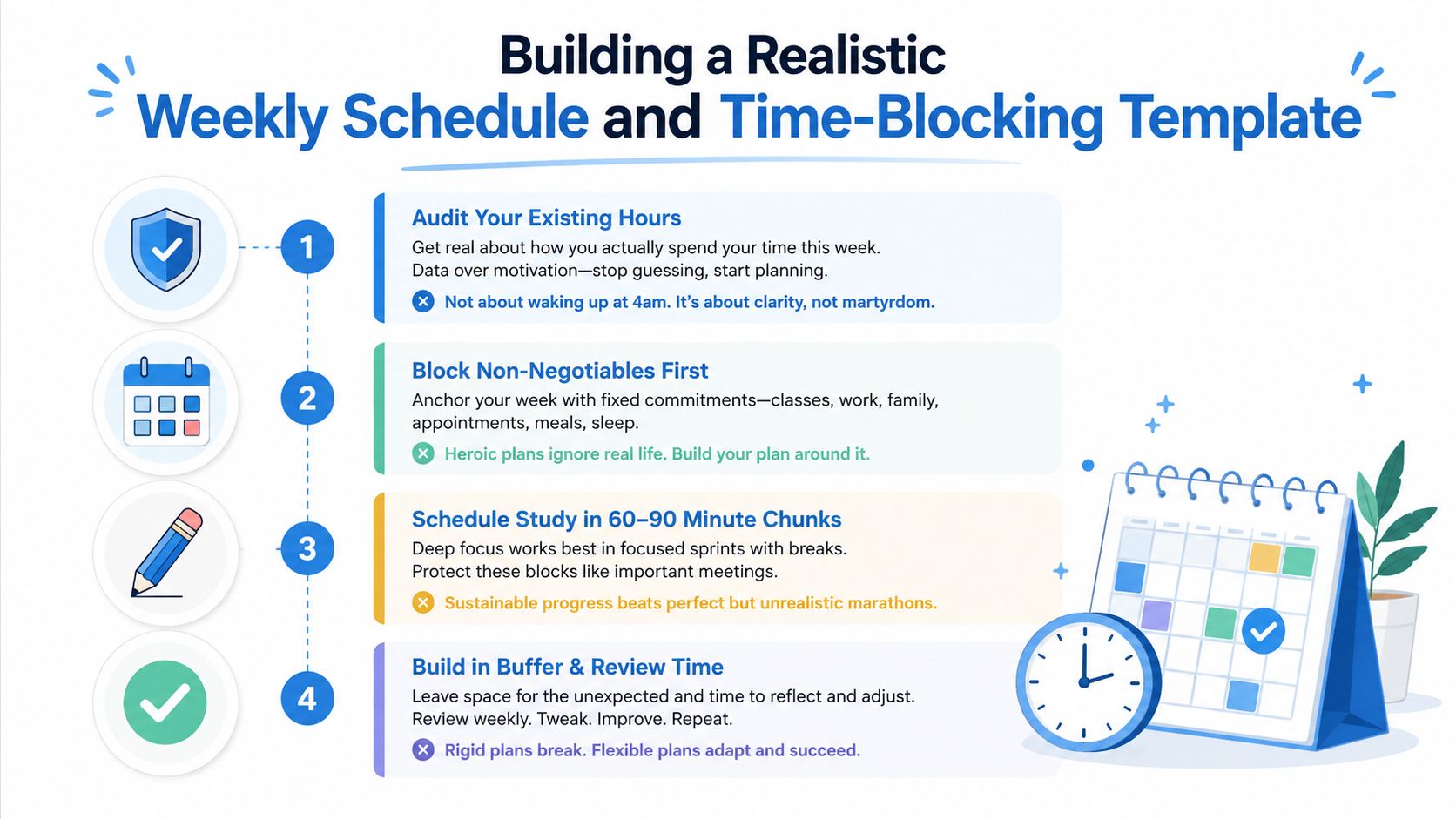
Use four decisions, in order
- Audit the week on paper. Write down working hours, travel, childcare, meals, sleep and recurring responsibilities. Don't begin with ideal availability. Begin with what already happens.
- Block essentials first. Mark work, school runs, medical appointments, exercise and essential household tasks. Fixed commitments show you where study cannot go.
- Protect two or three study slots. Use sessions of 45 to 90 minutes for reading, problem-solving or writing. Give each slot one job, such as outlining an assignment or completing a lesson, rather than labelling it vaguely as “study”.
- Leave recovery and buffer space. Keep Friday evening deliberately open if possible. It can absorb overtime, a missed session or the need to rest without turning one disruption into a failed week.
The guide to creating a study schedule that actually works is useful for turning these principles into a repeatable routine. The key is to make the calendar visible and specific.
A practical weekly template
| Day | Standard 9-to-5 pattern | Compressed hours or shifts |
|---|---|---|
| Monday | 7.30pm to 8.30pm, reading | Recovery after shift, optional 20-minute review |
| Tuesday | No study, household or recovery time | 60-minute study block after the best-rested shift |
| Wednesday | 7.30pm to 8.30pm, active recall and notes | 45-minute task during a reliable quiet window |
| Thursday | No study, prepare for deadline | 60 to 90 minutes, assignment work |
| Friday | Protected buffer evening | Buffer for overtime or missed work |
| Saturday | 9am to 10.30am, deep work | Longer block after sleep, if energy allows |
| Sunday | 20-minute weekly review | Review rota, swap sessions and set one priority |
If overtime removes Wednesday's session, don't add an exhausting midnight block. Swap it with Friday's buffer or shorten Saturday's task. The minimum viable session might be reviewing active-recall notes, reading a short section or writing a rough paragraph. A reduced session maintains continuity while protecting sleep.
Review the plan every Sunday. Ask what happened, which slot produced the best work and what needs moving before the next rota or deadline arrives.
Study Techniques That Actually Fit Around a Working Week
The best study technique depends on the shape of your workday. Pomodoro can support concentrated evening work, microlearning suits fragmented shifts, and spaced repetition keeps knowledge active without demanding a long session. None of them can compensate for a timetable that leaves no recovery.
Three methods, three different uses
Pomodoro divides focused work into short intervals followed by breaks. A common version uses 25 minutes of study and a five-minute break, repeated as appropriate. It suits an office worker who can create a quiet evening, particularly for writing, calculations or reading that requires uninterrupted attention. Forest can add a simple phone barrier, while a written task keeps the interval focused.
Microlearning breaks material into small units that fit around natural gaps. A shift worker might review one definition during a break, listen to a short explanation during travel or answer a small set of questions before collecting the children. It works best for terminology, recall prompts and preparation, not for every complex assignment. For a practical introduction to designing short, timely learning activities, see this guide on micro-learning with AI from Acheloa Wellness, Inc.
Spaced repetition revisits information over increasing intervals. Anki can schedule flashcards, while active-recall notes can be reviewed manually for 15 minutes in the morning. This method works well when layered onto either Pomodoro or microlearning because it maintains memory without requiring a full study evening.
| Technique | Best For | Session Length | Job Type Fit |
|---|---|---|---|
| Pomodoro | Writing, reading and problem-solving | 25-minute focus periods with five-minute breaks | Office-based roles with predictable evenings |
| Microlearning | Definitions, short concepts and review questions | Brief, fragmented sessions | Rotating shifts and frontline retail |
| Spaced repetition | Terminology, processes and factual recall | 15-minute review | Any role, especially early mornings or commutes |
Match method to the work pattern
An office worker can reserve one or two quiet evening sessions for Pomodoro and use spaced repetition before work. A shift worker should protect sleep after a late shift, then use microlearning during stable gaps and schedule deeper work after recovery. A frontline retail worker may need short recall sessions on working days, with one longer weekend block for assignments.
No technique survives a week that has no boundaries.
The important question isn't which app you download. It's whether the method matches the material, your concentration and the interruptions you can realistically expect.
Choosing the Right Flexible Online Course and Support
A course that fits around full-time work needs more than recorded lectures. It should offer a recognised route, clear deadlines, tutor access and a workload you can compare with a 35–48 hour working week. Before paying a deposit, test the course as though you were already enrolled. Check whether its demands fit your available time and energy, not only your calendar.
Four checks before commitment
Accreditation and progression come first. Confirm what the qualification is, who recognises it and where it can lead. For Access to HE Diplomas, check that the provider and qualification support the university route you need, including relevant UCAS and quality-assurance arrangements. A course can sound suitable yet fail to meet a target university's entry requirements, costing time without advancing your application.
Tutor contact must be concrete. Ask how quickly tutors respond, how marked work is returned and whether live contact is available. A platform full of videos leaves you carrying too much responsibility if difficult feedback has to be interpreted alone.
Payment terms affect sustainability. Compare the full payment structure, interest-free instalments where offered, Advanced Learner Loan eligibility and employer sponsorship. A payment plan is unsuitable if it leaves too little for household essentials. For a practical view of fitting online learning around employment and home commitments, read how online learning fits into a busy lifestyle.
Progression should be written down. Ask which universities, professional routes or employment pathways learners commonly target, then verify the requirements independently. Broad claims about career outcomes are not enough.
The advertised duration matters less than the notional learning hours and assessment pattern. A longer course may suit a full-time worker better than an intensive programme, even when both use the same online format. Look for assessment deadlines that avoid predictable work peaks, and check whether extensions or resubmissions have clear rules.
Compare provider types
| Provider Type | Typical Cost (UK) | Flexibility for Shift Work | Tutor Support | Recognition & Progression |
|---|---|---|---|---|
| University part time | Varies by programme | Often structured around terms | Usually established academic support | Strong where the award meets route requirements |
| FE college | Varies by course and funding | May offer blended or scheduled delivery | Often direct and practical | Depends on qualification and progression route |
| Private online provider | Varies by provider | Can be highly flexible | Must be checked carefully before enrolment | Verify awarding and progression arrangements |
| Professional body | Varies by qualification | Often designed around working professionals | Usually subject-specific | Strong within the relevant profession |
Shortlist three providers. Place their deadlines, tutor contact expectations and learning requirements beside a typical working week, including commute, caring responsibilities and recovery time. The right course is one you can sustain through busy weeks, not one that works only during a quiet month.
Talking to Your Employer and Your Family About Study
A study plan often fails in conversations that never happened. Your employer controls part of your working time, while your household controls the practical conditions around your non-working hours. Discuss both before the first deadline rather than waiting until you're already behind.
Make the employer request specific
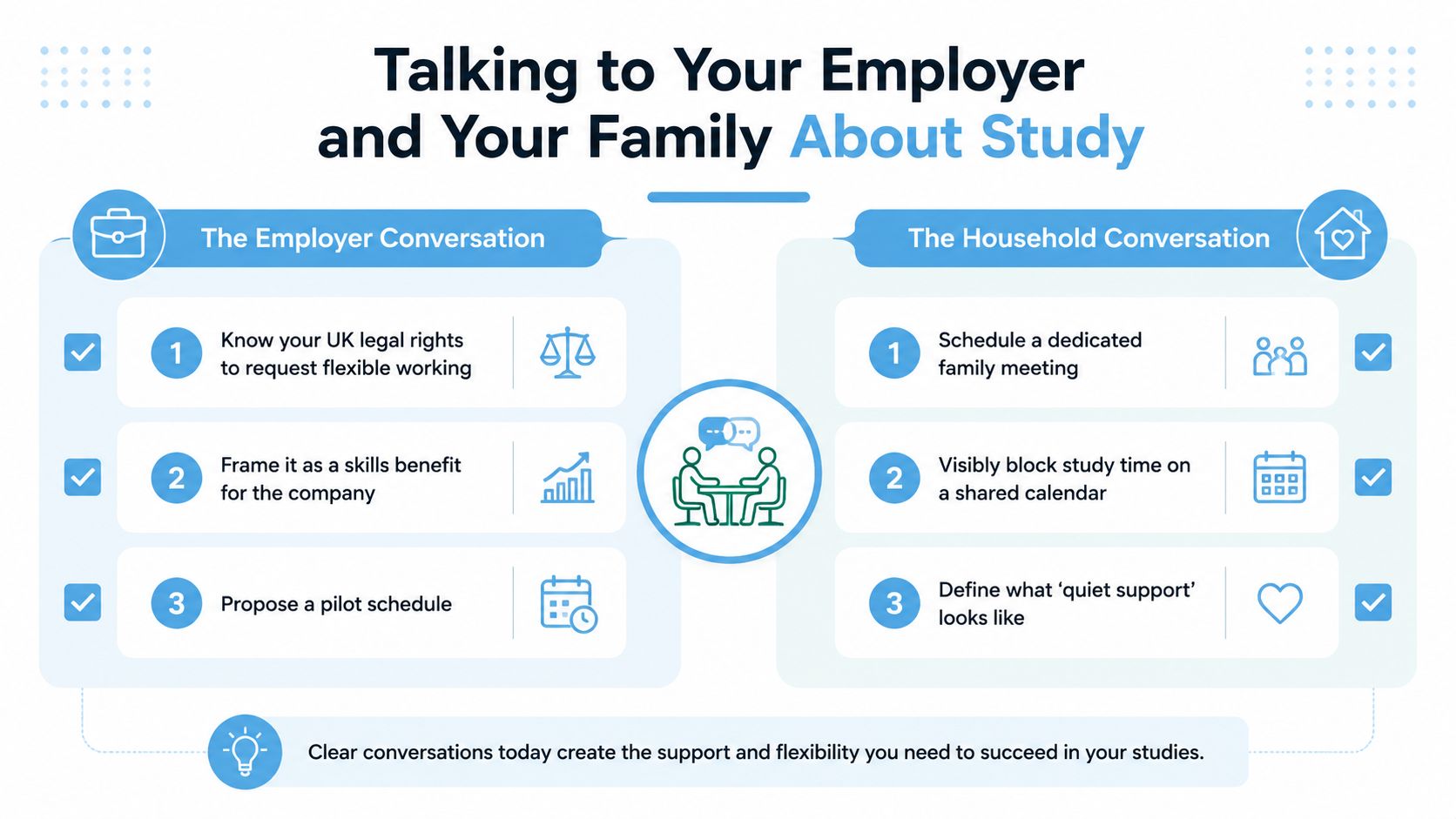
The UK position matters. There isn't a general statutory right to paid study leave, so don't build your plan around an assumption that your employer must fund or release you. Check your contract and workplace policy, and use Acas guidance on training, flexible working and time off to understand the options relevant to your circumstances.
A useful request sounds like this:
“I'm starting a course that supports the skills I use in this role. Could we trial protected study time on quieter periods, reduce overtime during assessment weeks and review the arrangement after the first month?”
Keep the request operational. Explain the schedule, identify the periods when work will remain unaffected and propose a trial rather than demanding a permanent exception. If the arrangement affects rotas, overtime or breaks, put the agreed terms in writing and keep copies of messages, meeting notes and dates.
Turn family support into a shared agreement
Your family doesn't need a motivational speech. They need to know when you'll be unavailable, what support means and what will happen during deadlines. Say, “I need two protected study blocks each week, and I'll take responsibility for these chores before or after them. Can we agree what changes during assessment weeks?”
Use a shared calendar and hold a short weekly review. Agree which blocks are protected, who covers essential tasks, how interruptions will be handled and when you'll be fully present with the household.
Before week one, record:
- Study blocks: The exact days and times you'll normally work.
- Fallback plan: Which session moves if overtime or illness intervenes.
- Assessment periods: Dates when household and work flexibility may be needed.
- Quiet support: Whether this means no interruptions, help with meals or shared childcare.
This changes study from a private hobby into a visible commitment with agreed boundaries.
Protecting Your Wellbeing and Avoiding Burnout
After a 48-hour week, a late-night study session may look productive while leaving you unable to concentrate at work the next day. More hours do not guarantee more progress. Fatigue can lead to rereading, avoidance and lost confidence, whereas a shorter focused session may produce useful work without extending the problem into tomorrow.
The pressure is real. The Health and Safety Executive reports 17 million working days lost to work-related stress, anxiety and depression in its work-related stress, anxiety and depression statistics. For adult learners, that makes energy management part of the study plan, particularly when lower-paid work already leaves less control over hours and recovery.
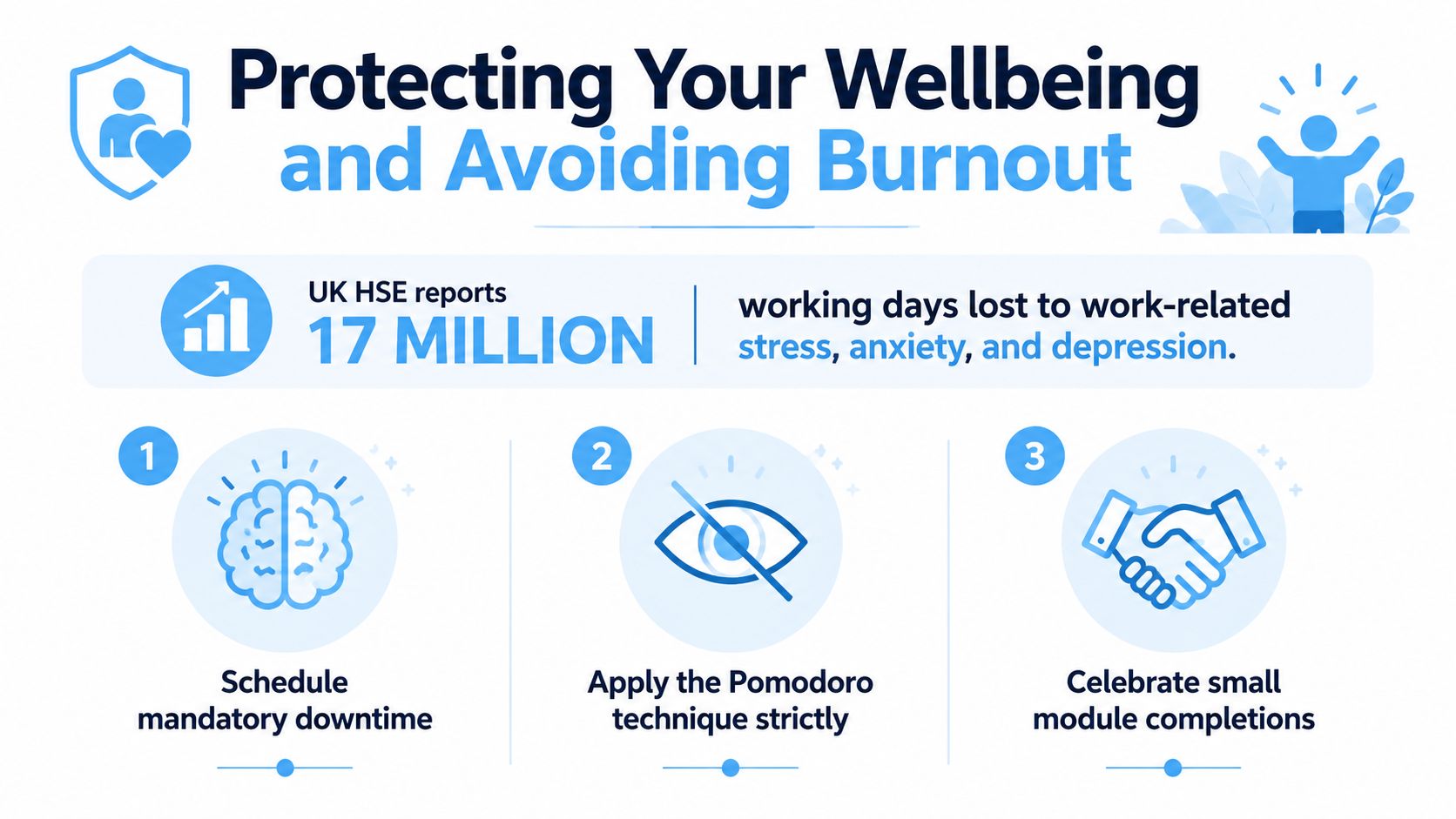
Five warning signs and the adjustment to make
Decision fatigue by Wednesday suggests too many choices in the plan. Set the task before the session and keep low-energy activities available for difficult days.
Weekend catch-up that ruins Sunday signals that the backlog is consuming recovery time. Drop the least valuable task, contact your tutor about priorities and prevent one missed session becoming a full-week crisis.
Declining sleep quality is a reason to stop extending evening study. Move review work to a rested morning or reduce the week's target.
Losing interest in the subject may reflect exhaustion rather than a wrong career choice. Complete one smaller practical task, speak to your tutor and reassess after recovery.
Friction at home shows that study is creating hidden costs. Revisit the household agreement and redistribute tasks instead of relying on goodwill.
For someone working a 35 to 40-hour job, roughly 8 to 10 hours per week may be a more sustainable starting budget than an ambitious target. If that budget collapses during a demanding week, switch to maintaining contact with the course: review one key concept, submit a question to your tutor or record the next action. Reschedule only the work that affects the deadline, rather than trying to repay every missed hour at once.
Practical fatigue management includes movement, sleep, meals and realistic pacing. BionicGym's approach to metabolic health offers context for supporting energy instead of treating exhaustion as a productivity problem.
Use a 10-minute weekly review. Rate your energy, check sleep and relationships, identify the next deadline and remove one unnecessary task. The guide to managing stress as an adult learner can help structure that conversation with yourself and your support network.
Sample Study Plans and Your First 30 Days
Your first month should prove that the routine works before you increase the load. Start with a lighter week, identify the sessions that survive real life and build gradually. A rotating shift worker shouldn't copy an office worker's timetable, because recovery after a late shift is part of the schedule, not an obstacle to it.
Two seven-day patterns
| Day | 9-to-5 Worker | Shift Worker |
|---|---|---|
| Monday | 45 minutes before work, recall review | Recovery after shift, no demanding study |
| Tuesday | 60 minutes after dinner, reading | 20-minute microlearning session during a reliable gap |
| Wednesday | No study, protected evening | 60 minutes after a rested morning |
| Thursday | 60 minutes, assignment outline | Recovery or short review, depending on rota |
| Friday | Buffer evening | Buffer for overtime, swaps or rest |
| Saturday | 90 minutes in the morning, deep work | 90-minute block after the best sleep window |
| Sunday | 30-minute review and planning | 45-minute review, rota check and deadline plan |
A four-week ramp
Week one: Complete two focused sessions and one short review. Learn the platform, record deadlines and contact your tutor.
Week two: Add a third protected session only if sleep, work performance and home responsibilities remain stable. Break the first assessment into small tasks.
Week three: Use the full planned pattern. Move difficult work into your strongest concentration window and keep the buffer session available.
Week four: Review what the course demands. If the workload exceeds your available energy, discuss pacing or support before the next module begins.
Your first 30 days can follow this checklist:
- Days one to three: Confirm entry requirements, payment arrangements and the weekly workload.
- Days four to seven: Write the schedule, share it at home and speak with your employer.
- Week two: Contact your tutor with a focused question and complete the first meaningful task.
- Week three: Check whether your study method suits the content and your shift pattern.
- Week four: Hold a wellbeing review, inspect missed sessions and adjust the plan without self-blame.
Take one action today. Set a 30-minute timer, write down every fixed commitment in the next seven days, choose two protected study slots and send one message to the person who needs to know about them. That turns the idea of studying while working full time into a plan you can test.
Access Courses Online provides accredited online Access to HE Diploma courses for adults progressing towards university routes including Nursing, Midwifery, Health Professions, Computer Science, Science, Social Science, Business and Management, with flexible self-paced study, tutor guidance and interest-free payment plans over 12 months. If you need a course that can sit alongside employment and family responsibilities, visit Access Courses Online to review the available routes and request practical guidance.