

Sunday evening. Your diary is open, but there's no obvious gap left. Work shifts occupy the weekdays, the school run controls the mornings, and by the time the children are asleep, your concentration has already run out. You still need to read, write, revise, and submit work, yet the usual advice says to “block out a few hours” as though your calendar were waiting patiently for you.
Time management for students has to start with the week you have. Paid work, childcare, commuting, appointments, fatigue, and unexpected interruptions aren't signs that you're failing to organise yourself. They're the design constraints. The useful question is not how to create a perfect timetable, but how to build a study routine that can keep moving when life changes.
Why Time Management Feels Different for Adult Learners
A working adult returning to education often begins with good intentions. They buy a planner, download a calendar app, and reserve an evening for study. Then a shift changes, a child becomes ill, or a journey takes longer than expected. By the end of the week, the plan has collapsed, and the student concludes that they lack discipline.
The problem is usually the plan, not the person. Much student productivity advice assumes predictable energy, uninterrupted afternoons, and control over most of the day. Adult learners often have none of those advantages. Their study time may arrive in short periods between responsibilities, with the most available window appearing when they're already tired.

The scale of higher education also matters. The Quality Assurance Agency's contact-hours guidance describes a longstanding UK benchmark of about 10 hours of learning for each academic credit. A typical 360-credit degree therefore represents roughly 3,600 notional learning hours overall, including substantial independent work. That framework makes one point clear: attending classes is only part of studying.
The pressure is not imaginary
Recent UK evidence reflects a tighter reality. The Higher Education Policy Institute's student working lives report found that two-thirds of students work to cover basic living costs, while students averaged 17 hours of paid work each week and an overall workload of 50 hours when academic work and travel were included. This isn't a minor inconvenience that better stationery will solve.
The same report describes how term-time employment now competes directly with independent study. In 2025, 68% of full-time undergraduates worked during term time, while independent study had fallen to 11.6 hours per week, according to HEPI's Student Academic Experience Survey. Your schedule may be full.
This guide won't promise that you can fit everything in without making choices. It will help you identify the study time that exists, protect the most valuable parts of it, and recover quickly when a week goes wrong. For further ideas about fitting learning around work and family, see this practical guide to how online learning fits into a busy lifestyle.
Auditing Your Real Week Before You Plan Anything
Before choosing an app or drawing up a timetable, establish your baseline. Planning from hope creates an attractive schedule that fails by Wednesday. Planning from evidence gives you something you can adjust.
Start with fixed commitments
Use one page or calendar and record everything that cannot move easily:
- Work: Include shifts, handovers, preparation, and the journey there and back.
- Family responsibilities: Add school runs, childcare, meals, bedtime routines, and regular care.
- Essential appointments: Include medical appointments, shopping, household administration, and recurring commitments.
- Recovery time: Record the periods when you need to eat, sleep, decompress, or reset before you can think properly.
Commute time isn't automatically study time. You might be able to listen to a recorded lecture on a train, but you can't assume that a crowded bus after a long shift will support careful academic writing.
Now mark the remaining windows as high-energy, moderate-energy, or low-energy. A quiet morning before work may suit reading and analysis. A late evening may only suit filing notes, checking references, or watching a short tutorial.
Practical rule: Don't label every empty space as available study time. Some gaps are necessary for rest and basic life maintenance.
Define progress in observable terms
“Study Nursing” is too broad to schedule. “Read the assessment guidance and make notes on the first topic” gives you a clear finish line. Break your course into actions such as reading, making notes, planning, drafting, editing, submitting, and contacting your tutor.
Take a learner completing a 12-month Access to HE Diploma while working 24 hours a week and caring for two school-age children. Their first audit might show that weekday evenings are unreliable, but two school-run gaps support shorter sessions and one weekend block is dependable. Their baseline could be:
| Study window | Likely task | Planning decision |
|---|---|---|
| Quiet school-run gap | Reading and notes | Protect it for demanding work |
| Short afternoon gap | Referencing or quiz questions | Use for contained tasks |
| Weekend block | Assignment planning or drafting | Reserve for deep work |
| Unpredictable late evening | Admin only | Keep optional, not essential |
The point isn't to copy those windows. It's to identify your own minimum dependable routine, then add optional study when energy and circumstances allow. Record the result in plain language: “I can protect two focused sessions and one longer block each week. I'll use small gaps for review and administration.”
That statement is more useful than “I need to find more time”. It tells you what to protect, what to reserve for lighter work, and where your plan is vulnerable.
Building a Monthly and Weekly Study Plan That Survives Contact
A reliable plan has two layers. The first shows the wider shape of the course. The second tells you what to do next without pretending that the entire month will remain unchanged.
UK university guidance recommends combining a broad semester plan with a more specific two-to-three-day working plan. Southampton's organisation and time-management guidance also recommends breaking assignments into sub-tasks, estimating their duration, prioritising urgent work, and allowing more time than your first estimate suggests.
Put the pressure points on the calendar first
Enter every known deadline as soon as you receive it. Then work backwards:
- Deadline: Note the submission date and time.
- Final checks: Reserve time for editing, references, formatting, and uploading.
- Draft: Set a separate point for producing a complete draft.
- Research and structure: Add reading, note-making, and outlining before writing begins.
- Buffer: Leave space for illness, shift changes, technical problems, and family disruption.
A quick monthly template might look like this:
| Month view | What to record |
|---|---|
| Deadlines | Submission dates and tutor meetings |
| Heavy weeks | Work peaks, school holidays, or several assessments |
| Milestones | Research complete, outline finished, draft ready |
| Protected time | Dependable study blocks and rest |
| Buffer | Unassigned space around major tasks |
Don't spread work evenly across the term if the deadlines aren't evenly distributed. A calm week should help you get ahead, not tempt you to postpone everything until the busy period.
Convert the plan into the next few days
Your weekly view should identify priorities, but your two-to-three-day plan should remain flexible. If a shift swap removes Tuesday's study window, move the task to the next realistic slot rather than rewriting the entire month.
Group similar work where possible. Read several related sources together, batch administrative tasks such as uploading evidence, and keep a short list of tasks that can be completed when concentration is low. If you prefer digital support, a Superchat AI schedule tool can help turn commitments and priorities into a more usable schedule, but it shouldn't replace your judgement about fatigue, travel, or caring responsibilities.
Review the plan each Sunday, but don't redraw it from scratch. Ask three questions: What was completed? What took longer than expected? What must move because the coming week has changed? The guide to creating a study schedule that actually works is useful alongside this approach because the schedule needs to reflect your real commitments, not an idealised version of your life.
The best plan is not the one with the most blocks. It's the one you can still understand and use after a difficult day.
Choosing the Right Focus Method for Each Type of Study
Study methods need to match the task and the life around it. Reading, drafting, administration, and short practical jobs place different demands on attention. For adult learners fitting study around paid work, childcare, travel, or shifts, the best method is the one that works within the available window.
Use short cycles for starting and sustaining concentration
A Pomodoro-style cycle uses 25 minutes of focused work followed by a five-minute break. UK study-skills guidance supports this as a practical benchmark, while St Mary's University's student time-management advice recommends firm start and end times, fewer distractions, and regular breaks.
Short cycles suit:
- Reading: Focus on one section, then record its key argument before the break.
- Note-making: Work from one source or topic instead of opening several tabs.
- Revision questions: Complete a defined set, then check your understanding.
A complex first draft may need longer uninterrupted attention. Use time-blocking when stopping at a fixed interval would break your train of thought.
Match the method to the task
| Method | Best use | What can go wrong |
|---|---|---|
| Pomodoro cycles | Reading, notes, recall practice | The timer becomes more important than the thinking |
| Time-blocking | Assignment drafting, analysis, planning | A missed block can make the whole day feel ruined |
| Task-batching | Uploads, emails, references, forms | Small jobs expand and consume higher-value study time |
| Two-minute rule | Printing, filing, opening documents, simple setup | It can become an excuse to avoid difficult work |
Time-blocking gives one task a clear start and finish. For an assignment, schedule “create outline” or “write the first section”, rather than “work on essay”. A narrow task reduces decisions when you sit down after work or family responsibilities.
Task-batching suits low-cognitive work. Keep one administration list and handle it in a contained period. The two-minute rule helps with small actions that remove friction, such as putting a journal article in the correct folder or opening tomorrow's document. It should not consume your strongest study time through unnecessary tidying.
One focused session with a clear boundary is more useful than several hours of switching between messages, household tasks, and half-read sources.
Fatigue can undermine even a well-designed plan. Understanding how sleep boosts cognitive function helps explain why protecting rest supports concentration and learning. A planned session should produce useful study, not merely screen time.
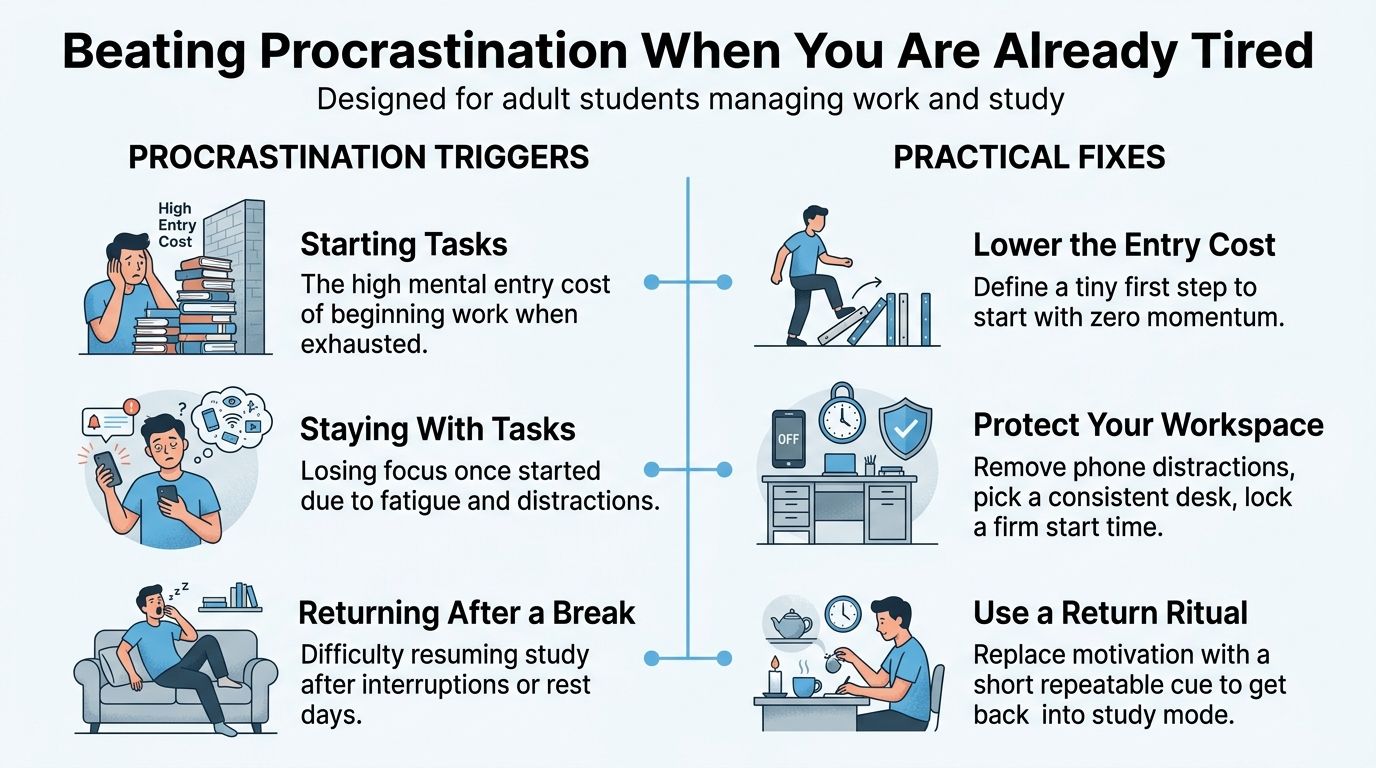
Beating Procrastination When You Are Already Tired
Procrastination is often treated as a character flaw. For adults balancing paid work, family duties, and study, that diagnosis is too simple. Avoidance usually appears when the task feels unclear, the environment is full of interruptions, or the student has no mental energy left for another demanding decision.
Start by lowering the entry cost. Don't write “complete assignment” on your list. Write “open the assessment brief”, “copy the question into a document”, or “find one relevant source”. The first action should be so clear that you don't need motivation to interpret it.
Fix the point where work stops
If you begin but drift quickly, change the environment before blaming your concentration:
- Remove the phone: Put it in another room or use an app blocker during the session.
- Choose one study place: A consistent desk, library seat, or quiet room tells your brain what happens there.
- Set a firm start time: “After dinner” is vague. A calendar entry gives the task a visible boundary.
- Match work to energy: Put analysis and drafting in your strongest window. Save filing or viewing recorded material for low-energy periods.
Returning after an interruption needs its own ritual. Clear the desk, open the same course page, read the last sentence or note you completed, and write the next action. Repeating that sequence removes the need to feel ready.
Mental load deserves attention here. TASO's report on student mental health in 2025 records that 18.9% of students reported a mental health difficulty, and identifies mental health as the leading reason students consider dropping out. Separate UK survey evidence reported that 64% of students worry about money daily or weekly, according to the student working lives evidence from HEPI. Financial anxiety can consume the same attention you expect to use for study.
On a bad day, reduce the target instead of abandoning the week. Read one page, make three useful notes, or send your tutor a precise question. Guidance such as procrastination help for expats in Italy can offer broader support when avoidance connects with anxiety or persistent emotional strain. For study-specific encouragement, use this guide on how to get motivated to study, but keep the immediate goal small enough to complete.
Two Sample Weeks for Real Access to HE Learners
The same planning principles look different depending on the shift pattern. These examples aren't schedules to copy exactly. They show how to assign demanding work to reliable energy windows and keep lighter tasks for fragmented time.
A day-shift worker with a baby
The first learner works retail day shifts and cares for a 9-month-old. Nap times are useful but uncertain, so they aren't treated as the only foundation. The dependable structure is one evening block, supported by shorter sessions when the baby sleeps.
| Day | Study shape | Task |
|---|---|---|
| Monday | Short nap window | Read assessment guidance and highlight requirements |
| Tuesday | Retail shift and family evening | No essential study |
| Wednesday | Nap window | Make notes from one source |
| Thursday | Evening block | Build an assignment outline and contact tutor |
| Friday | Short flexible window | Check references and organise notes |
| Saturday | Family and work demands | Optional recorded lesson |
| Sunday | Review period | Plan the next few days and confirm deadlines |
The learner's important decision is to protect the Thursday evening block for work that needs continuity. Nap-time sessions handle tasks that can stop without damage. If a nap doesn't happen, the learner hasn't lost the entire week.
A four-on, four-off shift pattern
The second learner is preparing for Midwifery and works a rotating four-on, four-off pattern. Work days allow only micro-sessions, such as reviewing flashcards, listening to course material, or writing a question for the tutor. Rest days carry the deeper work.
A typical cycle might look like this:
| Shift position | Study shape | Task and contact |
|---|---|---|
| Work day one | Brief review | Recall key terms before the shift |
| Work day two | No essential study | Protect sleep and recovery |
| Work day three | Micro-session | Read tutor feedback and list amendments |
| Work day four | Brief admin | Upload evidence or confirm a tutorial |
| Rest day one | Deep block | Research and compare sources |
| Rest day two | Deep block | Draft an assignment section |
| Rest day three | Tutor contact | Bring specific questions and review progress |
| Rest day four | Flexible block | Edit, submit, or prepare the next task |
This learner shouldn't force demanding writing into the end of every work day. The trade-off is clear: shorter work-day contact keeps the course active, while rest-day blocks carry the intellectual weight. Both schedules work because they distinguish dependable study, optional study, and recovery, rather than counting every empty minute as productive.
Working with Tutors and Adjusting When Life Slips
Tutor contact becomes more valuable when you arrive prepared. “I'm stuck” is understandable, but a short list produces a better conversation:
- Name the task: Identify the assignment, topic, or learning outcome.
- Show the attempt: Bring your outline, notes, draft paragraph, or specific question.
- Explain the barrier: Say whether the issue is understanding, structure, referencing, time, or confidence.
- Agree the next action: Leave with one manageable step and a realistic date.
An Access to HE Diploma paced across 9 to 12 months needs regular review, especially when work and family commitments fluctuate. Don't wait until you've missed several tasks before telling your tutor that the schedule has become unrealistic. Early adjustments can protect progress without turning one delay into a crisis.
A recovery routine for disrupted weeks
When a child is ill, shifts change, or energy disappears, use this sequence:
- List what remains open. Remove tasks that are no longer relevant.
- Mark the nearest consequence. Identify the next deadline or tutor checkpoint.
- Choose one minimum action. Make it small enough to complete under pressure.
- Move, don't multiply. Reschedule unfinished work instead of adding it to an already impossible day.
- Tell the right person. Contact your tutor with a clear update and a proposed next step.
| Pattern | Best study window | Session length | Risk to plan |
|---|---|---|---|
| Fixed day shifts | Consistent morning, evening, or weekend slot | Short sessions plus one protected block | A shift change can remove the main window |
| Rotating shifts | Rest days for deep work, work days for review | Longer blocks on rest days, brief sessions on shifts | Fatigue can make rest days less productive |
| Childcare-led routine | Reliable care or school windows | Short, repeatable sessions | Illness and disrupted care can remove several slots |
| Irregular casual work | Plan only confirmed windows | Flexible sessions with backup options | Hours can change with little notice |
Time management isn't a personality trait. It's a routine you rebuild after disruption, using the information the previous week gave you. Protect realistic study blocks, keep your tutor informed, and measure progress by completed actions rather than by how busy the calendar looks.
Access Courses Online offers flexible online Access to Higher Education Diploma courses, tutor guidance, and payment plans designed for adults studying around work and family responsibilities. If you're ready to create a realistic study routine and explore routes into Nursing, Midwifery, Health Professions, or other degrees, visit Access Courses Online to review your options and request personalised advice.