
If you're looking at university and thinking, “I want the degree, but I don't have A-levels, I've been out of education for years, and I've no idea whether any university will take me,” you're not alone.
Many adult learners reach this point with a clear goal but a foggy route. You might be working full-time, raising children, changing career, or trying to return to a plan that got pushed aside years ago. The hardest part often isn't motivation. It's uncertainty. Which course counts? Which universities accept it? What do admissions teams want?
That's where university partnerships matter.
For adults taking an Access to HE Diploma, university partnerships can turn a vague hope into a workable plan. Instead of guessing whether your qualification will be recognised, you can apply through routes that have already been discussed, mapped, and understood by both sides. That changes the experience completely. It gives structure to something that can otherwise feel confusing.
The conversation around university partnerships frequently overlooks adults returning to study. Partnership news usually focuses on international recruitment, business links, or large institutional deals. Yet one of the most practical forms of partnership is the one that helps a mature student move from an Access course into a degree with confidence.
Your University Dream Might Be Closer Than You Think
Adult learners often assume university admissions work like a locked gate. If you didn't follow the traditional path at 18, it can seem as though the door has closed.
In practice, it's often more like a route you haven't been shown yet.
An Access to HE Diploma exists for exactly this reason. It gives adults a recognised way to prepare for degree study without needing to go back and recreate a full school-based academic history. The remaining question is how that diploma connects to the university and subject you want.
That connection is where university partnerships become powerful.
Why this route feels different
When a university understands an Access diploma well, several things become easier:
- Entry expectations are clearer. You're less likely to spend weeks decoding admissions pages and wondering whether you qualify.
- Your current study is properly valued. Admissions teams can assess your recent academic work instead of judging you mainly on qualifications from years ago.
- The next step feels real. A degree stops being an abstract ambition and starts looking like a sequence of manageable decisions.
Adult learners rarely need more ambition. They need a route that makes sense.
For many people, the emotional impact is just as important as the practical one. Uncertainty drains confidence. Clear progression builds it back. When you know there's a recognised pathway from your Access course to a degree in nursing, business, social science, or another field, you can focus on doing the work well instead of second-guessing whether the work will lead anywhere.
What often confuses applicants
A lot of readers mix up three separate things:
| Term | What it usually means for you |
|---|---|
| Access to HE Diploma | Your qualification for getting ready for university |
| Entry requirements | The grades, subjects, or extra conditions a university asks for |
| University partnership | A formal relationship that helps connect one learning route to university progression |
Those three things work together, but they aren't the same.
Once you understand that, university starts to look less like a leap and more like a plan.
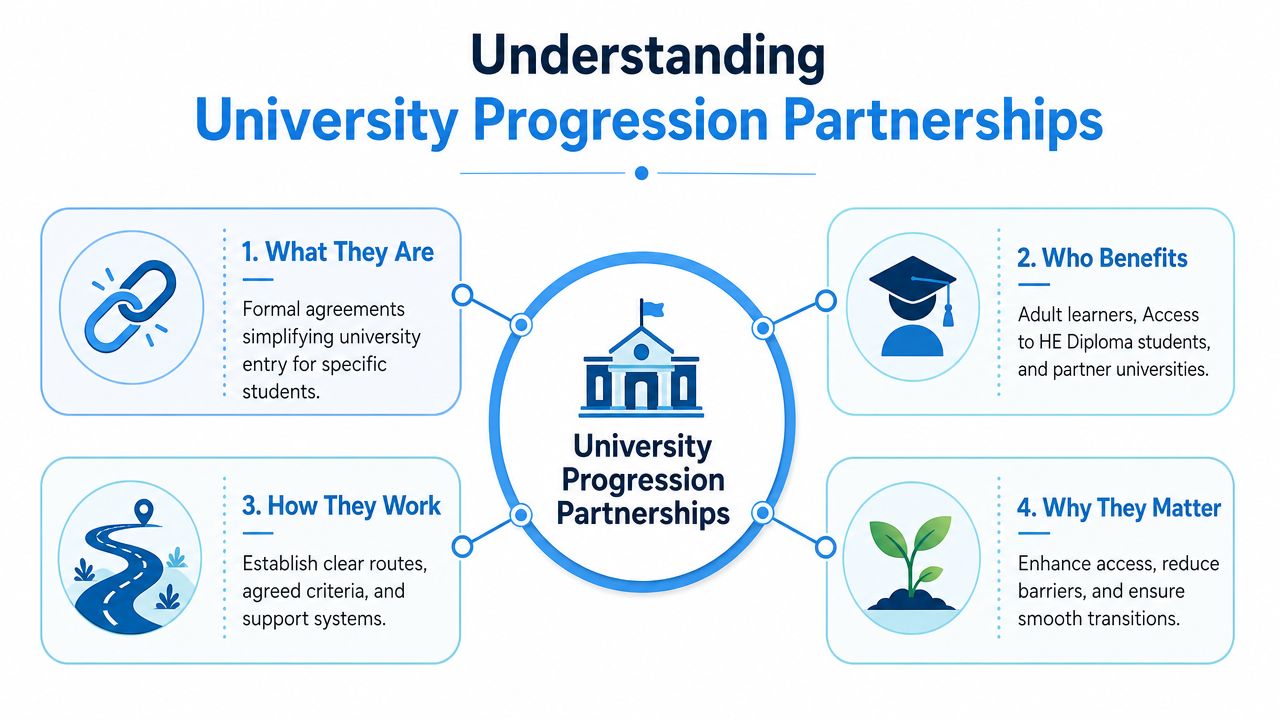
Understanding University Progression Partnerships
A good way to think about a progression partnership is as a pre-built bridge.
You still have to walk across it. You still need to meet the stated requirements. But someone has already designed the crossing. The college or course provider knows where students are coming from. The university knows where students are heading. The bridge exists to make that movement smoother.
That's very different from applying in the dark.
What the terms actually mean
You may come across phrases such as progression route or articulation agreement. They sound technical, but the basic idea is straightforward.
A progression route usually means there is an agreed pathway from one qualification into a suitable degree or group of degrees. An articulation agreement is a more formal version of that arrangement. It sets out how one institution's course is recognised by another institution for progression purposes.
For an adult learner, the useful question isn't “What is the exact policy term?” It's this: Does this arrangement make my route into university clearer and more secure?
If the answer is yes, the partnership is doing its job.
If you're still getting familiar with the qualification itself, this guide on what an Access to Higher Education course is gives a helpful starting point.
What partnerships do behind the scenes
A strong partnership usually means people have already done work you don't see. They've compared course content, discussed academic standards, checked suitability for degree progression, and agreed how students should present their applications.
That matters because universities don't make admissions decisions in a vacuum. They look at evidence, curriculum fit, and prior experience with qualifications. Across the wider higher education sector, partnerships are a major part of how institutions operate. In 2023/24, 81,499 documented interactions between UK universities and businesses were recorded, a 6.4% increase on the previous year, according to the National Centre for Universities and Business review. Adult progression routes sit within that broader partnership culture, even though they get less public attention.
A simple test for recognising a useful partnership
Ask these three questions:
-
Is the route explicit?
Can you tell which degree courses the pathway supports? -
Are the expectations concrete?
Do you know what grades, units, or subject background you'll need? -
Is there shared understanding?
Does it look as though the university already knows how to assess applicants from this route?
Practical rule: A partnership is most useful when it removes guesswork, not when it just sounds impressive.
That's the heart of it. University partnerships aren't magic shortcuts. They're structured connections that help adults move forward with fewer unknowns.
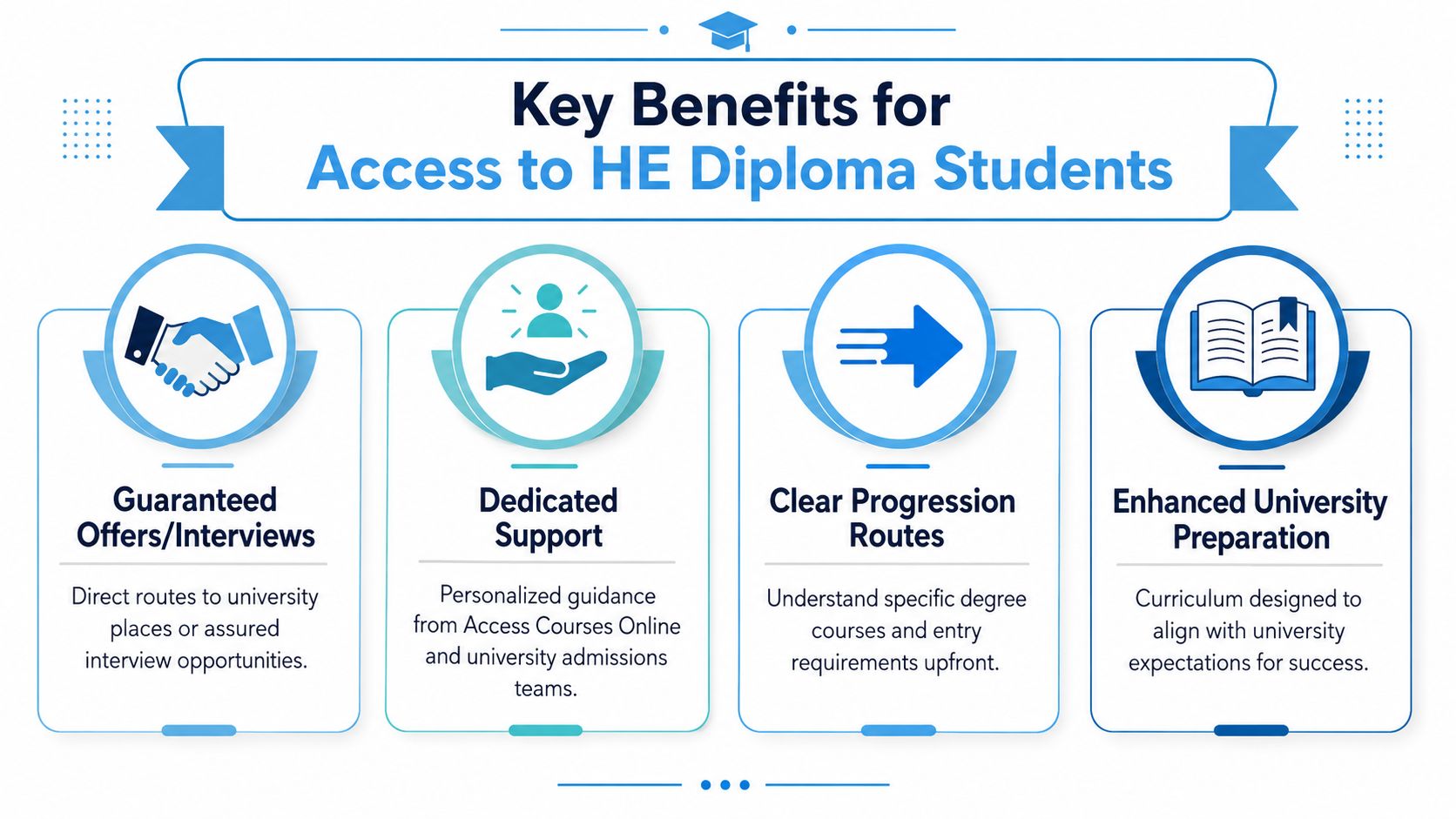
Key Benefits for Access to HE Diploma Students
The biggest benefit of university partnerships isn't prestige. It's relief.
When you're returning to education as an adult, uncertainty can become a second job. You compare courses, read admissions pages, wonder whether your background will count, and worry about wasting time on the wrong application. A strong progression partnership cuts through that.
What changes for the applicant
The first shift is clarity. Instead of trying to interpret broad university wording, you can work from a route that already recognises the value of the Access diploma.
The second shift is confidence. You're no longer asking a university to take a chance on an unfamiliar applicant profile. You're presenting a qualification that fits a known progression route.
The third shift is focus. Once you know which degrees and entry conditions matter, you can put your energy into achieving them.
The practical advantages
Some benefits are emotional, but many are concrete:
- Clearer target setting. You can aim for the right grades and subject outcomes because the destination is more defined.
- Better application decisions. You're less likely to apply blindly to courses that don't fit your diploma or intended field.
- Stronger personal statements. It's easier to explain why your academic preparation suits the degree when the progression path is already coherent.
- A smoother transition into university study. Courses linked through progression arrangements are often designed with university readiness in mind.
That final point matters more than people realise. Entry is only one part of success. The ultimate goal is arriving prepared.
Why this matters especially for adults
There's a major gap between how often adults need these routes and how often the sector talks about them. One source notes that 1.2 million UK adults were missing Access to HE Diplomas in 2024/25, while only 12% of university partnership communications focused on pathways for adults re-entering education, highlighting how overlooked this route can be in public messaging, as discussed in this article on educational partnerships and progression pathways.
That gap is why many mature applicants still feel they're piecing everything together alone, even when workable routes already exist.
Confidence matters more than people admit
A partnership can't do the studying for you. It can't replace your assignment marks, your interview preparation, or your commitment. But it can reduce the kind of stress that makes people talk themselves out of applying.
“I'm too late” is often a feeling, not a fact.
When adults understand that universities already work through structured progression arrangements, the process starts to feel less personal in the worst sense. You're not asking for special treatment. You're using a recognised path built for people in your position.
That's a powerful difference.
How We Forge Pathways with UK Universities
Useful university partnerships don't appear by accident. They're built through careful alignment.
That usually starts with a straightforward question from both sides: does this course effectively prepare students for this degree? If the answer is going to be yes, the evidence has to be clear.
What universities need to see
Admissions teams and academic departments don't just look at a course title. They want to understand the content behind it. For an Access route into nursing, for example, they may want to see how the diploma supports academic writing, science-related study, and readiness for professional training. For business or social science, they may focus on analytical skills, independent study, and subject fit.
Partnership work transitions to practicality. People compare curriculum content with degree expectations. They discuss whether the route is suitable for progression and what conditions should apply.
That kind of collaboration has become more common across the sector. A survey found that around 47% of UK universities significantly increased private partnerships for student recruitment during the pandemic, showing how institutions have shifted towards structured external collaboration, as reported by The PIE News on UK university private partnerships.
Why the process is more formal than many students realise
Many adult learners imagine partnerships as little more than a friendly understanding. In reality, the stronger ones are usually more deliberate than that.
They often involve:
- Curriculum mapping so universities can see what students study
- Admissions dialogue about realistic entry expectations
- Quality review to make sure the route supports degree-level progression
- Ongoing communication so requirements stay current
If you want to understand the application side of that journey, this guide on applying to university after an Access course is a useful companion.
A short overview can help make the process feel less abstract:
What this means for the student
When the groundwork has been done well, students feel the difference. The route into university becomes easier to understand because the adults making admissions decisions already know the learning route being presented.
That doesn't remove standards. If anything, it makes them more visible. You can see what the university expects and prepare for it properly.
A good partnership doesn't lower the bar. It shows you where the bar is and gives you a fair chance to reach it.
For adult learners, that fairness matters. You're not trying to decode a system built for school leavers only. You're entering through a pathway that recognises mature study, recent achievement, and academic potential.
Real Journeys From Access Course to Degree
The value of university partnerships becomes easiest to understand when you picture a real person using one.
Not a headline. Not a policy term. A person with work history, gaps in education, and a reason for wanting a different future.
Leanne and nursing
Leanne had wanted to become a nurse for years, but the idea never seemed practical. She'd left school without the qualifications universities usually advertise, and she assumed that had settled the matter.
When she started an Access route focused on health progression, the change wasn't instant confidence. It was structure. For the first time, she could see how her current study connected to a nursing degree, what grades mattered, and how to speak to admissions teams about her readiness.
Her biggest shift came during the application process. Instead of writing as someone hoping a university might overlook an unconventional background, she wrote as someone completing a recognised preparation route into a relevant professional degree.
Aaron and social science
Aaron had been working for years and wanted to move into a field connected to people, policy, and community work. He didn't have one fixed career title in mind, which made choosing a degree harder.
A progression partnership helped because it narrowed the options in a useful way. Rather than treating “university” as one huge category, he could identify specific courses where his Access background aligned well with admissions expectations.
That meant his application became sharper. He could explain why the course fit his goals, what his recent study had taught him, and how he'd prepared for degree-level work.
The strongest applications often come from adults who can explain not just what they want to study, but why this route makes sense now.
Samira and business
Samira wanted a business degree but worried that online systems and application processes would feel unfamiliar after years away from study. That's where wider institutional partnerships in higher education can help students, even when those partnerships aren't visible on the application form.
For example, a strategic partnership between Infosys and the University of Nottingham has modernised the university's digital backbone and supported systems serving more than 30,000 students, showing how partnership work can improve student management and data handling behind the scenes, according to this analysis of the Infosys and University of Nottingham partnership.
For someone like Samira, that matters because smoother systems make the student journey less intimidating. Applications, records, communication, and onboarding all become easier to manage when universities invest in the infrastructure around progression.
What these journeys share
These stories differ in subject, but the pattern is similar:
| Stage | What changed |
|---|---|
| Before study | University felt distant or unclear |
| During the Access route | The learner gained a recognised academic pathway |
| During applications | The partnership made progression easier to understand |
| After entry | The degree felt achievable because the route had been planned |
That's why university partnerships matter so much for mature students. They don't replace effort. They turn effort into directed progress.
A Practical Guide to Using Our University Links
When you know a progression route exists, the next step is using it well. In this process, small details make a big difference.
Many applicants assume the partnership alone will “carry” the application. It won't. Your job is to show that you understand the route, meet the requirements, and are ready for degree study.
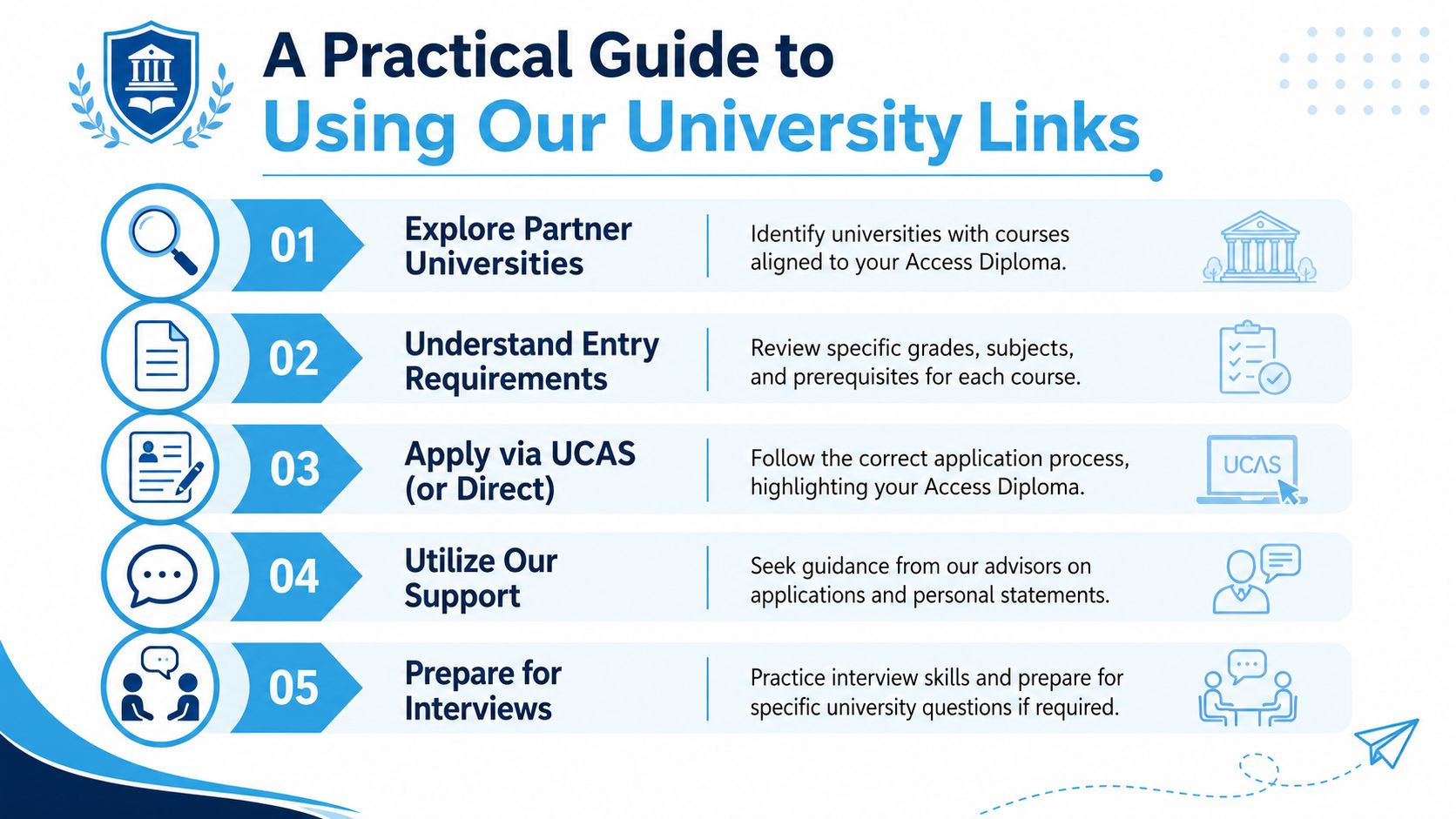
Five steps that make the route work for you
-
Start with course fit
Look for degree courses that match your subject and long-term aim. If you want nursing, don't treat allied subjects as interchangeable without checking. If you want business, make sure the degree accepts your route and background. -
Read the entry requirements slowly
Don't skim. Look for subject expectations, grade conditions, interview requirements, and any extra checks for professional courses. If you need help understanding how the qualification is represented in admissions terms, this guide to Access to Higher Education Diploma UCAS points can help clarify the admissions environment. -
Reference the route clearly in your application
In your personal statement or direct communication, explain that you're taking an Access to HE Diploma designed to prepare you for degree-level study in your chosen field. Be specific about modules, academic skills, and your reason for returning to education. -
Contact admissions with focused questions
Don't send a vague message asking if they “accept Access”. Ask whether your specific diploma is suitable for the specific course, and whether there are preferred grades or subject units to prioritise. -
Prepare for the next checkpoint
Some courses may ask for interviews, written tasks, or further evidence. Start early, especially for healthcare and professional programmes.
A simple message you can adapt
You don't need formal language. You need clear language. A short email could say:
I'm completing an Access to HE Diploma and plan to apply for your degree course. I'd like to confirm whether this route is suitable for entry and whether there are any specific units, grades, or additional requirements I should be aware of before applying.
That kind of message is respectful and useful. It helps admissions staff give you a better answer.
Why checking the partnership quality matters
Students should also remember that progression routes sit inside a regulated environment. UK government rules require stronger oversight of franchised providers, and partnership due diligence now includes checks on academic quality and governance, as set out in the government consultation response on strengthening oversight of partnership delivery.
For you, that means a good partnership should feel structured, not vague. It should rest on real academic planning, not marketing language.
Your Questions on Partnerships Answered
What if my chosen university isn't an official partner
You can still apply.
A partnership helps, but it isn't the only route into higher education. Many universities accept Access to HE Diplomas even without a formal progression arrangement. The key is to check the course requirements carefully and contact admissions with specific questions about your diploma and subject background.
Does a partnership mean I'm guaranteed a place
Usually, no.
A partnership often gives you a clearer route, better alignment, and more confidence that your qualification will be understood. It doesn't remove the need to meet entry requirements. You may still need the right grades, a strong application, references, and for some subjects an interview or additional checks.
That isn't bad news. It means you should see the partnership as a strong advantage rather than an automatic offer.
How do partnerships affect student finance
The partnership itself doesn't normally replace the usual student finance process. You'll still need to apply through the standard funding route for your degree and make sure your course and university meet the required conditions.
What the partnership can do is make the academic side of progression clearer, which helps you plan your timeline more confidently. Once your application route is defined, it becomes much easier to organise funding, documents, and deadlines around it.
If you're unsure about the right next step, speak to an adviser before you apply. A short conversation can save a lot of confusion later.
If you're ready to explore a realistic route into higher education, Access Courses Online offers flexible online Access to HE Diplomas designed for adults returning to study. Whether you want to progress into nursing, business, science, social science, or another degree path, their team can help you understand your options, choose the right course, and move towards university with a clearer plan.