

You've been looking at business degrees and wondering how to get there without going back to school from the beginning. Perhaps you left education before taking A levels, need a route after redundancy, or want to move from an operational role into management. An Access course in Business Management can provide that bridge, but it isn't a casual shortcut. You'll need to budget for the course, protect regular study time, and check that your English and maths qualifications meet the requirements of the university you eventually want to attend.
The sensible question isn't only, “Is the course online?” It's whether you can complete the work consistently and whether the qualification will support your chosen degree application. This guide looks at the decision from that practical angle, using current UK progression evidence and the questions mature applicants most often need answered.
Why Adults Choose an Access Course Business Management
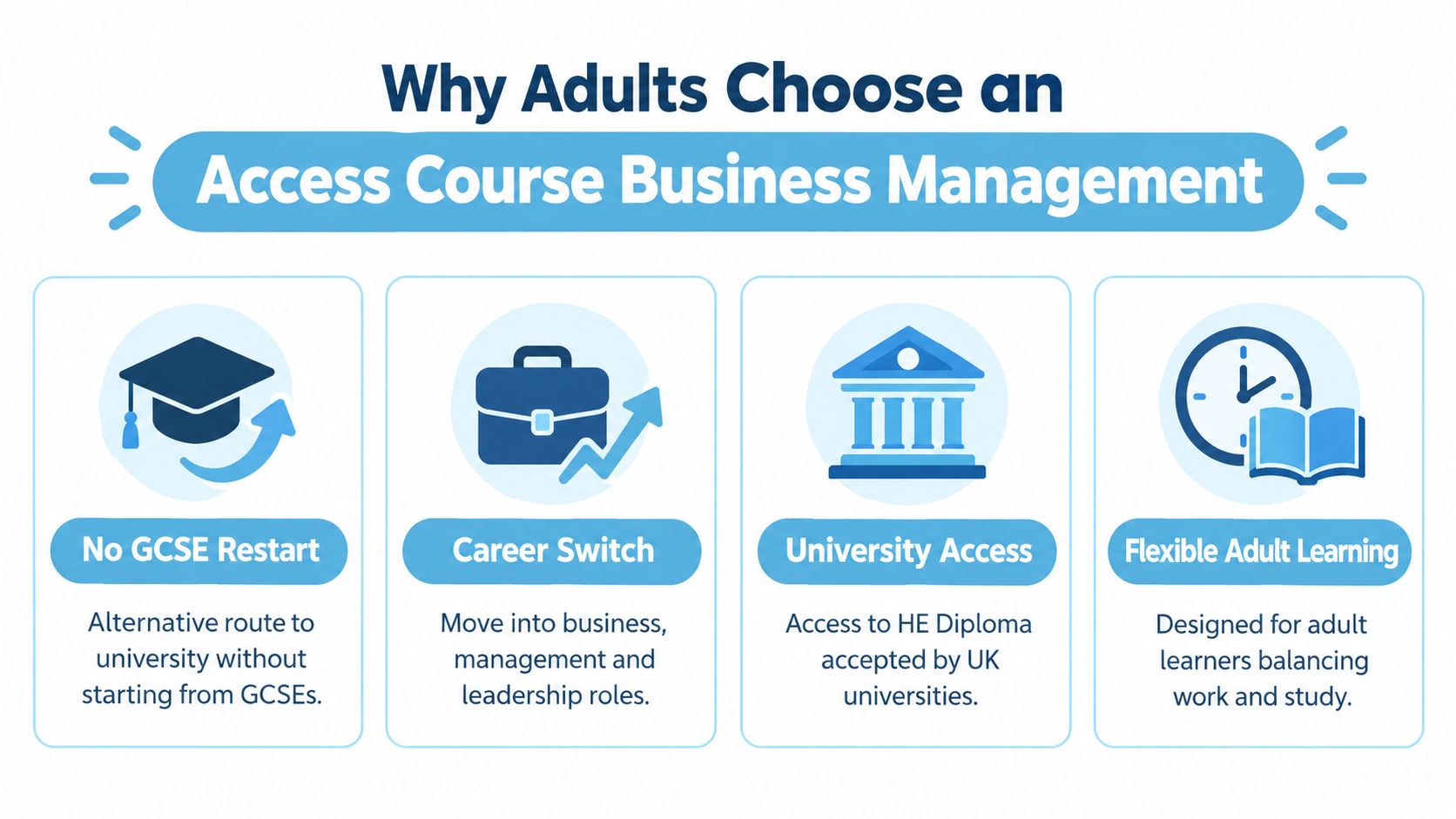
You may be working full time, caring for family, or considering a career change after redundancy. A university business degree can feel out of reach if you do not have A levels, yet returning to GCSEs before starting the next stage may take longer than your plans allow. An Access course in Business Management can provide a more direct route, provided you can fund it and protect regular study time.
The Access to HE Diploma in Business and Management is intended for adults aged 19 and over who lack the traditional qualifications commonly used for university entry. It combines subject knowledge with guided preparation in business, management, finance and academic research. That structure matters because you are building the study habits needed for degree-level work, not collecting an entry certificate.
A route with a clear purpose
Before applying, identify the degree or career direction the diploma is meant to support. Possible destinations include:
- Business administration: Build an academic foundation for office, operations or administrative management.
- Marketing and communications: Study customers, campaigns and communication within organisations.
- Human resources: Prepare for further study involving people management and workplace policy.
- Finance and enterprise: Gain introductory knowledge of accounting, financial decisions and entrepreneurship.
The route is established within adult education. In 2022–23, 38,220 students registered for an Access to HE Diploma in the UK, according to Access to HE statistics. The same release recorded 995 business and management registrations. Those figures show that business is a recognised subject area, while also highlighting why you should inspect each provider's course details rather than relying on the title.
The trade-off many pages understate
Treat the diploma like a second job with academic deadlines. Even a flexible course requires reading, research, written assignments and submission planning. You also need to budget for fees alongside rent, childcare, travel and any reduction in working hours. Online delivery may remove commuting, but it does not remove the work.
Check your English and maths position before enrolling. Many providers and universities expect GCSE English and maths at grade 4/C or above, although accepted alternatives vary. Holding only one subject can leave a progression gap, and the Access diploma may not automatically fill it. Compare the requirements for your intended degree with the provider's entry rules, then confirm what you would need to complete alongside the course.
What the Access to HE Diploma in Business and Management Actually Covers
Suppose you find two courses with almost identical titles. One may teach more finance, while the other gives greater space to academic writing or people management. Both can be valid Level 3 qualifications, yet their weekly teaching, assessment methods and progression support may differ because individual colleges and online providers deliver the content.
The national system provides context, but the practical comparison is provider by provider. Check the credit structure, unit list, assessment schedule and university links before treating a course title as evidence of what you will study.
Qualification structure
An Access to HE Diploma combines subject learning with preparation for degree-level study. You learn how organisations work, while also practising source evaluation, referencing, argument building, deadline management and academic writing. These skills are the framework supporting the business content.
Providers organise the diploma through credits and units. Unit names and combinations vary, so request the course specification or handbook before applying. Compare those details with the entry requirements for your intended university course, particularly if it asks for particular business, finance or study-skills content.
| Qualification | Level | Typical Duration | UCAS Tariff Points | Primary Purpose |
|---|---|---|---|---|
| Access to HE Diploma in Business and Management | Level 3 | Provider-dependent | Depends on the graded profile | Prepare adult learners for progression to a business-related degree |
The diploma can also rebuild academic confidence. A supported assignment gives you a chance to see how university work differs from a workplace report, an informal presentation or study completed many years ago. Feedback should help you correct weak referencing, unclear structure and unsupported conclusions before those habits affect degree work.
Course pages may use the same qualification label while offering different amounts of tutor contact, online activity and independent study. Ask who marks assignments, how quickly feedback is returned and whether the provider has established links with universities. These details affect both your timetable and the evidence you can present in an application.
For wider business discussion, you could listen to top-rated finance and business podcasts. They may help you recognise commercial vocabulary and follow current debates, but listening does not replace assessed reading, research and writing.
Before applying, read this guide to the Access to Higher Education Diploma. Then confirm the specific business units, grade profile, delivery pattern and progression agreements offered by your chosen provider.
Modules and Learning Outcomes You Will Study
The course usually combines two kinds of learning. One strand is people-focused and interpretive, covering how organisations operate, how managers lead and how businesses communicate. The other is more quantitative, asking you to work with figures, financial information and economic ideas.
Common subject areas include:
- Business organisation: Explore business structures, ownership, stakeholders and the way organisations pursue objectives.
- Marketing principles: Study customer needs, market research, segmentation, promotion and positioning.
- Management theory: Compare approaches to leadership, motivation, decision-making and organisational behaviour.
- Economics: Consider supply, demand, competition and the wider conditions affecting businesses.
- Accounting and finance: Work with financial information and learn why managers use budgets, costs and performance measures.
- Human resources: Examine recruitment, development, employee relations and workforce planning.
- Academic research skills: Learn to find suitable sources, reference them accurately and develop a sustained written argument.
Where learners commonly need more support
Marketing, communication and management often feel more approachable because they connect with workplace experience. If you've supervised colleagues, dealt with customers or helped organise projects, you may recognise some of the situations discussed in class.
Accounting, economics and data handling can feel less familiar. That doesn't mean you can't succeed, but you should expect to practise rather than rely on general business knowledge. A learner who understands customer service may still need to learn how to interpret a financial statement or explain an economic relationship using evidence.
Practical rule: Treat every learning outcome as a task to demonstrate, not a topic to recognise.
Each unit carries a credit value, often shown as a smaller or larger block depending on its importance within the programme. Providers then assess your work against learning outcomes and assign grades such as Pass, Merit or Distinction where grading applies.
Research work needs early attention
Independent research assignments often require the greatest self-direction. They involve choosing or narrowing a question, locating credible material, organising notes, planning an argument and revising a draft. Leaving that process until the deadline creates pressure that no amount of subject knowledge can fully remove.
Set up a basic research routine from the first week. Keep a source record, note the author and publication details as you go, and ask your tutor how much analysis the marking criteria expect. Good research isn't just collecting information. It's explaining why the evidence supports your conclusion.
| Module | Typical Credits | Strand | Grade Scale |
|---|---|---|---|
| Business organisation | Provider-dependent | Business foundations | Pass, Merit or Distinction where graded |
| Marketing principles | Provider-dependent | Humanistic and applied | Pass, Merit or Distinction where graded |
| Management theory | Provider-dependent | Humanistic and applied | Pass, Merit or Distinction where graded |
| Economics | Provider-dependent | Quantitative and analytical | Pass, Merit or Distinction where graded |
| Accounting and finance | Provider-dependent | Quantitative and analytical | Pass, Merit or Distinction where graded |
| Academic research skills | Provider-dependent | Higher education preparation | Provider-dependent |
Entry Requirements and the GCSE Gatekeeper Question
Before paying an application fee or arranging study leave, run an eligibility check. The most important question isn't whether you've worked in business before. It's whether your qualifications and circumstances will allow you to enrol and progress to the degree you want.
Start with the basic checklist
Age and funding: Access to HE funding rules generally focus on adult learners aged 19 and over. Ask the provider how its eligibility assessment applies to your circumstances, particularly if you're returning to education after a long gap.
Residency: Funding and enrolment can depend on your residency history. Providers will tell you what evidence they need, but don't leave this until the final stage.
Previous study: You don't normally need previous business qualifications. Experience in retail, administration, hospitality, logistics, care or another sector can still give you useful examples, even though it won't replace formal entry requirements.
English and maths: Check both subjects separately. A provider may accept one alternative while your university requires another, so “accepted onto the Access course” and “eligible for my chosen degree” aren't always the same thing.
The English and maths guidance for Access learners is useful background, but your target university's admissions page remains the decisive source for progression.
GCSEs and Functional Skills aren't interchangeable everywhere
Many applicants have English but not maths, or maths but not English. Some hold Functional Skills Level 2, Key Skills or an equivalent qualification instead of GCSEs. Providers differ in what they accept, and universities can apply their own rules to a degree application.
This is the hidden risk. Completing the diploma may be possible, but a missing or unsuitable English or maths qualification can still prevent progression to a particular university. Ask the admissions team a direct question and keep the reply in writing:
- Does the degree accept my exact alternative qualification?
- Must English and maths be achieved before applying, or before enrolment?
- Can I study the missing subject alongside the diploma?
- Does the Access provider have a recognised route for closing the gap?
Admissions check: Never rely on “equivalent qualifications accepted” without confirming the exact awarding body, level and subject.
Gather certificates before you apply. If you have a gap, decide which subject to address first based on the requirements of your intended degree, not on whichever option appears easiest.
Study Format, Weekly Workload and How Long It Takes
Flexible study still takes a defined amount of time. Several UK providers list a supported fee of about £3,022 and durations of 9 to 12 months, with study expectations around 15 hours per week or more than 12 hours outside class, as shown in published course information from East Surrey College and related Access course materials.
That workload matters more than the word “online”. An online learner may avoid commuting, but still needs protected time for reading, discussion, drafting and editing. A parent may be able to attend daytime teaching but find that written assignments move into evenings. A shift worker may prefer asynchronous study but need a reliable plan for weeks when working patterns change.
Three common delivery patterns
Classroom-based study gives you set teaching times and immediate access to tutors and classmates. It can suit learners who need external structure, but travel and fixed attendance can make shifts or childcare harder to manage.
Blended delivery combines scheduled sessions with online activities. It offers some accountability without requiring every learning activity to happen on campus.
Fully online delivery can remove commuting and make study easier to fit around work. You'll need stronger self-management because nobody in the room sees that you've missed a study session.
The course structure normally involves 60 Level 3 credits, completed over roughly 9 to 12 months, but confirm the timetable with each provider. An accelerated route may reduce the calendar time while increasing the pressure of weekly deadlines. The shorter option isn't automatically more flexible.
| Format | Typical Duration | Contact Hours per Week | Self-Study Hours per Week | Best Fit |
|---|---|---|---|---|
| Classroom-based | Provider-dependent | Provider-dependent | Provider-dependent | Learners who benefit from fixed attendance |
| Blended | Provider-dependent | Provider-dependent | Provider-dependent | Adults needing a mixture of tutor contact and online work |
| Fully online | Provider-dependent | Provider-dependent | Provider-dependent | Learners managing work, caring or distance constraints |
Test your diary before enrolling
Write down a normal week, including commuting, school runs, overtime, meals and rest. Then mark realistic study blocks rather than imaginary empty time. If the only available hours are after exhausting shifts, a slower route or a different start date may protect your completion chances.
You should also ask how quickly tutors respond, where feedback appears, how extensions work and whether live sessions are recorded. Those practical details often matter more than the provider's description of flexibility.
Assessment, Grading and Progression to a Business Degree
Picture a submitted report being judged against a checklist rather than workplace instinct. Each unit has learning outcomes, and your work must demonstrate explanation, application, analysis and appropriate referencing. Assessment is therefore evidence that you can study at degree level, not proof that you understand business in practice.
Providers commonly assess essays, reports, presentations, research tasks and practical business analysis. The combination varies by course. A confident workplace presentation may still fall short of an academic assignment if it lacks a clear structure, suitable sources and conclusions based on analysis.
Grades influence the degree choices available
Graded units usually use Pass, Merit or Distinction. Your overall profile matters because universities set their own conditions for Access applicants. Some business degrees accept a broad range of profiles. More competitive courses may require a substantial number of higher grades.
Completing the diploma and meeting a university offer are separate outcomes. You may pass the qualification yet miss the conditions for your preferred course. Build your university shortlist before the Access year, or very early in it, so your assignments have a clear purpose.
According to Open Awards' analysis of Access to HE opportunity and progression, 13,100 applicants progressed with an Access to HE Diploma in 2024 and 77.3% were accepted, compared with 75.9% in 2023. The same analysis reports that learners aged 30 and over accounted for a quarter of those accepted, while learners aged 35 and over represented the largest single age group at 25.87%. These figures show that progression is achievable, not guaranteed. Your subject, grades, course requirements and application quality still affect the result.
Build your application around evidence
Treat tutor feedback like a diagnostic report. If an assignment loses marks because of weak knowledge, structure, analysis, referencing or clarity, identify that specific problem and address it in the next submission. A mark is more useful when it changes how you work.
A practical progression plan includes:
- A shortlist of degrees: Check entry grades, GCSE conditions and whether each course accepts your Access subject.
- A grade target: Work backwards from the published offer, leaving room for an assignment that does not go to plan.
- A UCAS plan: Ask how your provider handles references, predicted grades and application timing.
- A backup route: Consider courses with different entry profiles, locations or delivery models.
Your age should not postpone the decision. Your available time should shape it. A degree offer may depend on sustained work across the year, so choose targets that fit your responsibilities as well as your ambitions.
Funding, Payment Plans and Your Application Timeline
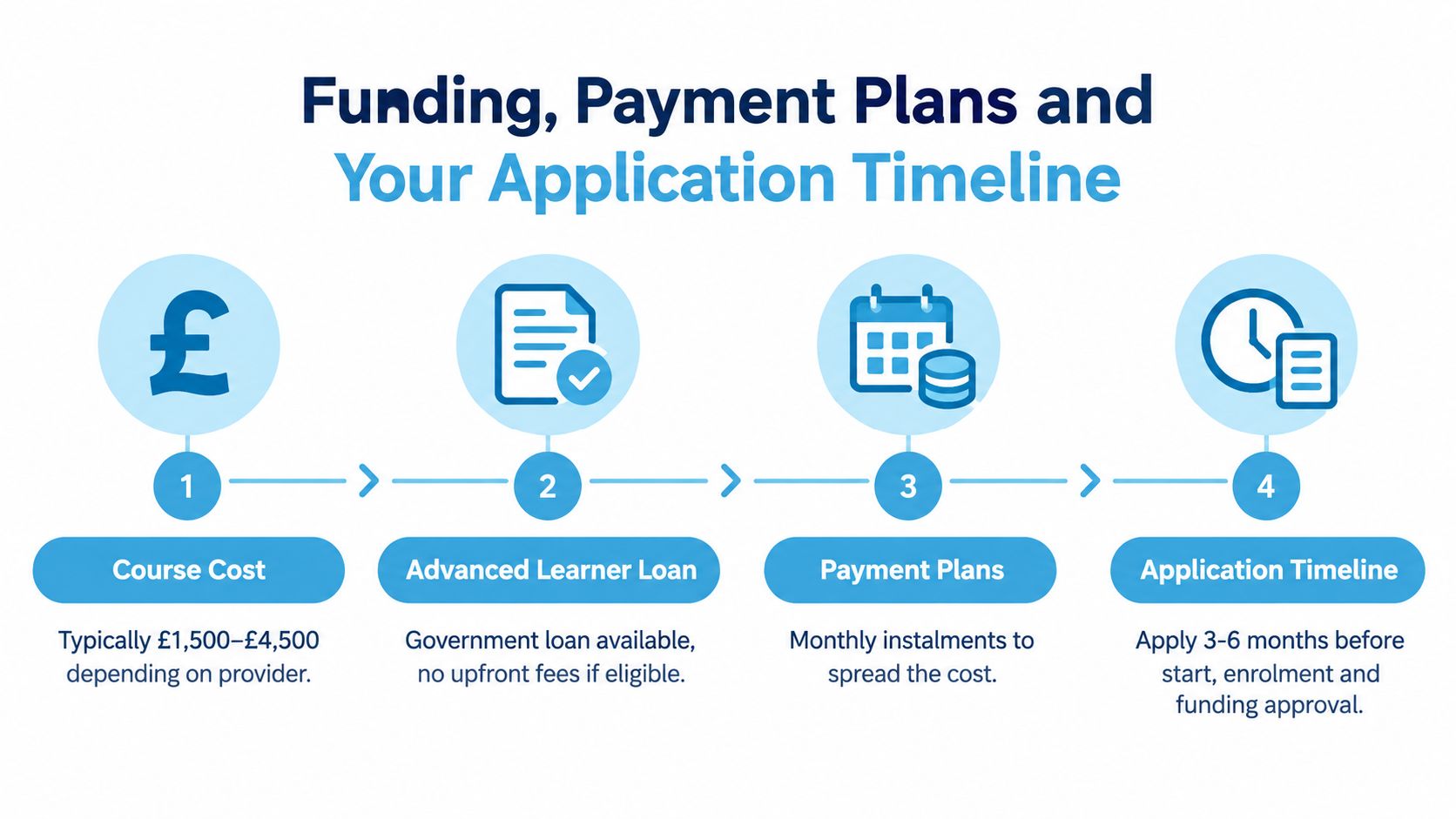
Course finance needs the same attention as admissions. Published UK provider information places a standard supported fee at about £3,022, while broader provider pricing can vary. Some learners use an Advanced Learner Loan, some pay by instalments, and some ask an employer about sponsorship or professional development support.
An Advanced Learner Loan can cover eligible course fees, but check the current rules and the provider's eligibility process. You should also ask how the loan interacts with your wider student finance position, particularly if you're planning to progress directly to university. Don't assume that a fee arrangement answers questions about maintenance support.
A practical application sequence
- Enquiry and course comparison: Ask for the full fee, delivery pattern, timetable, unit list, entry requirements and progression guidance.
- Eligibility discussion: Discuss age, residency, prior qualifications and any English or maths gaps with admissions staff.
- Application and interview: Prepare identification, qualification certificates and any residency evidence requested.
- Offer and enrolment: Read the conditions carefully. An offer may depend on documents, funding approval or an outstanding skills qualification.
- Induction: Learn how the online platform works, find tutor contact details and record every deadline.
- University planning: Speak to your provider early about UCAS timing, references and the courses you intend to apply for.
Start dates vary. Some providers use fixed September or January intakes, while others offer more flexible starts. Ask whether late enrolment is workable, or whether joining after teaching and assessment have begun would put you immediately behind.
For a clearer explanation of the funding routes, read this guide to Access to HE funding. Then ask each provider the same questions so you can compare like with like.
Budget question: Ask for the total amount payable, the deposit, instalment dates, withdrawal terms and what happens if funding approval is delayed.
Before you commit, confirm whether monthly payments are available, whether an Advanced Learner Loan is suitable for your circumstances, whether you can receive other support, and which documents must be supplied. If you're considering disability support, ask what evidence is needed and whether an assessment should happen before the course begins.
A short orientation video can also help you understand the transition into online learning and the importance of planning your study routine.
Access Courses Online offers a fully online Access to HE Diploma in Business and Management, with tutor guidance, flexible pacing and payment-plan support for adults studying around work or family commitments. If you're ready to compare your entry qualifications, workload and funding options, visit Access Courses Online and request practical advice about the next available route.