

You've found an Access to Higher Education course, chosen a possible degree, and started checking the entry requirements. Then two familiar subjects appear on the application form: maths and English. Perhaps your school results are incomplete, your grade is below the required standard, or you've been away from education for years and aren't sure whether GCSEs are still the right route.
That uncertainty is common among adult learners. The decision isn't about passing two school subjects. It's about choosing the qualification that matches your target university, intended career, existing certificates, age, and available time. A nursing applicant may need evidence that a computing applicant doesn't, while one university may accept Functional Skills and another may insist on GCSEs.
This guide follows the decision as an adult learner might experience it, using Jade's situation as a practical example. It'll help you understand what universities check, compare GCSEs with Functional Skills, identify possible exemptions, and plan preparation alongside an Access diploma.
Why Maths and English Matter for Access Students
Jade is 34 and works as an NHS receptionist. She's considering an Access to HE Diploma because she wants to apply for nursing, but her school history is awkward. She left with a D in maths and never sat an English GCSE. Her application form keeps asking for both subjects, even though the diploma itself includes academic study.
Her first thought is understandable: if she can complete the diploma successfully, why should old school qualifications still matter?
An Access to HE Diploma is a Level 3 qualification, designed to prepare adults for higher education. It can include health studies, biology, psychology, study skills, and other academic units. However, universities often treat maths and English as separate entry conditions. Your diploma shows that you can complete advanced preparatory study. Your maths and English certificates show that you meet a basic gateway requirement.
A useful comparison is driving. The Access diploma is like learning to handle the car on the road. Maths and English are closer to passing the theory test. Doing well in one doesn't automatically replace the other.
The gateway question
Admissions teams may ask for GCSE English and maths at a particular grade, or for an accepted equivalent. If you haven't met the condition, a university might make an offer subject to you providing the missing evidence. In some cases, an offer can be withdrawn if the condition isn't met by the stated deadline.
That's why Jade shouldn't leave the issue until the end of her diploma. Clearing the requirement early means she can concentrate on her graded units, personal statement, references, and university application rather than worrying about an unresolved certificate.
The national picture explains why universities continue to focus on these foundations. The 2023 OECD Survey of Adult Skills national report for England found average scores of 272 points in literacy and 268 points in numeracy among adults aged 16 to 65 in England. It also estimated that around 20% of adults, about 8.5 million people, had low basic skills in literacy, numeracy, or both.
Practical rule: Treat maths and English as entry evidence to resolve, not as optional extras attached to your Access diploma.
Jade's next step isn't automatically “book GCSE resits”. She needs to check how her chosen nursing course defines an acceptable qualification, whether either subject is already covered by an equivalent certificate, and how much time she has before enrolment and application deadlines.
How Universities Use These Subjects
Suppose Jade has a strong Access to HE Diploma application for a nursing degree, but her maths evidence is missing. The university may still treat that as an incomplete application, because the diploma and these subjects often serve different purposes.
Universities generally do not add GCSE maths and English to the tariff points generated by an Access diploma. They use them as threshold checks. The diploma supports the academic offer, while maths and English confirm that a separate entry condition has been met.
The application works like a building with two entrances. Your Access diploma takes you through the main academic entrance. Maths and English open additional gates that remain closed until the required evidence is recorded.
Three reasons the checks exist
First, these qualifications indicate academic readiness. A degree involves reading substantial material, following instructions, writing clearly, interpreting information, and working with figures where relevant. An adult applying for a health degree may need to understand dosage calculations, clinical documentation, research findings, and written procedures.
Second, some courses connect directly with professional expectations. Nursing, midwifery, teaching, and social work programmes can set requirements linked to professional practice, placement work, and regulatory expectations. The exact rule varies, so check the course page instead of relying on a general equivalence chart.
Third, English evidence can form part of wider admissions or immigration requirements in relevant cases. International applicants and recent migrants may be asked for a recognised English language qualification. The accepted test and required result depend on the university, course, and individual circumstances.
A typical application might include:
- Degree target: BSc Nursing.
- Academic preparation: Access to HE Diploma with the required subject content and grades.
- Separate evidence: GCSE maths and English at the university's stated level, or an approved equivalent.
- Application risk: A strong diploma result will not necessarily replace missing prerequisite evidence.
Read the requirement carefully
Admissions staff often check formal conditions first. If your application lists the diploma but leaves the maths or English section blank, the university may pause its assessment while requesting clarification. That delay can matter when exam results, references, or offer conditions have deadlines.
Universities do not all use the same wording. One may accept Functional Skills Level 2. Another may accept it for English but not maths. A third may require GCSEs for a competitive professional course.
Before enrolling, email the admissions team with your exact qualification title, awarding organisation, level, and result. Keep the written response. This record can prevent you from spending months preparing for a qualification your intended course does not accept.
GCSEs, Functional Skills, and Other Accepted Routes
The choice between GCSEs and Functional Skills Level 2 should follow three filters. Start with the university and course, then consider your previous attainment and age, and finally work backwards from your deadline.
Match the route to the course
GCSE maths and English at grade 4 or above, formerly grade C, remain the clearest route because universities recognise them widely. Functional Skills Level 2 is also an important adult route and is accepted by many institutions, but “many” doesn't mean “all”. A specific nursing, midwifery, teaching, or highly competitive degree may state GCSEs explicitly.
Other qualifications can appear in admissions policies:
- Functional Skills Level 2: A DfE-approved alternative used by many universities and employers.
- Key Skills Level 2: An older qualification that may still appear in equivalence lists.
- IELTS Academic: Used for English evidence in relevant international applicant cases, subject to the course's required result.
- Scottish National qualifications: National 5 and related awards may be accepted by some English universities.
- Irish qualifications: Junior Certificate equivalents may satisfy some English requirements.
- Mature learner discretion: A small number of institutions may consider age, work experience, and other evidence instead of the usual certificate.
If you're working on your spoken English as well as formal writing, a structured resource such as Polychat's English roadmap can provide useful practice ideas. It won't replace a university-approved qualification, but it may support confidence and everyday study habits.
Consider your starting point
GCSEs cover a broad school curriculum and usually involve formal written examinations. Functional Skills focuses more directly on practical reading, writing, communication, and numeracy tasks. That can make Functional Skills feel more relevant to an adult who wants a flexible route back into education.
Your previous grade matters too. Someone just below the GCSE threshold may benefit from targeted GCSE preparation. Someone who hasn't studied for many years may prefer an initial skills assessment before choosing a qualification.
Work from the deadline backwards
If your Access course begins soon, Functional Skills may fit the timetable more comfortably, subject to acceptance by your university. If you have a longer preparation period and want the most universally recognisable school qualification, GCSEs may be safer.
| Qualification | Typical required grade | Widely accepted by |
|---|---|---|
| GCSE maths and English | Grade 4 or above, formerly grade C | Universities, professional courses, employers |
| Functional Skills Level 2 | Level 2 pass | Many universities, colleges, employers, and adult education providers |
| Key Skills Level 2 | Level 2 pass | Some institutions, depending on their published equivalence policy |
| IELTS Academic | Course-specific result | Universities using English language evidence for relevant applicants |
| Scottish or Irish equivalents | Course-specific equivalent | Some English universities |
Don't choose from the table alone. Send the exact qualification details to your target university and ask for confirmation in writing. That answer carries more weight than a general claim that two qualifications are “equivalent”.
Comparing GCSEs and Functional Skills at a Glance
The simplest comparison is this: GCSEs are the traditional academic benchmark, while Functional Skills is designed around practical application. Both can support progression, but acceptance depends on the destination.
GCSE maths and English are usually the safer choice for Russell Group applications, teacher training, and courses with tightly worded entry conditions. Modern universities, adult colleges, and some nursing or midwifery programmes may accept Functional Skills Level 2, but you must check each course.
Functional Skills Level 1 rarely satisfies a standard university entry requirement by itself. Level 2 is normally the relevant adult equivalent to the basic GCSE threshold, although a university may still specify GCSEs.
| Route | Level equivalent | Typical assessment | University acceptance | Resit frequency |
|---|---|---|---|---|
| GCSE maths | Level 2 at grade 4 or above | Formal written examination, with specified calculator rules | Broadly accepted, subject and institution dependent | Set examination series and centre availability |
| GCSE English | Level 2 at grade 4 or above | Reading and writing examinations, with controlled assessment elements where specified | Broadly accepted, subject and institution dependent | Set examination series and centre availability |
| Functional Skills Level 1 | Level 1 | Practical tasks and examinations, often on screen | Rarely enough alone for degree entry | More flexible windows through approved centres |
| Functional Skills Level 2 | Level 2 | Practical, problem-based assessment, often on screen | Accepted by many institutions, but not universally | Often more flexible than GCSE arrangements |
| Key Skills or Basic Skills | Legacy or equivalent route | Varies by qualification and awarding body | Depends on the university's equivalence policy | Depends on the centre and qualification status |
Assessment style affects adult learners. GCSE preparation typically involves a linear curriculum, formal exam papers, and a fixed sitting. Functional Skills may offer more immediate, applied tasks and greater flexibility, although the exact arrangement depends on the awarding body and centre.
For a course-specific answer, compare the published entry rules rather than assuming that an equivalent level guarantees acceptance. The Functional Skills versus GCSE comparison can help you frame the questions to ask before you register.
How Maths and English Are Assessed Within an Access Diploma
An Access diploma assesses more than your ability to recall school topics. Academic units carry credits and may be graded at pass, merit, or distinction. Units can be worth 3, 6, 9, or 12 credits, depending on the course structure and awarding arrangements.
English appears throughout the diploma rather than sitting in one isolated classroom. You might read a journal article, extract its central argument, write a structured assignment, reference sources, and present a conclusion. Your tutor assesses how well you communicate, use evidence, organise ideas, and follow academic conventions.
Maths can be more visible in a numerical skills unit, but it also appears inside subject work. A health learner may interpret rates, measurements, or data. A science learner may calculate values and explain results. A social science learner may read a table or discuss findings without writing a traditional maths essay.
A typical study week
A week might involve:
- Seminar reading: Identify key points and unfamiliar terms in a course text.
- Writing practice: Turn notes into a paragraph with a clear claim and supporting evidence.
- Numeracy workshop: Practise calculations, units, percentages, or interpreting information.
- Applied assignment: Use a calculation or source in a health, science, or social science task.
- Tutor feedback: Revise your work after comments on accuracy, structure, and explanation.
These activities prepare you for university study, but they don't automatically provide the standalone GCSE or Functional Skills certificate your university requests. That distinction causes confusion. A tutor may say your written work is at the expected academic level, while admissions staff still ask for formal English evidence.
The diploma develops your ability to study. The separate qualification proves that you've met the university's stated gateway condition.
GCSE exams usually test a defined subject syllabus under formal examination conditions. Access assessment is more varied and often asks you to demonstrate research, reasoning, communication, and application over a sequence of tasks. Neither route is “easier”. They measure different forms of readiness.
Jade might therefore study academic writing inside her diploma while completing a separate maths qualification outside it. Keeping a checklist of each university's entry requirements will help her distinguish diploma grades from prerequisite certificates.
Exemptions and Mature Learner Alternatives
An exemption isn't an informal promise that your experience will count. It's a decision made by the university or college after reviewing your specific evidence.
Start by collecting every relevant document. That includes GCSE certificates, Functional Skills results, Key Skills records, overseas qualifications, vocational awards, and transcripts. If a certificate is missing, contact the awarding body or your former school before assuming you need to retake the subject.
Follow the evidence pathway
- Check for a direct equivalent. A completed Functional Skills Level 2, Key Skills Level 2, or recognised overseas qualification may satisfy the requirement.
- Separate maths from English. You might hold an accepted English qualification but still need maths, or the other way around.
- Ask about mature learner discretion. Some universities consider applicants over 21 or 25 using work history, prior study, admissions tests, or other evidence. This isn't universal.
- Request a prior learning assessment. If your experience or qualification doesn't fit a standard equivalence table, ask whether the institution offers recognition of prior learning.
- Get the decision in writing. Keep the email or letter with your application records.
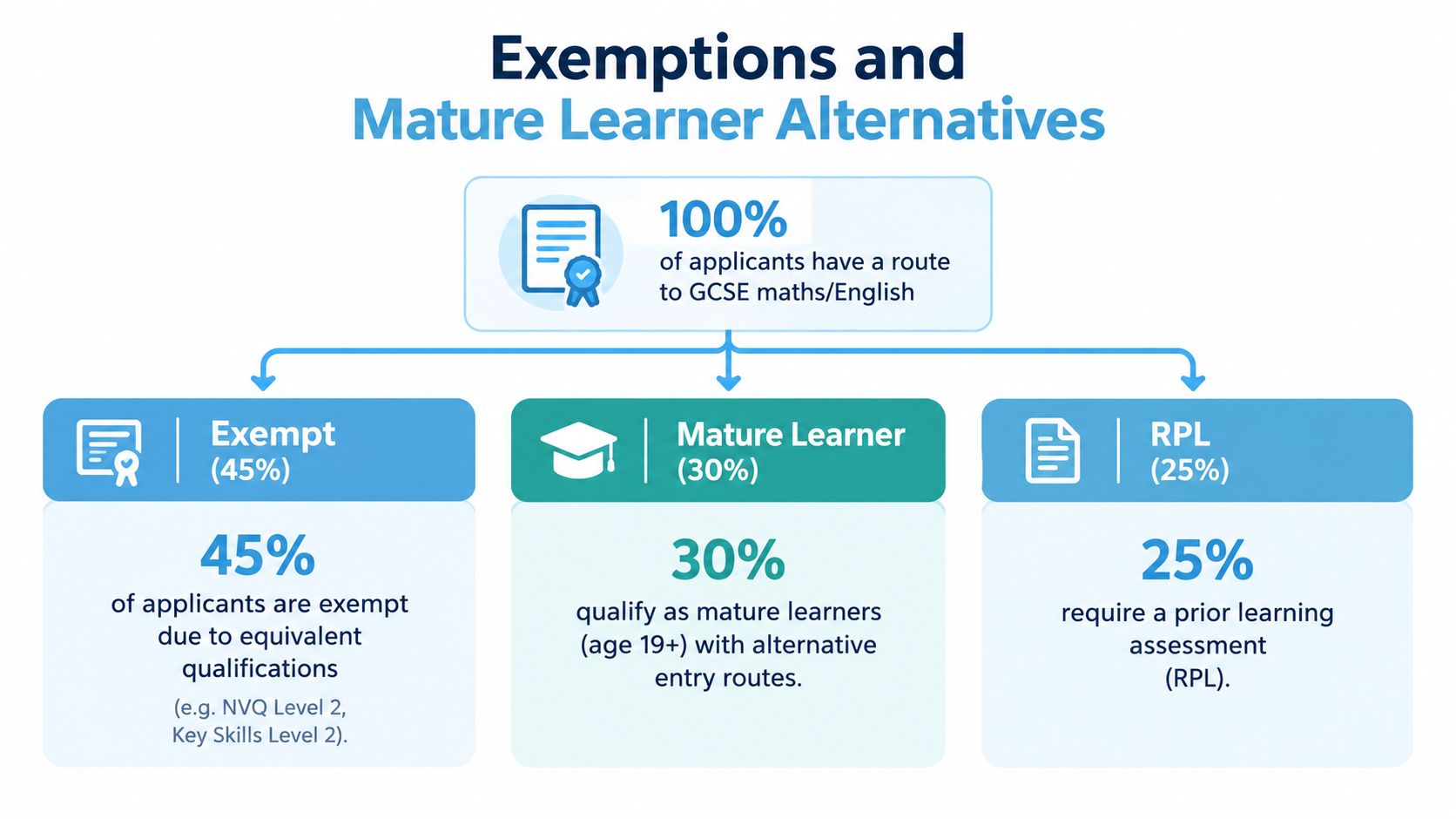
A mature learner route can be useful for someone with substantial relevant employment, but age alone doesn't guarantee an exemption. A healthcare applicant might have years of patient-facing work yet still need formal maths evidence for a course with strict numeracy requirements.
Ask the university first, then choose the qualification. Don't pay for a resit until you know what evidence the course accepts.
Jade's decision pathway is straightforward. She should send her D in maths, explain that she has no English GCSE, provide details of her NHS experience, and ask whether the nursing department accepts Functional Skills Level 2 or considers mature applicants through an alternative assessment. If the answer is yes for English but no for maths, she can avoid repeating a qualification she already holds and focus only on the genuine gap.
Planning Your Study and Resit Strategy
A sensible plan begins when you first discover the gap, not when the Access application deadline is close. A 9 to 12 month preparation window gives you room to audit your records, build skills, sit an exam, and respond if the first attempt doesn't go to plan.
Months one to three
Begin with an audit. Find your certificates, identify whether you need maths, English, or both, and ask each target university which routes it accepts. Then register early with an approved centre for the chosen qualification.
Use an initial diagnostic rather than guessing your weaknesses. For maths, look for gaps in number, ratio, algebra, measures, and interpreting information. For English, check reading comprehension, spelling and punctuation, sentence control, paragraph structure, and the ability to support a point with evidence.
Months four to eight
A manageable weekly routine might spread 4 to 6 hours across both subjects, with shorter sessions rather than one exhausting block. Divide your time between topic drills, timed questions, reading practice, and tutor-marked writing.
Course-specific resources can make revision more focused. For example, course-specific study notes downloads may help you organise subject material, provided you use them to understand and practise rather than copy. Keep a mistake log. Write down the question type, your error, the correct method, and what you'll do differently next time.
Months nine to twelve
Move into timed practice and exam technique. Complete a paper or task under realistic conditions, mark it carefully, and choose the next revision topic from the errors you made. For English, practise planning before writing and leave time to check accuracy. For maths, show each stage of the calculation so you can identify where a method went wrong.
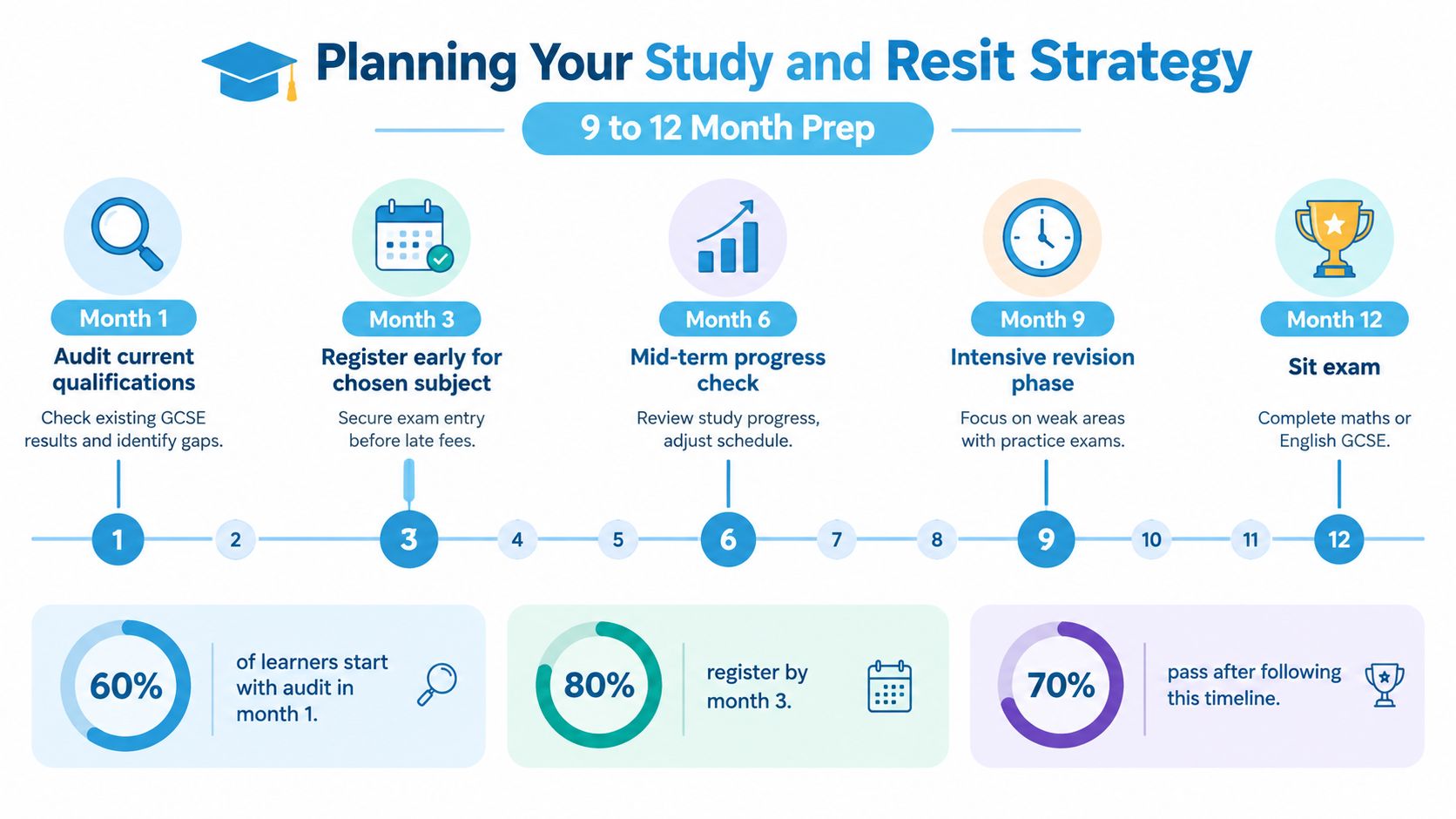
Some centres offer examination opportunities outside the main summer GCSE series, while arrangements vary by qualification and provider. Ask about available sittings, entry deadlines, late fees, and Functional Skills retake windows before you commit.
If you're unsuccessful, request a review or remark where appropriate, then check the retake rules for your qualification. GCSE maths and English can be retaken, and the rules differ from those for many other GCSE subjects. You can also read guidance on how to retake GCSEs while checking your centre's current process.
This video may help you think through the practical preparation process:
Set your qualification deadline before your UCAS application is finalised, and tell your Access tutor about the plan. A certificate already achieved is easier for an admissions team to verify than an unresolved intention to resit.
How Access Courses Online Supports Your Preparation
Adults often need preparation that fits around employment, caring responsibilities, and an existing routine. Access Courses Online offers fully online Access to HE study alongside Functional Skills options in English and maths, including Level 1 and Level 2 pathways. That makes it one practical route for learners who want to prepare for a university application without attending a traditional college every day.
The useful question is whether the format matches your needs. An online provider can suit someone who needs flexible study, tutor messaging, scheduled calls, and the ability to work through materials around other commitments. A local college may suit someone who learns best in a classroom. Self-study may work for a confident learner who already understands the exam specification and can arrange an examination centre independently.
What to check before enrolling
Ask how the provider handles:
- Bridging preparation: Whether optional pre-Access maths and English units are available before graded diploma work.
- Qualification routes: Whether you can follow GCSE preparation, Functional Skills, or both where appropriate.
- Assessment practice: Whether mock tasks reflect the conditions and format of the actual examination.
- Tutor access: How quickly tutors respond and whether support includes messaging or scheduled calls.
- Payments and timing: Whether monthly payment plans and flexible enrolment are available.
- Age and entry history: Whether there's an upper age limit or a requirement for previous qualifications.
Speaking clearly can matter as much as writing accurately when you're preparing for seminars, interviews, presentations, or healthcare placements. An additional resource such as Intonetic's guide to clearer speech may help you practise pronunciation and spoken confidence, although it shouldn't be confused with a formal admissions qualification.
Your preparation should also lead naturally into the diploma. You'll be more comfortable with reading instructions, writing assignments, interpreting numerical information, and responding to tutor feedback. That can make the transition less abrupt, but no provider can guarantee a university offer. The university still assesses your qualifications, course suitability, application, and any professional requirements.
For a realistic view of studying remotely, read what it's like to study an Access course online from home. Then compare the course structure, support arrangements, costs, qualification route, and target university requirements before deciding.
Access Courses Online offers flexible online Access to HE Diplomas and Functional Skills preparation in maths and English, with tutor support for adults balancing study with work or family. Visit Access Courses Online to review the available pathways, check your entry options, and choose a preparation route that fits your intended degree.