
You're balancing work, family, bills and the practical question of whether university is still possible without A-levels. Perhaps you've been away from formal education for years, or you're considering a new career but don't know how your existing experience will translate into an application. You might also be wondering whether studying online is flexible enough, whether universities accept the qualification, and who will pay for it.
An Access to HE Diploma is designed for this situation. It offers adults a recognised route into degree-level study, with subject preparation, academic skills and structured support. This guide explains how an access course online in the UK works, how to choose the right pathway, and what learners in different parts of the UK need to check before starting. For broader advice on fitting study around adult responsibilities, SwiftNet Wifi's guide to online education for adults is also useful. You may find reassurance in this practical perspective on returning to education as an adult.
Returning to Learning as an Adult in the UK
Consider a typical learner: someone who left school without the qualifications needed for university, built a career, and later began thinking seriously about nursing. Work commitments, household costs and family responsibilities have not disappeared, but a clear career goal can make study feel worth planning.
The first concern may be confidence rather than biology. Many adult learners wonder whether they can still write an essay, whether they will be older than their classmates, and whether study can fit around employment or caring responsibilities. They may also question whether a university will accept them without A-levels, or whether online learning will feel unfamiliar.
These worries are normal. Adults often bring workplace discipline, communication skills, resilience and a clearer reason for choosing a particular career. Those strengths can support learning, even if academic study feels rusty at first.
A practical starting point: choose the degree first, then work backwards to the qualification and subject pathway it requires.
Access to Higher Education courses were introduced in the UK in 1978 as a pilot scheme across 8 local authorities (Learning and Work Institute's review of Access to HE). By 1986, they had expanded to 40 local authorities and attracted around 7,000 students (the same Learning and Work Institute review of Access to HE).
Today, an Access route can provide a structured bridge from previous education to university. You build relevant subject knowledge, practise academic work and prepare an application around a realistic progression plan. Online study may reduce travel and scheduling barriers, although you still need regular study time, reliable organisation and contact with tutors.
Start by checking the entry requirements for the degree and university you want. Then compare the course pathway, assessment style, timetable and support available. Access Courses Online may be one provider to investigate, alongside wider advice in this guide to online education for adults and practical reassurance about returning to education as an adult.
You do not need to feel ready in every respect before applying. You need a suitable course, an honest view of your available time and a provider that explains the next step clearly.
What an Access to HE Diploma Actually Is
The Access to HE Diploma is a regulated Level 3 qualification for adults who want to progress to higher education but don't hold the traditional qualifications usually requested for university entry. The diploma follows a fixed 60-credit structure. 45 credits are graded academic subject content at Level 3, while 15 credits are ungraded and may be studied at Level 2 or Level 3. The structure is set out by the Quality Assurance Agency for Higher Education.
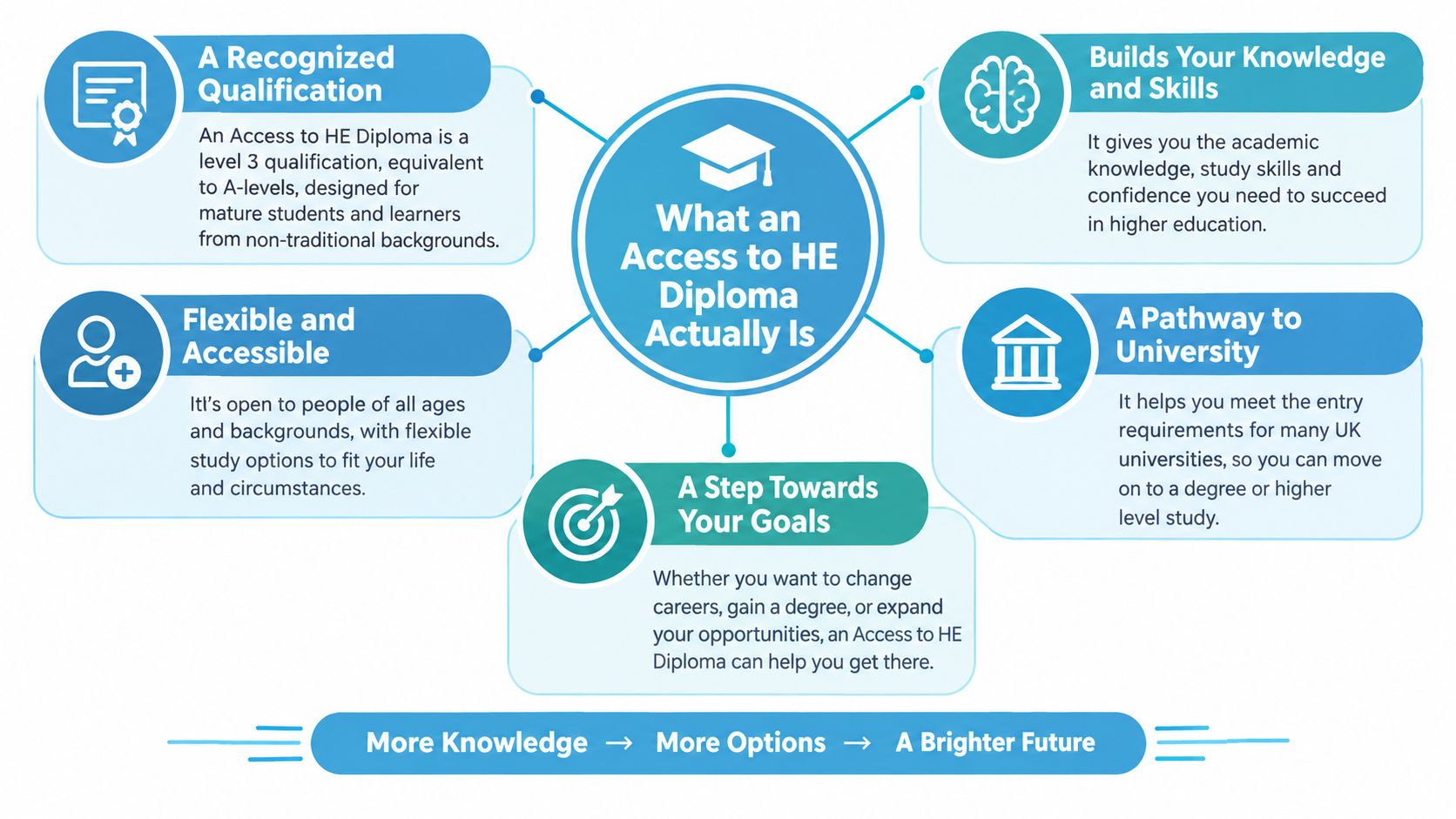
Think of the diploma as two connected parts.
Subject knowledge
The graded credits cover the academic area linked to your intended degree. On a Nursing pathway, that might include health-related study and relevant science. On a Computer Science pathway, you may work with computing concepts, problem-solving and digital systems.
Universities assess the grades and subjects on your transcript. A general diploma title alone doesn't guarantee entry to every course, so you must compare the pathway with the exact requirements of your preferred university.
Study skills
The ungraded credits help you become a capable university student. You may practise academic writing, referencing, research, presentations, planning and exam preparation. These skills matter because university work often expects you to interpret evidence, construct an argument and manage deadlines independently.
Full-time study can typically be completed in one year, making the diploma a compressed route into degree-level education. The QAA explains the qualification's credit structure and purpose in its overview of the Access to HE Diploma.
The diploma isn't just a collection of short courses. It's a coherent qualification designed to demonstrate that you're ready for higher education. Your provider should explain how the units fit together, how assessment works and how the pathway supports your intended university application.
Subjects and Career Pathways You Can Choose
Subject choice is one of the most important decisions you'll make. Start with the degree you want, not with the course title that sounds most interesting. Universities may require a particular Access pathway or specific units, especially for professionally regulated subjects.
| Access Pathway | Typical Degree Routes | Example Career Outcomes |
|---|---|---|
| Nursing and Midwifery | Adult nursing, children's nursing, mental health nursing, midwifery | Registered nurse, midwife |
| Health Science | Physiotherapy, radiography, occupational therapy, paramedic science | Allied health professional, paramedic |
| Science | Biomedical science, pharmacology, biosciences | Laboratory scientist, research assistant |
| Business | Management, accounting, marketing, business administration | Business manager, accountant, marketing professional |
| Computer Science | Software development, information technology, cybersecurity | Software developer, IT professional, security analyst |
| Social Science | Psychology, criminology, sociology, social work-related degrees | Psychologist, criminology professional, social researcher |
Healthcare routes
Nursing and Midwifery pathways suit applicants who already have a clear professional direction. Check whether your target course asks for biology, psychology, health studies or another specific subject. A university may also have separate requirements for GCSE English, maths or science, so don't assume the diploma covers every condition.
Health Science can be a better match for physiotherapy, radiography or paramedic science, although the exact route varies between universities. Some healthcare degrees include interviews, occupational health checks or work experience expectations alongside academic requirements.
Science and digital routes
A Science diploma may support applications to biomedical, pharmacology or bioscience degrees. Look closely at laboratory or biology requirements if your chosen university includes practical science in its entry criteria.
Computer Science is suited to degree routes in software, IT and cybersecurity. Providers may differ in how much programming, mathematics or systems content they include, so ask to see the unit list before enrolling.
Business and Social Science offer broader progression options. Business can lead towards management, accounting or marketing degrees, while Social Science may align with psychology, criminology or sociology. The important question is always, does this pathway meet the entry requirements for the degree you want?
Create a shortlist of university courses and record the required diploma title, graded units and other conditions. Only then should you choose an online provider.
Accreditation and How Universities View the Diploma
A university admissions team will examine more than the course title. It will check whether the Access to HE Diploma is recognised, which credits you completed, the grades awarded and whether the subjects match the degree. A credible diploma sits within the UK Access to HE framework. Access Validating Agencies support course approval and consistency, and you can check the recognised-agency listing on accesstohe.ac.uk.
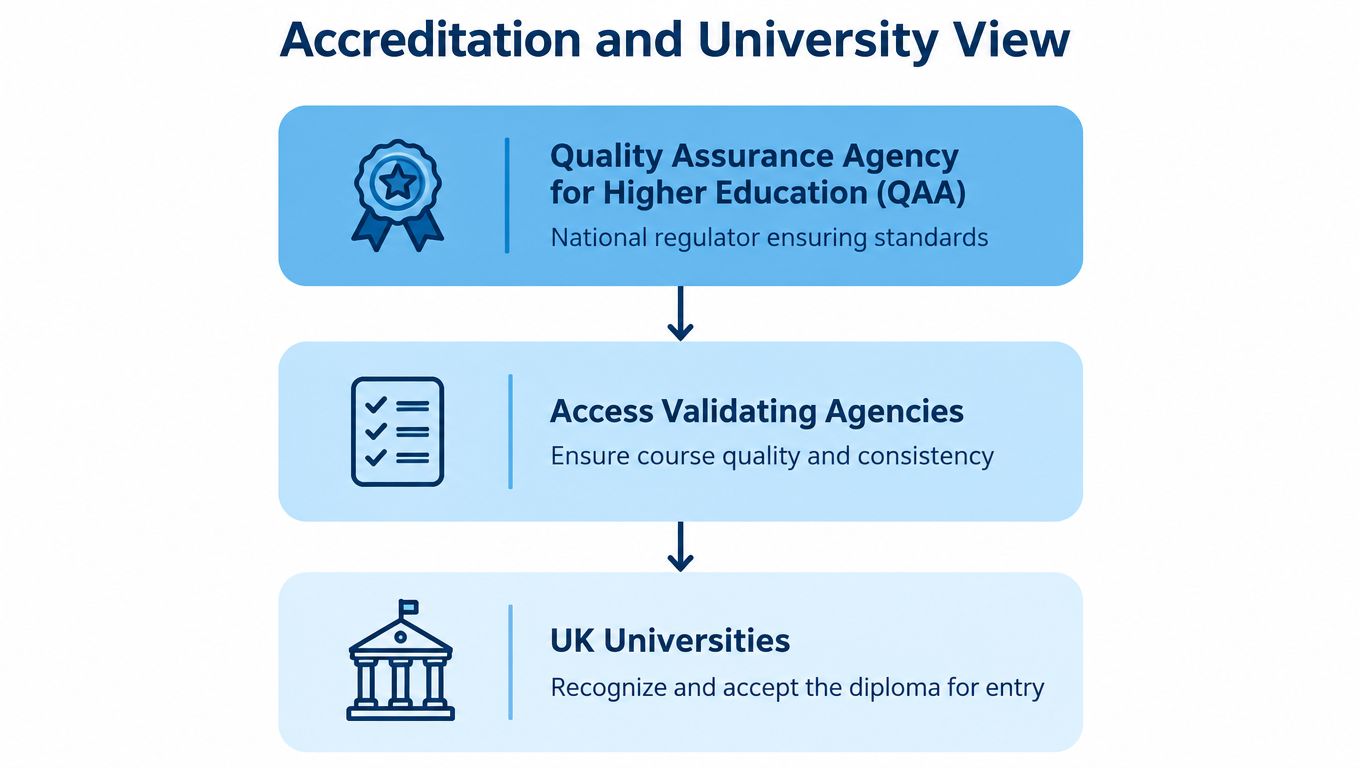
Your transcript provides the evidence. It shows the 45 graded Level 3 credits and the 15 ungraded credits that form the complete diploma. Admissions staff can then compare your academic preparation with the requirements for the degree, including the relevant subjects and grades.
How entry decisions are made
The Access Diploma is a Level 3 qualification, broadly comparable in level with other advanced school-leaving routes, although its structure is designed for adults preparing for a particular degree area. Study is often concentrated into a shorter period, so universities assess the actual credit profile rather than relying on the qualification name alone.
Access qualifications can contribute up to 144 UCAS Tariff points from the 45 graded credits, according to UCAS guidance on Access to HE Diplomas. Points form only part of the decision. A Nursing or Midwifery course, for example, may require particular grades in Biology or Psychology units, as well as other conditions.
Your checks before enrolment
Treat the university's course page as your main checklist. Confirm:
- Qualification wording: Does it accept the Access to HE Diploma?
- Pathway: Does your intended subject route appear?
- Unit requirements: Are Biology, Chemistry, Psychology or mathematics specified?
- Grade profile: Are particular grades required in graded credits?
- Additional conditions: Do you need GCSEs, an interview, placement experience or a health check?
Ask the provider whether learners from that exact pathway have progressed to the type of degree you want. A useful answer should include clear progression information, rather than relying on the general statement that universities accept Access courses. This check can prevent you from completing a diploma that does not meet your chosen university's specific conditions.
How Studying an Access Course Online Works
Online study is flexible, but it isn't passive. You'll usually work through a virtual learning environment, such as Moodle or Microsoft Teams, where your provider stores teaching materials, assignment instructions, announcements and feedback.
Your first stage is induction. You'll learn how to access the platform, contact your tutor, submit assignments and understand academic expectations. A good induction should also clarify the timetable, assessment rules and arrangements for support.
After that, study typically combines recorded teaching, reading, downloadable materials, live tutorials and discussion activities. Some learners prefer a fixed weekly routine. Others study around shifts or school runs, completing work in planned blocks.
What a study week may involve
A realistic week can include:
- Teaching materials: Watch a recorded lecture or read a study pack.
- Active learning: Complete questions, research a topic or contribute to a discussion.
- Tutor contact: Attend a live tutorial or send a question by email.
- Assessment work: Plan, draft and edit an assignment.
- Review: Read feedback and record actions for the next task.
Assessment may include essays, presentations, academic posters, timed examinations or a research project. Your provider should tell you whether any assessment must take place under supervision and how identity checks are handled.
Online learners should receive the same recognised diploma as learners studying in a classroom when they complete an approved course. The difference is the delivery method, not the academic purpose.
Watch this short video for a practical view of studying remotely:
You'll find a useful learner-focused explanation of the experience in what it's like to study an Access course online from home.
Before enrolling, ask how quickly tutors respond, how feedback is delivered and whether you'll have live contact with other learners. Those details often make the difference between studying alone and feeling properly supported.
Funding, Fees, and the 2026 Policy Changes
Funding is where many prospective learners become uncertain, because support depends on where you live, your age, your previous qualifications and the type of course you choose. Don't rely on a generic statement that an online Access course is free or fully funded. Ask the provider to assess your individual position.
In England, eligible learners aged 19 and over can use an Advanced Learner Loan for an Access to HE Diploma. If the learner completes an eligible higher education course after the diploma, the Access loan is written off. The Access to HE funding guidance explains the current relationship between the diploma, loans and progression.
The policy position is changing. From September 2026, new Access to HE Diplomas will only be approved for funding through 16 to 19 study programmes for learners aged 18 and over. Government guidance also states that students aged 19 and over can continue using Advanced Learner Loans, and those loans remain writable off after progression to eligible higher education. Because the rules can interact with age, previous qualifications and local entitlements, obtain written confirmation before you commit.
| UK Nation | Main Funding Route | Typical Age Eligibility | Repayment Rule | 2026 Change |
|---|---|---|---|---|
| England | Advanced Learner Loan for eligible Access learners | Usually 19 and over, subject to eligibility | Written off after progression to eligible higher education | Funding approval rules for new diplomas change from September 2026 |
| Wales | Check current Welsh learner funding and loan arrangements | Depends on the programme and learner circumstances | Confirm with the relevant funding body | Check current rules before enrolling |
| Scotland | Ask about Scottish funding, including applicable part-time support | Depends on residency, study mode and eligibility | Confirm the terms of the specific support | Devolved rules may differ from England |
| Northern Ireland | Check the current Northern Ireland learner loan and funding position | Depends on course and personal circumstances | Confirm with the relevant funding body | Do not assume English rules apply |
The table is a decision aid, not a funding approval. Scotland, Wales and Northern Ireland have devolved education systems, so a provider should direct you to the appropriate national authority rather than applying English guidance automatically.
Questions to ask about your actual cost
Ask whether the advertised fee includes registration, assessment, tutorial support and any required materials. Clarify whether you can pay monthly, whether an employer can sponsor the course and what happens if you defer or withdraw.
For a detailed explanation of the questions to raise, use this Access to Higher Education funding guide. Get the answer in writing, particularly if your course begins near the 2026 policy change.
Choosing a Provider and Applying With Confidence
A provider should make it easy for you to verify what you're buying. Compare evidence, not just course descriptions. The most useful checks concern recognition, progression, teaching support and payment arrangements.
| Check | What to Look For | Why It Matters |
|---|---|---|
| Qualification status | Clear details of the Access Validating Agency and diploma title | Confirms what qualification you'll receive |
| University progression | Named progression records or transparent destination information | Helps you judge whether the pathway suits your goal |
| Course content | A full unit list, including graded subject credits | Lets you compare the diploma with university requirements |
| Tutor support | Contact methods, feedback arrangements and response expectations | Online learners need reliable academic guidance |
| Assessment | Plain explanation of essays, presentations, examinations and deadlines | Prevents surprises after enrolment |
| Funding | Individual eligibility guidance and written fee information | Reduces the risk of unexpected costs |
| Flexibility | Start dates, study pace and deferral rules | Shows whether the course fits your responsibilities |
| Learner welfare | Mature learner support, safeguarding and accessibility processes | Provides help when personal circumstances affect study |
The application process
Most providers begin with an enquiry or application form. You may need to provide identification, details of previous qualifications and information about your intended degree. Don't worry if your qualifications are incomplete. Tell the admissions team what you have, because they can explain whether Functional Skills, GCSE study or another preparation route is needed.
A skills assessment or interview may follow. Treat it as a planning conversation, not a test of whether you deserve a place. The provider should ask about your goals, available study time and support needs.
Before you accept an offer, confirm the start date, study pace, fees, funding route and learning agreement. Access Courses Online is one provider that offers fully online Access to HE Diplomas across areas including Nursing, Midwifery, Health Professions, Computer Science, Science, Social Science and Business, with tutor guidance and payment-plan information available through its admissions team.
Realistic Outcomes, Timelines, and Common Questions
An online Access Diploma gives you a route, not an automatic university place. Your result depends on completing the required credits, meeting the university's entry conditions and submitting a strong application. Many learners use the course to progress towards Nursing, Midwifery, Social Work, Business or Computing, but the destination must match the pathway and admissions requirements.
A full-time route can typically be completed in one year, according to the QAA's explanation of the diploma. The journey usually involves enrolment, induction, subject modules, regular assessments, a final transcript and a university application.
Common questions
Will universities accept an online Access Diploma?
They can accept a recognised Access to HE Diploma, but check the individual course page. The university may require a particular pathway, unit or grade profile.
Can I work while studying?
Many adults do, but you'll need a reliable weekly routine. Ask whether the course has live attendance requirements and how quickly assignments must be completed.
Can I transfer Access credits to a degree?
The diploma is primarily an entry qualification. Universities decide how they treat prior learning, so ask the admissions team rather than assuming credits will reduce your degree workload.
What happens if I fail a unit?
Contact your tutor immediately. The provider should explain resubmission rules, deadlines and how a revised assessment affects your final transcript.
You don't need to have every answer before you enquire. Start by choosing a degree direction, checking its requirements and asking a provider for an honest funding and study plan.
Access Courses Online offers fully online Access to HE Diploma courses, tutor support and flexible study options for adults preparing for university in subjects such as Nursing, Health, Computer Science, Science, Social Science and Business. Review the available pathways and contact Access Courses Online to discuss your target degree, eligibility and the funding route that applies to you.