

If meeting the entry requirements gets you a place, why do so many adult learners meet them and still miss out? That's the gap most guides to an access course to health professions leave open. They explain that an Access to HE Diploma can replace A levels, but they don't separate eligibility from admission. A subject-compliant diploma can pass the entry check. It doesn't, on its own, secure an offer.
You'll need to clear other hurdles before you enrol, and some of them have nothing to do with your Access grades. Universities may set separate GCSE-equivalent conditions, expect you to pass health and disclosure checks, and compare your profile with other applicants for a limited number of places. The degree that follows also brings placement costs and full-time blocks that online study can't remove. If you're a career changer, a parent, or someone returning after years away from formal study, those details matter as much as the unit list. Read the route in order, and check each step against your own target university, work pattern and budget before you commit.
Access to HE Health Diplomas at a Glance
The official picture is concrete: the UK government learning aim record for the Access to HE Diploma in Nursing lists the route at Level 3 with 600 funded guided-learning hours and Adult Skills Fund rates of £3,600 unweighted and £5,040 after programme weighting, while the Quality Assurance Agency case study on the Access to HE Diploma reports more than 25,000 students preparing for degree-level study through the Diploma each year, across approximately 1,200 courses, with 36,183 students registered in 2023-24.
Key facts for the Access to HE Nursing Diploma
| Item | Value | What it means for you |
|---|---|---|
| Qualification level | Level 3 | Recognised post-16 level for university entry |
| Typical starting age | 19 and over | Designed for adults returning to study |
| Funded guided-learning hours | 600 | A substantial planned programme, not a short taster |
| Adult Skills Fund unweighted rate | £3,600 | Base rate in the English funding record |
| Rate after programme weighting | £5,040 | Weighted equivalent in the same record |
| Typical study length | 16 to 18 months | Common where learners spread study over more than one year |
| Students registered for Access to HE (2023-24) | 36,183 | Scale of the national route |
| Health subject descriptors | Nursing and Health Professions | Only compliant Diplomas can use these titles |
For health degrees, universities usually look for Access to HE Nursing or Access to HE Health Professions, because the subject descriptors match the preparation admissions teams expect. QAA reserves those titles for compliant Diplomas, so the label helps you separate a health-built route from a course with a reassuring name but the wrong unit mix. The distinction is practical: health applicants need academic writing, scientific understanding and subject-specific study, not general study skills alone.
A health-focused title alone isn't evidence. Look for the reserved Nursing or Health Professions descriptor.
Use the table as an eligibility filter, not an offer predictor. A compliant diploma can pass the entry check; admission still depends on the conditions attached to your chosen degree, the strength of the applicant field and the costs of practice-based study.
Entry Requirements for Nursing, Midwifery and Allied Health
In England, the UK government's learning aim record for the Access to HE Diploma in Nursing classifies it as a Level 3 qualification within Health, Public Services and Care, specifically Nursing and Subjects and Vocations Allied to Medicine. Universities can therefore evaluate it alongside other Level 3 qualifications, by subject content and graded achievement. The same record doesn't promise admission, and regulated health degrees may also require GCSE-equivalent English, mathematics and science, occupational-health clearance, a satisfactory enhanced DBS check and evidence of suitability for professional practice.
Entry conditions by health degree
| Degree | Access diploma route | Usually also required | Check before applying |
|---|---|---|---|
| Nursing (adult, child, mental health, learning disability) | Accepted with a subject-compliant Nursing or Health Professions Access Diploma | GCSE-equivalent English, maths and usually science; enhanced DBS; occupational health | Interview and values-based assessment; the field of nursing you choose |
| Midwifery | Accepted by many providers; confirm the Access subject matches | GCSE-equivalent English and maths; science often specified; enhanced DBS | Placement requirements and suitability checks for practice |
| Allied health (physiotherapy, occupational therapy, radiography, paramedic science) | Accepted where your diploma includes the biology or chemistry content named in the course profile | Maths, English and science; health and immunisation checks | Entry profile differs by course; check each course's subject list |
| Health and social care degrees | Usually accepted with a matching Access subject | English and maths at GCSE-equivalent level | Whether placements or DBS checks apply to your course |
Conditions the diploma doesn't replace
The wording around GCSEs catches many applicants out. Some universities accept Functional Skills in English and maths, others name GCSEs specifically, and some accept one but not the other for science. Don't assume that strong Access grades cancel a missing GCSE condition. If you're targeting nursing, the detailed guide to Access to Nursing requirements helps you compare what a course asks for before you apply.
You should also expect immunisation evidence and a values-based interview. Tutors aren't only testing knowledge at interview. They're looking for communication, honesty about challenging situations, respect for dignity, and an understanding that placements involve shift patterns, supervision and professional boundaries.
Edge cases matter here. A learner with science units at Distinction may look stronger for paramedic science or physiotherapy than a learner whose diploma is heavy on sociology, even if both totals look similar. An older applicant may need to show recent study, because a qualification from many years ago doesn't always prove you can write, reference and meet deadlines now.
Practical rule: meeting the minimum makes you eligible to be considered. Your grades, subject fit, statement and interview decide whether you're competitive.
That minimum-versus-competitive distinction should shape your shortlist. A course listing a requirement isn't saying every applicant who meets it receives an offer.
Units You Study and the Workload to Expect
Unit names vary by provider, so treat this table as typical rather than a fixed national list. What matters is the mix. A health diploma should build scientific knowledge, numeracy, research skills and professional communication together, because a health degree uses all four from early on.
Typical Access to HE health units and what they prepare you for
| Unit (typical) | What it covers | Why it matters for health degrees |
|---|---|---|
| Human Biology or Anatomy and Physiology | Body systems, cells, homeostasis | Core for clinical reasoning and medication calculations |
| Health Psychology | Behaviour change, illness experience, stress | Patient communication and care planning |
| Sociology of Health | Inequality, health services, social care | Understanding wider factors in patient outcomes |
| Introduction to Health Care Practice | Care roles, ethics, safeguarding, care settings | Early exposure to professional expectations |
| Mathematics for Health | Ratios, percentages, dosage, statistics | Medication safety and reading research data |
| Academic Writing and Study Skills | Referencing, essays, reflective writing | Preparation for degree assessments |
| Research Methods | Study design, data, evidence appraisal | Foundation for evidence-based practice modules |
| Communication and Professional Practice | Teamwork, confidentiality, presenting | Interview and placement readiness |
Anatomy and physiology gives you the vocabulary and body-systems reasoning you'll use when a lecturer moves from normal function to illness. Health psychology helps you explain why a patient may not follow advice, instead of labelling them difficult. Mathematics for Health covers dosage, ratios and percentages, while research methods teaches you to question whether a study supports the intervention it recommends.
Turning 600 hours into a weekly plan
The QAA's Access all areas article reported that more than 26,000 new students registered onto approximately 1,300 Access to Higher Education courses in Britain in 2024, delivered by around 180 providers, and that 54% of Access students chose to spread their learning over more than one academic year in 2023-24, with many taking approximately 16 to 18 months.
Use those 600 guided-learning hours as your planning anchor. Over 52 weeks, that's about 11 to 12 hours a week. Over 16 to 18 months, roughly 70 to 78 weeks, it's about 8 hours a week.
Say you're a parent working 25 hours a week. You might plan three evening sessions for reading and drafting, plus one weekend block for an assessment. Online study spreads the hours through tutor feedback, set reading, independent work and deadlines, so count assessment time as well as any live or recorded teaching. If you shorten the timeline, the total doesn't shrink. Your weekly load rises instead.
Progression Routes After Your Access Diploma
A full-time degree in nursing, midwifery or an allied health subject is the standard route after Access. A part-time pattern can suit you if you need to keep earning, but it stretches the calendar and placements still have to be completed. A degree apprenticeship works differently, because you're employed while you study and placement time is built into the job structure.

Post-diploma routes compared
| Route | Learner cost | Weekly commitment | Time to registration |
|---|---|---|---|
| Full-time degree | Tuition plus living costs | High; placements in blocks | Typically three to four years; set by the degree programme |
| Part-time degree | Tuition, spread over more years | Lower weekly load; placements still required | Longer than full-time; set by the part-time programme length |
| Degree apprenticeship | Usually lower for the learner; employer involvement | Paid work with placement time built in | Set by the apprenticeship standard and employer programme |
| Working in health care while studying | Costs of study plus lost earnings if hours reduce | Set by your job contract and the course placement rules | Set by the degree or apprenticeship you are studying alongside work |
Working in a health-related role while you study can help you understand ward routines, documentation and teamwork. If you want an entry point that builds familiarity with clinical notes, a guide to becoming a medical scribe from PatientNotes is a useful reference for what that support role involves. Paid care work, support work or volunteering can also give you concrete examples for your personal statement, provided your hours don't breach course placement rules.
Before you choose, compare routes on learner cost, weekly commitment and time to registration. Providers such as Access Courses Online offer online Access study, so you can ask how UCAS tariff information applies to your graded credits using its explanation of Access to HE Diploma UCAS points. If a degree's placement blocks clash with your existing job, an apprenticeship that builds placement into paid work may fit better.
Ask each provider two direct questions. How are placements arranged, and who pays for them?
Funding and Placement Costs to Budget For
Online and flexible study solves one problem well. It lets you fit Access learning around work and family. It doesn't remove the time, travel and income pressures of a health degree once teaching and clinical placements become mandatory.
The Council of Deans response to UCAS end-of-cycle data 2025 highlighted that healthcare courses are intensive, leave limited scope for part-time work, and can involve upfront travel costs for clinical placements. It also recorded 47,660 nursing applicants but 26,315 acceptances in the 2025 cycle, so you're planning for competition and affordability at the same time.
Build a transition budget, not a fee list
- Access course tuition: Check whether you're eligible through routes such as the Adult Skills Fund or an Advanced Learner Loan, using the overview of Access to Higher Education funding as a starting checklist.
- Travel to placements: Budget for journeys that may be longer than your normal commute, plus early starts that rule out cheaper off-peak fares.
- Uniforms and equipment: Ask what's issued, what you must buy, and whether shoes, watches or placement accessories are included.
- Occupational health and immunisations: Confirm which appointments, vaccinations and records you need before placement.
- Enhanced DBS checks: Ask whether the university covers the check or passes the cost to you.
- Lost working hours: Cost the shifts you can't accept during placement blocks, not just your usual weekly pattern.
- Childcare: Plan for cover that matches placement hours, including early, late and weekend shifts.
- Laptop and internet: Online Access study and degree work both depend on reliable equipment and connection.
Funding isn't identical for everyone on the same course. Eligibility can turn on residency, household circumstances and your home nation, so two learners sitting in the same online group may receive different support. Timing matters too. Support that arrives after a placement block doesn't help if you had to pay for travel before it began.
List every cost as confirmed, likely or unknown, then fund the unknowns before your first placement block.
That method sounds cautious because it is. It's far easier to build a small buffer during Access study than to find money halfway through a placement when your paid shifts have dropped.
From Route to Offer to Enrolment
Competition is the context you can't skip. The UK Parliament research briefing reporting UCAS data records later 2025 end-of-cycle figures showing 47,660 people applied for undergraduate nursing courses, but only 26,315 were accepted, a 0.7% fall in acceptances from 2024. It also notes the Council of Deans reported declines in mature applicants and acceptances, particularly among those over 25.
Those figures don't mean Access learners shouldn't apply. They mean you should plan as if eligibility is the first gate, not the finish line. Nursing applications also rose overall in the earlier 2025 reporting, so popular courses can receive many more suitable applications than they can accommodate.
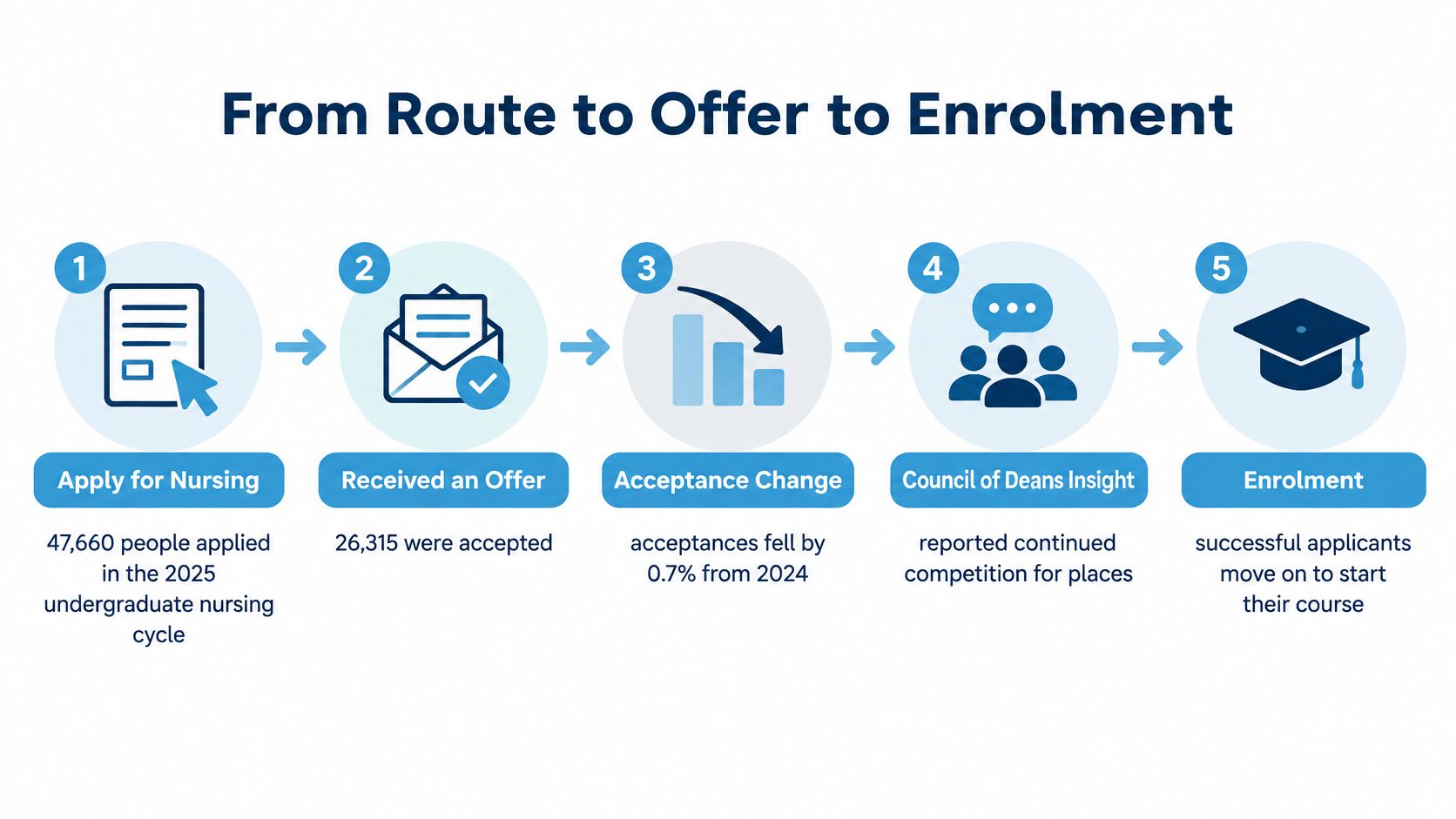
Your route to an offer, step by step
- Confirm the diploma title: Check that it carries the Nursing or Health Professions descriptor, because only compliant titles give admissions tutors the subject assurance they're looking for.
- Map your units: Match your Access subjects and grades against each target university's entry profile, because subject fit decides whether you're eligible in the first place.
- Check separate conditions: Confirm GCSE-equivalent English, maths and science, or whether Functional Skills is accepted, because these are often conditions on top of the diploma.
- Build a balanced shortlist: Include one course where you meet the minimum comfortably and two competitive courses, because a realistic spread protects you if offers are tight.
- Gather care evidence: Use paid work, volunteering or caring experience in your personal statement, because tutors need evidence you understand the realities of care, not only the idea of it.
- Prepare for selection checks: Apply through UCAS and prepare for values-based interviews, DBS checks, occupational health and immunisations, because an academic offer can still depend on suitability for practice.
If you're over 25, don't rely on general claims that mature applicants are welcomed. Ask each university how mature and Access applicants are considered for that specific course, what grade profile recent applicants held, and whether interviews use multiple mini interviews, group tasks or a panel. Two universities can publish similar entry wording and select very differently.
Do the checking before you enrol on Access, not after you've finished. If your target physiotherapy course wants strong biology, a diploma without enough biology content creates a problem no personal statement can fix. If your chosen midwifery course names science at GCSE-equivalent level, plan that qualification alongside Access rather than discovering the gap at application stage.
Your single next action is simple. Confirm the entry profile in writing with your target university, including Access subject, grades, GCSE-equivalent conditions and interview format, then choose an Access diploma that matches it.
If you're ready to match an Access to HE Health Professions diploma to your target nursing, midwifery or allied health degree, Access Courses Online offers online Access study you can fit around work and family, with tutor and funding guidance to help you plan the route. Visit the site, compare the health diploma units against your university shortlist, and ask for advice before you enrol so your first step supports the offer you want.