

You've searched for nursing courses, opened several university pages, and now you're staring at different lists of grades, tests, interviews and checks. One provider mentions A levels. Another accepts an Access to HE Diploma. A third asks for an interview, DBS clearance and occupational health approval before you can even begin clinical learning. If you're changing careers or returning to education, that inconsistency can make the process feel harder than the study itself.
The good news is that access to nursing requirements become much clearer when you separate them into four areas: academic qualifications, course-specific selection, professional clearance and practical availability. You don't need to understand every university rule at once. You need a reliable method for checking each requirement, identifying gaps early and choosing courses where your qualifications and circumstances genuinely fit.
Understanding the Pathway to a Nursing Degree
Sarah has worked in retail management for years. She's supported relatives through illness, volunteered at a community centre and knows she wants a more purposeful career. She doesn't have traditional A levels, though, and the language on university websites feels unfamiliar. UCAS points, Level 3 credits, equivalencies, references and occupational health forms seem to belong to a system designed for school leavers rather than someone with work and family responsibilities.
That reaction is common. Mature applicants often underestimate how much relevant experience they already bring, then overestimate the importance of having followed one particular school-based route. Nursing degrees can accept applicants through different qualification pathways, including A levels and Access to HE Diplomas, provided the applicant meets the university's academic and professional conditions.
Your route usually looks like this:
- Check the baseline qualifications. Confirm your English, maths and science background before choosing courses.
- Select an accepted Level 3 route. This might be A levels, an Access to HE Diploma or another qualification recognised by the university.
- Compare individual course requirements. Universities can set different tariff conditions and selection procedures.
- Prepare for selection. You may need an interview, references or evidence of relevant understanding.
- Complete clearance. DBS checks, occupational health assessments and immunisation evidence can affect your start date.
Practical rule: Treat every nursing course page as its own set of rules. General guidance gives you a starting point, but the university makes the final decision.
Your life experience can strengthen an application when you explain what it has taught you. Managing difficult conversations, staying calm under pressure, caring for another person or balancing competing responsibilities can all provide useful evidence. Admissions tutors won't expect you to present yourself as an experienced nurse. They'll want to see that you understand the demands of professional healthcare and have a realistic plan for meeting them.
Core Academic Entry Criteria and GCSE Benchmarks
The first academic question is usually not “How many UCAS points do I have?” It's “Do I meet the required foundation in English, maths and science?” UCAS says most universities ask for at least five GCSEs at grades 9 to 4, or A to C, including English, maths and a science. It also states that providers commonly ask for at least two A levels, with many preferring three, and that biology is often required. You can review the wider subject guidance in the UCAS nursing entry requirements.
That baseline matters because nursing involves accurate documentation, medication calculations, clinical communication, interpreting information and scientific study. A university may consider an equivalent qualification, but you shouldn't assume that any English or maths certificate will automatically meet its rule. Ask admissions staff to confirm equivalence in writing before you apply.
What universities check first
For each course, create a simple comparison sheet with these headings:
| Requirement | What to verify |
|---|---|
| English | Required GCSE subject, grade and accepted alternatives |
| Maths | Required grade and whether Functional Skills or another equivalent is accepted |
| Science | Whether one science, combined science or a specific subject is needed |
| Level 3 study | A levels, Access Diploma or another accepted qualification |
| Tariff condition | Whether the offer uses UCAS points or named grades and credits |
| Additional selection | Interview, test, reference or work-related evidence |
This prevents a common mistake: finding one course that accepts an Access Diploma, then assuming every course uses the same conditions. Some providers may use a tariff offer, while others specify particular modules, grades or tests instead.
If you're missing GCSE English or maths, don't abandon the plan. First, contact the admissions team for each university you're considering and ask which alternatives they accept. Some routes may include an approved equivalent, while others may require you to complete a GCSE or Functional Skills qualification before enrolment.
Why the detail matters
Applicants often focus on the total qualification and overlook subject conditions. A strong overall result won't necessarily compensate for a missing required GCSE or an unsuitable science background. You'll save time by checking the smallest requirement first, then working upwards to the Level 3 qualification.
For a more detailed comparison of academic pathways, use this guide to nursing degree entry requirements. Keep a record of every response, because course pages and admissions guidance can change and different staff members may interpret equivalencies differently.
How the Access to HE Diploma Prepares Applicants
For adults without the usual A level combination, the Access to HE Diploma can provide a structured route into degree-level nursing. It's designed for learners who need to rebuild study habits, develop subject knowledge and demonstrate that they can manage higher education work.
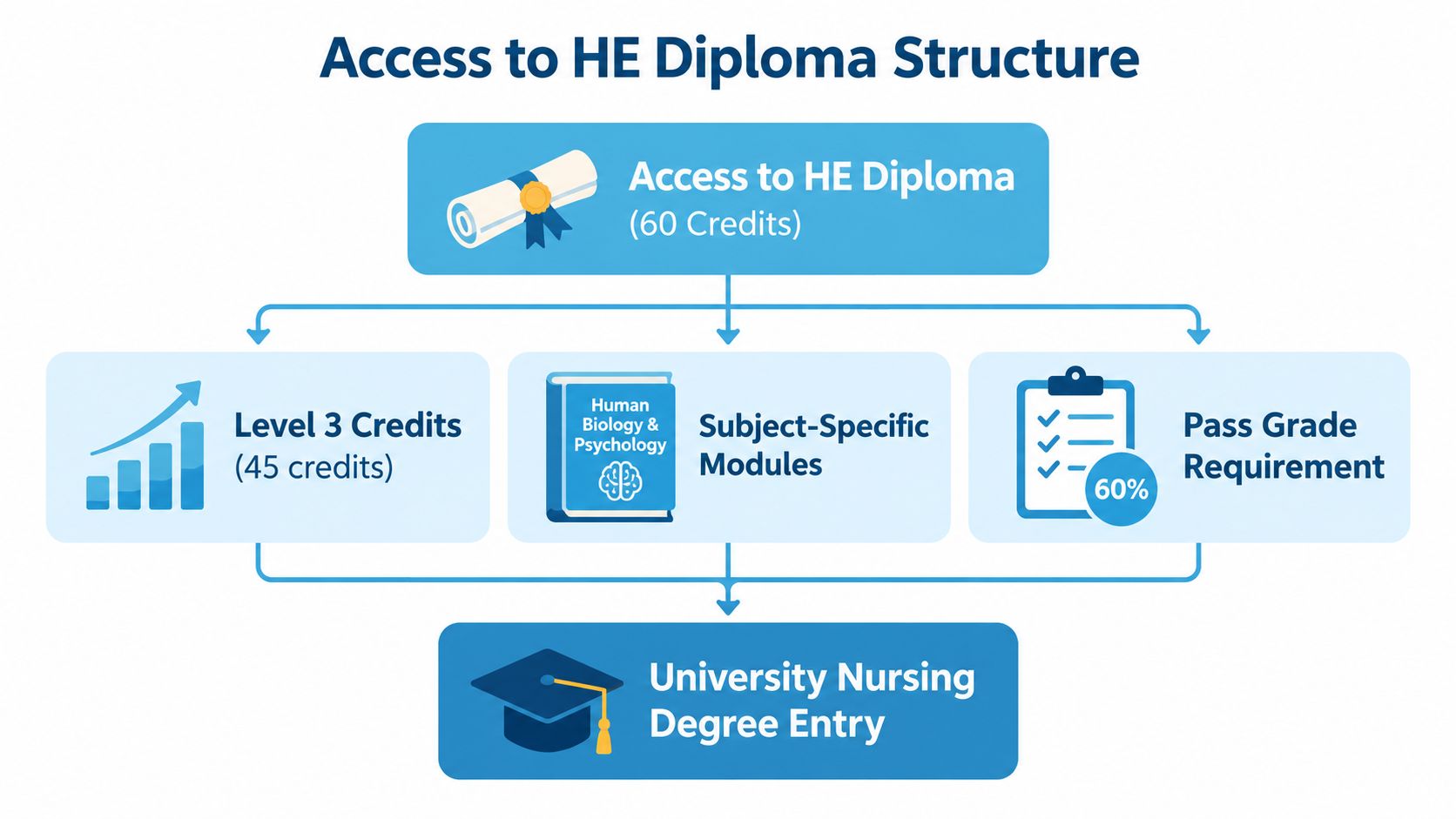
The qualification has a defined technical structure. The QAA subject descriptor for Nursing and Health Professions states that the Diploma contains 60 credits in total, made up of 45 graded Level 3 credits and 15 ungraded Level 2 or Level 3 credits.
That split is important. “Passing the Access course” isn't always enough to secure the university offer you want. Admissions teams can map your achievement in the graded credits to tariff-based conditions, so the grades attached to the 45 Level 3 credits deserve sustained attention.
Plan your study around the graded credits
Use this four-part approach:
- Read the target university's Access conditions. Check whether it requires a particular number of credits at specific grades or asks for named science units.
- Choose a relevant subject route. Nursing and health-related modules can help you build knowledge in areas such as human biology, health studies and psychology, where those modules are included and accepted by your chosen university.
- Track every assignment. Keep a record of deadlines, feedback and grades so you can identify a weak area before it affects your final result.
- Ask about progression early. Your tutor can help you compare your expected achievement with the conditions of the courses you're considering.
The ungraded credits still matter. They can develop academic skills, communication and preparation for university, even though they don't carry the same grade value in an offer. Treat the Diploma as a complete programme, not as a collection of assignments where only the graded work counts.
Make flexible study realistic
Online or part-time study can suit an adult applicant with employment or caring responsibilities, but flexibility doesn't remove the workload. Set fixed study sessions, protect time for reading and leave space for unexpected family or work demands. You'll also need to check how a university views the delivery format and whether the course provider is appropriately recognised.
The strongest preparation is not just collecting credits. It's learning to read academic sources, plan written work, respond to feedback and explain why evidence supports a conclusion. Those habits transfer directly into degree assignments and clinical learning.
Keep a written list of target universities while you study. If one course asks for particular grades or modules, you can use that information to guide your choices rather than discovering the condition after completing the Diploma.
Navigating Non-Academic Clearance and Health Checks
A conditional offer isn't always the final hurdle. Nursing applicants can meet the academic conditions and still face delays if they haven't prepared for the professional checks attached to clinical education.
One university course example lists an Access to HE Diploma, GCSE English and maths or equivalent, an interview, a reference, an Occupational Health check, a DBS check and specific English-language evidence for some applicants. That combination, set out in the course specification from the University of Essex, shows why grades alone don't tell the whole admissions story.
What the main checks involve
DBS clearance helps the university assess whether there are criminal record issues relevant to working with patients and vulnerable people. A past offence doesn't automatically answer the question for you, but you must disclose information accurately and follow the university's process.
Occupational health considers whether you can undertake the practical and clinical requirements of the programme safely, with reasonable adjustments where appropriate. The process may ask about health history, immunisation evidence, allergies, medication or other factors relevant to placement.
References should give the university confidence that you're reliable, suitable for study and able to work responsibly with others. A recent employer, tutor or professional contact may be more useful than someone who knows you socially.
English-language evidence may apply to applicants who haven't completed their previous education in English or who hold qualifications from another education system. Check the exact evidence required rather than relying on assumptions about your background.
Start the paperwork before you need it
Keep a digital folder containing qualification certificates, identity documents, reference details, vaccination records and correspondence with admissions teams. If you need to request older medical or education records, begin early because another organisation may control the timetable.
A general essential health screening checklist can help you organise questions and documents before completing a university occupational health form. It doesn't replace the university's instructions, but it can prompt you to gather relevant information calmly.
Don't hide a health condition or assume disclosure will end your application. Universities assess fitness to study and practise, and they may be able to discuss adjustments or support. The sensible approach is accurate disclosure, prompt responses and direct questions to the occupational health team.
Mastering the UCAS Application and Interview Process
A mature applicant's advantage is often depth of experience, but only if the application connects that experience to nursing. Listing jobs without explaining what you learned gives the reader a timeline. Showing how you handled responsibility, communication or care gives them evidence of readiness.

Build evidence rather than a job list
For each significant experience, ask yourself:
- What situation did I face?
- What action did I take?
- What did I learn about people, communication or responsibility?
- How does that learning relate to nursing?
A care assistant might describe supporting a person with dignity during a difficult personal-care task. A manager might explain how they resolved conflict while protecting confidentiality. A parent returning to education might demonstrate planning, persistence and the ability to manage competing commitments. Keep the focus on learning and professional behaviour, not on claiming experience you don't have.
Your application should also show that you understand nursing involves science, emotional pressure, teamwork, accountability and lifelong learning. Avoid presenting the profession as just “helping people”. Compassion matters, but admissions tutors also need to see realism about boundaries, evidence-based practice and responsibility.
Prepare for scenario-based selection
Universities may use values-based interviews or Multiple Mini Interviews. You could be asked how you'd respond to a communication problem, an ethical concern, a distressed patient or disagreement within a team.
A useful response structure is:
- Identify the immediate safety or dignity concern.
- Explain how you'd communicate respectfully.
- State when you'd seek help or escalate.
- Reflect on confidentiality, equality and professional responsibility.
You don't need to memorise model answers. Practise speaking clearly, listen to the whole question and pause before responding. Ask a friend to give you unfamiliar scenarios so you learn to reason rather than recite.
For focused preparation, review these nursing interview questions and answers. You can also use the following video as a prompt for your own interview practice:
Formal clinical experience isn't always required, but you should seek opportunities to understand care environments where possible. Volunteering, paid support work, community activity or conversations with practising professionals can help you test your expectations before committing to a demanding degree.
Funding Realities and Course Capacity in 2026
Meeting the access to nursing requirements doesn't guarantee that every specialism will remain available at every university. Funding decisions, placement capacity and local workforce planning can affect which programmes continue to recruit.
The Royal College of Nursing reported in 2026 that the University of Nottingham suspended its children's nursing and mental health nursing programmes. The RCN also warned that cuts to nursing course funding could limit student choices and affect patient care, as described in its discussion of the pressures facing nursing.
That creates a difficult situation for applicants. Healthcare needs qualified nurses, but universities still need sufficient teaching staff, placement capacity and funding to run each pathway. A shortage in the workforce doesn't automatically mean that every applicant will find a nearby place in their preferred branch.
Compare the course, not just the profession
When you shortlist universities, ask:
- Is the specialism recruiting for your intended start date?
- Where are clinical placements likely to take place?
- Does the university publish clear information about funding and support?
- What happens if a placement location changes?
- Are there attendance requirements that affect work or childcare?
- Does the course lead to the professional registration route you expect?
You may need to consider more than one location or related field of nursing. That doesn't mean abandoning your interests. It means separating your long-term ambition from one specific course, campus or intake.
Financial planning should cover tuition support, living costs, travel to placements, equipment, childcare and the possibility that clinical schedules will reduce your working hours. Review current government and university guidance rather than relying on old forum posts. You can also consult this overview of funding for Access to Higher Education while building your plan.
A financially workable course is part of suitability. An offer you can't attend sustainably isn't a successful route into nursing.
The 2026 environment rewards applicants who remain flexible without becoming vague. Apply to courses that meet your academic and professional goals, but verify that the specific branch, location and intake are actually available.
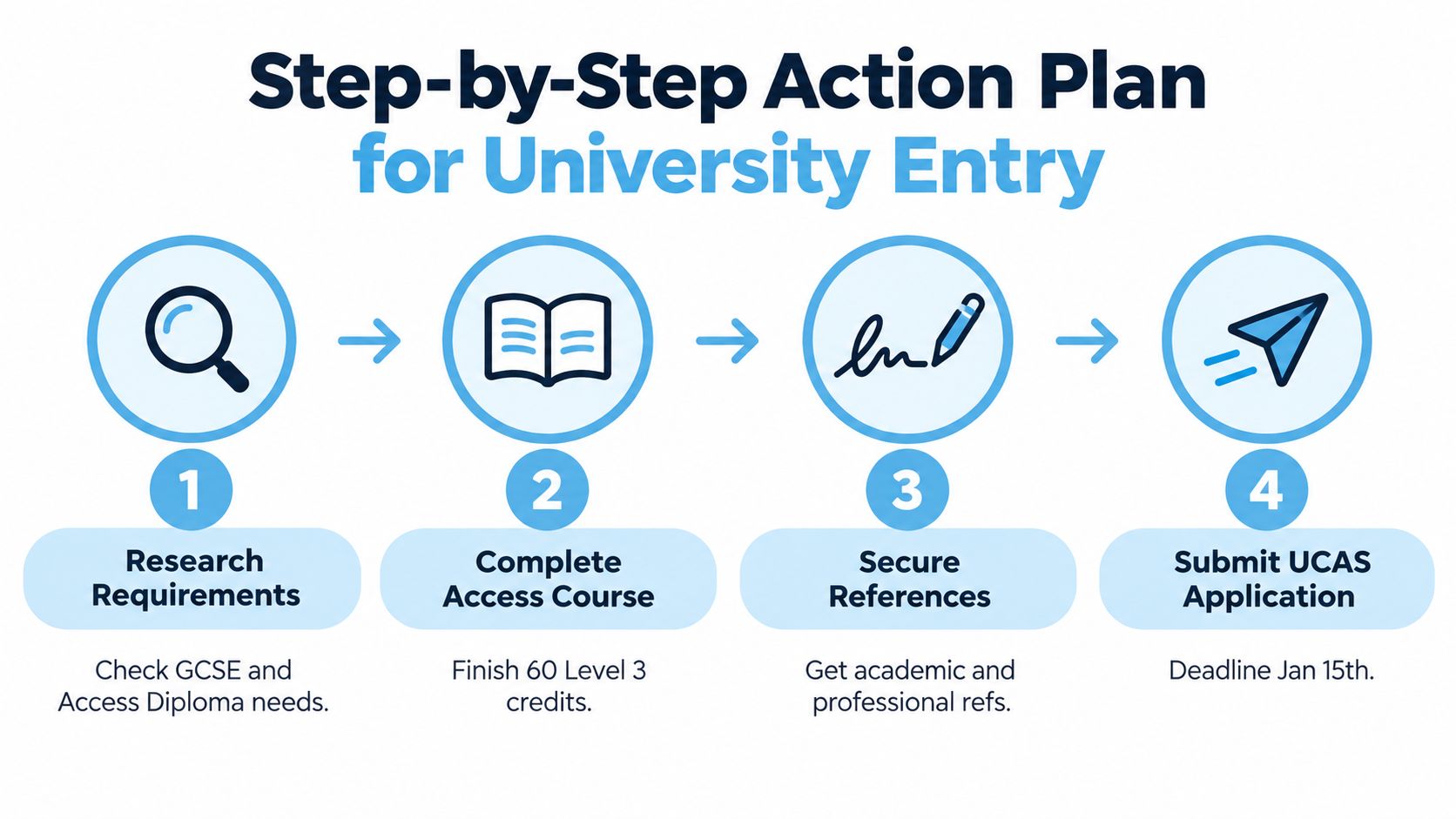
Your Step-by-Step Action Plan for University Entry
A career change feels less intimidating when you turn it into decisions you can complete one at a time. Don't begin by applying everywhere. Begin by identifying the gap between your current qualifications and the requirements of realistic target courses.
Start with an audit
Write down your GCSE subjects and grades, Level 3 qualifications, employment history, caring or volunteering experience and any documents you may need to retrieve. Mark each item as confirmed, uncertain or missing.
Then choose a small group of nursing courses and compare their pages line by line. Record the English, maths and science conditions, Access grade requirements, interview format, reference rules and clearance checks. Contact admissions teams about anything unclear before paying for a new qualification.
Follow a workable sequence
- Resolve GCSE gaps. Arrange an accepted English, maths or science qualification if your target universities require it.
- Choose the Level 3 route. Compare Access Diploma content, assessment style, delivery format and progression support.
- Create a study timetable. Reserve regular time around work, caring and travel commitments.
- Build your evidence bank. Keep notes about work, volunteering and life experiences that demonstrate communication, resilience, compassion and responsibility.
- Check course capacity. Confirm that your preferred branch and intake are recruiting before finalising your choices.
- Prepare documents. Gather certificates, identification, references and health or immunisation records.
- Submit a careful application. Check every qualification, date and answer before sending it.
- Respond quickly after an offer. Complete interview, DBS and occupational health tasks within the requested timescale.
Keep copies of emails and forms, and use a calendar for every deadline. If a university gives you verbal advice about an equivalency or clearance issue, ask for confirmation by email so you have an accurate record.
You don't need to look like a school leaver to succeed. You need to show that your qualifications meet the course conditions, your experience has prepared you for professional study and your practical arrangements can support attendance. If you take each requirement seriously, the route becomes a sequence of manageable tasks rather than one overwhelming application.
Access Courses Online offers flexible online Access to Higher Education Diploma courses for adults preparing for nursing and other university degrees, with tutor guidance and options to study alongside work or family commitments. Review the nursing route and progression support, then visit Access Courses Online to discuss which qualification pathway fits your starting point.