
An Access to Nursing course is a specialised Level 3 qualification that’s on par with A-Levels. Think of it as a direct pathway to a university nursing degree, specifically created for adults who didn’t go the traditional A-Level route. It's the purpose-built bridge you need, giving you all the essential scientific knowledge and academic skills to hit the ground running at university.
Your Bridge to a Nursing Degree
Have you always felt a calling to care for others but thought a nursing career was out of reach because you don't have A-Levels? An Access to Higher Education (HE) Diploma in Nursing is designed specifically for people like you. It's a nationally recognised qualification that unlocks university for ambitious career changers and mature learners.
Think of it as the ultimate academic stepping stone. It recognises that your life experience—whether from a previous job, raising a family, or volunteering—is an incredible asset. Instead of focusing on school-leaver qualifications, it offers a focused, one-year curriculum that gets you ready for the demands of a nursing degree.
To give you a clearer picture, here’s a quick summary of what an Access to Nursing course involves.
Access to Nursing Course At a Glance
| Feature | Description |
|---|---|
| Qualification Level | Level 3 (Equivalent to 3 A-Levels) |
| Primary Goal | Provides a direct entry route to a university nursing degree |
| Target Audience | Adults (19+) without traditional university entry qualifications |
| Typical Duration | 9-12 months (often studied flexibly online) |
| Key Focus Areas | Core science (Biology, Chemistry), academic skills (essay writing, research) |
| Recognition | Widely accepted by UK universities for nursing and healthcare degrees |
This table shows just how targeted and effective the qualification is at getting you where you need to be.
Who Is This Course Really For?
This qualification is the perfect fit for a wide range of motivated people. Maybe you're a healthcare assistant ready to become a registered nurse, a parent returning to work with a new sense of purpose, or a professional in a completely different field who wants a more rewarding career. The common thread is the ambition to become a nurse and the need for a practical way to get there.
The course is structured to build your academic confidence from the ground up. It covers the must-know topics and teaches you how to research, write brilliant essays, and reference your work correctly—skills that are absolutely fundamental for succeeding at university.
A Proven Pathway to Higher Education
The Access to HE Diploma isn't a new idea; it's a well-established and respected route into higher education, especially in healthcare. For thousands of aspiring nurses each year, it has become a vital alternative to the traditional path.
The Access to HE Diploma provides a critical entry point for individuals who might otherwise be excluded from higher education. It champions life experience and dedication, offering a structured path for those committed to joining the healthcare profession.
The numbers back this up. In the 2021-22 academic year, there were a staggering 24,745 registrations for health and care-focused Access to HE Diplomas, making up over 60% of all registrations. You can discover more insights about these Access to HE statistics and see their impact on university admissions. This just goes to show how trusted and effective this qualification is for launching a career in nursing.
Here is the rewritten section, crafted to sound completely human-written and natural, following the provided style guide and examples.
Is an Access to Nursing Course Right for You?
Choosing to become a nurse is a huge life decision, and an Access to Nursing course is one of the most powerful ways to turn that dream into a reality. This isn't a qualification for recent school-leavers; it's designed specifically for adults from all walks of life who share one common goal: a desire to care for others.
Your journey to this point is what makes you unique, and that experience is your biggest asset. The course recognises this, offering a supportive and structured path for anyone who has been out of the classroom for a while. It's a place where your life skills are just as important as your academic potential.
Who Is This Course Really For?
Many of our most successful students see a bit of themselves in the stories below. See if any of these sound familiar.
- The Dedicated Healthcare Assistant: You're already in a care setting, supporting patients and the nursing team. You witness the impact nurses have every single day and you're ready to step up, make clinical decisions, and take on more responsibility.
- The Parent Returning to Work: After putting your family first, you're ready for a new professional challenge. Managing a household has equipped you with incredible organisation, empathy, and resilience—all essential qualities for a great nurse.
- The Career Changer Seeking More: Your current job might pay the bills, but it doesn't give you that sense of fulfilment you're looking for. You want a career where you can make a real, positive difference in people's lives and go home feeling like you've done something that truly matters.
If you nodded along to any of these, then an Access to Nursing course is built for someone just like you.
Tackling Those Common Worries
It’s completely normal to have some doubts, especially if you're trying to juggle existing commitments or feel nervous about studying again after a long break. This course was created to tackle those challenges head-on.
The curriculum is designed to build your academic confidence piece by piece. You won't be thrown in at the deep end. Instead, modules on study skills are woven right into the course, teaching you how to research properly, write a solid essay, and reference your work—skills you'll need to excel at university.
Think of an Access to Nursing course as an academic equaliser. It takes all your life experience and channels it, while systematically building the specific knowledge and study habits you need to thrive on a demanding degree programme. It’s as much about building confidence as it is about gaining knowledge.
For instance, many providers offer flexible online learning. This format is a game-changer, allowing you to fit your studies around your work rota, the school run, or other family duties. You can study in the evenings or on weekends, moving forward at a pace that works for your life, not against it.
Your Journey Has Prepared You for This
A common fear we hear from mature students is that they're "too old" or that their background isn't "academic enough." The truth is the exact opposite. Universities and the nursing profession place huge value on the maturity, dedication, and different perspectives that students from Access courses bring.
Your life experiences have given you qualities that can't be taught in a lecture hall:
- Real Empathy: Maybe you've cared for a family member or navigated tough personal situations. That gives you a much deeper understanding of what patients and their families are going through.
- Strong Communication: Previous jobs and raising a family have likely sharpened your ability to listen, explain things clearly, and handle difficult conversations with grace.
- Unshakeable Commitment: Deciding to go back to education as an adult shows a level of drive and determination that really makes you stand out.
An Access to Nursing course is so much more than a qualification. It's a confirmation that your unique path has prepared you for this moment. It gives you the final pieces of the puzzle you need to step confidently towards your nursing degree and, ultimately, into a career that is incredibly rewarding.
What You'll Learn: Core Modules and Skills
An Access to Nursing course is much more than a simple qualification. It’s a dedicated training ground, carefully designed to arm you with the precise knowledge and academic confidence you'll need to thrive in a university nursing degree. Every single module serves a purpose, creating a direct line between what you’re learning and the real-world challenges you'll face on a hospital ward.
Think of it like building a house. You can't put the roof on without solid foundations. In the same way, your course will methodically build your expertise from the ground up, starting with the essentials and layering knowledge until you feel completely ready for what's next.
Laying the Scientific Foundations
The absolute bedrock of any nursing education is a rock-solid understanding of the human body. This is where your biology and health science modules come in, providing the core knowledge that will underpin every clinical decision you one day make.
You'll quickly move beyond basic, school-level science and dive into topics with direct relevance to patient care. Expect to explore everything from cellular biology to the complex workings of the cardiovascular, respiratory, and nervous systems. This isn’t about just memorising facts for a test; it's about truly understanding why a patient’s blood pressure is high or how a certain medication actually works inside their body.
Your science modules are essentially your clinical toolkit. They give you the scientific vocabulary and physiological understanding to grasp complex medical concepts at university and, just as importantly, to communicate clearly with other healthcare professionals.
Understanding the Human Side of Healthcare
Great nursing is just as much about people as it is about physiology. That’s why modules in Psychology and Social Science are so crucial. These units help you develop the empathy, communication skills, and self-awareness needed to provide genuinely holistic care.
You’ll look into topics like human development across the lifespan, cognitive processes, and the immense psychological impact of illness. This knowledge is key to understanding a patient's behaviour, supporting families through a crisis, and recognising the social factors that can influence a person’s health. It’s how you learn to treat the whole person, not just the condition.
To give you a clearer picture of what to expect, the table below breaks down the common areas of study.
Common Modules in an Access to Nursing Diploma
| Module Category | Example Topics Covered | Skills Developed |
|---|---|---|
| Human Biology | Anatomy, Physiology, Genetics, Human Disease | Scientific literacy and a deep understanding of bodily functions. |
| Psychology | Human Development, Cognitive Psychology, Mental Health | Empathy, stronger communication, and patient-centred care skills. |
| Healthcare Practice | The NHS, Roles & Responsibilities, Ethics, Patient Care | Professionalism and a working knowledge of the healthcare system. |
| Academic Skills | Essay Writing, Research Methods, Referencing | University-level study habits and critical thinking. |
Building Your Academic Confidence
For many mature students, the biggest worry isn't the subject matter—it's the thought of writing essays and studying again. This is exactly why the Access to Nursing course is designed to build your academic confidence from day one. Study skills modules are woven right into the curriculum, and for many, they are the most valuable part of the entire course.
You'll get back into the swing of things by learning how to structure a brilliant essay, find and use credible research sources, and reference your work correctly—all non-negotiable skills for university life. Assessments are set up to mirror what you'll face in higher education, giving you practical experience with essays, reports, and presentations in a supportive environment. The ability to analyse information is vital for nursing, so it's a great time to learn how to improve your critical thinking skills and get a head start.
By the time you finish your diploma, you won't just have the specialist knowledge you need. You'll have the academic polish and self-assurance to walk into your first university lecture feeling like you truly belong there, ready to succeed.
How to Apply and Meet Entry Requirements
Taking that first step towards becoming a nurse is a huge moment, and applying for an access nursing course is where the journey really begins. It might feel a bit intimidating, especially if you’ve been out of the classroom for a while, but don't worry. The process is designed to see your potential and dedication, not just look back at old school grades.
It all starts with finding the right course provider. From there, you'll usually fill out an application form, write a personal statement, and maybe have an interview. This is your moment to let your personality and life experience shine through, showing them exactly why you'd make a brilliant nurse.
Understanding the Core Entry Requirements
While an Access to HE Diploma is specifically for people without A-levels, there are a couple of other qualifications that universities almost always look for when you apply for a nursing degree. Think of these as the non-negotiable foundations for your future studies.
Most universities will require you to have GCSEs in English and Maths at grade 4 (or C) or above. Some might ask for a science GCSE too.
Your GCSEs in English and Maths are like an academic passport. English proves you can communicate clearly and handle university-level writing, while Maths is absolutely essential for things like calculating drug dosages—a skill that is critical for patient safety.
These qualifications show that you have the fundamental literacy and numeracy skills needed to cope with the demands of a nursing degree. They're a baseline requirement from the universities themselves, so it’s vital to get them sorted before you start your UCAS application.
What If You Do Not Have the Right GCSEs?
It’s actually very common to be missing these GCSEs, so please don't think it’s a dead end. It’s just a hurdle that plenty of successful nursing students have cleared before you, and you have some really straightforward options to get on track.
- Functional Skills Qualifications: These Level 2 qualifications are widely accepted by universities as a GCSE equivalent. The great thing is you can often study for Functional Skills in English and Maths at the same time as your access nursing course, which is a really efficient way to tick all the boxes.
- Online GCSE Courses: If you'd rather get the traditional qualification, loads of providers offer flexible online GCSE courses. This lets you study at your own pace and fit it around your life, making sure you have the grades you need when it’s time to apply for your degree.
Always double-check the specific entry requirements of the universities you’re interested in to see which equivalent qualifications they accept. A quick phone call or email to their admissions team will give you all the clarity you need to move forward confidently. For a deeper dive into how these courses bridge the gap, our guide on the Access Course for Nursing has some great insights.
Crafting a Standout Application
Your application is where you get to tell your story. It’s your chance to connect all your experiences—from work, family, and life in general—to the core values that make a great nurse.
- Your Personal Statement: This is the most important part of your application. Don't just say you’re compassionate; tell a story that shows it. Maybe you cared for a relative, did some volunteering, or used empathy in a customer-facing job. This is where you highlight your resilience, communication skills, and your genuine passion for helping people.
- Preparing for the Interview: If you're invited for an interview, be ready to talk about what nursing means to you. It’s a good idea to research the "6 Cs of Nursing" (Care, Compassion, Competence, Communication, Courage, and Commitment) and think of examples from your own life that reflect these values. Your passion and understanding of the role will really make you stand out.
Choosing Your Learning Path Online vs On-Campus
You’ve decided to go for an access nursing course – that’s a brilliant first step. Now comes the next big question: how are you going to study? Picking between an online or on-campus course is a major decision, and the best choice really comes down to your learning style, your life, and everything else you have going on.
There’s no magic formula here. Both routes lead to the same nationally recognised qualification that universities love, getting you one step closer to that nursing degree. The goal is to find the environment where you’ll feel motivated, comfortable, and ready to succeed right from the get-go.
The Flexibility of Online Learning
For so many people changing careers or juggling family life, studying online is the only way to make it all work. The biggest draw is, without a doubt, the flexibility. You can wrap your learning around your job, the school run, and everything in between. No commuting, no rigid timetables – just you, your course, and the freedom to study when it suits you.
This approach puts you firmly in the driver's seat of your own schedule. All your course materials, from lecture notes to assignment briefs, are there for you 24/7. That means you can get your head around a tricky biology concept at 10 p.m. after the kids are in bed, or draft an essay on your lunch break. It's about making every spare moment count.
Of course, this freedom comes with responsibility. Online learning demands a good deal of self-discipline to keep yourself on track and meet deadlines. If you want to get a better feel for how it all works, have a look at our guide on Access to Nursing courses online for a more detailed picture.
This little decision tree can help you map out the very first steps on your application journey.
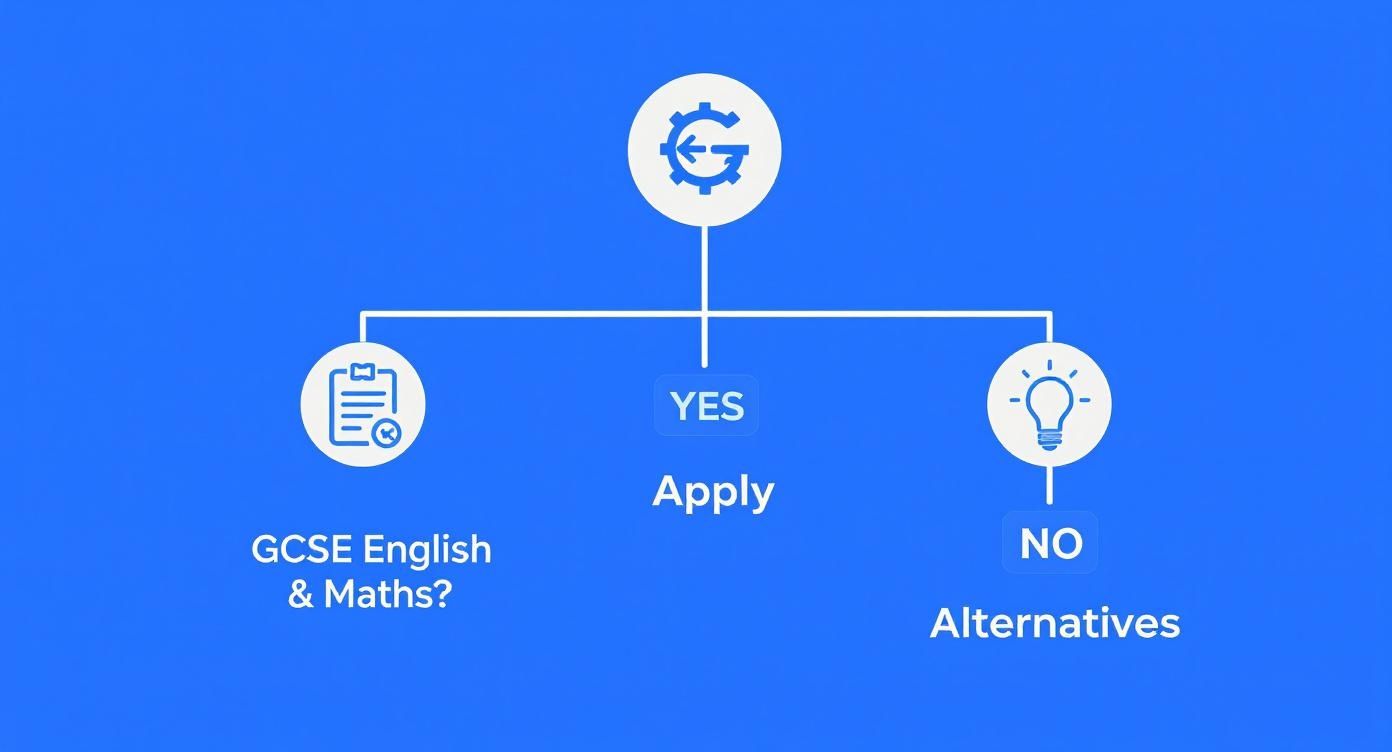
As the infographic shows, before you even think about how you’ll study, making sure you have the basics like GCSEs covered is the first hurdle.
The Structure of On-Campus Study
On the flip side, some people just learn better in a traditional classroom. Studying on campus gives you a set timetable and a structured environment, which can be a huge help for staying focused and on task.
One of the best things about it is the direct, face-to-face time with tutors and classmates. Being able to ask a question the moment it pops into your head or bounce ideas off others in a group discussion creates a really supportive and collaborative atmosphere. You also get the bonus of campus facilities like libraries, quiet study areas, and computer suites.
The choice between online and on-campus study isn't about which is 'better' in general, but which is better for you. It’s a balance between the convenience and autonomy of online learning and the community and structure of a physical campus.
Making the Right Choice for You
Still weighing it up? Ask yourself these questions:
- How disciplined are you? Be honest. Can you motivate yourself to study without a teacher setting a schedule for you?
- What are your commitments? If you have a full-time job or young children, the adaptability of an online course could be a game-changer.
- How do you learn best? Do you enjoy working through things on your own, or do you thrive on group chats and instant feedback?
- What resources do you need? Do you have a good laptop and reliable internet at home, or would you rather use the facilities at a college?
At the end of the day, both paths are designed to give you the knowledge and skills you need to get into university and start your nursing degree. By thinking carefully about these points, you can confidently pick the route that will best support you on your journey to becoming a nurse.
How to Fund Your Access to Nursing Course
Let's be honest: figuring out the finances for a course can feel overwhelming. But money worries should never be the thing that stands between you and a fulfilling career in nursing. Thankfully, there are clear, supportive funding routes designed specifically for adult learners taking an access nursing course, so your main focus can be on your studies.
The most popular and helpful option by far is the Advanced Learner Loan. This is a government-funded loan that covers the entire cost of your course fees. That means you don't have to pay a single penny upfront to get started on your new career path.
The Advanced Learner Loan Explained
It helps to think of the Advanced Learner Loan not just as a loan, but as an investment—in you, your future, and the future of the NHS. It's available to anyone aged 19 or over who is studying for a Level 3 qualification, like the Access to HE Diploma. Applying is refreshingly straightforward and isn't based on your household income or your credit history.
The repayments are designed to be completely manageable. You only start paying it back once you've finished your course and are earning over a certain threshold, which is currently £25,000 a year. The repayments are then taken automatically from your salary, typically at 9% of whatever you earn above that amount.
Now for the best part: If you use an Advanced Learner Loan to fund your Access to HE Diploma, Student Finance England will completely write off your outstanding balance once you go on to complete a higher education course, like your nursing degree.
This is a game-changer. It effectively makes your Access course free, as long as you successfully progress to university. It's a powerful incentive created to encourage more skilled and dedicated people just like you to enter vital professions like nursing. Our detailed guide offers even more information on Access to Higher Education funding options to help you understand all the specifics.
Other Financial Support and Future Funding
While the Advanced Learner Loan is the main route for most students, a few other options exist. Some providers offer flexible, interest-free payment plans, allowing you to spread the cost over several months. It's always worth asking your chosen course provider what kind of support they can offer.
And looking ahead to your university degree, the financial support continues. Once you’re enrolled on your nursing degree, you'll be eligible to apply for:
- Student Loans: To cover your university tuition fees and living costs.
- NHS Learning Support Fund: This provides at least £5,000 per academic year as a non-repayable training grant to help with your studies.
For a broader look at funding, including grants and scholarships, you can review resources on financial aid for CNA classes, as many of the principles apply across healthcare education. By planning your finances from the start, you can map out a clear and stress-free journey from your Access course all the way to becoming a qualified nurse.
Your Questions, Answered
Deciding to start a new course is a big step, and it’s natural to have a few questions swirling around. Let’s tackle some of the most common ones we hear about the Access to Nursing course, so you can move forward with confidence.
Is an Access to Nursing Course a Recognised Qualification?
Yes, it absolutely is. The Access to Higher Education Diploma is a nationally recognised Level 3 qualification, which is regulated by the Quality Assurance Agency for Higher Education (QAA).
UK universities widely accept it as a standard way into a nursing degree, especially for adult learners who don’t have A-levels. Just make sure your chosen provider offers a QAA-validated diploma – that’s your guarantee of quality.
How Long Does the Course Take to Complete?
This really comes down to how you choose to study. If you go the traditional route and enrol at a physical college full-time, you'll likely follow the academic year, which takes about nine months.
But the real beauty of an online access nursing course is the flexibility. Most online providers let you work at a pace that suits you. That means you could power through it in as little as nine months or take your time and spread it over two years. It's perfectly designed for fitting learning around work, family, and everything else life throws at you.
Do I Need Healthcare Work Experience to Apply?
While it’s not always a strict requirement to get onto the Access course itself, getting some experience in a health or social care setting is highly recommended. This could be paid work or even a volunteer position.
Think of it this way: having some real-world experience, even just for a few hours a week, shows your commitment. It proves you understand the day-to-day realities of nursing and will make your application for university stand out for all the right reasons.
This kind of practical insight tells admissions tutors that you’ve done your homework and are making a thoughtful career choice. It will strengthen not only your Access course application but, crucially, your future UCAS application for your nursing degree.
How Are Access to HE Diplomas Graded for University?
This is where things are a little different from A-levels. Access to HE Diplomas aren't graded using UCAS points. Instead, universities will make you an offer based on the number of credits you earn at certain grades.
The whole diploma is made up of 60 credits. A typical offer for a nursing degree from a university will look something like this:
- Pass the Access to HE Diploma.
- Achieve 45 credits at Level 3.
- Of those 45 credits, a set number must be at Merit and Distinction grades (for example, "30 credits at Distinction and 15 at Merit").
It’s so important to look up the specific entry requirements for the nursing degrees at the universities you’re interested in. The grade profile they ask for can vary, and knowing your target from day one helps you stay focused on what you need to achieve.
Ready to take that next step towards the career you’ve always wanted? At Access Courses Online, we provide fully accredited, flexible online courses designed to fit around your life. Start your nursing journey with us today!