
An Access to HE Diploma is a nationally recognised Level 3 qualification, but it’s so much more than that. It's specifically designed for adults who are ready for a change and want to return to education. Think of it as your key to unlocking university-level study, especially if you don't have traditional qualifications like A-levels.
Your Bridge to University Education
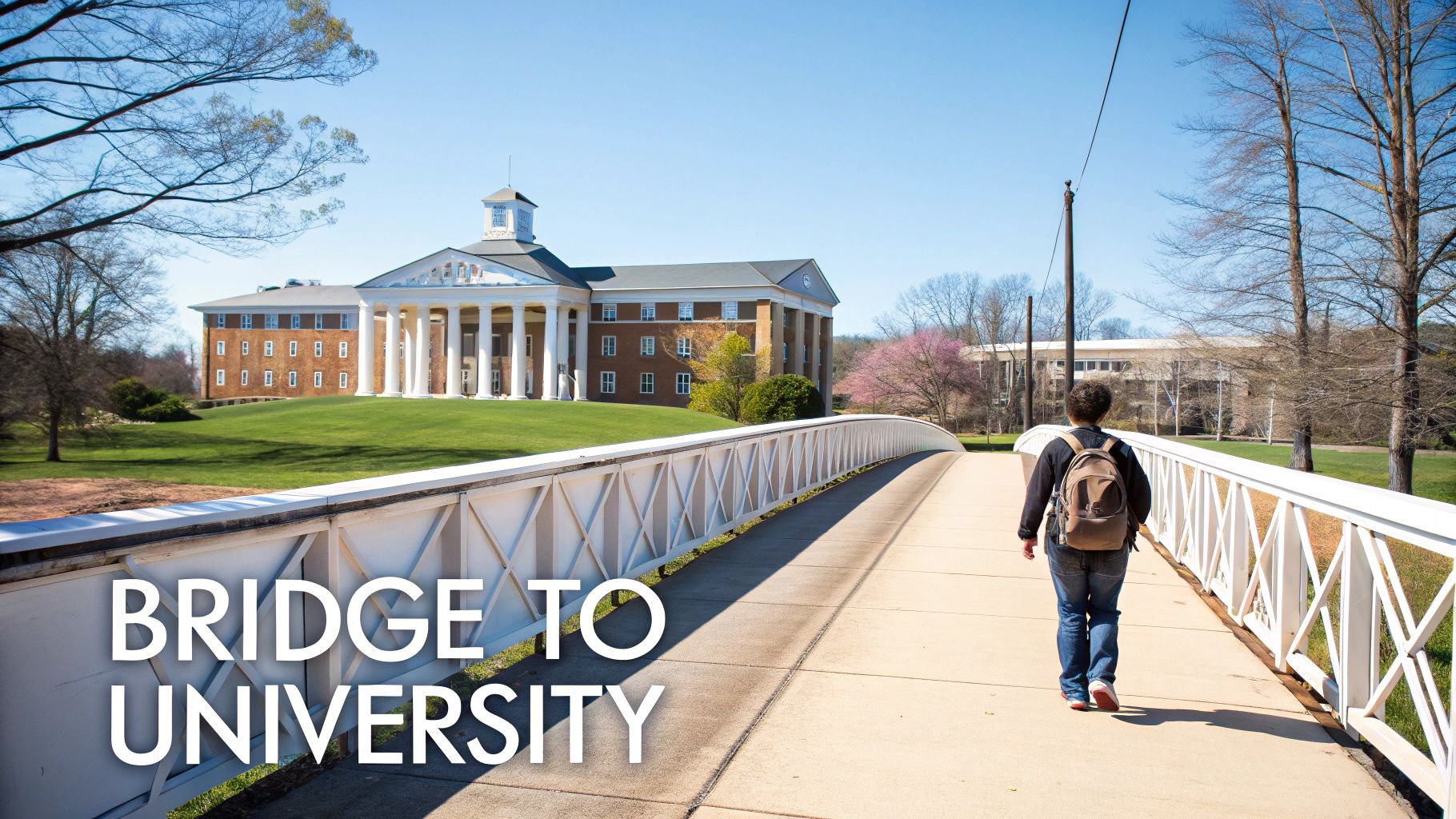
The best way to picture an Access to HE Diploma is as a purpose-built bridge. It connects your current life experience directly to the university course you've been dreaming of. It offers a focused, efficient route for adult learners, completely bypassing the need for A-levels and giving you a well-deserved second chance at higher education.
This isn't just about getting a certificate. It’s a properly structured programme designed to build both your subject-specific knowledge and the crucial academic skills you’ll need to thrive at university. And it works. Every year, around 20,000 students successfully finish their diplomas and move on to degrees, proving just how effective this pathway is.
What Makes the Diploma a Trusted Qualification?
So, why do universities across the UK not only accept but actively welcome students with this diploma? It all comes down to its credibility. The academic rigour of these courses isn't an accident; every single one is carefully regulated to meet the highest standards.
- QAA Regulation: The diploma is regulated by the Quality Assurance Agency for Higher Education (QAA). This is the very same independent body that monitors standards at UK universities, which means your diploma is a robust and respected qualification.
- University Recognition: Universities don't just recognise the diploma; they genuinely value the skills, maturity, and life experience that Access students bring to the table. In fact, the curriculum is often designed with universities to make sure it perfectly aligns with the demands of a degree.
- UCAS Tariff Points: Just like A-levels, a completed Access to HE Diploma carries UCAS tariff points, which are a non-negotiable part of your university application. This officially cements its status as a powerful and legitimate alternative for getting into uni.
The Access to HE Diploma is so important because without it, so many people might never get the opportunities it can present. There is no other route for adult learners to progress into higher education that is structured, funded, and delivered in this way.
More Than Just Academic Knowledge
One of the biggest strengths of an Access to HE Diploma is its focus on preparing you for the reality of academic life. Lots of adult learners worry about stepping back into a classroom after years away, but the course is designed to make that transition as smooth as possible.
You'll develop critical skills that are often just assumed in other qualifications. These are the practical tools you'll use every single day at university.
You’ll learn things like:
- Academic Writing: How to structure brilliant essays, build a solid argument, and write with real clarity.
- Research Skills: Finding, evaluating, and properly citing credible academic sources.
- Critical Thinking: Analysing information, questioning assumptions, and forming your own well-supported conclusions.
- Time Management: Juggling assignments and deadlines—an absolutely essential skill for independent study.
This all-around approach means you don't just scrape into university; you arrive confident, fully prepared, and ready to succeed from day one.
Who Is This Diploma Designed For?
One of the best things about the Access to HE Diploma is just how flexible it is. It hasn't been created for one specific type of person but for a whole range of people who all share the same goal: unlocking their potential and getting to university. There’s absolutely no upper age limit, and it doesn't matter how you did in school the first time around.
This diploma is for anyone who feels that the traditional route, like A-levels, just wasn’t the right fit for them at the time. You might be one of the thousands of adults who are now fired up and ready to tackle a university degree but need a clear, supportive path to get there.
The Career Changer
Maybe you've spent years climbing the ladder in a certain industry only to realise it's not making you happy anymore. You could be dreaming of a more fulfilling profession—like nursing, social work, or law—but feel stuck because you don't have the right qualifications. The Access to HE Diploma is the key to opening that door.
Many of our students use the diploma as a launchpad into a completely new field. If you're thinking about a fresh start, it’s worth understanding how to pivot careers and find your dream job. This qualification gives you the precise subject knowledge and academic skills needed to apply for a degree in a totally different area.
The Parent Returning to Education
It's a familiar story: you've dedicated years to raising your family, and now that the kids are a bit older and more independent, you finally have the time and energy to focus on your own goals.
The thought of returning to study after a long break can feel pretty daunting, but the diploma is designed to ease you back into learning. Its flexible format, especially with online study, means you can easily fit your coursework around family life. It’s a practical and popular choice for busy parents.
The Second-Chance Achiever
Life happens. For so many reasons, lots of people don't hit their academic stride during their school years. Personal circumstances get in the way, or maybe the motivation just wasn't there back then. The Access to HE Diploma is built on the belief that your past doesn't define your future.
This qualification is perfect for anyone who now has the maturity and drive to succeed. It focuses on your commitment today, not on exam results from ten years ago. It offers a genuine second chance to prove what you're capable of and chase the degree you've always wanted.
The course is specifically designed to tackle the common anxieties adult learners face. It supports your unique journey back into education and gets you fully prepared for university, building your confidence right alongside your knowledge.
Unfortunately, educational outcomes in the UK can often depend on your background. Data shows that mature students (over 21) and those from less privileged areas have historically faced more hurdles in completing university courses. An Access to HE Diploma is a vital tool for bridging these gaps, offering targeted support to help learners from all walks of life succeed.
Ultimately, this diploma is for anyone who is:
- Motivated to learn and fully committed to the goal of getting to university.
- Looking for a career change and needs a new set of qualifications to get into a different industry.
- Returning to education after a break and wants a supportive and structured pathway.
- Ready to build essential academic skills for degree-level success—like critical thinking, research, and essay writing—not just subject knowledge.
Exploring Subject Pathways and Career Opportunities
Think of an Access to HE Diploma as a specific key designed for a particular door. Each subject pathway isn't just about racking up academic credits; it's meticulously designed to get you ready for the unique demands of a university degree and the career you want to build. It’s all about creating a straight, logical path from where you are now to where you see yourself professionally.
This focused approach means you can line up your diploma with your biggest career goals. Whether you dream of working in a hospital, a courtroom, a laboratory, or a design studio, there's a specialised pathway built to take you there. Suddenly, the big, abstract idea of "going to university" feels like a solid, achievable plan.
Pathways into Healthcare and Science
For so many adult learners, the end goal is a career in a caring or scientific profession. These fields are incredibly rewarding, but you need very specific qualifications to even get your foot in the door. The Access to HE Diploma provides that perfect foundation.
Popular pathways in this area include:
- Health and Social Care: This is one of the most common routes, leading you straight into degrees in Nursing, Midwifery, Paramedic Science, Occupational Therapy, and Social Work. You’ll be studying modules in human biology, psychology, and sociology, which gives you the ideal knowledge base to hit the ground running.
- Science: If you’re fascinated by research and discovery, this pathway opens doors to degrees in Biomedical Science, Pharmacy, Forensic Science, or Marine Biology. The curriculum is tough and focuses on the core sciences to make absolutely sure you're ready for a demanding degree.
Unlocking Careers in Social Sciences and Humanities
If your passion lies in understanding people, society, or culture, the social science and humanities pathways offer a rich and varied route to university. These diplomas are fantastic for building the critical thinking and analytical skills that are non-negotiable for success in these fields.
For instance, a Social Science diploma often includes modules in Psychology, Criminology, and Sociology, setting you up for degrees in those exact subjects or related fields like Social Policy.
Likewise, the Humanities pathway can lead to degrees in English, Creative Writing, or History. And don't let anyone tell you these subjects aren't in demand. Recent data shows a huge rise in students pursuing history qualifications. Between 2018 and 2024, GCSE history enrolments shot up by 25%, and graduate outcomes are looking great, with many finding sustained employment and earning competitive salaries after their degree. You can explore more about the value of history qualifications and see the full data.
The great thing about the Access to HE Diploma is how effectively it supports students from all backgrounds. Just look at the completion rates.
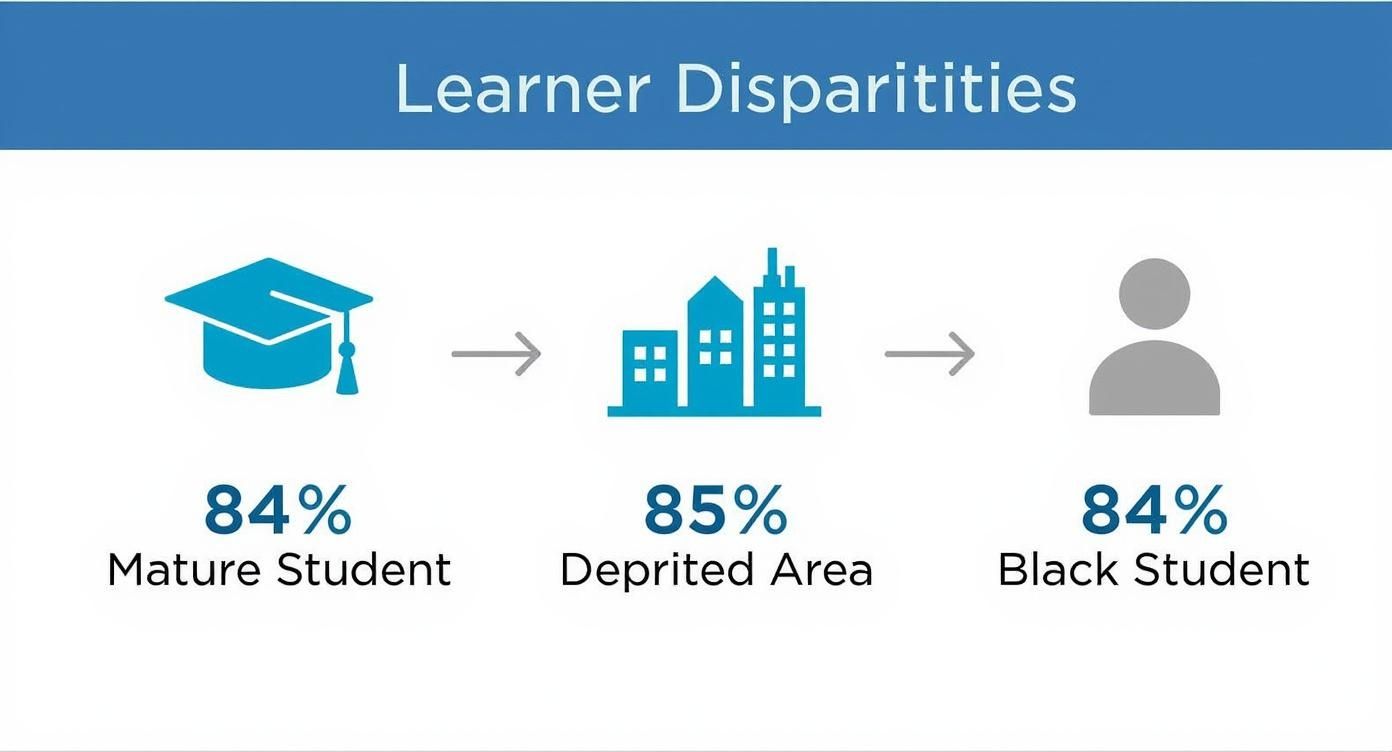
These numbers really drive home how well the diploma helps learners who might otherwise face barriers getting into higher education.
Building a Future in Business and Law
For those with a strategic mind and an ambition to work in the corporate or legal world, there are dedicated diplomas that give you a solid commercial and legal grounding.
The Access to HE Diploma is your opportunity to specialise early. Unlike broader qualifications, it allows you to immerse yourself in the subject you love from day one, proving to universities that you are passionate and committed.
A Business and Law diploma is the perfect launchpad for a whole range of professional degrees.
- Degrees it leads to: You could go on to study Law (LLB), Business Management, Marketing, Accounting and Finance, or Human Resource Management.
- Potential careers: After your degree, you could become a solicitor, marketing manager, financial analyst, or business consultant.
To give you a clearer picture, here’s how some of the most popular pathways connect to university courses and future careers.
Common Access to HE Pathways and University Degrees
| Access to HE Pathway | Example University Degrees | Potential Career Fields |
|---|---|---|
| Health & Social Care | Nursing, Midwifery, Paramedic Science, Social Work | Healthcare, Emergency Services, Social Care |
| Science | Biomedical Science, Pharmacy, Forensic Science | Laboratory Research, Pharmaceuticals, Forensics |
| Social Science | Psychology, Criminology, Sociology, Social Policy | Counselling, Criminal Justice, Public Policy |
| Humanities | English Literature, History, Creative Writing, Philosophy | Publishing, Museums, Education, Journalism |
| Business & Law | Law (LLB), Business Management, Marketing, Finance | Legal Practice, Corporate Management, Marketing |
| Education | Primary Education (QTS), Early Childhood Studies | Teaching, Educational Psychology, Curriculum Design |
| Computing & IT | Computer Science, Software Engineering, Cyber Security | IT Support, Software Development, Network Security |
These are just a few examples, of course. The key takeaway is that each diploma is a stepping stone to a specific set of degree options.
Ultimately, the power of an Access to HE Diploma lies in its focused design. When you choose the right pathway, you're not just earning another qualification—you're taking the first deliberate step on a clear, structured journey toward the career you’ve always wanted.
Getting Started: Entry Requirements and Study Options
One of the biggest myths holding people back from returning to education is the idea that you need a string of top-grade A-levels from your school days. The truth is, while an Access to HE Diploma is a serious academic qualification, its entry requirements are built for adult learners. The focus is on your potential now, not your exam results from years ago.
This whole approach is designed to make university a realistic goal for everyone. Instead of digging up old certificates, colleges look at your readiness to learn today. They know that life experience counts for a lot—often more than qualifications you earned as a teenager—and it’s a brilliant indicator of how well you’ll do.
What Qualifications Do I Actually Need?
While your commitment is the main thing, there are a couple of basics you’ll likely need to have in place. Most universities have set requirements for their degree courses, so Access to HE providers need to make sure you’re on track to meet them.
Typically, this means you’ll need:
- GCSEs in English and Maths at grade C/4 or higher.
- Equivalent qualifications, like Functional Skills Level 2, are also accepted by most places.
If you don’t have these yet, please don’t let it stop you. It’s a common situation! Many colleges offer GCSE or Functional Skills courses you can take before, or even alongside, your Access to HE Diploma. They’ll help you get everything sorted so you're ready to progress.
The most important entry requirements aren't written on a certificate. Colleges want to see your passion for the subject, a real commitment to your studies, and the maturity that comes from life experience.
Your admissions interview is where you can really show them what you’re made of. Get ready to talk about why you’ve chosen this subject, what your career ambitions are, and how you’ll manage your time. This is what truly shows the dedication that both colleges and universities are looking for.
Finding a Study Mode That Fits Your Life
Flexibility is at the heart of the Access to HE Diploma. Tutors and colleges know that adult learners are often spinning a lot of plates—work, family, and everything in between. That’s why you can choose a study option that fits into your life, rather than one that forces you to put everything on hold.
Each way of studying has its own benefits, so you can pick the one that works best for your schedule and how you like to learn.
Full-Time Study
This is the fast track to university, usually taking one academic year (about nine months) to complete. It’s pretty intensive, often meaning you’ll be in a physical college two or three days a week, with plenty of independent study on top. It’s the perfect choice if you can dedicate a big chunk of your time to learning and want to get your degree started as soon as possible.
Part-Time Study
For anyone trying to fit their studies around a job or childcare, the part-time route is a lifesaver. The course is spread over two years, which makes the weekly workload feel much more relaxed and manageable. It’s a great way to absorb everything properly without feeling rushed or overwhelmed.
Online Distance Learning
This is the ultimate flexible option. With providers like Access Courses Online, you can study from absolutely anywhere and set your own timetable. Online learning is ideal for self-starters who need to fit their education around shift work, family commitments, or an unpredictable schedule. You get the exact same quality of teaching and tutor support, but with the freedom to learn on your terms.
Funding Your Studies and Financial Support

Let's talk about one of the biggest questions on any adult learner's mind: the cost. The great news is that an Access to HE Diploma is designed to be a genuinely affordable investment in your future, and there are excellent financial support systems in place to make it happen.
The most common way to fund your studies is with the Advanced Learner Loan. This is a government-backed loan created specifically for learners aged 19 and over who are studying approved Level 3 qualifications, like this one. It covers your tuition fees entirely, meaning you don’t have to pay a penny upfront to get started.
The Advanced Learner Loan Explained
Think of the Advanced Learner Loan not just as a loan, but as the key that unlocks the door to your university ambitions. It's refreshingly straightforward to apply for, isn't based on your income, and your credit history doesn't come into it. Better yet, you only start paying it back once you’ve finished your course and are earning above a certain amount.
But here’s where it gets really interesting for Access to HE students.
If you take out an Advanced Learner Loan to pay for your Access to HE Diploma and then go on to complete a higher education course (like a university degree), Student Finance England will write off your outstanding loan balance completely.
That’s a huge incentive. It effectively means that for thousands of students, the Access to HE Diploma ends up being completely free. The government offers this to encourage adults just like you to progress to university, making it a risk-free financial stepping stone towards your degree. For a deeper dive, check out our complete guide on Access to Higher Education funding.
Other Financial Support Options
While the Advanced Learner Loan is the main route for most, it isn't the only support out there. Many learners can get extra help to cover other study-related costs like childcare, travel, and equipment.
Here are a few other places to look for financial support:
- Bursaries and Scholarships: It’s always worth checking if your chosen college or provider offers their own bursaries. These are often based on financial need or academic merit and don't need to be paid back.
- Hardship Funds: These are special funds that colleges can use to help students who run into unexpected financial trouble that might stop them from finishing their course.
- Grants and Allowances: Depending on your personal circumstances, you might be eligible for other non-repayable grants, such as support for childcare or extra help for learners with disabilities.
Deciding to invest in your education is a big step, but the UK's higher education system is built to help you succeed. With around 2.28 million students enrolled in UK higher education each year, the structures are firmly in place to help people from all backgrounds get the qualifications they need.
By using the Advanced Learner Loan and looking into other support options, you can take financial stress out of the picture. This leaves you free to focus on what really matters: your studies and taking this life-changing step with total confidence.
Your Next Steps From Diploma to Degree
Finishing your **Access to HE Diploma** is a massive achievement, but it’s also the launchpad for the next exciting chapter of your life. The skills, confidence, and knowledge you’ve worked so hard to gain have fully prepared you to make the leap to university.This is the moment where that long-held dream of getting a degree transforms into a real, achievable plan. Your hard work is about to open doors to the career you've been aiming for.
Plenty of students who complete their diploma go on to absolutely thrive at university. Take Emma Scully, for instance. After a career-ending injury, she used her Art and Design diploma to retrain. She didn't have the UCAS points for a textiles degree at first, but the diploma gave her exactly the skills she needed to get her place and chase her new passion.
Her story isn't unique. Every year, thousands of adult learners just like you use this very qualification to bridge the gap to higher education. It just goes to show that with the right pathway, anything is possible.
Making Your University Application Stand Out
When you get to your UCAS application, your Access to HE Diploma and your life experience are your biggest strengths. Honestly, universities really value the maturity, dedication, and real-world perspective that adult learners bring to the lecture hall.
Your personal statement is the perfect place to let this shine. Don't just list what you’ve learned; tell your story. Talk about what drove you to return to education and how your life experiences connect to the subject you're so passionate about. This personal narrative is incredibly powerful and helps you stand out from the crowd of applicants coming straight from A-levels. Our guide on how to apply to university after an Access course has more great tips for crafting an application that gets noticed.
Universities don't see the Access to HE Diploma as a lesser alternative to A-levels. They view it as a robust, dedicated qualification specifically designed to prepare adults for the rigours of degree-level study.
How Universities View Your Diploma
One of the biggest worries students have is how their diploma will be seen by universities. The good news is that the Access to HE Diploma is a nationally recognised qualification, and it's regulated by the Quality Assurance Agency (QAA)—the same body that monitors university standards.
This means universities trust that you’re coming in with the essential skills needed for success, including:
- Critical thinking and analysis
- Independent research and referencing
- Academic writing and structuring arguments
- Effective time management and self-discipline
As you prepare your applications, creating a portfolio can be a fantastic way to show off your work and skills. It’s well worth the time to learn how to build a winning student portfolio that really makes an impression.
Ultimately, your diploma signals to admissions tutors that you are not just academically capable but also highly motivated and ready to commit. You’ve already proven you can handle an intensive learning environment, which makes you an ideal candidate for any degree programme. The path is clear, and your future is waiting.
Your Questions, Answered
Thinking about jumping back into education can bring up a lot of questions. It’s a big step! So, let's clear up some of the most common queries we get about the Access to HE Diploma, helping you feel confident about the path ahead.
Is This Diploma the Same as A-Levels?
We hear this one all the time, and it’s a great question. While both an Access to HE Diploma and A-levels are Level 3 qualifications that get you the UCAS points you need for university, they’re really built for different people at different stages of life.
A-levels are what 16-18 year olds typically study over two years, covering a few different subjects. The Access to HE Diploma, on the other hand, is an intensive, one-year course designed specifically for adults who are ready to get back into learning. It’s laser-focused on getting you ready for a degree, with a huge emphasis on the practical academic skills you'll need—like writing essays, doing proper research, and thinking critically.
Universities really value the diploma. It shows them you have the maturity, drive, and specific skills to hit the ground running and succeed in higher education, especially after time away from a classroom. It’s not just an equivalent; it’s a purpose-built pathway for people just like you.
Can I Get a Job with Just This Diploma?
The main goal of an Access to HE Diploma is to get you into university, but finishing the course itself is a massive achievement that employers will definitely notice. It proves you have a high level of academic skill, commitment, and solid knowledge in your chosen field.
That said, it’s best to think of the diploma as a key, not the final destination. The real career-changing power comes after you’ve completed the university degree it opens the door to. It’s the stepping stone that leads you to those graduate-level jobs you’ve been dreaming of.
What Support Is Available for Students?
Deciding to return to education is a big deal, but you’re absolutely not on your own. We, and other providers, understand the unique challenges adult learners face and have brilliant support systems in place to help you every step of the way.
You’ll find there’s a whole network of support ready to cheer you on, including:
- Personal Tutors: You'll have a dedicated tutor to guide you, offer one-to-one feedback, and give you that bit of encouragement when you need it most.
- Study Skills Workshops: Many places run extra sessions on the essentials, like academic writing, referencing, research skills, and how to manage your time effectively.
- Pastoral Support: You'll have access to teams who can help with everything from managing your workload to navigating personal issues that might pop up during your studies.
- University Application Guidance: You’ll get expert help with the whole UCAS process, from picking the right degree to crafting a personal statement that truly stands out.
This support network is designed to make sure you have everything you need to not only finish your diploma but to walk onto your university campus feeling prepared and confident.
Ready to take the next step towards your dream career? At Access Courses Online, we provide accredited, fully online diplomas that fit around your life. Discover your perfect course today and start your journey to university.