
So, you're dreaming of becoming a midwife but don't have the A-Levels to get into university? Don't worry, that door isn't closed. The Access to HE (Midwifery) Diploma is the key you need. It’s a nationally recognised qualification designed specifically for adults returning to education, giving you the exact knowledge and academic skills that universities are looking for.
Your Pathway to a Rewarding Midwifery Career
For many aspiring midwives, the thought of changing careers can feel like you’re standing in front of a locked door. You have the passion and the drive, but you're missing the traditional keys—in this case, A-Levels—that universities usually ask for.
This is where the Access to HE (Midwifery) diploma shines. It’s a purpose-built key designed to unlock that door for you.
Think of it as an intensive, focused prep course that bridges the gap between your life experience and the demands of a university degree. It completely bypasses the need for A-Levels by providing an equivalent, university-recognised qualification. Best of all, you can complete it in just one year, or sometimes even faster.
This diploma isn't just about hitting the books; it's about building your confidence and proving you’re ready to step into one of the most trusted professions there is.
This visual shows exactly how the diploma acts as that crucial link between your career goals and getting your university place.
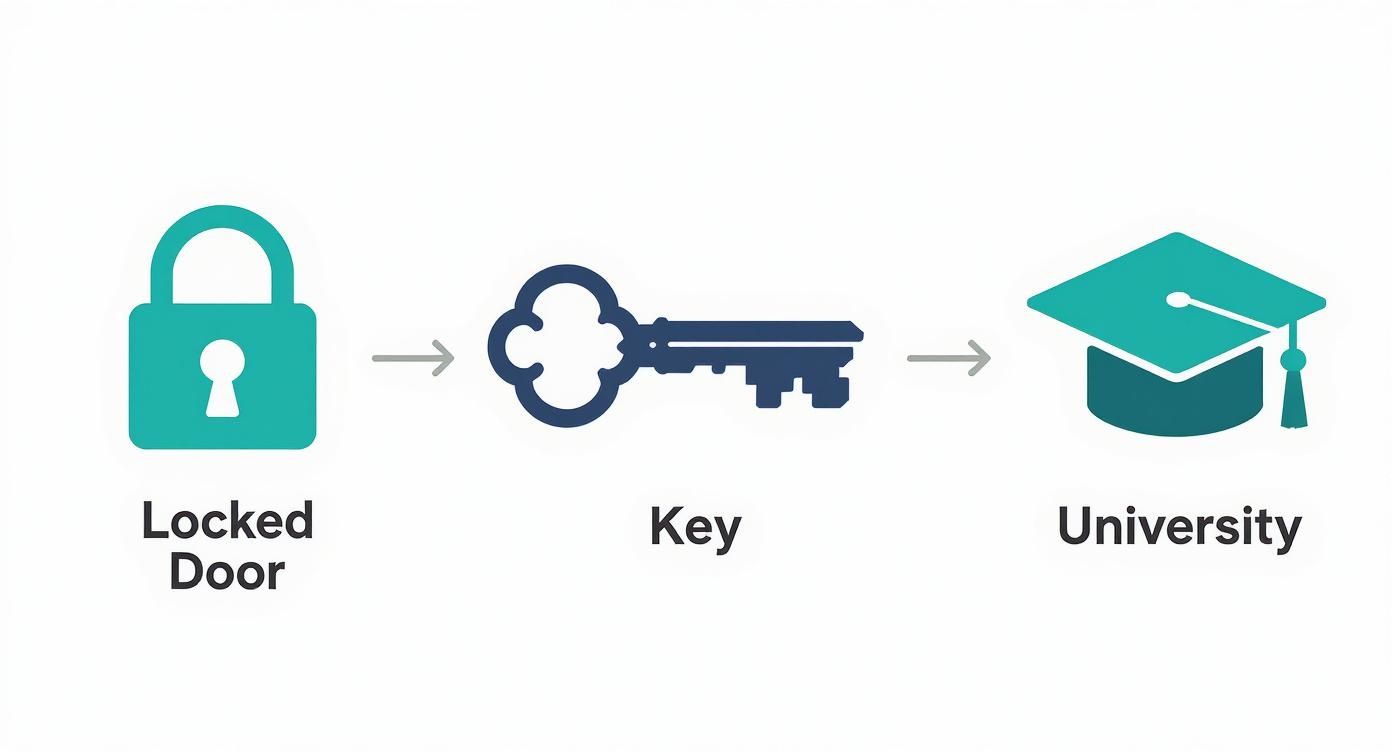
As you can see, the diploma is the essential tool that helps you overcome those entry barriers and progress straight into higher education.
Planning Your Journey to Success
Embarking on this path requires a bit of organisation. To really map out your journey from the Access to HE Diploma to your first day as a student midwife, using a personal development plan template can be a game-changer. It gives you a clear, structured way to set your goals, track your progress, and make sure you tick all the boxes. That kind of strategic mindset is vital, especially when you're balancing your studies with other life commitments.
The Access to HE Diploma is your formal, accepted route into a profession that is not just a job, but a calling. It acknowledges your life experience and channels your motivation into the qualifications universities are looking for.
This guide will walk you through every step of the process. We'll cover everything from the course content to navigating your university applications, making sure you feel prepared and empowered to start your journey.
What Exactly Is the Access to HE Midwifery Diploma?
So, you're thinking about midwifery but don't have the usual A-Levels to get into university. Where do you go from here? Let's break down what the Access to HE Midwifery Diploma is all about, because it might just be the perfect route for you.
Simply put, the Access to HE Midwifery diploma is a Level 3 qualification, which puts it on the same academic footing as A-Levels. It’s been specifically created for adults who are ready to pursue a midwifery degree at university but need a recognised qualification to get their foot in the door.
Think of it as a dedicated 'university prep' programme, built from the ground up to bridge the gap between where you are now and the demands of a degree. It's not just some random course; it's a nationally respected pathway into higher education.
Because it’s regulated by the Quality Assurance Agency for Higher Education (QAA), universities across the UK trust it. They see it as a solid sign that a student is ready for university-level study, which is exactly what you need when applying for a competitive course like midwifery.
Bridging the Gap to University Study
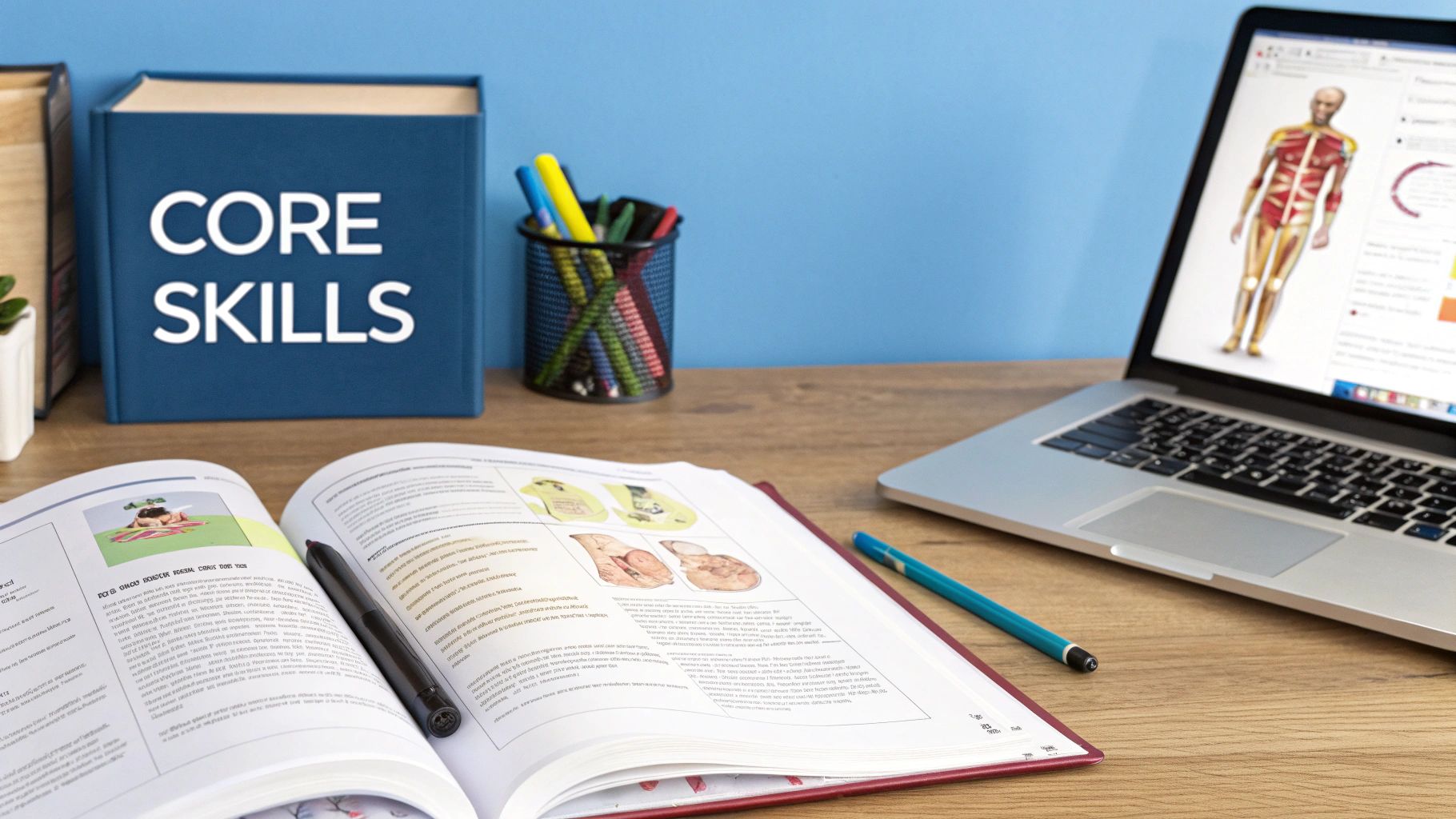
The diploma's real magic lies in its two-pronged approach. First, it dives deep into the core subjects you’ll need for your midwifery degree. Second, it equips you with the essential academic skills that are crucial for surviving—and thriving—at university.
This means you’re not just memorising facts; you’re learning how to learn at a higher level. This is a massive advantage that even students with A-Levels don’t always have, as they often have to figure out things like academic writing and research on their own.
The main subject areas you can expect to cover include:
- Human Biology: This will get you up to speed on the fundamentals of anatomy, physiology, and human reproduction.
- Psychology: You'll explore the mental and emotional journey of pregnancy, birth, and postnatal care.
- Health Studies: This module gives you the bigger picture, covering things like professional standards, patient communication, and the structure of healthcare.
By weaving together subject-specific knowledge with vital skills like essay writing, research, and critical thinking, the diploma ensures you're not just ready to get in to university, but to excel once you start.
To give you a clearer snapshot, here’s a quick overview of what the diploma offers.
Access to HE Diploma at a Glance
| Feature | Description |
|---|---|
| Qualification Level | Level 3, equivalent to A-Levels. |
| Target Audience | Adults (19+) aiming for university without traditional qualifications. |
| Regulation | Regulated by the QAA, ensuring quality and university recognition. |
| Focus | A dual focus on core midwifery subjects and academic study skills. |
| Assessment | Coursework and assignments, not final exams. |
| Credits | 60 credits total; 45 graded (Pass, Merit, Distinction), 15 ungraded. |
| UCAS Points | Graded credits are converted into UCAS points for university applications. |
This structure is designed to build your confidence and knowledge steadily, preparing you fully for the next step.
How Is the Diploma Assessed?
One of the best things about the Access to HE Diploma is that there are no big, scary final exams. Instead, your progress is tracked through a series of assignments spread throughout the course. This approach allows you to build your skills gradually and get continuous feedback from your tutors, taking a lot of the pressure off.
The entire course is credit-based. To earn the diploma, you need to rack up 60 credits. Of these, 45 are graded (Pass, Merit, or Distinction) and cover the academic subjects, while the other 15 are ungraded and focus on your study skills.
When you apply to university, they'll make you an offer based on the number of credits you achieve at Merit or Distinction. These grades are then converted into UCAS tariff points, giving universities a really clear picture of your academic capability.
Understanding University and Professional Requirements
Getting your Access to HE Midwifery diploma in the bag is a huge achievement, but it’s the first big step, not the last. Think of your diploma as the key that unlocks the door to a midwifery degree; now you need to understand what universities and professional bodies require to let you walk through it.
Universities see your Access to HE diploma credits as the equivalent of A-Levels, converting them into UCAS tariff points. Each university will have its own specific offer, usually asking for a certain number of your credits to be at Merit or Distinction.
The Academic Foundations
Aside from the diploma itself, there are some non-negotiable academic building blocks pretty much every UK university will ask for. We’re talking about your GCSEs.
- English: You’ll need a grade 4/C or above. This is vital for communicating clearly, writing accurate patient notes, and getting your head around complex medical texts.
- Maths: A grade 4/C or above is essential for things like drug calculations, reading charts, and managing clinical measurements.
- Science: Many universities also want to see a GCSE in Science (often Biology) at grade 4/C or higher. This gives you that fundamental grasp of human physiology.
If you’re looking at that list and feeling a bit worried, don’t be. If you don’t have these GCSEs, you can study for them while you complete your Access to HE course. Widely accepted equivalents like Functional Skills Level 2 qualifications are a great option.
It’s absolutely critical to check the specific entry requirements for every single university you’re interested in. While the core needs are similar, one might have slightly different grade expectations than another.
Professional Standards and Checks
Becoming a midwife means stepping into a role of immense trust and responsibility. Because of this, you’ll need to meet some strict professional standards before you can be accepted onto a degree programme and start your placements.
These checks aren't just bits of admin; they’re in place to protect the public and make sure you’re fit to practise safely and ethically.
Disclosure and Barring Service (DBS) Check
This is a mandatory criminal record check. You’ll need an enhanced DBS check to confirm you’re suitable to work with vulnerable adults and children. The university will review any cautions or convictions to assess your suitability for the profession.
Occupational Health Screening
You'll also go through a health assessment. This isn’t about being in perfect health, but about making sure you can handle the physical and mental demands of the course and the job. It's a measure to protect both you and your future patients.
Why Relevant Experience Matters
While it might not always be listed as a formal requirement, getting some relevant experience is one of the most powerful things you can do for your application. It shows universities you’re truly committed and have a realistic idea of what the role involves.
They want to see that you’ve explored what being a midwife is really like, beyond the dramas you see on TV. This kind of experience helps you explain why you want to pursue such a demanding career.
You could consider things like:
- Volunteering: Roles at a local children’s centre, a breastfeeding support group, or with a charity like St John Ambulance can be fantastic.
- Paid Work: A job as a Healthcare Assistant (HCA) or Maternity Support Worker gives you direct, invaluable insight into a clinical environment.
This hands-on experience proves you have the resilience, empathy, and dedication needed to succeed, making your university application stand out from the crowd.
Core Subjects and Skills You Will Master
Think of the Access to HE Midwifery diploma as more than just a course; it's your complete toolkit for building a new career. It’s been carefully designed to give you both the deep scientific knowledge and the practical academic skills you need to thrive in a demanding university degree. This isn't about memorising facts for an exam—it's about understanding how every single concept connects back to the real, day-to-day world of a midwife.
The entire curriculum is built around core science subjects that are essential for understanding pregnancy, birth, and postnatal care. You'll dive into Human Biology, getting to grips with anatomy and physiology to understand the incredible processes of conception, foetal development, and labour. This isn't just dry science; it’s the knowledge you’ll rely on every day to monitor the health of a mother and her baby.
Alongside the biology, you'll explore modules in Psychology and Health Studies. These subjects are just as crucial, as they help you understand the profound emotional and social journey that expectant parents go through. You'll learn about compassionate communication, empathy, and professional ethics—all vital skills for providing the person-centred care that is at the heart of modern midwifery.
Building Your Academic Toolkit
Beyond the subject-specific knowledge, a huge part of the access to he midwifery course is getting you ready for the academic demands of university. We know that many adult learners worry about things like writing essays or doing research, especially after years away from a classroom. This diploma is designed to put those fears to rest.
You’ll master these essential academic skills through dedicated modules, including:
- Academic Writing and Referencing: Learn how to build a strong argument, structure a clear essay, and correctly cite your sources. This is a non-negotiable skill at university.
- Research Skills: Get confident finding, evaluating, and using information from credible sources. This is the foundation of evidence-based practice in midwifery.
- Critical Analysis: Learn to go beyond simply repeating information and start analysing it, questioning it, and forming your own well-supported conclusions.
Think of these skills modules as your university survival guide. They are intentionally woven into the course to make sure you don’t just scrape by in your degree—you excel. This preparation is a huge advantage for Access to HE students.
This dual focus on subject knowledge and academic skill means that when you step into your first university lecture, you’ll feel confident and fully prepared for what’s ahead. If you want a real taste of what it's like to study these topics with us, you can explore a sample lesson with our registered midwife, Dana Colborne, which gives you a fantastic insight into our online learning experience. It's these foundational skills that will help you turn your passion for midwifery into a successful and deeply rewarding career.
Finding and Applying for Your Access Course
Okay, so you’ve decided this is the path for you. Taking that first real step from thinking about it to actually doing something can feel like a huge leap, but it’s an exciting one! Now it’s time to find the right access to he midwifery course that fits your life.
The best place to start is with accredited providers. The Quality Assurance Agency for Higher Education (QAA) has an official database where you can check if a course is legitimate – it’s a great way to make sure you’re looking at a properly recognised qualification. You can also check out the websites for your local further education colleges to see what in-person options are available nearby.
Choosing Your Study Method
Once you have a few potential courses lined up, you need to think about how you’ll study. This is a big decision, so be honest with yourself about what will work with your current schedule and commitments.
- Full-time: This is the traditional route, usually done over one academic year at a physical college. It’s intense and structured, which is perfect if you can commit to studying full-time.
- Part-time: Also college-based, this option spreads the course out over two years. It gives you a lot more breathing room to juggle learning with a job or family life.
- Distance Learning: For many adult learners, this is the game-changer. It offers the flexibility to study from home and fit your learning around everything else. If this sounds like a good fit, you can find out more in our guide that explores if you can do an Access to Higher Education course online.
The right study mode is the one that allows you to succeed without putting the rest of your life on hold. Be realistic about your commitments and choose the path that gives you the best chance of completing the diploma successfully.
Mastering the Application and Interview
Once you’ve picked your course, it's time to apply. This usually means filling out an online form and writing a personal statement. Knowing how to craft a compelling personal statement is so important, both for your Access course and later for university. This is your moment to let your passion for midwifery shine through, linking it to any experience you have and showing you understand what the job really involves.
If your application hits the mark, you’ll probably be invited for an interview. The tutors want to see your commitment, resilience, and empathy. Be ready to talk about why you want to be a midwife, what you know about the role, and how you’ll handle the demands of the course. This is your chance to show them you have the dedication it takes for this incredibly rewarding career.
How to Fund Your Studies and Progress to University
The dream of becoming a midwife is a powerful one, but we know that financial worries can feel like a major hurdle. For many adult learners, figuring out the funding is a big piece of the puzzle. Thankfully, there are excellent support systems in place for the Access to HE Midwifery diploma.
The most common route our students take is the Advanced Learner Loan. This is a government-backed loan that covers your course fees entirely, meaning you don’t have to pay a single penny upfront to get started. It isn't means-tested and your credit history isn't a factor in the decision, making it a genuinely accessible option for most people.
The Loan Write-Off Advantage
Now, here’s the best part for anyone serious about becoming a midwife. Once you complete your Access to HE diploma and then go on to finish an approved midwifery degree at university, the government completely writes off your entire Advanced Learner Loan balance.
That’s right – it means your Access to HE diploma essentially becomes free. This fantastic incentive was created to encourage more people to train for vital healthcare roles like midwifery by removing that initial financial barrier.
If your plans change and you don’t end up completing a university degree, you only start repaying the loan once your earnings are over the government's set threshold. For those who prefer to self-fund, many course providers also offer flexible instalment plans to spread the cost. You can get the full breakdown in our complete guide to Access to Higher Education funding options.
Progressing to Your Midwifery Degree
With your funding sorted, the final piece of the puzzle is applying to university. Your diploma is the key qualification that gets your foot in the door, and you'll make your application through the Universities and Colleges Admissions Service (UCAS).
Don't worry, you won't be on your own. Your tutors will be there to support you through the entire UCAS process, helping you write a compelling personal statement that really shows off your passion and commitment.
Universities truly value the maturity and dedication of Access to HE graduates. They know just how rigorous the diploma is and recognise that it prepares you perfectly for degree-level study. This is exactly why our students have such high success rates in getting offers for competitive midwifery degrees, putting you in a brilliant position to take that final, exciting step.
Your Access to HE Midwifery Questions Answered
Embarking on a new career path naturally brings up a lot of questions. It’s a big step! This final section is all about tackling some of the most common queries we hear from aspiring midwives, giving you clear, straightforward answers to help you move forward with real confidence.
Is Work Experience Mandatory Before I Start?
This is a great question. While it’s not always a strict requirement for the Access to HE Midwifery diploma itself, getting some relevant experience is something we strongly recommend. Think of it as your secret weapon. It shows universities your commitment and, just as importantly, gives you a real-world peek into the profession.
Volunteering at a local children’s centre or working as a Healthcare Assistant can make your application shine. It proves you have the empathy, resilience, and firsthand understanding needed for such a demanding yet rewarding role.
How Long Does the Midwifery Diploma Take?
The beauty of the Access to HE diploma is that it’s designed to fit around your life, not the other way around. Most students comfortably complete it within 9 to 12 months, studying at a pace that works for them.
But what if you have more time to dedicate? It's entirely possible to fast-track your studies and finish the course in as little as 6 months. The timeline is completely in your hands.
Is an Online Course as Valuable as an In-Person One?
Absolutely. It’s a common worry, but let’s put it to rest. An online Access to HE diploma is regulated by the very same body (the QAA) as its classroom-based equivalent. That means it’s just as recognised and respected by universities right across the UK.
The key thing to remember is that you're earning the same Level 3 qualification, which is what gets you into university. It’s the quality of the content and the official accreditation that count, not how it’s delivered. This makes it a perfect choice for adult learners juggling other commitments.
What If I Don't Get the Grades I Need?
First of all, don't panic! It’s not like a one-shot exam. The course is based on assignments, which means you get continuous feedback from your tutors as you go. This process is designed to help you improve.
Most providers, including us, offer opportunities to resubmit your work. Your tutors are there to guide you and provide all the support you need to get across the finish line.
Ready to take that exciting next step towards becoming a midwife? At Access Courses Online, we provide accredited, flexible diplomas designed for real life. Start your journey with us today.