

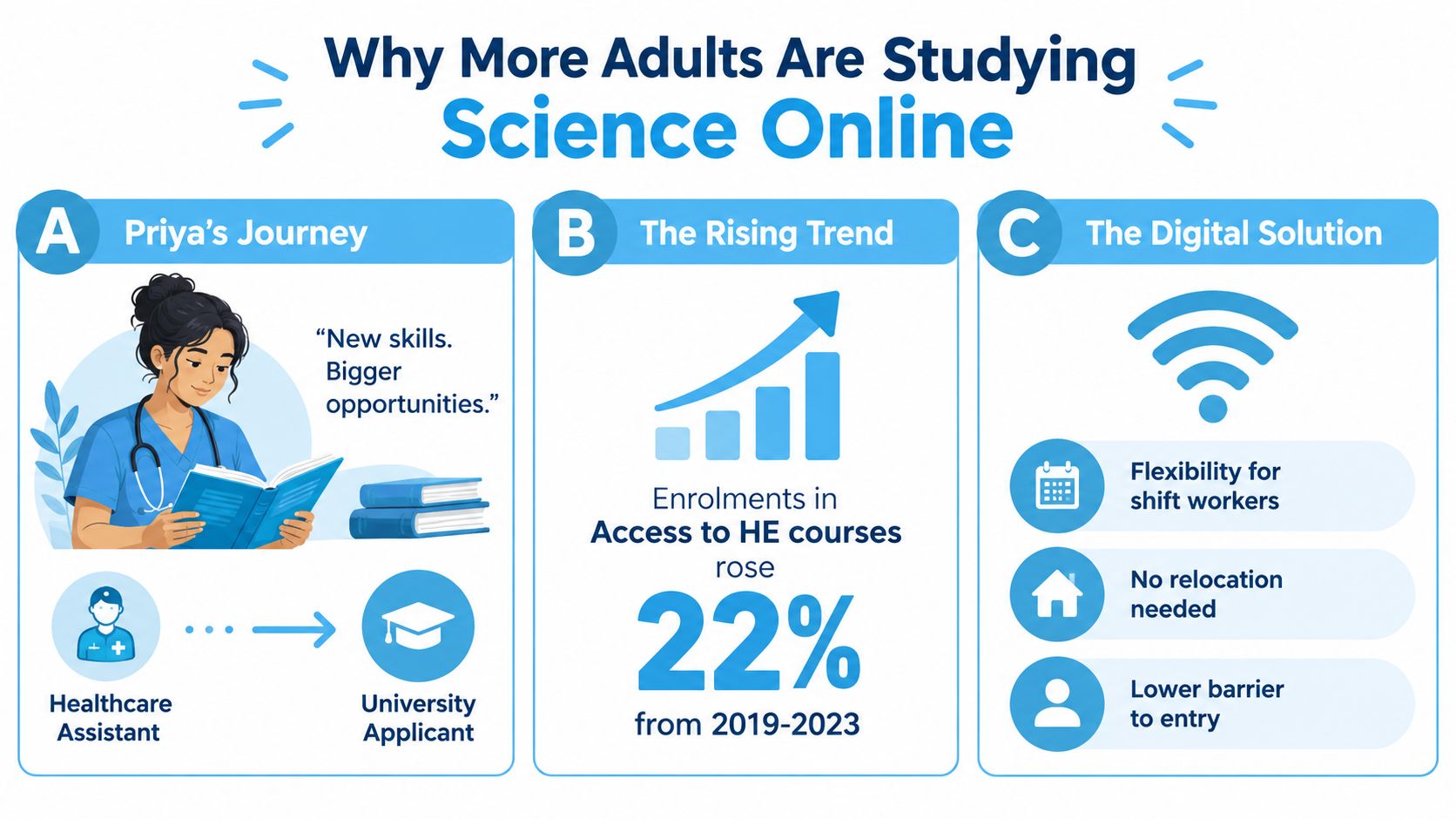
Priya has just finished a late shift as a healthcare assistant in Leeds. Before collecting her child from nursery, she opens UCAS on her phone and searches for biomedical science degrees. The entry requirements look familiar, but her old school qualifications don't fit neatly into them. An Access to HE Science online diploma could bridge that gap, yet she needs to know whether she can study around shifts, afford the course, and choose a pathway that a university will accept.
That combination of questions is common among adults returning to education. Online study can remove the daily commute and make recorded teaching available around work and family life, but flexibility doesn't remove the need for planning. You still need the right subject units, a realistic UCAS points profile, a funding check based on your age and postcode, and a weekly routine you can maintain.
The important decision isn't whether to enrol. It's which degree you want, which Access pathway supports it, how the offer requirements fit your profile, and whether the online learning model suits your circumstances.
Why More Adults Are Studying Science Online
Priya's week doesn't look like a traditional student timetable. She manages nursery drop-off, works changing shifts, and sometimes has only twenty minutes at the kitchen table before everyone else needs her. An online science course gives her a way to divide study into smaller sessions, revisit difficult explanations, and keep moving without relocating or giving up work immediately.
That access matters because online science content has become a routine part of how young people encounter the subject. In England, the Royal Society's Science Education Tracker 2023 found that 63% of students had read about science online in the previous month, compared with 27% using television or streaming and 24% using books, newspapers or magazines. Earlier evidence from the Wellcome Science Education Tracker 2019 recorded online science exposure as an established route before the later update.
Flexibility without lowering the academic expectation
An online Access diploma isn't a casual collection of videos. You'll still complete structured units, submit assessed work, develop academic skills, and meet deadlines. The difference is that providers can deliver lessons through a virtual learning environment, recorded tutorials, discussion areas, and downloadable resources rather than requiring you to attend a college building at a fixed time.
For an adult learner, that can make the difference between an ambition that stays on a list and an application that gets submitted. Priya might watch a biology lesson during a quiet afternoon, read the accompanying material after a shift, and use a tutor session to resolve a question before starting her assignment.
The qualification still needs to match the destination degree. A learner aiming for biomedical science may need a stronger biology and chemistry profile than someone applying for an environmental course. A student considering nursing should check whether a health-focused pathway would be more appropriate than a general science diploma.
Practical rule: Choose the degree destination first, then work backwards to the Access subject, unit profile, entry conditions, and funding route.
The rest of the decision is practical. You'll need to understand what the diploma contains, compare Science with Health and Computing routes, check the UCAS tariff profile requested by your target universities, and ask exactly how online support works. You'll also need to confirm whether your age, previous qualifications, and local authority affect the price.
What the Access to HE Science Diploma Actually Is
Think of the diploma as a bridge, not a shortcut. One side is your current position, perhaps work experience, GCSEs, or qualifications from several years ago. The other side is a university degree in a science-related subject. The course gives you recent academic evidence and subject preparation to cross that gap.
The Access to Higher Education Diploma is a regulated Level 3 qualification designed for adults who want to progress to higher education but don't have the traditional qualifications normally expected for direct entry. The qualification is approved within the Access to HE framework overseen by the Quality Assurance Agency for Higher Education.
How credits and grades fit together
A full diploma contains 60 credits. Those credits are divided between subject units and study skills. Of the total, 45 credits are Level 3 graded credits, which contribute to the UCAS tariff, while the remaining credits support preparation and are assessed differently.
You may see grades such as Distinction, Merit, and Pass attached to graded units. Universities then consider the resulting tariff profile alongside GCSE or Functional Skills requirements, subject prerequisites, references, and your application statement. A course page may describe the diploma as equivalent in level to advanced school qualifications, but admissions teams still decide whether the particular unit combination meets their degree requirements.
The online version is the same type of diploma as a classroom delivery model when it is offered through an approved provider and validating agency. Online delivery changes how you access lessons and submit work. It doesn't automatically remove assessment standards or university entry conditions.
What it isn't
It isn't a GCSE retake. GCSE study focuses on foundational school-level knowledge and may be necessary if a university specifies English, maths, or science GCSEs as a condition. It isn't a BTEC either, although both can support progression to higher education. Nor is it a T Level, which follows a different technical education structure and includes its own requirements.
Before enrolling, ask for the exact qualification title, validating agency, pathway name, unit list, grading structure, and intended university destinations. Those details matter more than a broad label such as “science access course”.
Choosing Between Science, Health, and Computing Routes
The best pathway depends on the degree you intend to apply for. Subject interest matters, but the destination course should drive the choice because universities can specify particular subjects, grades, and units.
The 2024 Access to HE progression data from the AIM Group gives a useful picture of demand. 2,153 Access to HE students received offers from 140 higher-education institutions, and over 60% progressed to health-related degrees. Health-related courses accounted for 1,372 offers, including Nursing and Midwifery, with typical offers ranging from 64 to 144 UCAS points. Computing-related routes accounted for 62 offers, with typical requirements of 80 to 112 UCAS points.
| Pathway | Typical degree destinations | Indicative progression rate | UCAS tariff profile |
|---|---|---|---|
| Health Science Professions | Nursing, Midwifery, allied health professions | Over 60% of the reported progression was health-related | Typical offers of 64 to 144 points |
| Science | Biomedical science, pharmacology, environmental science | The cited dataset doesn't provide a separate Science percentage | Confirm the target university's required profile |
| Computing | Computer science, software, data-related degrees | The cited dataset reports 62 computing-related offers | Typical offers of 80 to 112 points |
Use the table as a decision tool
Choose Health Science Professions if your clear goal is nursing, midwifery, or another health profession and the course includes the science and professional preparation those universities request. Choose Science for degrees such as biomedical science, pharmacology, or environmental science, particularly where biology and chemistry form the core entry profile.
Computing is a separate corridor. It may be right for software, data, or computer science degrees, but it shouldn't be selected because it sounds technical. The course content, mathematics expectations, and university acceptance rules can differ sharply from a pure science application.
Ask yourself: Which degree would you apply for if you had the entry qualification today? That answer should determine the Access route you investigate.
What You Will Study on a Science Pathway
A Science pathway usually builds knowledge in layers. You begin with the language of science, then apply it to organisms, materials, energy, and data. The exact units vary by provider, so treat the examples below as a planning framework rather than a guaranteed syllabus.
Biology foundations
Biology units may include cell structure, cell division, genetics, physiology, microbiology, or ecology. These topics prepare you to interpret how living systems function, how traits are inherited, and how evidence is gathered from biological samples.
A student targeting biomedical science might prioritise cell biology, genetics, and microbiology. Someone interested in environmental science may need ecology, biodiversity, and environmental systems. If nursing is your destination, human physiology and health-related biology deserve close attention.
Chemistry foundations
Chemistry often covers atomic structure, bonding, reactions, organic chemistry, acids and bases, and laboratory calculations. You don't need to become a professional chemist before university, but you do need a working understanding of how substances behave and how to present experimental findings safely.
These foundations return in degree modules such as biochemistry, pharmacology, medical chemistry, environmental chemistry, and laboratory science. Chemistry can also affect admissions decisions, so check whether your intended university specifically asks for it.
Physics, maths, and data handling
Science courses also commonly include measurements, graphs, formulae, data handling, energy, forces, or radiation. These units help you read results rather than memorise facts. You may use them in laboratory reports, health measurements, environmental monitoring, or research methods.
| Unit topic | Typical credits | Degree it supports |
|---|---|---|
| Cell biology | Confirm with the provider | Biomedical science, biology, health science |
| Organic chemistry | Confirm with the provider | Pharmacology, chemistry, biomedical science |
| Data handling | Confirm with the provider | All science degrees, especially research-led courses |
| Human physiology | Confirm with the provider | Nursing, biomedical science, allied health |
| Environmental science | Confirm with the provider | Environmental science, ecology, geography |
| Microbiology | Confirm with the provider | Biomedical science, biology, public health |
The graded units normally sit alongside academic study skills. Assessments can include written assignments, laboratory write-ups, data interpretation, a research project, and an examination or assessed task in study skills, depending on the provider.
Before applying, compare the unit list with your target degree. A useful example is this sample Access to HE Science lesson on plant biology, which shows the kind of subject-specific learning you may encounter.
Funding, Loans, and Interest-Free Payment Plans
Funding is one of the areas where online learners receive the most confusing advice. The right answer depends on where you live, your age, your previous Level 3 qualifications, and the funding rules used by your authority.
In England, an adult learner aged 19 or over may be eligible for an Advanced Learner Loan if they don't already hold a full Level 3 qualification. The loan can cover tuition, and the balance may be written off after the learner completes an eligible higher-level qualification. Confirm the current conditions directly with the provider and the official funding service before enrolling.
Why your postcode matters
Learners aged 19 to 23 without a full Level 3 qualification may qualify for full funding through the Adult Skills Fund in England, but local rates and eligibility can vary by mayoral authority. The Ascentis Access to HE funding guidance explains why learners need to check both age and location rather than assuming every online course is free.
Scotland, Wales, and Northern Ireland use different arrangements. Scotland may involve SAAS support, while further education fee arrangements in Northern Ireland should be checked with the relevant college or provider. Don't rely on a funding statement written for England if you live elsewhere in the UK.
For self-funders, providers may offer interest-free instalments. The precise deposit, monthly amount, course total, and administration fee differ between centres, so ask for a written payment schedule. A plan can make budgeting easier, but it doesn't make the course free and shouldn't be confused with an Advanced Learner Loan.
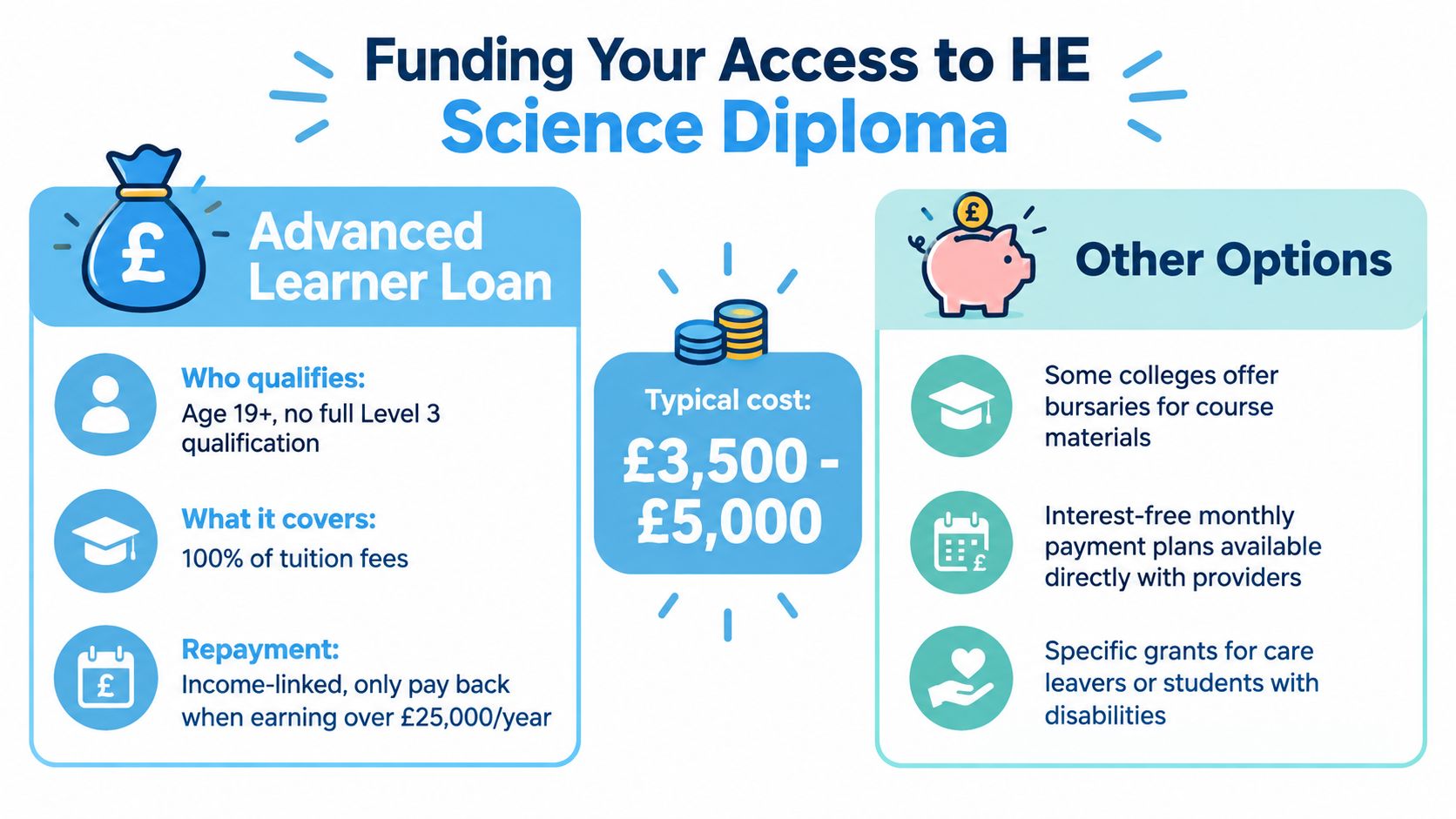
Before you commit, ask four direct questions:
- Eligibility: Will my age, postcode, and previous qualifications qualify me for funding?
- Coverage: Does the funding cover the entire tuition fee or only part of it?
- Repayment: When would repayment begin, and what happens if I progress to university?
- Self-funding: What deposit, instalments, and administration charges apply?
For a clearer explanation of the wider options, read this guide to Access to Higher Education funding.
How Online Study and Tutor Support Work in Practice
Online study works best when you treat it like a regular appointment rather than something to squeeze in only when life becomes quiet. A realistic week might include reading, watching teaching material, completing a practical activity, joining a discussion, and drafting assessed work. The exact workload varies by provider and learner, so ask for the expected weekly commitment before you enrol.
A typical platform might be Moodle, Google Classroom, Canvas, or a provider's own virtual learning environment. Look for clearly labelled modules, downloadable notes, mobile access, recorded teaching, assignment submission, and visible deadlines. A course that works only with uninterrupted high-speed broadband may create avoidable problems for learners using a phone or shared device.
A manageable study pattern
You could divide a week into short weekday sessions and one longer block at the weekend:
- Early week: Review the new lesson and make a short list of unfamiliar terms.
- Middle of the week: Complete the activity, contribute to the forum, and note questions for your tutor.
- Later week: Draft the assignment or laboratory write-up while the material is fresh.
- Weekend: Edit, check references, submit work, and plan the next unit.
Tutor support should include feedback on assessed work, academic guidance, and a clear way to ask questions. Some providers offer one-to-one tutorials and pastoral support through a personal tutor. Ask how quickly tutors normally respond, whether sessions are recorded, and who helps if a family or work crisis affects your deadline.
Digital access can still be a barrier. Ofcom's digital-exclusion research identifies adults who don't use the internet or lack home internet or device access as digitally excluded, while separate UK government survey evidence reports that 56% of adults improved their digital or online skills in the last 12 months. Providers should therefore offer low-bandwidth materials, downloadable resources, mobile-friendly content, and practical IT help.
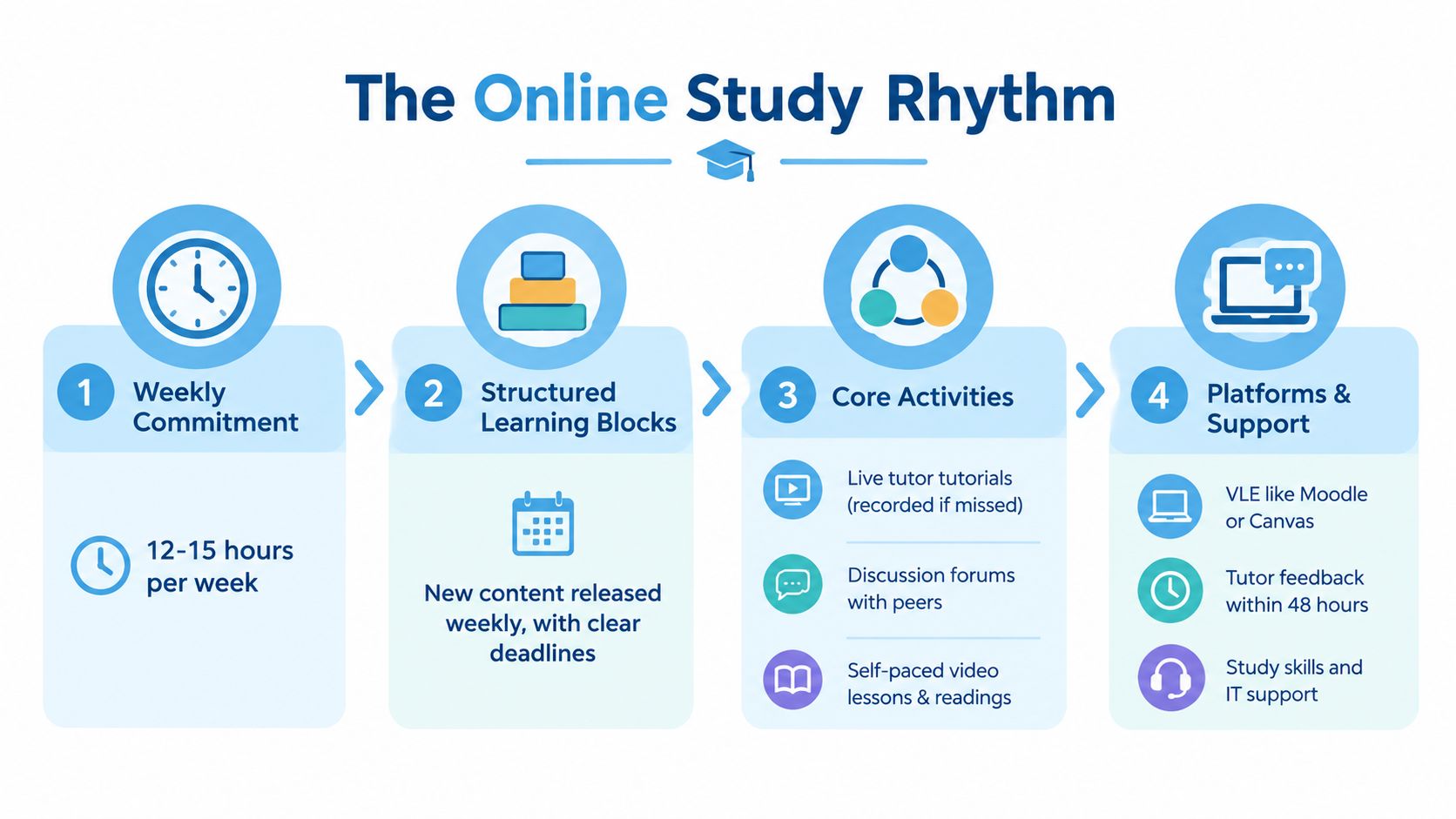
Before signing up, ask whether you can download lecture notes, catch up through recordings, use a phone for key tasks, and request printed materials. This first-hand guide to studying an Access course online from home can help you compare your expectations with the day-to-day reality.
From Diploma to University Offer and Career
Aisha's route starts with a specific degree, not a general wish to study science. As a single parent in the West Midlands, she wants to move towards biomedical science, but her earlier qualifications do not match the course's entry profile. She checks the university's required subjects first, then chooses an Access Science pathway covering biology, chemistry, and research-focused units.
Her weekly plan fits around school hours and evening study. Tutor feedback helps her improve assignments, while application support helps her connect recent academic work, healthcare experience, and her reason for changing direction in her personal statement. The university then reviews her Access results alongside English and maths evidence, references, and her application statement.
How tariff points become an offer
The 45 graded Level 3 credits are the part of the diploma that typically produces UCAS tariff points. Your final tariff profile depends on the grades achieved across those credits. A university may therefore ask for a particular mix of Distinctions and Merits, as well as specific science units.
The earlier progression figures show that students received offers across a wide range of higher-education institutions, with health-related degrees the largest reported destination group. Biomedical science, environmental science, pharmacy, physiotherapy, and secondary teaching followed by a PGCE can also be possible routes, depending on the university and your subject profile.
Treat tariff points as one part of the application. A course may also require GCSE or Functional Skills English and maths, particular Access units, or conditions linked to professional registration. Strong Access grades do not automatically replace those requirements.
For Aisha, this means asking the biomedical science admissions team a precise question: does her proposed Access course title and unit list meet the degree's subject conditions, and what Access grade profile will they consider? She should keep the response and compare it with the published entry requirements. Policies differ between universities, so an answer for one course cannot be assumed to apply to another.
Her provider may review the personal statement, practise interview questions, and explain the UCAS steps. Aisha still needs to check each destination course herself, including the required subjects, grades, English and maths evidence, and any additional experience. That check turns a broad career aim into a realistic application plan.
How to Apply and Frequently Asked Questions
Start with the university, not the enrolment form. Find two or three degree courses that interest you, record their subject, grade, English, maths, and experience requirements, and then compare Access providers against those conditions.
A practical application sequence
- Shortlist recognised providers. Check the validating agency, qualification title, delivery method, assessment style, and progression information.
- Test the funding route. Use your age, postcode, previous Level 3 qualifications, and residency details to ask whether you may qualify for an Advanced Learner Loan or local funding.
- Complete the skills assessment. This helps identify whether you need additional English, maths, digital, or study support before starting.
- Prepare your documents. Providers may request identification, previous certificates, and evidence relevant to eligibility.
- Attend the interview. Use it to ask about tutor access, deadlines, practical science activities, platform requirements, and university progression.
- Confirm the start date and payment arrangements. Get the full fee, funding decision, instalment schedule, and cancellation terms in writing.
Questions adult learners often miss
Will every UK university accept the diploma? No qualification should be treated as universally accepted without checking. Universities set their own entry requirements, and some degrees require particular units or grades. Use UCAS course search and entry requirement guidance as a starting point, then contact the admissions team for your chosen course.
Can Access credits be combined with A levels? Sometimes an admissions team may consider a mixed qualification profile, but the decision belongs to the university. Send the exact subjects, grades, and dates before applying.
What happens if I fail a unit? Contact your tutor or provider immediately. The available reassessment or extension process depends on the centre's rules and the validating agency, and a failed or incomplete unit can affect your final tariff profile.
Is the Advanced Learner Loan written off after higher-level study? Eligible loan balances may be written off after completion of an eligible higher-level qualification, but you must confirm the current eligibility rules and the qualification level with the official service.
How long does the diploma remain valid? The qualification itself doesn't normally expire, but universities can set their own rules about how recent study must be. Ask your target admissions team before relying on an older diploma.
Can I study online with limited internet access? Ask for downloadable materials, recorded tutorials, mobile compatibility, and alternative support before enrolling. A strong subject course still needs a delivery system you can use consistently.
Does “online” mean self-directed with no tutor? Not necessarily. Providers differ, so ask how feedback, tutorials, personal support, and assignment deadlines operate in practice.
A sensible next action is to choose one degree destination, copy its entry requirements into a checklist, and use that checklist when speaking to providers. That single step prevents you from choosing a course that looks suitable but lacks the units your university expects.
Access Courses Online offers fully online Access to Higher Education Diplomas, including Science, with tutor guidance, flexible study, and payment plans designed for adults balancing work and family commitments. Visit Access Courses Online to review the Science pathway, check funding guidance, and request practical advice about your university progression plan.