

You may be sitting at the kitchen table with a half-finished application, wondering whether university is still realistic. Perhaps you left school without the GCSEs you need, have spent years working or caring for family, or hold qualifications that don't fit neatly into an online application form. The phrase access to higher education entry requirements can sound like a locked door, but it usually describes a series of practical checks rather than one impossible test.
The route becomes clearer when you separate the academic requirements from the practical ones. You need to know what your chosen university asks for, whether an Access to Higher Education Diploma meets its Level 3 requirement, how to replace missing GCSEs or use Functional Skills, and whether your age, residency, postcode and study mode affect funding. You also need a sensible UCAS plan and a timetable that fits around real life.
Standing at the University Gates Without the Right Key
Consider Sam, who left school before gaining the English and maths qualifications listed on a nursing degree page. Sam now has relevant work experience, strong motivation and family responsibilities, but the university website appears to speak only to applicants with A-levels. The problem is not a lack of ability. Sam needs to identify which evidence the university will accept and in what order it must be gained.
That distinction matters for adults. A university may ask for a Level 3 qualification, particular grades in relevant units, GCSE-equivalent English and maths, a reference and additional checks linked to the profession. One course might accept an Access Diploma with a specified grade profile, while another may require particular science or maths content. A provider may also apply different rules to online learners depending on where they live.
Admissions mindset: Treat every requirement as a question to answer, not as a judgement about whether you belong at university.
Start with the degree, not with a generic Access course search. Read the university's course page, record the exact qualification and subject requirements, then contact admissions if anything is unclear. Keep separate notes for academic entry, professional checks, application documents and funding eligibility, because meeting one category doesn't automatically satisfy the others.
The route ahead includes the national entry picture, the structure of the Access to HE Diploma, subject examples from nursing, midwifery and computing, and alternatives to GCSEs. It also covers UCAS, funding geography and a practical 30-day plan. By the end, you'll have a way to turn uncertainty into a list of tasks you can complete.
What UK Universities Actually Ask For
Universities set their own undergraduate entry requirements. In everyday language, most offers contain four parts:
- A Level 3 qualification, such as A-levels, a BTEC or an Access to HE Diploma. This shows that you can handle advanced academic study.
- Level 2 English and maths, commonly GCSE grade 4 or C, or an accepted Functional Skills equivalent. These qualifications demonstrate core literacy and numeracy.
- Evidence of readiness, often through a personal statement, reference, interview or relevant experience.
- Course-specific conditions, which can include particular subjects, practical checks or professional requirements.
The national picture helps explain why English and maths appear so often. Among English-domiciled full-time first-degree entrants to UK providers in 2021/22, 76.6% had GCSEs at grade C/4 or higher, or Level 2 Functional Skills, in both English and maths, while 69.6% had A-level attainment equivalent to CCC or higher. These figures come from the official higher education entrants and qualifiers statistics. They don't mean every applicant needs A-levels, but they show how Level 2 and Level 3 evidence commonly sits within the admissions system.
The language on course pages
A Level 3 qualification is study above GCSE level and includes the Access Diploma. Tariff points are a numerical way of representing some Level 3 grades for applications. You can read a practical explanation of the system in this guide to how UCAS points work.
A conditional offer means the university will accept you if you meet stated conditions, such as achieving a particular Access grade profile or providing a missing qualification. An unconditional offer doesn't depend on future grades, but you should still read all terms carefully.
| Requirement | Qualification Level | What It Means in Practice |
|---|---|---|
| Access Diploma, A-levels or another accepted award | Level 3 | Your main evidence that you're prepared for degree-level academic work |
| English and maths | Level 2 | GCSE grade 4/C or an accepted equivalent, depending on the course |
| Personal statement | Application evidence | Your explanation of motivation, preparation and relevant experience |
| Academic reference | Application evidence | A tutor, employer or other suitable referee comments on your readiness |
| Interview or assessment | Course-dependent | The university explores suitability where written evidence isn't enough |
Mature applicants may be considered on individual merit, but “mature” doesn't mean “no requirements”. Admissions teams still need evidence that you can succeed on the specific degree. Ask whether the university accepts your proposed Access subject, whether it requires particular graded credits and whether missing Level 2 qualifications can be completed before enrolment.
How the Access to HE Diploma Fits In
The Access to HE Diploma has a standard national structure. It contains 60 credits in total, including 45 graded Level 3 credits and 15 ungraded credits at Level 2 or Level 3. The graded core lets admissions teams assess your academic profile rather than seeing only a pass or fail.
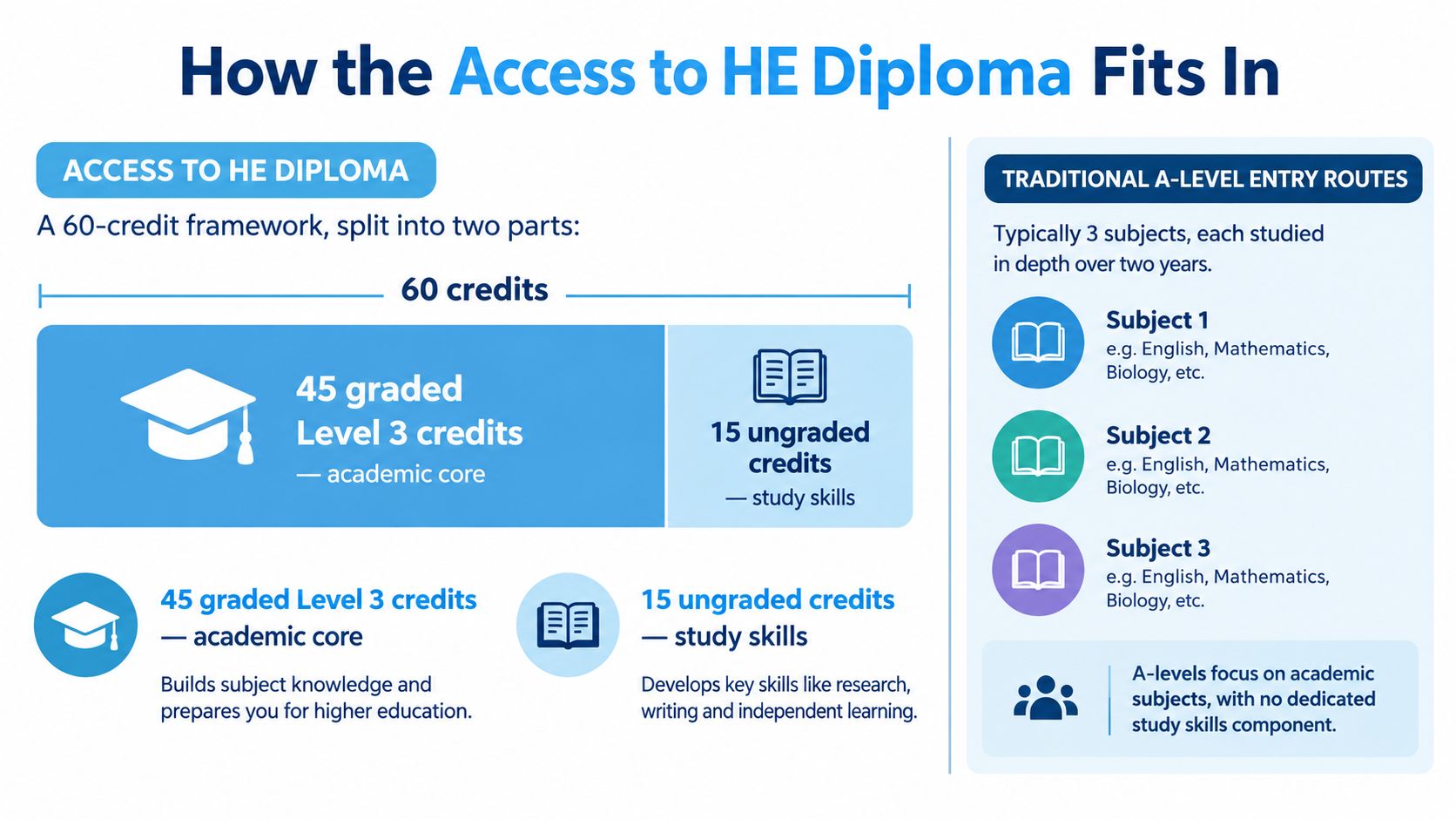
The remaining credits usually support study skills and preparation for higher education. That can include academic writing, research, referencing, planning assignments and working independently. For an adult returning after a long break, these units aren't decorative. They help rebuild the habits university study demands.
Comparing the routes
A-levels are traditionally studied as separate subjects, with assessment commonly centred on examinations. BTECs are vocational qualifications whose size and grading structure vary. An Access Diploma is designed specifically as a progression route for adults who need preparation as well as a Level 3 award.
The Access to Higher Education Diploma guide can help you understand the qualification in more detail, but the university remains the final authority on acceptance. Most universities recognise the Diploma as an alternative route, although a course may still insist on specific subject preparation.
The 45 graded Level 3 credits form the basis for UCAS Tariff conversion, and providers may make offers using tariff points or a grade profile. Guidance for admissions staff also describes diagnostic English and sometimes maths testing, interviews, and Pre-Access routes where applicants don't yet have the required GCSE English or maths.
A useful way to think about the Diploma is as a bridge with two lanes. Subject units build the knowledge your degree expects, while ungraded preparation units help you learn how to study at that level. The right pathway is therefore the one that matches the degree's content, not merely the course with the most convenient timetable.
Subject-Specific Entry Expectations
A general Access Diploma may open the door, but the course you choose decides how wide that door is. Nursing and midwifery often place particular emphasis on English and maths, alongside a relevant health or science pathway. Computing may look for mathematical preparation within the Diploma itself, even when the general university requirement appears flexible.
| Subject | Typical UCAS Tariff | GCSE Requirements | Access Diploma Specialism | Additional Checks |
|---|---|---|---|---|
| Nursing | Varies by provider | English and maths are commonly specified at GCSE-equivalent level | Nursing, health or science units may be expected | Interview, DBS and occupational health checks may apply |
| Midwifery | Varies by provider | English and maths are commonly specified at GCSE-equivalent level | Midwifery, health or science preparation may be requested | Interview and professional suitability checks may apply |
| Computing | Varies by provider | English is commonly required, with maths requirements depending on the course | Level 3 maths or science content may be requested | Diagnostic testing or an interview may be used |
Don't rely on a tariff figure copied from another university. Providers can express offers as points or as a specific combination of Distinctions, Merits and Passes, and the same subject title may contain different unit requirements.
Professional courses need extra planning
Healthcare applicants should check the university page and the relevant professional expectations. A university's preferred evidence may sit alongside requirements connected to registration, placement suitability, health screening or criminal-record checks. Those checks normally happen at a later admissions stage, but you should know about them before committing to a course.
For computing, ask whether the university wants maths inside the Access Diploma, whether a particular unit must be graded, and whether GCSE maths can replace that requirement. For nursing or midwifery, ask about placement preparation, interviews and the exact English and maths equivalencies.
Before applying, send admissions tutors these questions:
- Which Access Diploma pathways do you accept?
- What grade profile do you require?
- Must particular credits be in science, health or maths?
- Do you accept Functional Skills Level 2?
- Are interviews, tests, DBS or occupational health checks required?
- Can I apply while completing a missing qualification?
Written answers are useful because they give your Access tutor a clear target and reduce the risk of choosing a course that doesn't meet the university's conditions.
Applying Through UCAS as an Adult Learner
UCAS is an application system, not a test of whether you remember school. Begin by creating your account and entering your education history accurately, including qualifications gained many years ago and any current Access study.
Choose up to five courses, but treat those choices as a research exercise rather than a lottery. Compare the exact entry requirements, subject content, placement arrangements, location, study pattern and funding implications. A course that looks similar in its title may ask for a different Access grade profile or a different Level 2 qualification.
Turning experience into evidence
Your personal statement should explain why this degree makes sense now. Caring responsibilities, employment, volunteering, community work and previous study can all be relevant when you connect them to skills the course requires. Don't just list life events. Show what you learned, how it changed your direction and how it prepared you for study.
An Access tutor can usually provide an academic reference. If you're already working, an employer may also be appropriate, provided they can comment meaningfully on your reliability, communication or readiness to learn. Ask early, give your referee the course details and explain any gap in your formal education.
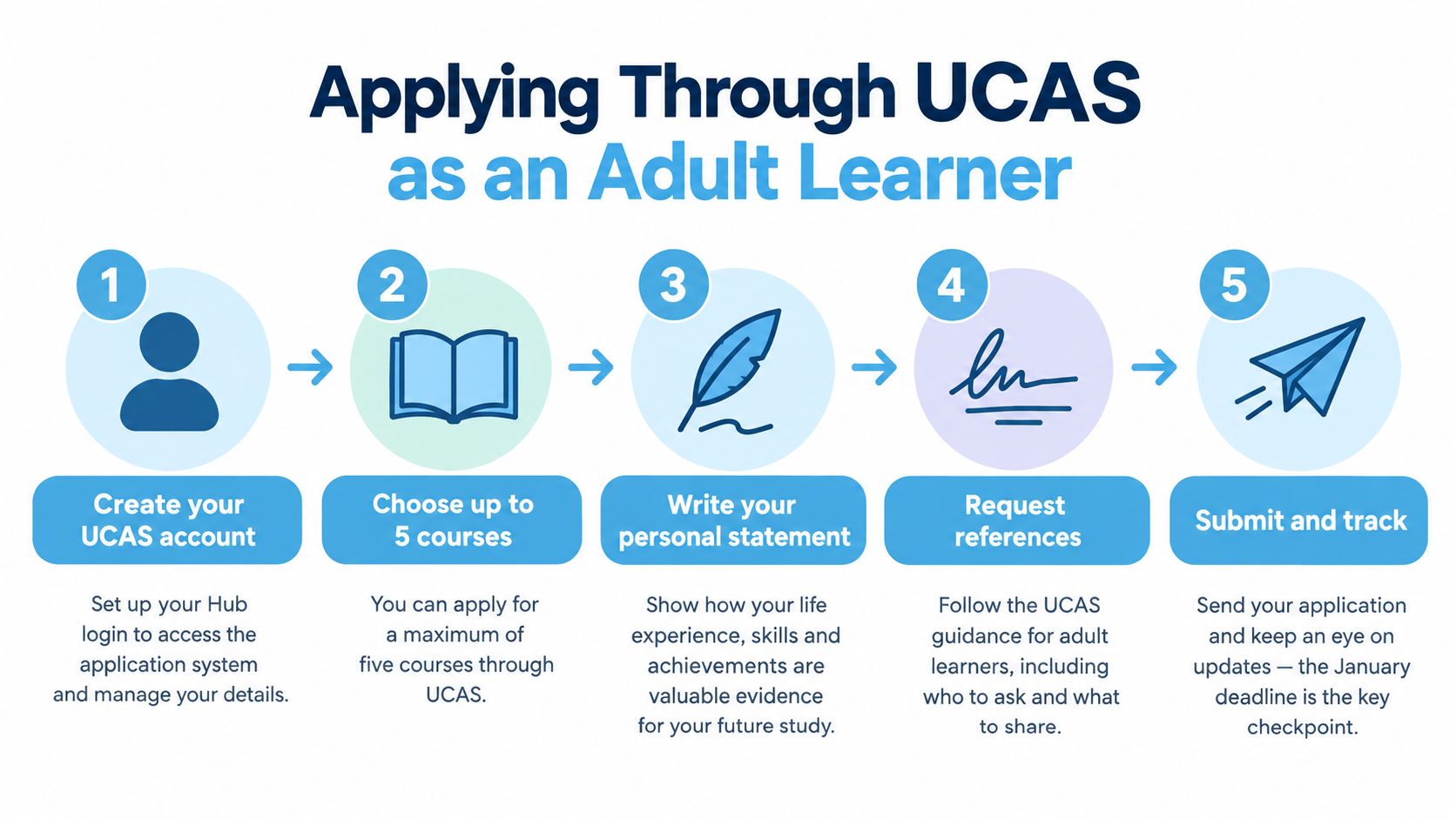
Plan for the main UCAS equal-consideration deadline shown for your application cycle. Some subjects, including medicine and dentistry, and applications to Oxford or Cambridge, use earlier deadlines, so check the current UCAS guidance and course pages rather than relying on a remembered date.
The Diploma's 45 graded Level 3 credits are used for Tariff conversion, while some universities focus on the actual Distinction, Merit and Pass profile. A university may make a conditional offer while you finish the Diploma, request an interview, or consider an alternative offer after reviewing your application.
You might receive a conditional offer, an unconditional offer or a changed course offer. If results don't go as hoped, Clearing and UCAS's post-results services can provide further routes, but they work best when you've already researched realistic alternatives.
GCSEs, Functional Skills and Other Evidence
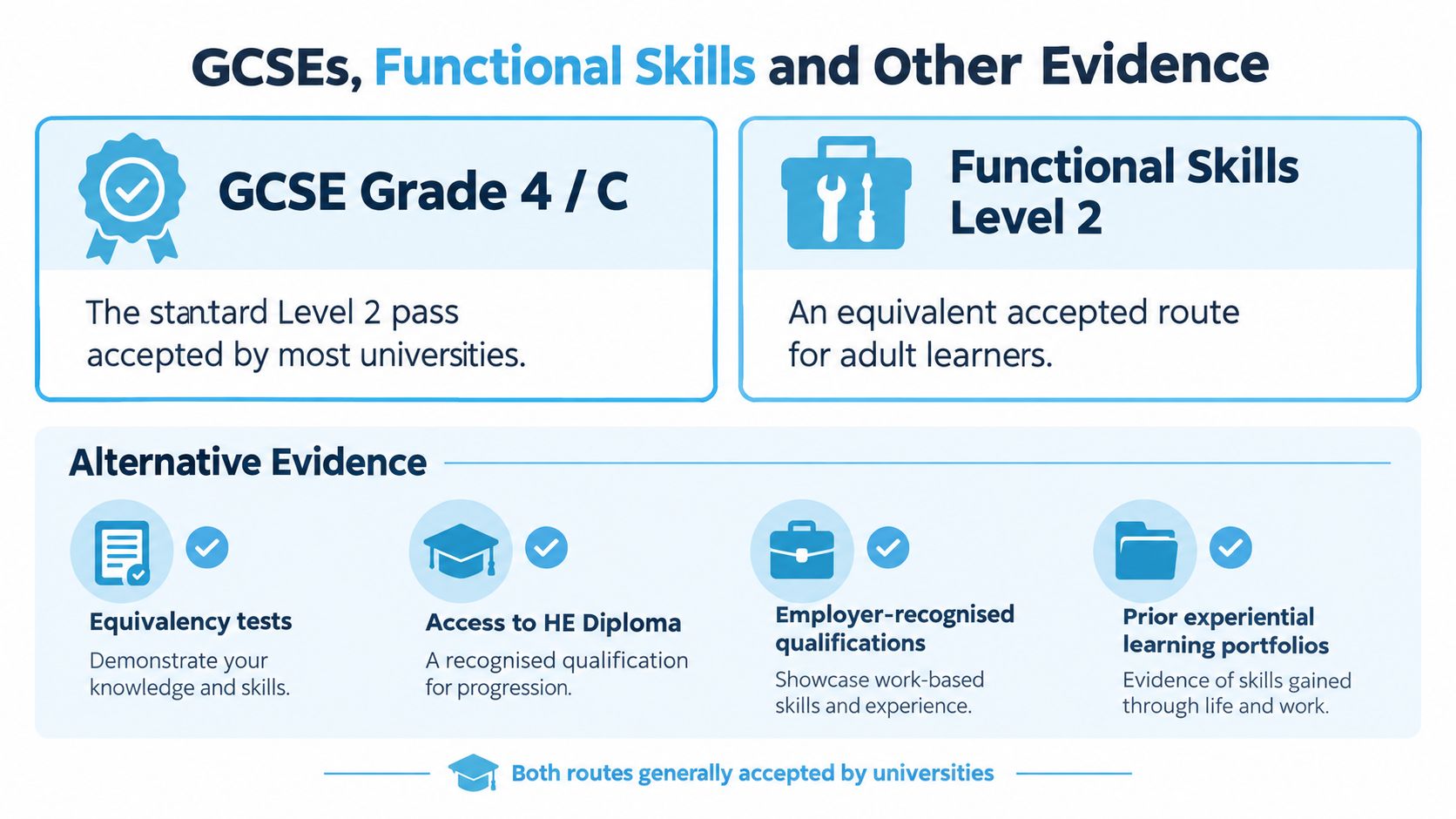
Missing GCSEs don't automatically end your application. The first task is to identify exactly what the course requires. English language, English literature, maths and sometimes science are separate requirements, so don't assume one certificate covers every item.
GCSE grade 4 or C is the familiar Level 2 benchmark. Functional Skills Level 2 may be accepted as an equivalent, but acceptance varies by university and subject. A healthcare course can be stricter than a general undergraduate programme, so confirm the rule with admissions rather than relying on a provider's general statement.
Possible ways to fill a gap
- Functional Skills: A practical alternative for adults who need recognised Level 2 English or maths evidence.
- GCSE study: The direct route where a university specifies GCSE rather than an equivalent.
- Pre-Access: A bridge that can develop academic confidence and prepare you for the Diploma.
- Diagnostic assessment: A college may test your current English or maths level before recommending the next course.
- Prior learning evidence: An employer reference or portfolio can support your application, although it may not replace a qualification where the course makes one mandatory.
International applicants may need English-language evidence such as IELTS Academic, but the required score and permitted alternatives belong to the individual university. Refugees and applicants with interrupted education should ask whether the provider accepts other evidence or offers an assessment route.
Don't confuse admissions evidence with funding evidence. A provider may accept your academic profile but still need separate information about residency, prior qualifications or your chosen mode of study before confirming financial support. Before contacting an Access provider, make a simple grid showing every missing credential, the course that could provide it, the university that must accept it and the funding question attached to it. This English Functional Skills Level 2 guide is a useful starting point for understanding one common alternative.
Funding, Eligibility and the Geography of Access
A course can be academically suitable and still be unavailable on the funding terms you expected. Eligibility may depend on age, residency, postcode, previous qualifications, enrolment on another funded programme and whether you study online, part time or full time. Provider pages increasingly spell out these conditions because funding is not uniform across the UK.
England, Scotland, Wales and Northern Ireland operate different education and student-support arrangements. Even within England, an online course may restrict eligibility by region or exclude particular devolved or combined-authority areas. Your postcode can therefore affect which provider, delivery mode or funding route is realistic.
Questions to ask before enrolment
- Where must I normally live to qualify for this funding?
- Does my previous qualification history affect eligibility?
- Is the course funded in my nation and local area?
- Does online study follow the same rule as classroom study?
- Will part-time attendance change the available support?
- Do I need to apply through the provider, a loan scheme or a national agency?
| Nation | Full-time Funding | Part-time Funding | Prior Qualifications Rule |
|---|---|---|---|
| England | Provider and national funding rules may apply | Mode and eligibility conditions can differ | Previous study can affect public funding or loan eligibility |
| Scotland | National arrangements differ from England | Check the relevant Scottish funding guidance | Residency and prior qualifications remain important |
| Wales | Welsh support arrangements apply | Confirm whether the specific mode is supported | Previous qualifications may affect entitlement |
| Northern Ireland | Northern Irish rules and providers should be checked | Availability can differ by course and mode | Residency and earlier study can affect eligibility |
Learners often need to compare an ESFA-funded place with an Advanced Learner Loan arrangement, but don't assume either route applies until the provider checks your circumstances. Residency evidence and previous qualifications may matter more to funding than to academic admission.
If disability, health or learning needs affect your study plans, you may also want practical guidance on student support resources 2026 while comparing providers. Ask for a written eligibility decision before paying a deposit or leaving employment. That small step can prevent a costly surprise later.
Your Practical Next Steps
A good application starts with a short audit, not a rushed course purchase. Use the next 30 days to test both sides of your plan, academic suitability and practical eligibility.
Days 1 to 7
Collect certificates, transcripts, employment records and any evidence of previous learning. Mark each requirement as met, missing or awaiting confirmation, then search for Access courses that match your intended degree, subject content and preferred mode.
Days 8 to 14
Contact providers with your qualification grid and postcode. Ask for the prospectus, course timetable, assessment method, support arrangements and funding decision process. Attend an open evening or virtual information session, and ask admissions teams to confirm any GCSE, Functional Skills or subject-unit condition in writing.
Days 15 to 21
Create your UCAS account and begin a personal statement built around evidence. Explain why your experience points towards the degree, what you've done to prepare and how you'll manage study alongside work or family responsibilities. Brief your referee with the course list and deadlines. If you're also preparing for employment, practical guidance on how to apply for jobs with no resume can help you present transferable experience clearly.
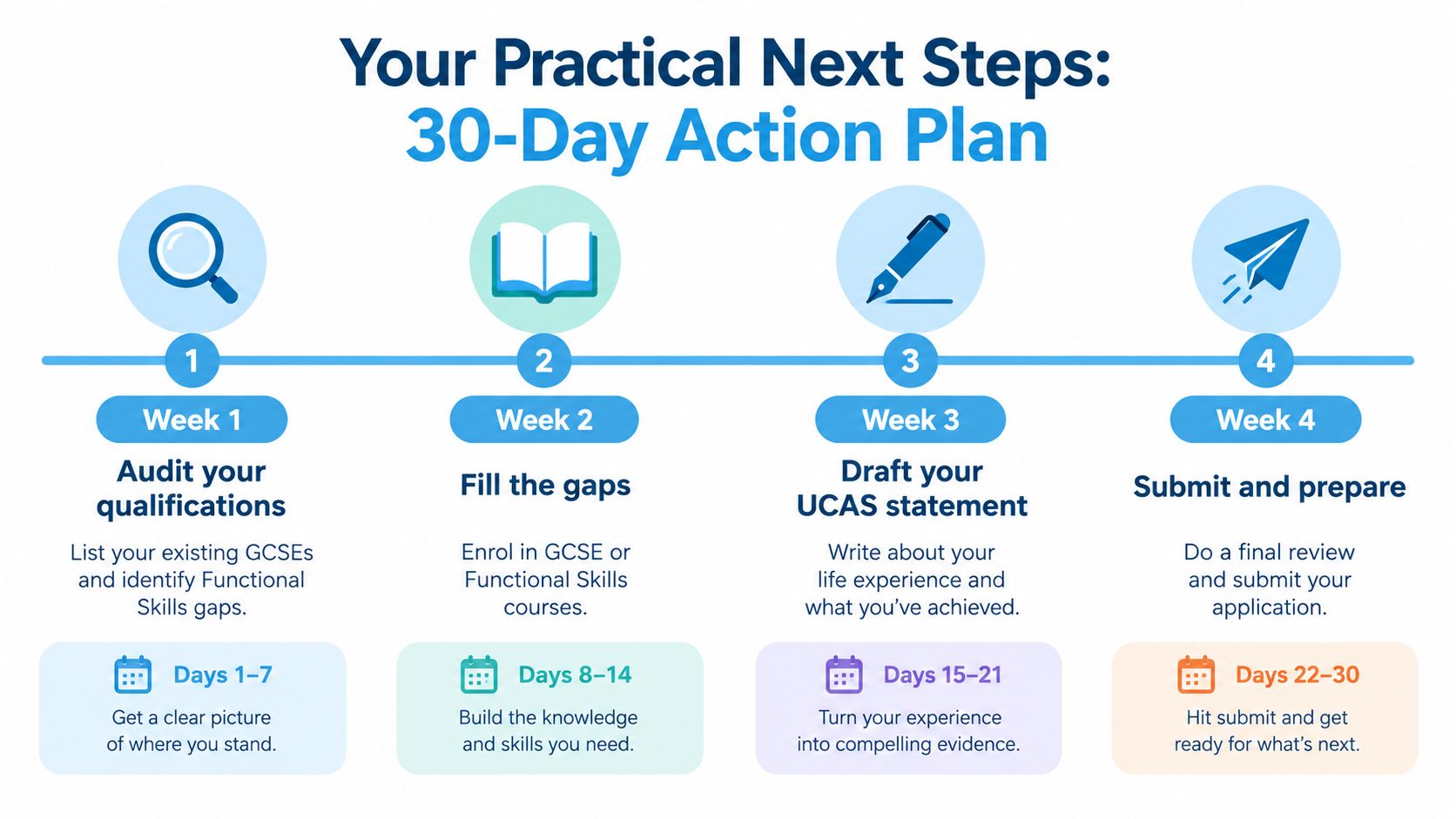
Days 22 to 30
Review every course choice against its actual entry page. Submit your UCAS application by the relevant deadline, start any funding application that applies to you and book diagnostic, interview or enrolment appointments. Keep a record of names, dates and written answers so you can resolve conflicting information quickly.
If a provider says you need Pre-Access or a Level 2 qualification first, that isn't a rejection. It gives you a defined route. If your first-choice course has a funding restriction linked to your postcode or delivery mode, compare another provider or study pattern before abandoning the degree goal.
Access Courses Online offers online Access to Higher Education Diploma pathways for adults preparing for university in areas including Nursing, Midwifery, Health Professions, Computer Science, Science, Social Science and Business. To compare relevant courses and ask about entry preparation, funding guidance and flexible study, visit Access Courses Online and speak with its support team about your intended degree.