
English Functional Skills Level 2 is a nationally recognised qualification that gives you the practical, real-world English skills you need for work, further education, and just day-to-day life. Think of it as the direct equivalent of a GCSE grade 4 (what used to be a C), but with a sharp focus on using those skills, not just knowing the theory. It's a key stepping stone for adults looking to get into university, start an apprenticeship, or open up new career doors.
What This Key Qualification Really Means
Trying to build a career or get into university without solid English skills is like building a house on shaky ground. No matter how great your plans are, things can quickly become unstable without that strong foundation. English Functional Skills Level 2 is that foundation. It’s official proof that you have the practical English abilities to operate confidently and effectively, whether in an office or a lecture hall.
Unlike some traditional exams that get bogged down in literary theory, this qualification cuts straight to the skills you’ll actually use every single day. It’s perfect for adults who might have just missed out on a passing GCSE grade at school or for anyone who needs to prove their English competence for a specific goal.
The Three Pillars of Practical English
The qualification is built around three core components, and you’re assessed on each one separately to make sure your skills are solid across the board. These are the essential tools for clear and effective communication in any setting.
- Reading: This is all about understanding and getting the important information from different types of texts. We’re talking work emails, instruction manuals, online articles, and company reports. You'll get good at spotting the main points, pulling out key information, and figuring out what it all means.
- Writing: The focus here is on creating clear, accurate, and properly structured documents. This could be anything from writing a formal letter or composing a professional email to drafting a report, all with correct spelling, punctuation, and grammar.
- Speaking, Listening & Communicating (SLC): This part checks your ability to join in discussions, give a short presentation, and really listen to what others are saying. It’s all about confident and effective verbal communication, whether you're in a team meeting or just chatting with a colleague.
By mastering these practical areas, you're not just learning English—you're learning how to use English effectively. This is exactly why so many universities and employers see it as powerful proof of your abilities.
This hands-on approach makes it a brilliant alternative to a GCSE. It’s a direct pathway to meeting the entry requirements for many Access to Higher Education Diplomas, which are a popular route into university degrees for careers like Nursing, Midwifery, and Social Work. If you want to dig a bit deeper into these kinds of qualifications, our guide on what functional skills qualifications are has more information.
Ultimately, earning this qualification can open doors that you might have thought were closed for good, giving you a clear and respected path towards your goals.
Understanding the Grading and Assessment Process
Thinking about exams can sometimes feel a bit stressful, but the assessment for English Functional Skills Level 2 is refreshingly straightforward. Forget the complicated grading systems you might remember from school. This qualification uses a simple pass/fail model, which strips away all the noise and focuses on what really matters: can you use your English skills confidently in everyday life and work?
This practical focus is reflected in how the qualification is tested. It's broken down into three separate components, with each one assessing a different core skill. To gain the full qualification, you just need to pass all three. It's as simple as that.
Think of it like building a sturdy tripod – you need all three legs to be strong and secure. Reading, writing, and communication are the three pillars that hold up your overall English proficiency.
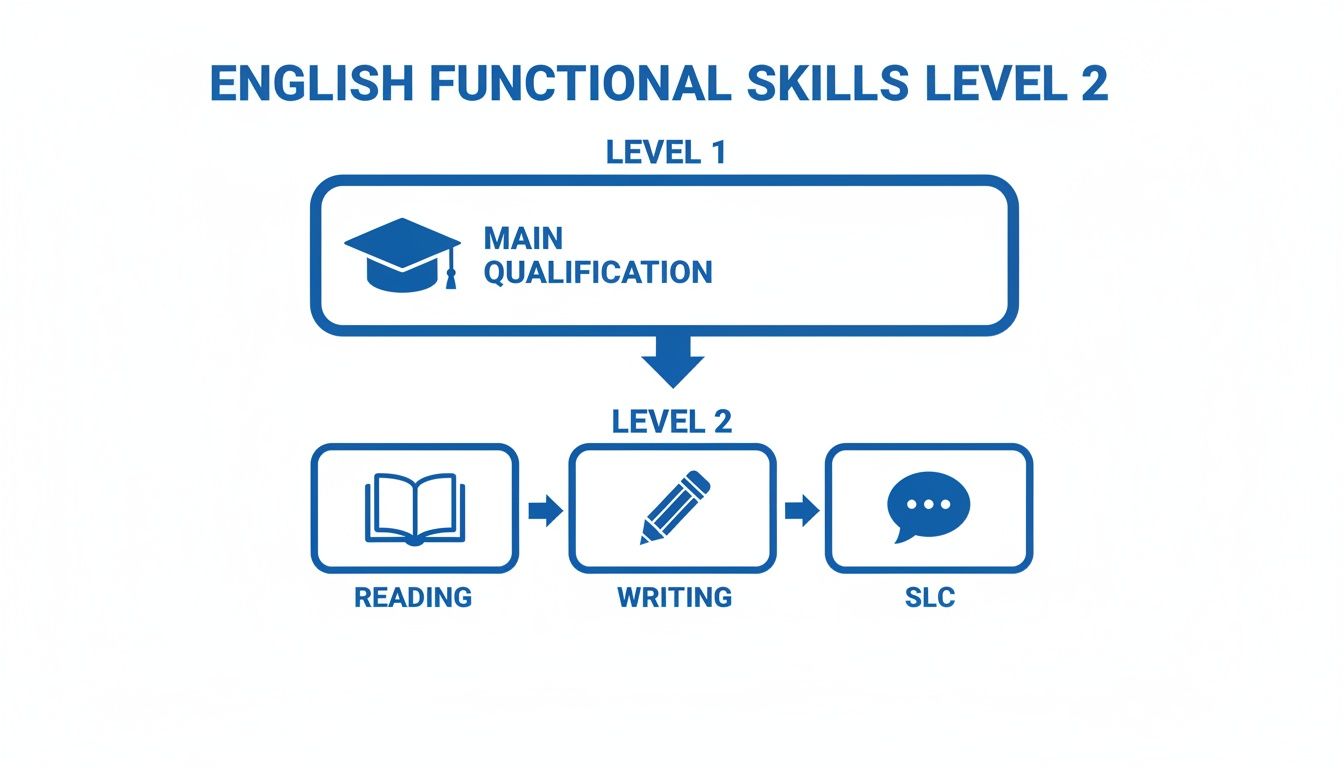
As the diagram shows, each skill is given equal importance. Let’s take a closer look at what each of the three assessments actually involves.
A Closer Look at the Three Assessments
The beauty of these exams is that they’re designed to mirror real-world tasks. The skills you’re tested on are the same ones you’d use in an office, on a college course, or just navigating daily life.
To make it even clearer, here’s a quick breakdown of what you can expect in each part of the exam.
English Functional Skills Level 2 Exam Component Breakdown
| Component | Assessment Format | Key Skills Tested |
|---|---|---|
| Reading | A timed test (approx. 60 mins) with multiple texts (e.g., articles, emails, reports). | Understanding the main points, finding specific details, and interpreting the purpose and tone of different documents. |
| Writing | A timed test (approx. 60 mins) requiring you to produce two different types of written documents. | Writing clearly and effectively for a specific audience, using correct grammar, spelling, and punctuation. |
| Speaking, Listening & Communicating (SLC) | An interactive assessment involving a group discussion and a short individual presentation. | Contributing ideas clearly in a discussion, listening to others, and presenting information confidently. |
Each assessment is a standalone task, allowing you to focus your preparation and demonstrate your abilities in a targeted way.
The pass/fail system is a real game-changer. Instead of worrying about different grade boundaries, you get a clear 'yes' or 'no' on whether you’ve met the standard. It tells you, and any future employer or university, that you have the practical English skills needed to succeed. For many adults, this straightforward result is exactly what they need to take their next step.
Pass Rates and Online Flexibility
It’s natural to wonder how achievable these qualifications are, and the good news is that learners tend to do very well, especially with the support of a structured online course. National data consistently shows strong pass rates for English Functional Skills. Recent figures for Level 2 sit at 84.1% for Reading and 85.1% for Writing. You can dive into the specifics by checking the full functional skills pass rates for 2023-24.
One of the biggest advantages today is the option to take your exams online. Many providers now offer remotely invigilated assessments, meaning you can sit your exams from the comfort and convenience of your own home. This is a huge help for anyone juggling studies with a job, family, or other commitments. It removes the hassle of travelling to an exam centre and lets you schedule your tests at a time that works for you, making your English Functional Skills Level 2 qualification more accessible than ever.
Is Functional Skills Level 2 the Same as a GCSE?
This is one of the biggest questions we get, and it's a really important one. The short answer? Yes, for all practical purposes, it absolutely is.
Ofqual, the official UK body that regulates qualifications, formally recognises an English Functional Skills Level 2 qualification as equivalent to a GCSE at a grade 4. You might remember that grade as the old grade C.
This isn't just a technicality. It means that universities, colleges, and employers all view Functional Skills as a credible and valuable qualification. If a course application or job advert asks for a GCSE in English at grade 4/C or above, a Level 2 Functional Skills pass will almost always tick that box.
So, while they hold the same weight, they aren't identical twins. The real difference isn’t in their value, but in what they focus on.
Practical Skills vs Academic Theory
Think of it like this: a practical driving test versus a degree in automotive engineering.
Both are valuable qualifications related to cars, but they prove completely different things. The driving test proves you can get behind the wheel and operate a car safely and effectively in the real world. The engineering degree, on the other hand, proves you understand the complex theories of how the engine works, the physics of aerodynamics, and the chemistry of fuel combustion.
A GCSE in English is a bit like that engineering degree. It’s broader and more academic, often diving into literature, poetry analysis, and more abstract ideas about language. It's designed to give you a wide-ranging academic knowledge of the subject.
English Functional Skills Level 2, however, is your practical driving test. It is laser-focused on the essential English skills you actually need and use day-to-day. It’s not about analysing a Shakespearean sonnet; it’s about whether you can write a clear, professional email, understand a report from your boss, or communicate effectively in a team meeting.
For an adult learner, this practical emphasis is often the biggest advantage. The qualification is designed to prove you have the communication skills needed to succeed right now—in your career, further studies, and everyday life.
How Universities and Employers View the Qualification
This is exactly why the qualification is so well-respected. An admissions tutor for a Nursing degree needs to know an applicant can write clear patient notes, understand complex medical information, and communicate with empathy. Functional Skills Level 2 gives them direct proof of those abilities.
It's the same story with employers. Someone hiring a new project coordinator wants to be confident they can draft professional emails and understand company policies without any trouble. This qualification is a guarantee of that practical competence. For anyone wanting to weigh up the different routes, checking out an online GCSE English course guide can provide more insight into the academic path.
Ultimately, while a GCSE shows broad academic knowledge, Functional Skills proves practical, everyday proficiency. For many adult learners, this makes it the perfect, targeted tool to unlock their next step, whether that's an Access to HE Diploma in Midwifery or a promotion at work.
So, Who Is This Qualification Actually For?
The English Functional Skills Level 2 qualification isn't just a piece of paper. For so many people, it’s the key that unlocks a door they thought was bolted shut for good. It’s a seriously practical qualification for a huge range of people, all with different goals but one thing in common: needing to prove their English skills in a way that counts.
Think of the aspiring nurse who needs it to get onto their Access to Higher Education Diploma. Or the skilled tradesperson eyeing a promotion that requires Level 2 literacy. It's for anyone who left school without that crucial GCSE pass grade and now finds that one gap is holding them back from what they're truly capable of.

The stories we hear from learners are incredibly varied, but they often fall into a few key groups. By looking at these, you can get a real sense of how it might fit into your own journey.
Aspiring University Students and Access Course Learners
One of the biggest groups we see are adults dreaming of getting into university, especially those who need an Access to HE Diploma to get there. These diplomas are the main route to uni for adults getting back into education, and pretty much all of them demand a Level 2 English qualification just to get on the course.
Imagine you want to become a midwife, a social worker, or a paramedic. The Access to HE Diploma in Health Professions is your first big step, and English Functional Skills Level 2 is the ticket you need to get started. It shows the college and your future university that you have the communication skills to handle degree-level work.
Thousands of adult learners follow this exact path to success every single year. It’s a well-trodden route that really works.
Career Changers and Professionals Seeking Promotion
Another key group includes professionals looking to switch careers or finally climb the ladder in their current field. So many rewarding jobs, from teaching assistant roles to entry-level healthcare positions, list a Level 2 English qualification as a non-negotiable requirement.
For instance, someone who has worked in retail for years might decide they want to retrain as a pharmacy technician. That new role requires the ability to read prescriptions accurately and communicate clearly with patients. Functional Skills gives them direct, relevant proof that they can do just that.
This qualification acts as a bridge, connecting your real-world experience with the formal requirements of a new industry. It tells employers you are serious, capable, and ready for a fresh challenge.
Apprentices and Vocational Learners
Apprenticeships are a fantastic way to earn while you learn, but they come with their own set of academic requirements. To complete most intermediate, advanced, or higher-level apprenticeships, you must show you have English skills at Level 2.
This is to make sure apprentices can understand important health and safety documents, write reports, and communicate properly with colleagues and clients. For many, completing their English Functional Skills Level 2 is just an integrated part of their training, allowing them to progress and become fully qualified in their trade. It’s the academic piece of the puzzle that validates all their hands-on skill.
For those with learning difficulties like dyslexia, it’s also worth remembering that specialised tools can make a huge difference. Understanding how different types of assistive technology for dyslexia work can provide crucial support in preparing for the exam.
Your Strategy for Passing the English Level 2 Exam
Passing your English Functional Skills Level 2 exam isn’t about cramming at the last minute. It’s about building a smart, steady plan that actually fits into your life. The real key is to break everything down into smaller, more manageable steps, turning what feels like a huge mountain into a clear, walkable path. A solid strategy does more than just sharpen your skills—it builds the confidence you need to walk into that exam room feeling ready for anything.
Your very first move? A quick, honest self-assessment. Before you even think about hitting the books, take a moment to figure out where you’re strong and where you might need a bit more work across the three exam components: Reading, Writing, and Speaking, Listening & Communicating (SLC).
Maybe you’re a natural speaker but find formal writing a bit of a challenge. Or perhaps your grammar is spot-on, but you struggle to pull the main ideas out of a lengthy article. Knowing where you stand right from the start means you can focus your energy where it’ll make the biggest difference.
Creating Your Personalised Study Plan
Once you’ve identified your focus areas, it’s time to build a study schedule that works for you, not against you. Life is hectic, and a rigid, unrealistic timetable is just setting yourself up to fail. Instead, look for those small pockets of time you can consistently set aside for studying—even if it’s just 30 minutes a day.
Consistency is so much more powerful than cramming. A little bit of focused effort every day will build your skills far more effectively than one long, exhausting session on a Sunday. And don’t forget to factor in your other commitments, like work and family, to create a plan you can actually stick with for the long haul.
It can also be helpful to explore different learning styles. Understanding what a hybrid class means, for example, can open up new ways to learn that better suit your needs.
Mastering Each Exam Component
With a realistic schedule in hand, you can start zoning in on the specific skills needed for each part of the English Functional Skills Level 2 assessment. Each section requires a slightly different game plan, so tailoring your revision is absolutely essential.
Here are a few practical tips for each area:
- For the Reading Exam: Get comfortable with all sorts of texts, from news articles and work emails to instruction manuals. Time yourself reading and then try to summarise the main point in just one or two sentences. You’ll also want to practise scanning for specific information quickly.
- For the Writing Exam: Go back to basics and brush up on spelling, punctuation, and grammar. Practise writing in different formats, like a formal letter or an email to your boss. And always, always proofread your work to catch those little errors before they become bad habits.
- For the SLC Assessment: The best way to build confidence here is simply to talk. Chat with friends or family about topics you’re passionate about. Practise structuring your thoughts before you speak and really listen to what others are saying—this will help you contribute thoughtfully to the group discussion.
The single most effective preparation tool is using past papers and mock exams. It’s the closest you can get to the real thing, helping you get used to the question formats and manage your time under pressure.
The Power of Structured Online Learning
While self-study is great, enrolling in a structured online course can make a world of difference. A good course gives you professionally designed materials, helpful resources, and—most importantly—the support of an experienced tutor. That expert guidance is priceless for getting feedback on your writing or clearing up concepts you’re stuck on.
Online learning also offers incredible flexibility, letting you study whenever and wherever you want. For adults juggling work, family, and other responsibilities, this is a total game-changer. It puts you in the driver’s seat of your own education, allowing you to move at a pace that feels right for you.
If you’re ready to get started with a supportive and flexible programme, you can explore a fully accredited NCFE Level 2 Functional Skills Qualification in English designed specifically for adult learners. With the right strategy and resources, you can confidently work towards passing your exam and unlocking that next big opportunity.
So, You've Passed Your Exam – What's Next?
Passing your English Functional Skills Level 2 exam is a fantastic achievement, but it’s not the end of the road. Far from it! Think of it as the key that’s just started the engine. Now, you’re ready to put your foot on the accelerator and drive towards the next exciting stage of your journey.
With this qualification officially in hand, a whole new world of educational and career opportunities has just swung wide open.
Your Direct Pathway to University
For many adult learners, the most powerful next step is enrolling on an Access to Higher Education (HE) Diploma. These diplomas are purpose-built as a fast-track route to university, specifically for people who don’t have traditional qualifications like A-Levels. It’s the perfect bridge to get you to degree-level study.
Whether you dream of becoming a nurse, a social worker, a business leader, or a scientist, there’s an Access to HE Diploma tailored to get you there. These courses are designed with adult learners in mind and recognise the very skills your Functional Skills qualification proves you possess.
Some of the most popular and life-changing pathways include:
- Access to HE Diploma (Health Professions) for anyone aspiring to be a nurse, paramedic, or midwife.
- Access to HE Diploma (Science) to kickstart a career as a biologist, chemist, or environmental scientist.
- Access to HE Diploma (Business and Management) for the next generation of entrepreneurs and managers.
Completing your Functional Skills qualification isn't just about ticking a box. It's the essential first step that makes these ambitious university goals a tangible reality, proving you are ready for degree-level study.
Making Your Goals Affordable
We get it. Returning to education isn't just about ambition; there are practical things to consider, especially when it comes to funding. The great news is there are flexible and affordable options out there, so cost doesn't have to be a barrier. Many providers offer interest-free payment plans, letting you spread the cost of your Access to HE Diploma over a timeframe that works for you.
This kind of financial flexibility means you can invest in your future without putting yourself under immediate pressure. And it's an investment worth making. In a recent academic year, there were nearly 190,000 enrolments in Functional Skills English courses, a figure that shows just how vital these qualifications are for adults aiming higher. You can dig into more data on adult learner achievements on the UK government's statistics service.
Your English Functional Skills Level 2 qualification is your launchpad. The next move is to chat with an advisor who can help you map out your personal pathway, talk through funding, and turn your career dreams into a solid plan.
Got Questions? We’ve Got Answers
Stepping back into education can feel like navigating a maze, especially when you're juggling work, family, and everything in between. It’s only natural to have a few questions. To help you feel confident and clear about your next steps, we've put together answers to some of the most common queries we hear about English Functional Skills Level 2.
How Long Does This Course Actually Take?
This is one of the best parts – there's no one-size-fits-all answer. Because our courses are self-paced, how long it takes is completely up to you. It all comes down to your starting point and how much time you can carve out each week.
Some of our learners are incredibly focused and manage to power through the course in just a few weeks. Others prefer a slower, steadier pace, taking a few months to fit their studies comfortably around their lives. There are no rigid deadlines, so the power is truly in your hands to learn in a way that works for you.
Will Universities Accept This Instead of a GCSE?
Yes, absolutely. The overwhelming majority of UK universities and colleges see a Level 2 Functional Skills qualification in English as a direct equivalent to a GCSE at grade 4 (what used to be a grade C). In fact, it's a core requirement for most Access to Higher Education Diplomas, which are designed as the main route to university for adult learners.
It's always a good idea to double-check the specific entry requirements for the degree you have your heart set on, especially for really competitive courses. A quick look on the university’s website can give you that extra peace of mind.
Can I Really Do the Whole Thing Online?
You certainly can, and for many adult learners, this is a total game-changer. You can now complete the entire English Functional Skills Level 2 qualification from home, from the learning materials and tutor check-ins right through to the final exam.
Exams are usually taken remotely using online invigilation software, which means you can do it all from your own space. This amazing flexibility is what makes it the perfect choice for working parents, busy professionals, and anyone who needs their education to fit their life, not the other way around. It takes all the stress out of travelling to an exam centre and puts you firmly in control.
Ready to open the door to university and your dream career? Access Courses Online offers the accredited qualifications and expert support to get you there. Find the perfect course for you today at https://accesscoursesonline.com.