
Deciding to become a midwife is a massive, life-changing moment. But once that initial spark hits, the next thought is often, "Okay... so how do I actually do that?" Gaining access to higher education in midwifery isn't just a single step; it's a journey. You'll need to figure out if you're eligible, find the right university course, get your head around the UCAS application, sort out the finances, and mentally prepare for what's ahead. Getting a clear picture of this roadmap is the best possible start you can give yourself.
Your Path to Becoming a Midwife
Especially for adult learners, jumping back into education can feel like a huge leap. The path to a midwifery degree might look a bit tangled from the outside, but it breaks down into some very clear, manageable stages. This guide will give you that high-level overview, laying out the whole process so you can move forward with a real sense of confidence.
From that first flicker of interest right through to your first day on campus, every single phase needs a bit of planning. Let’s walk through the key milestones you'll hit along the way.
Key Stages on Your Midwifery Journey
Think of it as a logical flow: you research, you apply, and then you prepare. It’s that simple.
- Eligibility and Research: First things first, you need to know what universities are looking for. This means getting clear on the academic qualifications they require and, just as importantly, understanding how your life or work experience can play a huge role.
- The Application Process: Once you've got a shortlist of courses, it's all about putting together an application through UCAS that really stands out. Your personal statement is where you get to make your passion and commitment shine through.
- Financial Planning: Let's be realistic—figuring out the costs and securing funding is a major piece of the puzzle. You'll need to get familiar with options like student loans and NHS grants to make sure you can focus on your studies without constant financial stress.
This infographic breaks down those fundamental steps of research, application, and funding into a simple visual.
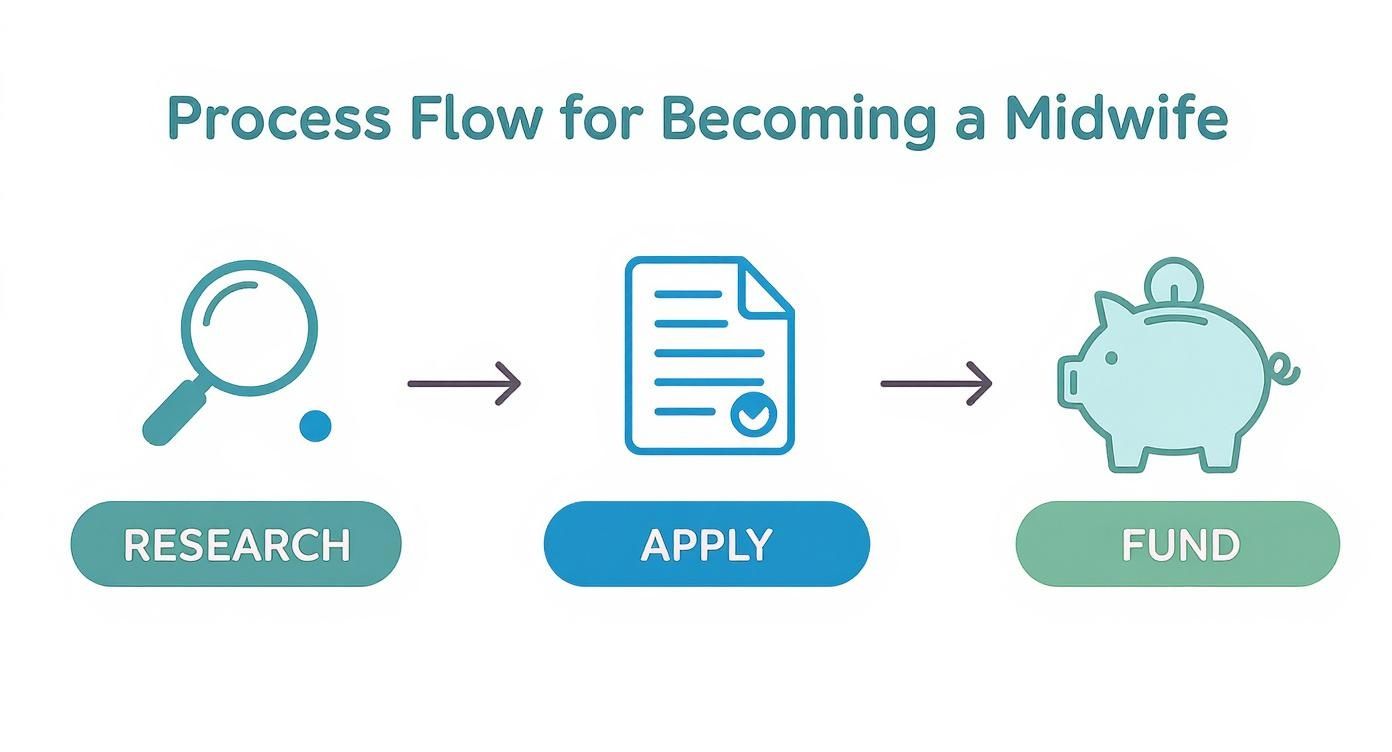
Sometimes, just seeing the process laid out like this can make a daunting journey feel much more achievable. It really just boils down to those three core actions.
Navigating the Modern Midwifery Landscape
It's important to be aware of the current realities of midwifery education, especially when it comes to money. Since the student bursary was removed back in 2017, the financial pressure on aspiring midwives has become a serious factor. In fact, the Royal College of Midwives (RCM) found that three-quarters of students in England graduate with debts over £40,000. That's a hefty number that can definitely influence whether someone can start—and finish—their degree.
To get a feel for what the degree itself involves, UCAS has a brilliant overview of what studying midwifery is actually like. The course is an intense but incredible mix of hands-on, practical skills and deep theoretical knowledge.
To help you sift through your options and understand the specific pathways into different degrees, you might want to see how AI Course Advisor tools can offer some personalised pointers. And for a really detailed breakdown of all the different ways you can get into the profession, our own guide on how to become a midwife is the perfect next step.
Meeting Midwifery Degree Entry Requirements
Before you even think about starting your UCAS application, the very first thing you need to do is get crystal clear on what universities are actually looking for. Every uni sets its own criteria, but there are definitely some common threads—both academically and personally—that you’ll need to tick off to get your foot in the door.
Getting to grips with these requirements early on is a game-changer. It lets you map out your journey properly. This isn't just about headline grades; it’s about showing admissions tutors the full picture of who you are: your academic ability, your real-world experience, and the personal qualities that prove you’re cut out for midwifery.
Core Academic Qualifications
For a lot of people, A-Levels are the traditional route in. Universities usually want to see two or three A-Levels, and they often ask for at least one to be in a science, like Biology. The grade requirements can vary quite a bit, typically falling somewhere between BBC and AAB, depending on how competitive the course is.
Another popular path is taking a BTEC Level 3 National Extended Diploma in a related subject, such as Health and Social Care. If you go this route, universities will be looking for specific grades, often something like Distinction, Merit, Merit (DMM) or even higher.
But here’s the thing you can’t overlook, no matter which of those qualifications you have: your GCSEs. You will almost certainly need GCSEs in English, Maths, and usually a Science at grade C/4 or above. If you don't have these, you’ll need to sort out an equivalent, like Functional Skills Level 2, before you can apply.
The Access to HE Diploma: A Game Changer for Adult Learners
For anyone returning to education after a break, the Access to Higher Education Diploma (Midwifery) is often the most direct and effective pathway. This Level 3 qualification is specifically designed to get you ready for the demands of a degree, and university admissions tutors really respect it.
An Access to HE Diploma with 45 credits at Distinction is the academic equivalent of three A-Levels at grade A, carrying the same number of UCAS Tariff points. This shows just how much weight it holds.
The diploma covers modules that are directly relevant to your future career—think human biology, psychology, and health studies. It also builds up essential academic skills like essay writing and research. This structure doesn't just get you qualified for entry; it builds your confidence and makes you genuinely ready for university-level study. It’s the perfect choice if you've been out of a classroom for a while.
To give you a clearer picture, here’s a quick breakdown of the most common ways people get the qualifications they need.
Common Entry Routes for Midwifery Degrees
| Qualification/Route | Typical Requirements | Ideal For |
|---|---|---|
| A-Levels | 2-3 A-Levels, often including Biology or another science. Grades typically BBC - AAB. | School leavers or those who followed a traditional academic path. |
| BTEC Level 3 Diploma | A relevant subject like Health and Social Care. Grades are often DMM or higher. | Students who prefer a more vocational, coursework-based learning style. |
| Access to HE Diploma | 45-60 credits, with many universities requiring a high number at Distinction. | Adult learners returning to education who need a direct route to university. |
| GCSEs (or equivalent) | English, Maths, and a Science at grade 4/C or above. A non-negotiable foundation. | Everyone! This is a baseline requirement for nearly all healthcare degrees. |
As you can see, there isn't just one "right" way to get into a midwifery degree. It’s all about finding the route that fits your background and your future ambitions.
Why Relevant Experience Is Non-Negotiable
Getting the right grades is only half the battle. Universities need to see that you have a realistic understanding of what a caring profession involves. This is where hands-on experience becomes absolutely essential—it’s how you demonstrate your commitment and prove you know what you’re signing up for.
This doesn't mean you need to have spent time on a maternity ward, which can be incredibly difficult to arrange. Instead, think broader. Focus on roles that let you showcase your ability to communicate, show empathy, and provide care.
Consider experiences like these to make your application shine:
- Healthcare Assistant (HCA): Working in a hospital or care home gives you invaluable, direct experience with patient care and teamwork in a healthcare setting.
- Volunteering: Getting involved with organisations like the NCT, local breastfeeding support groups, or children's centres shows a genuine passion for supporting families.
- Doula or Breastfeeding Peer Supporter: These roles offer incredible insight into the emotional and practical support people need during pregnancy, birth, and early parenthood.
Honestly, any experience where you can demonstrate the core values of the NHS Constitution—like compassion, courage, and commitment—will make your application so much stronger.
Mandatory Checks and Screenings
Finally, there are a few compulsory checks everyone has to go through. This is a standard part of the process for all healthcare degrees, designed to make sure you're suitable for the profession.
You will have to complete a Disclosure and Barring Service (DBS) check, which screens for any criminal record. On top of that, you’ll also need to pass an occupational health screening to confirm that you’re physically and mentally fit for the demands of the course and your future career. These aren't just boxes to tick; they are vital safeguards that protect the public and ensure you’re ready for the huge responsibility of being a midwife.
Crafting a Standout UCAS Application

Your UCAS application is so much more than just a form. It's your first real chance to connect with the admissions tutors and show them who you really are. This is where you get to go beyond grades and qualifications, telling a powerful story about why you’re meant to become a midwife. Getting this stage right is absolutely vital for landing a place on a competitive midwifery course.
The practical side involves registering an account, choosing up to five universities, and filling everything in with pinpoint accuracy. But the real heart of your application, the bit where you can truly shine, is your personal statement. It’s your opportunity to turn a list of achievements into a compelling narrative about your unique journey and passion for the profession.
Structuring Your Personal Statement
Think of your personal statement as a conversation starter with the admissions team. A jumbled, confusing statement can easily bury your best qualities, so having a clear beginning, middle, and end is non-negotiable. It needs to flow logically to keep them engaged and make sure your key messages hit home.
Start with an opening that grabs their attention right away. Please, avoid the clichés like, “I’ve wanted to be a midwife since I was five.” Instead, think about a specific moment or a powerful insight that really ignited your passion. This makes for a much more authentic and memorable introduction.
The main body of your statement is where you’ll build your case. Use these paragraphs to connect your academic knowledge, work experience, and personal skills directly to the core values of midwifery. Wrap it all up with a strong, confident conclusion that summarises your commitment and proves you’re ready for both the challenges and incredible rewards of the degree.
Articulating Your Passion and Understanding
Admissions tutors aren't just looking for someone who likes babies; they need to see that you have a deep, realistic understanding of what a midwife actually does. It's about showing you know the role involves providing holistic care to women and their families through pregnancy, birth, and the postnatal period.
Here’s how you can turn that passion into convincing evidence:
- Connect to the 6 Cs: Directly link your experiences to the core values of nursing and midwifery—Care, Compassion, Competence, Communication, Courage, and Commitment. For instance, describe a time in a care role where you used great communication to reassure someone who was anxious.
- Show, Don't Just Tell: Instead of simply saying, "I am a compassionate person," describe a situation where you showed compassion. Maybe you supported a vulnerable person while volunteering or offered a listening ear to a friend in need. Concrete examples are always more powerful.
- Reference Current Issues: Show you’re genuinely engaged with the profession. Briefly mention your awareness of a current topic in UK maternity services, like the importance of continuity of carer or informed choice. This proves you’re thinking critically about the field you want to join.
Your personal statement should reflect your understanding that a midwife’s role is incredibly diverse and complex. It’s about being an advocate, an educator, a clinician, and a pillar of support—often in highly pressurised situations.
Writing a personal statement can feel overwhelming, but breaking it down into smaller, manageable chunks makes the whole process much easier. For more detailed advice, you might find our dedicated article on how to write a personal statement really helpful.
What to Avoid in Your Application
Just as important as what you include is what you leave out. Small mistakes can really detract from an otherwise brilliant application, so it pays to be meticulous. To make sure you’re presenting the best version of yourself, steer clear of these common pitfalls.
First and foremost, avoid spelling and grammar errors at all costs. Proofread your statement several times, read it out loud, and then ask someone else to check it for you. A polished piece of writing shows professionalism and attention to detail—two qualities every midwife needs.
Also, be completely honest and authentic. Don’t exaggerate your experience or claim skills you don’t have. Tutors are experts at spotting insincerity, and it will almost certainly come out during an interview. It’s far better to reflect thoughtfully on the experience you do have, no matter how small it might seem. Finally, make sure every single sentence adds value and directly supports your application to study midwifery.
Securing Funding for Your Midwifery Degree
Let's talk about the money side of things. For many aspiring midwives, the financial side of returning to education is often the biggest hurdle, and it’s a perfectly valid concern. Understanding how to fund your degree is just as important as meeting the academic requirements, as it allows you to focus on your studies without constant money worries.
The good news is there's a structured support system in the UK designed to help you manage the costs of becoming a midwife. Your first port of call will almost certainly be Student Finance England. This is the government body that provides loans to cover your tuition fees and help with living costs, making higher education a realistic goal for thousands of people every year.
The Student Finance Loan System
The support from Student Finance is typically broken down into two main parts. You apply for both together in a single application, but they each serve a different purpose.
First up is the Tuition Fee Loan. This loan covers the full cost of your course fees—up to £9,250 per year—and is paid directly to your university, so you never have to handle the money yourself. What's really important to know is that your eligibility for this loan isn't based on your household income.
Then there's the Maintenance Loan, which is designed to help with day-to-day living costs like rent, food, and travel. The amount you can borrow here does depend on your household income and where you live and study. It’s paid straight into your bank account at the start of each term, giving you a budget to work with.
The best part? You only start repaying these loans once you've graduated and are earning above a certain salary. This means you won’t have to worry about paying anything back until you’re financially stable in your new career. For a more detailed look at how this works, it's worth checking out our complete guide on Access to Higher Education funding.
Unlocking the NHS Learning Support Fund
Now for the real game-changer for midwifery students: the NHS Learning Support Fund (LSF). This is an incredible source of non-repayable funding. That’s right—it’s a grant, not a loan, so you don't have to pay it back.
The LSF provides several key benefits that you can apply for once you've started your course:
- Training Grant: A straightforward payment of £5,000 for each academic year.
- Parental Support: An extra £2,000 a year if you have at least one dependent child.
- Travel and Accommodation Expenses: This helps cover the extra costs you'll rack up when travelling to and from your clinical placements, which can often be a hidden expense.
The NHS LSF is designed to support you throughout your degree, recognising the unique demands of healthcare training. Make sure you check the LSF application deadlines as soon as you enrol at university to avoid missing out on this vital support.
This financial backing is crucial. Despite some positive trends, such as a 3% rise in midwifery degree acceptances in 2025, the pressures of the course and finances mean not everyone makes it to graduation. The Royal College of Midwives reports that approximately 15% of students leave their courses, which really highlights the importance of securing all the funding you're entitled to. You can discover more insights about these student enrolment and retention figures.
Other Funding Avenues and Budgeting
While Student Finance and the LSF are the main pillars of support, don't stop there. Many universities offer their own bursaries and scholarships, some of which are specifically aimed at mature students or those from lower-income backgrounds. It is always worth digging into the "fees and funding" section on your chosen university's website to see what extra help might be available.
Balancing a demanding course with your finances requires a bit of planning. Sit down and create a simple budget to track what's coming in and what's going out. Factor in your Maintenance Loan and any LSF payments, and remember that your clinical placements will involve working shifts, which can make holding down a part-time job tricky. Getting a handle on your spending and planning ahead will make your journey through higher education in midwifery so much smoother.
Thriving During Your Midwifery Programme
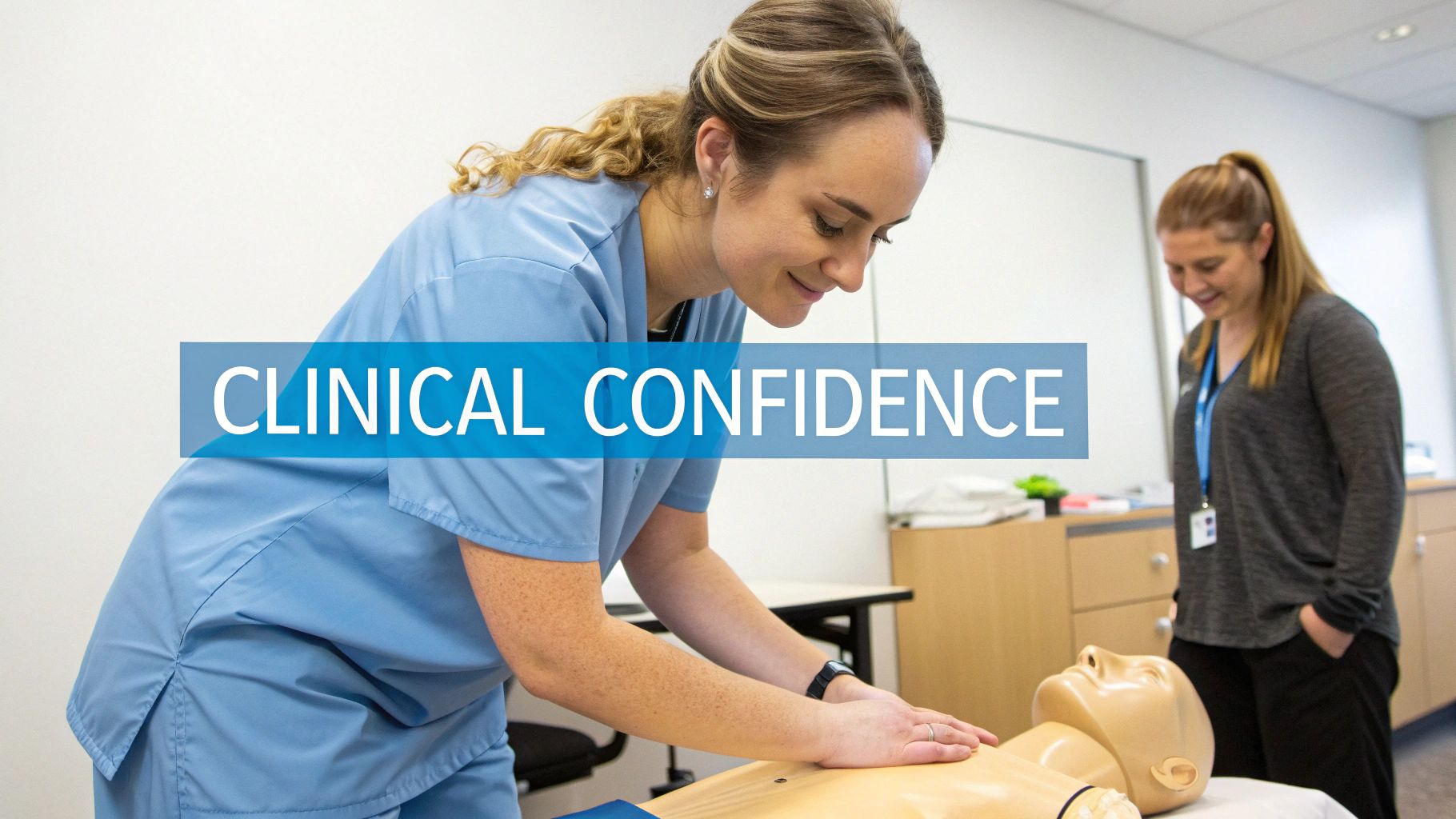
Securing your place at university is a massive achievement, but it’s also just the beginning of an intense and incredibly rewarding journey. A BSc (Hons) Midwifery programme is unlike most other degrees; it’s a dynamic blend of deep academic theory and hands-on, real-world experience right from the get-go.
Understanding what the course demands is the key to not just surviving, but truly thriving. You'll be challenged academically, emotionally, and practically. But remember, every lecture, every late-night essay session, and every placement shift is another step towards becoming a competent, confident, and compassionate midwife. This is where your dream starts to feel real.
The 50/50 Split: Theory and Practice
At the heart of every UK midwifery degree is its famous 50/50 structure. This simply means your time is split almost equally between learning at university and putting that knowledge into practice on clinical placements. This integrated approach is what makes it so effective—it ensures the theory you learn in the classroom is immediately applied and cemented in a real healthcare setting.
One week you might be in a lecture theatre learning about the physiology of labour, and the very next you could be on a labour ward, supporting a woman through that exact experience. It’s this constant back-and-forth that builds strong, capable midwives. It’s not about abstract concepts; it’s about connecting knowledge directly to the care you provide.
University-Based Learning Modules
Your time at university will be packed with modules designed to build your clinical knowledge from the ground up. These give you the comprehensive understanding needed to support women and their families through every single stage of their journey.
Your studies will typically cover a huge range of essential topics:
- Antenatal and Postnatal Care: Learning how to support health and wellbeing throughout pregnancy and in the crucial weeks after birth.
- Labour and Birth: Understanding the physiological processes and developing the skills to provide safe, woman-centred care.
- Complex Care and Emergencies: Preparing you to spot when things deviate from the norm and respond calmly and competently under pressure.
- Public Health and Health Promotion: Exploring the midwife's vital role in promoting health for individuals, families, and entire communities.
- Professional and Ethical Issues: Grounding your practice in the legal and ethical frameworks that govern everything you do.
These modules are taught through a mix of lectures, smaller seminars, practical skills workshops in simulation suites, and group projects. You’ll be assessed through essays, exams, presentations, and portfolios, all designed to sharpen your knowledge and critical thinking.
Navigating Clinical Placements
Clinical placements are where you truly learn to be a midwife. It’s where the theory comes to life. You’ll work alongside registered midwives and other healthcare professionals in a variety of settings, from community teams and birth centres to busy hospital maternity units.
Be prepared to work the full range of shifts—days, nights, and weekends—to get a true feel for the 24/7 nature of maternity care.
A key part of your practical assessment is your Midwifery Ongoing Record of Achievement (MORA). Think of it as your professional passport—a portfolio where you document the clinical skills you’ve mastered and the experiences you’ve had, all of which need to be signed off by your mentors.
It’s an intense but exhilarating experience. You’ll follow women through their pregnancies, be present at births, provide postnatal support, and learn to manage your time, energy, and emotions. This is where you build the core competencies and the confidence you need for professional registration.
The Final Hurdle: Your Path to NMC Registration
After three years of hard work, your journey culminates in meeting the requirements set by the Nursing and Midwifery Council (NMC). The NMC is the professional regulator that sets the standards for practice, ensuring every midwife has the skills to provide high-quality, safe care.
A crucial final step is the Objective Structured Clinical Examination (OSCE). This is a practical exam where you’re tested on your clinical skills and decision-making in a series of simulated scenarios. It's the final validation of your competence before you can join the professional register.
This rigorous process ensures standards are kept incredibly high. According to the NMC’s latest data, there were 46,606 midwives registered in the UK as of March 2025. This number is bolstered by fantastic qualification rates; in 2025, around 80% of candidates passed the OSCE, which shows that with dedication, students are more than prepared to meet these professional standards. You can dive deeper into the NMC registration data and trends on mentormerlin.com.
Passing this final assessment and completing your degree allows you to apply for your NMC PIN, officially marking your transition from student to a registered midwife, ready to start an incredible career.
Common Questions About Midwifery Education
Thinking about a midwifery degree can bring up a lot of questions, especially when you're trying to figure out the best path for your own situation. Let's tackle some of the most common queries we hear from aspiring midwives to help you move forward with confidence.
Can I Get into Midwifery Without A-Levels?
Yes, you absolutely can. While A-Levels are the traditional route, UK universities are very open to welcoming applicants with different qualifications and life experiences.
The most respected and widely accepted option for adult learners is the Access to Higher Education Diploma (Midwifery). This qualification is built from the ground up to prepare students without traditional qualifications for the academic rigour of a degree.
Other routes like a BTEC Level 3 Diploma in Health and Social Care are also great pathways. The golden rule is to check the specific entry requirements for each university you're interested in, as they do vary. Some might even consider a mix of qualifications alongside significant, relevant work experience.
What Work Experience Is Best for My Application?
Universities want to see that you get what compassionate care is all about and that you've tested your commitment in the real world. Getting direct experience on a maternity ward is brilliant, but honestly, it can be incredibly tough to arrange.
Admissions tutors know this and really value a wide range of experiences. Think about roles that show your empathy, communication skills, and resilience:
- Working as a Healthcare Assistant (HCA) in a hospital or care home.
- Volunteering for a charity that supports new parents, like the National Childbirth Trust (NCT).
- Becoming a doula or a breastfeeding peer supporter.
Any role where you've supported diverse groups of people, especially in a caring capacity, will make your application so much stronger. It gives you powerful, real-life examples to talk about in your personal statement and interview.
How Intense Are Clinical Placements?
There’s no way to sugar-coat this: clinical placements are demanding. But they are, without a doubt, the most important part of your midwifery education. This is where you'll do most of your learning and growing.
You'll be expected to work the full range of shifts—days, nights, weekends, and bank holidays—just like a qualified midwife. This usually adds up to around 37.5 hours per week when you're on placement.
Juggling this with your academic assignments takes brilliant time management, resilience, and a solid support system at home. It's tough, but it’s designed to prepare you for the realities and incredible rewards of the job.
A top tip from current students is to get organised from day one. Plan your meals, map out your study time around your shifts, and make sure you schedule in proper downtime to rest and recharge. This proactive approach can make all the difference.
What if I Don’t Get Any University Offers?
It’s completely disheartening to get rejections, but it is absolutely not the end of your dream. Midwifery is one of the most competitive courses out there, so plenty of successful midwives faced an initial setback.
First, take a moment. Then, look for any feedback the universities provided—it can offer priceless clues on how to strengthen your next application. If you used all five of your choices and didn't get an offer, you might be able to find a place through UCAS Extra.
Later in the summer, UCAS Clearing provides another fantastic opportunity to find courses with spaces still available. It's also worth looking into how universities are using chatbots to streamline student admissions to better understand how you can navigate these fast-moving processes. If you don't land a place this year, use the time wisely. Get more relevant experience, polish your personal statement, and reapply with an even stronger profile. Persistence is often the final key that unlocks the door.
Ready to take the first step towards your dream career in midwifery? At Access Courses Online, we provide accredited, fully online Access to Higher Education Diplomas designed for adult learners like you. Study flexibly, at your own pace, and gain the qualifications you need to get into university.
Explore our Access to HE Diploma (Midwifery) and start your journey today.