
An online Access to Higher Education Diploma in Nursing is a regulated Level 3 qualification, typically equivalent to three A-levels, that adults can study fully online without traditional university entry qualifications. It's a recognised route into nursing degrees, but you'll still need to meet each university's requirements and complete the in-person placement training that nursing demands.
You may be working shifts, caring for children, or wondering whether a decision you made at school still controls your future. Perhaps you've wanted to become a nurse for years, but the usual route through A-levels and sixth form wasn't available to you. Access to higher education nursing online can provide the academic bridge you need, while giving you more control over when and where you study.
The important question isn't only whether the diploma can be completed online. It's whether you can combine flexible preparation with university interviews, health checks, clinical placements and the practical demands of becoming a registered nurse. This guide explains that complete route in plain language.
What an Online Access to HE Nursing Diploma Is
You have found an online nursing degree that fits your ambitions, but the entry requirements show qualifications you do not hold. An Access to Higher Education Diploma in Nursing can provide the academic route into that application, particularly if traditional school-based qualifications were not part of your earlier education.
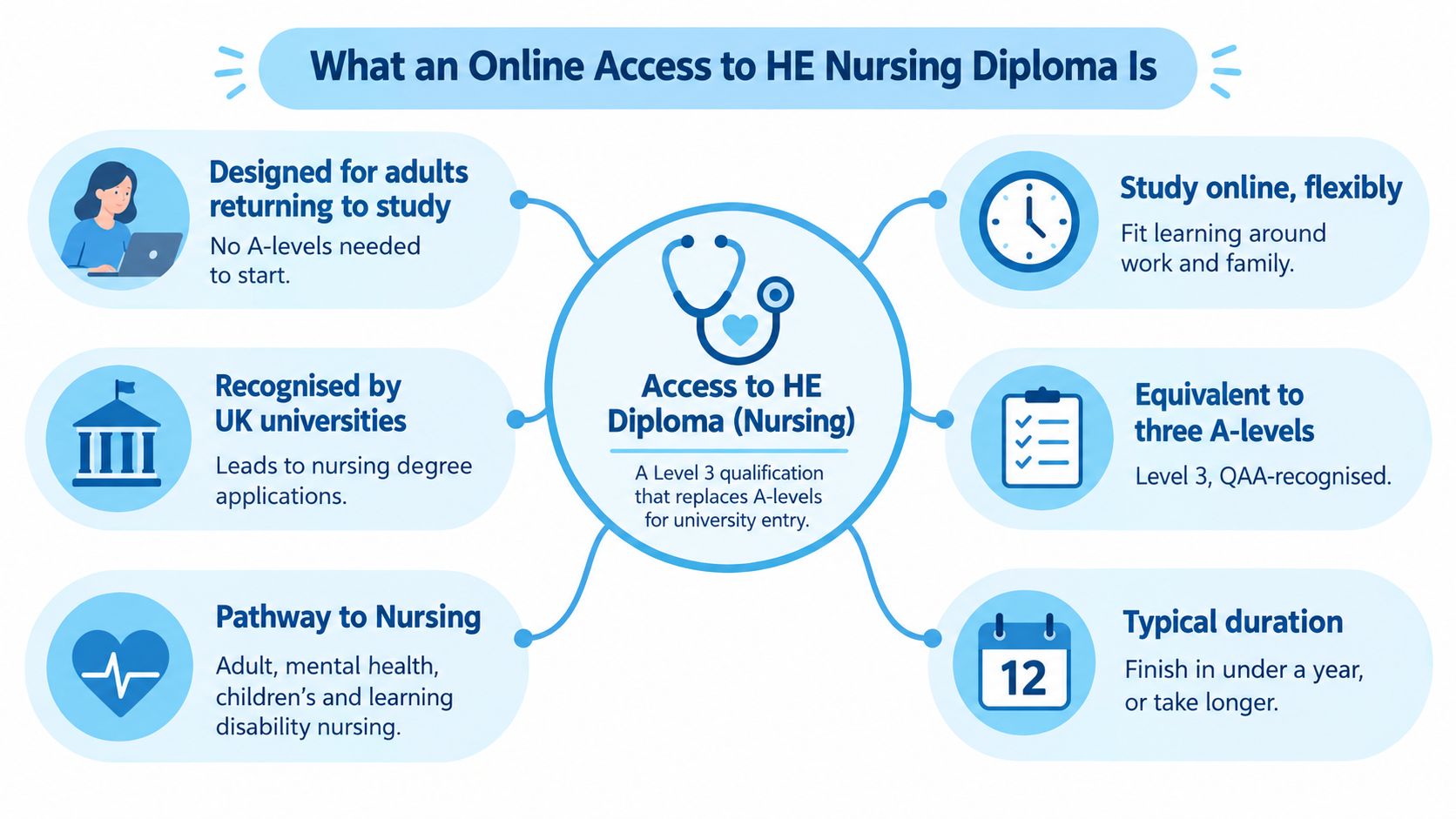
The diploma is a regulated Level 3 qualification for adults preparing for degree-level study. Level 3 study is typically treated as equivalent to three A-levels, although each university decides which qualifications it accepts and what grades or subjects it requires. You should check those requirements before enrolling, because completing the diploma does not guarantee an offer from every nursing degree.
Online delivery changes where you complete much of the academic preparation. Through a learning platform, you may study biology, academic writing, research and study skills, then submit assignments with guidance from tutors. Course information on the Level 3 nursing pathway shows how this format can reduce timetable and location barriers for adult learners.
A launchpad, not a shortcut
The diploma is a launchpad rather than a shortcut. It builds the academic evidence needed to apply for a nursing degree, but it does not replace the degree, professional registration or clinical training. Your later route will still involve university selection, health and suitability checks, and supervised in-person placements. Online study prepares you for that route; it does not turn clinical learning into a home-based activity.
Providers may organise the programme into separate units, combining guided learning with independent reading and assignment work. Plan for a suitable computer, reliable internet access and regular quiet study time. Flexibility helps you fit learning around work or family commitments, but the qualification still requires consistent effort and deadlines.
For a clear explanation of what Access to Higher Education means, read the plain-language guide before comparing nursing courses and checking their progression requirements.
Who the Course Is For and What You Need to Start
Consider three learners who often ask about this route.
The first is a career changer who has spent years in an office role. She has the maturity to communicate with patients, organise competing responsibilities and handle sensitive situations, but her school qualifications don't meet a university's usual academic requirement. The diploma gives her a structured way to prove that she can now study successfully.
The second is a parent returning to education. He can't attend a campus every weekday because of school runs and caring duties, but he can create regular study periods at home. Online learning doesn't remove the work involved, but it can make the timetable more compatible with family life.
The third is someone who left school without the grades they hoped for. That experience can make university feel as though it belongs to other people. It doesn't. Previous results may affect which route you need to take, but they don't decide whether you're capable of learning anatomy, writing academically or developing into a safe practitioner.
What to check before enrolling
Providers set their own admissions processes, so ask for an individual assessment rather than relying on a general eligibility statement. In many cases, the route is designed for adults who don't already hold the A-levels normally requested for university entry. You should still discuss your circumstances before enrolling, particularly if you have overseas qualifications, additional learning needs or a specific university in mind.
Use this checklist when speaking to a course adviser:
- Your target degree: Name the adult, mental health, children's or learning disability nursing degrees you may apply for.
- Your current qualifications: Share certificates, employment experience and any previous higher education study.
- Your available time: Explain your work pattern, caring responsibilities and the hours you can protect for assignments.
- Your technology: Confirm that you have suitable equipment, internet access and a private place to study.
- Your support needs: Ask how tutors give feedback, how quickly they respond and what happens if you need help with academic writing.
Practical rule: Choose the university first, then check that the Access diploma and its grading requirements match that university's admissions policy.
You don't need to feel academically confident before you start. Confidence usually grows after you complete your first piece of work, understand the feedback and see that improvement comes from practice. What matters at the beginning is readiness to work consistently and ask for help early.
What You Study: Biology, Health Studies, Academic Skills and Numeracy
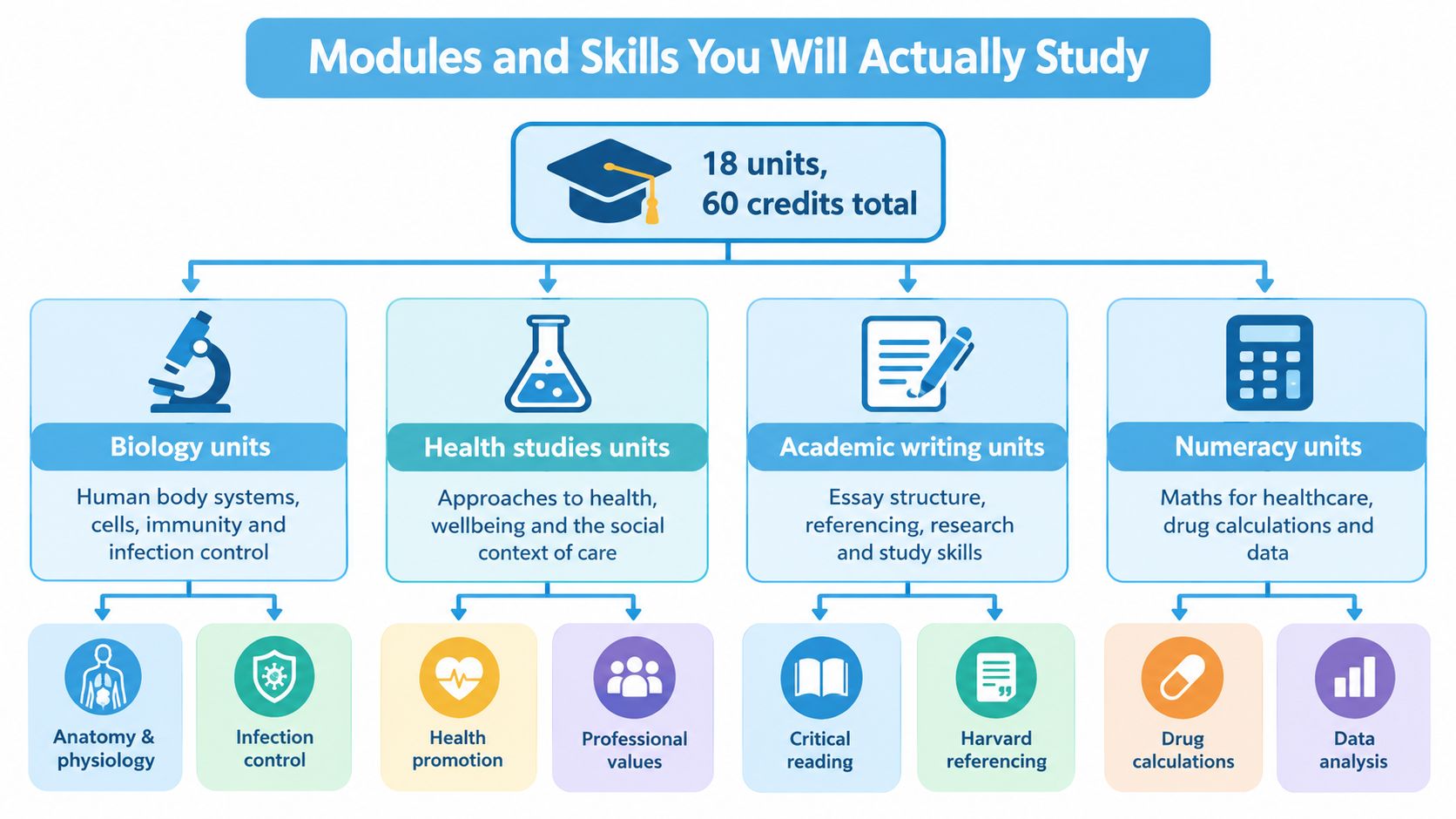
An online nursing Access diploma should connect each assignment with the degree and career you are considering. The course is usually divided into units that combine subject knowledge with preparation for university-level study. Providers organise these units differently, so check the specification and grading requirements before you enrol.
The main areas of learning
Human biology and health science cover areas such as cells, body systems, immunity and infection. A nursing degree builds on this foundation, so you may need to explain biological processes, interpret information and connect changes in the body with patient care. The aim is understanding, not memorising isolated facts.
Health studies and the social context of care examine health, wellbeing, prevention and the circumstances that shape people's experiences. Housing, income, culture, relationships, age and access to services can influence a person's health and ability to follow care advice. This helps you see why nursing decisions must consider the individual as well as the condition.
Academic writing and research skills help you replace unsupported opinion with clear, evidence-based reasoning. You will practise planning essays, structuring paragraphs, paraphrasing, referencing sources and reading critically. These habits matter on a nursing degree, where you must explain why a decision is appropriate rather than just state what you think.
Numeracy for healthcare develops accuracy with numbers, measurements, data and healthcare-related calculations. Assessment methods vary between courses, but the practical expectation is consistent. You need to handle information carefully and methodically before progressing into professional training.
These subjects work like the foundations of a house. Biology gives you the scientific base, health studies adds the wider context, and academic skills help you build a sound explanation. Numeracy supports safe interpretation of measurements and data.
How assessment builds readiness
Assignments can include essays, written answers, research tasks, presentations or other assessed activities. Tutor feedback identifies unclear arguments, missing evidence and imprecise writing, giving you a specific way to improve before the next task.
Use each assignment as preparation for university. Plan your week, record sources while reading and leave time to check your references. The diploma tests more than subject knowledge. It also shows whether you can manage the study habits a demanding nursing degree requires, alongside the practical entry requirements and placements that come later.
How Online Study Works in Practice
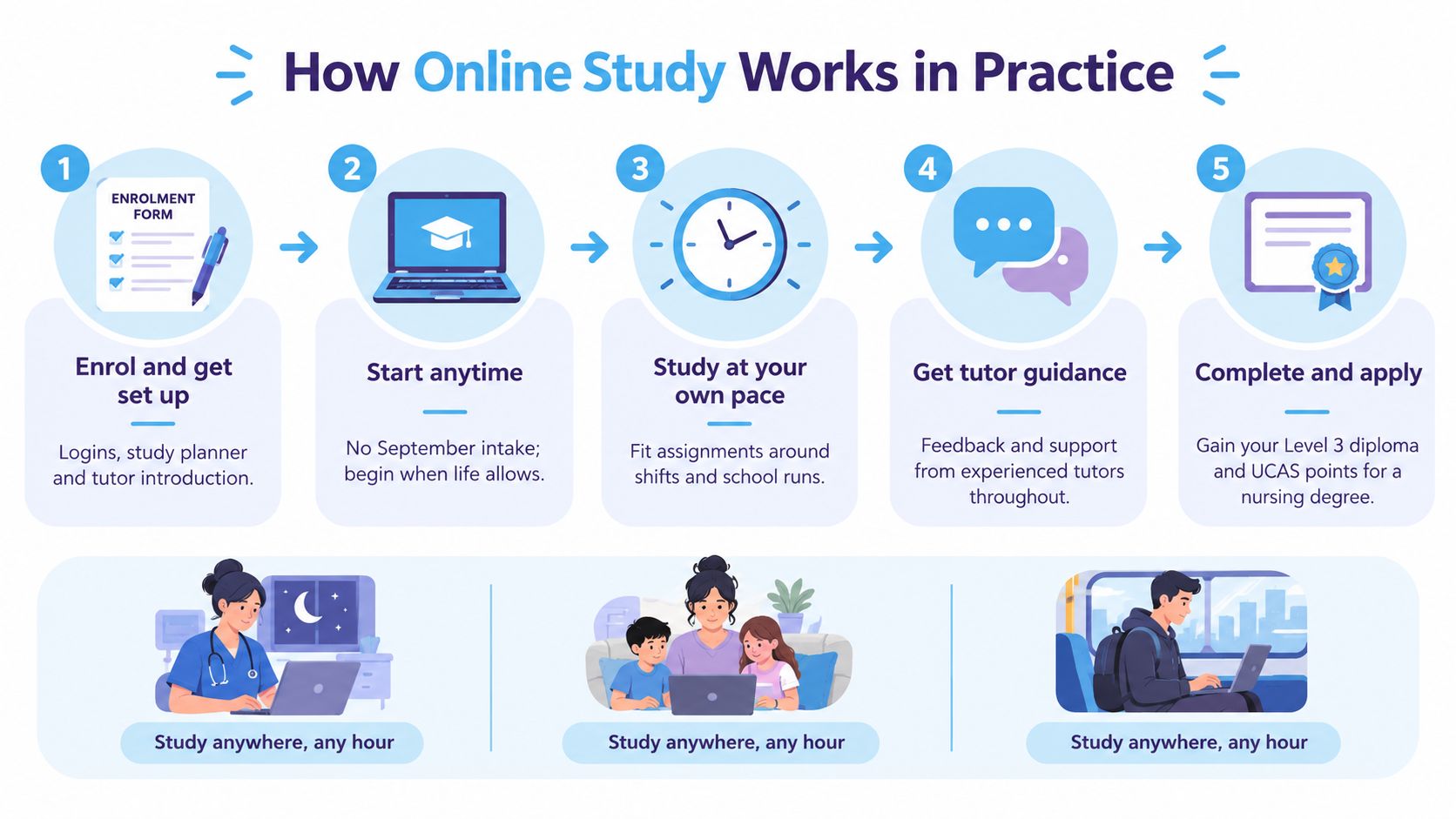
Online study usually begins with enrolment, access to a learning platform and a plan for working through the units. You may read course materials, watch lessons, complete activities and submit assignments digitally. Tutor feedback gives you a route to improve rather than leaving you to guess whether your work meets the standard.
The flexibility is practical. You can study before a shift, after a school run or during a quieter part of the week. That flexibility matters because a national nursing survey found that 21% of students wanted more flexible delivery and 19% wanted technology-enabled learning that reduced travel. The survey report on barriers in nursing education connects online learning with a genuine need among students, rather than treating it as a convenience for its own sake.
The part that can't be completed from your sofa
Online Access study prepares your academic foundation. A nursing degree still prepares you for hands-on practice, professional judgement and direct responsibility for patient care.
Think of it as learning the theory in your kitchen and developing clinical skills on the ward. The first setting can be flexible. The second requires supervised, in-person experience. Universities still expect placements, and they may add entry requirements beyond the minimum standards set by the Nursing and Midwifery Council. You'll need to check the policy for every degree you're considering.
This affects your planning before you enrol. Ask the university where placements take place, whether travel is involved, how placement hours fit around employment and what health, character or occupational requirements apply. An online diploma may remove regular travel to a classroom, but it won't remove the practical commitments of the degree that follows.
You can explore the student experience in this guide to studying an Access course online from home.
A successful online learner doesn't wait for motivation to appear. They put study time in the calendar, tell family members when they're unavailable and contact the tutor when a problem first appears. Flexibility works best when you give it structure.
Progression Routes Into Nursing Degrees and Careers
The progression route has several stages, and the Access diploma is the first academic stage rather than the final professional qualification.
| Stage | What It Involves | Typical Duration |
|---|---|---|
| Access diploma | Complete Level 3 nursing-related study and assessed work | Varies by provider and study pattern |
| University application | Compare courses, submit an application and meet admissions conditions | Varies by applicant and university |
| Nursing degree | Complete academic study, skills training and supervised placements | Set by the university course |
| Professional registration | Meet the requirements for registration after completing the degree | Determined by the relevant regulator |
| Employment | Apply for suitable nursing roles and complete employer checks | Depends on vacancies and personal choice |
The scale of the route is clear from national Access data. In 2022-23, 38,220 students in England were registered to study an Access to HE Diploma, and 7,105 students entering higher education in September 2023 with an Access diploma progressed into nursing and midwifery. This makes nursing and midwifery one of the largest progression pathways for Access learners. The Access to HE key statistics provide the underlying figures.
What the numbers do and don't prove
Those figures show that the route is established and that many Access learners progress into nursing-related higher education. They don't guarantee admission to your chosen university, successful completion of the degree or a particular job.
Your application will still be judged against the university's requirements. Some courses may specify particular science content, grades, interview performance, GCSE subjects, health checks or evidence of relevant experience. A provider can help you understand the diploma, but only the university can confirm whether your planned qualification meets its conditions.
The employment outlook also explains why many adults consider this route. A UK health and adult social care skills assessment identified higher education nursing and midwifery courses at Level 6 and above as an important route into priority occupations, with up to 93% of leavers entering those occupations. The same assessment recorded 16,130 recent leavers linked to nursing and midwifery at that level, 32,670 in the latest cohort table and a growth figure of 18%. The Skills England health and adult social care assessment provides that workforce context.
These figures describe a labour-market pipeline, not a promise of employment for every learner. Your best protection is to choose a university carefully, understand the placement commitment and build academic confidence before the degree begins.
Funding Your Access to Higher Education Nursing Online Course
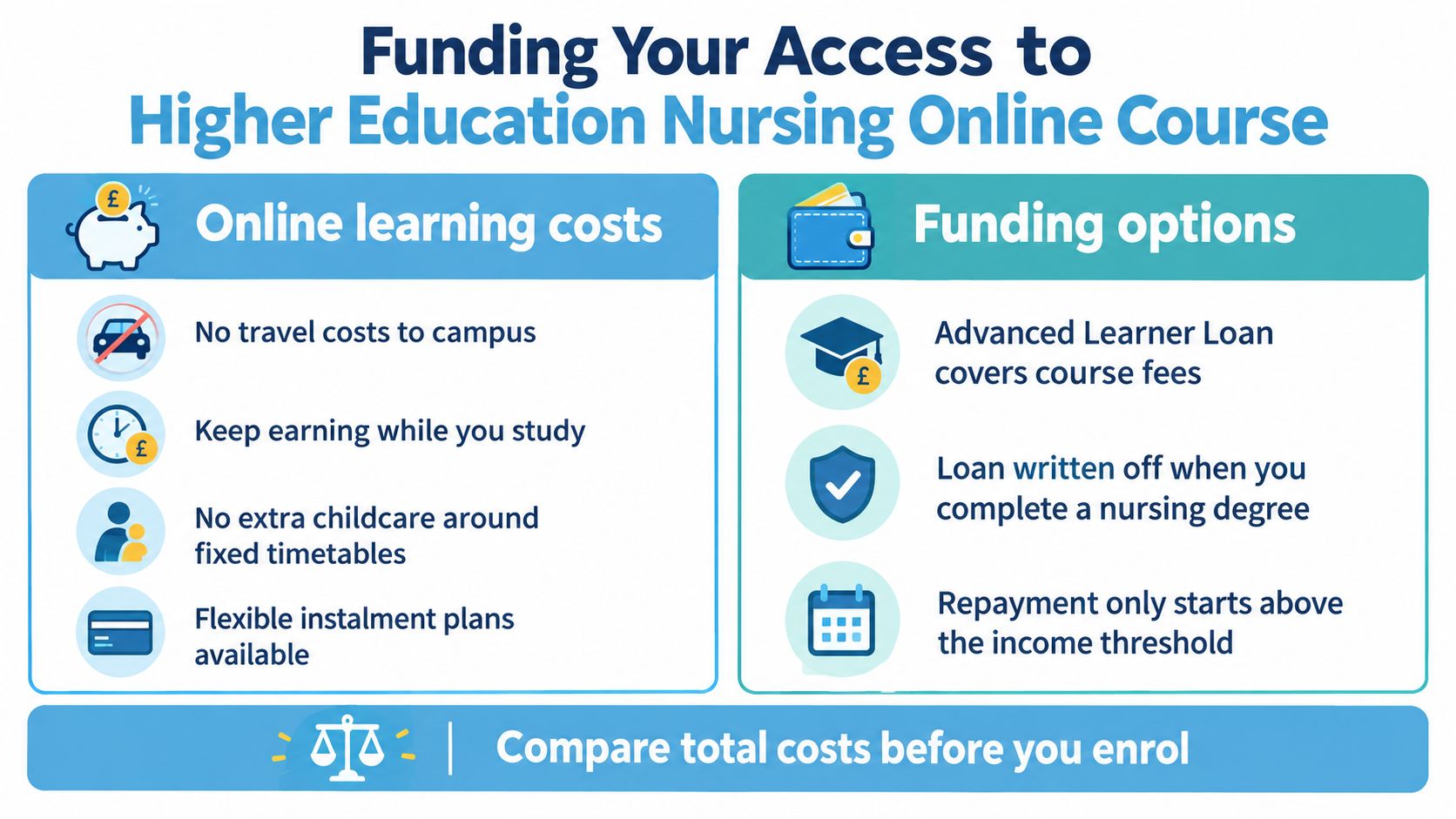
Cost affects whether adult learners can begin and whether they can continue. Compare the full financial picture, not only the advertised course fee.
Online study can reduce some indirect costs because you won't need regular travel to a campus. If the timetable fits around your job, you may also avoid reducing your working hours just to attend fixed classroom sessions. You should still budget for a computer, internet access, books or other course materials if the provider requires them.
Compare the payment choices
Paying the entire fee at enrolment gives you a clear immediate cost, but it may place pressure on your household budget. An instalment arrangement spreads payments and can make the monthly commitment easier to plan. Where a provider offers an interest-free payment plan over 12 months, ask whether it covers the complete diploma fee and whether any separate costs apply.
A funding route may work differently from a payment plan. Ask whether you qualify for an Advanced Learner Loan, what the loan covers and what conditions apply if you progress to a nursing degree. Don't assume that every online Access course, university or personal circumstance receives the same treatment.
Use this guide to Access to Higher Education funding to prepare your questions before speaking with an adviser.
Questions to ask before you commit
- Total fee: What is the complete cost from enrolment to diploma completion?
- Payment schedule: Are instalments interest-free, and what amount is due at each stage?
- Included support: Does the fee include tutor marking, feedback and access to the learning platform?
- Extra charges: Will you pay separately for assessments, certification, materials or administration?
- Progression advice: Can an adviser help you compare the requirements of your intended universities?
A clear answer is more useful than a vague promise that a course is affordable. Write down the fee, payment dates and included services, then compare them with your available income and household commitments.
Your Next Steps and Common Questions Answered
You don't need to solve the whole nursing journey in one afternoon. Start with the degree you may want, work backwards to its entry requirements and then choose an Access pathway that supports that destination.
A practical starting checklist
- List target universities: Check the published requirements for the nursing courses you're considering.
- Ask about diploma suitability: Give the provider your current qualifications and intended degree choices.
- Request funding guidance: Confirm the total fee, payment options and any possible funding route.
- Book a taster day: Use a taster session to experience the learning platform and ask about tutor support.
- Plan your study time: Protect regular periods for reading, assignments and revision before you enrol.
- Prepare for the degree: Research placement locations, interview expectations and the practical commitments that come later.
You can contact providers through email, phone or WhatsApp if you want to discuss your circumstances before making a decision. Personal advice is especially useful if you're working full-time, caring for relatives or unsure whether your previous qualifications count.
Can I study while working full-time?
Often, yes, provided the course schedule and your available study time are compatible. Online delivery can remove the need to travel to scheduled classroom sessions, but assignments still need sustained attention. Ask how deadlines work, whether you can pause or extend study and how tutors support learners whose shifts change.
Will universities accept an online diploma?
Universities assess the qualification and your application against their own admissions rules. Don't rely on the word “online” alone. Ask each university whether it accepts the specific Access diploma, whether it expects particular units or grades and whether additional conditions apply.
What happens if life interrupts my course?
Contact the provider as soon as you know there's a problem. A tutor may be able to discuss workload, deadlines or available support, but the options depend on the provider's policy and your circumstances. Delaying the conversation can make a manageable interruption feel much harder.
You're allowed to take this decision seriously without talking yourself out of it. Adults who missed out at school can still build the academic skills, resilience and confidence needed for nursing, as long as they understand both the opportunity and the practical reality.
Access Courses Online offers a fully online Access to Higher Education Diploma in Nursing, with tutor guidance, flexible study and advice about progression and funding. Visit Access Courses Online to enquire about the course, book a taster day and discuss whether the route fits your qualifications, work and family commitments.