

A woman in her mid-thirties has spent years working on a shop floor, and now she wants to train as a biomedical scientist. She left school at 16, has no A levels and isn't sure whether her old maths lessons are enough for university science. An Access to HE Science diploma could give her a route to apply, but she'll need to check both the course requirements and her readiness for the work ahead.
What an Access to HE Science Course Is and Who It Suits
An Access to Higher Education Diploma is a Level 3 qualification designed for adults preparing for university. It can provide an alternative to A levels when applying for degrees in science, health and engineering, but it isn't a shortcut around the knowledge those degrees require. Think of it as a bridge: each unit adds a plank between your current skills and the maths, writing and science a degree course expects.
University remains the main route into many scientific, technical and health-professional careers. The scale of the system is substantial: HESA's student statistics recorded 2,862,620 higher-education students in the UK in 2021/22, a 4% increase on the previous year. HESA also reported that the proportion of undergraduates from low-participation neighbourhoods rose by 1 percentage point over that period. Those figures show both the reach of higher education and why alternative entry routes matter for people whose school experience didn't lead directly to university.

The diploma may suit career changers, carers, adults who left school early and people who need to study around work. It can be a practical option if you can protect regular time for assignments and are ready to rebuild academic habits. Look carefully before enrolling if you need a degree within a year or can't manage weekly deadlines. The diploma itself takes sustained work, and university entry requirements still apply.
The next decisions are concrete: test your maths readiness, compare typical modules, find out how practical work is delivered, understand assessment and grading, match the diploma to a degree route, and plan how to finish. A final checklist can help you confirm that the course and provider fit your target university.
Maths and Prior Knowledge You Need Before Enrolling
A science diploma may provide a route to university, but you'll still need to meet the degree's entry requirements and handle its maths. Many courses ask for English and maths at a recognised standard. GCSE Maths at grade 4/C or Functional Skills Level 2 is a common benchmark, including on many nursing and midwifery routes. Universities set their own rules, so check the entry page for the specific course you want.
Before enrolling, try this short readiness check. Notice which questions take effort:
- Rearrange y = mx + c to make x the subject.
- Convert 250 mg into grams.
- Calculate a 15% increase on 80.
- Read a labelled bar chart and identify the largest value.
- Write 0.0045 in standard form.
Each question reflects a task you may meet in science. Unit conversions and percentages help make measurements meaningful; graphs help you interpret results. Chemistry may involve quantities and concentrations, while physics often asks you to rearrange a formula before substituting values. If making a variable the subject feels unfamiliar, practise it before a physics unit, rather than waiting until a deadline.
Maths attainment gaps persist for disadvantaged pupils, which can make access to science study harder. For adult learners, the practical point is to plan how to build the skills a degree will use, rather than assuming confidence alone will fill gaps.
How to rebuild your maths
If the check exposes weak areas, practise alongside your course. One possible plan is three hours a week for six to eight weeks on Functional Skills or GCSE-level maths, starting with the skill that causes the most difficulty. Short, regular sessions give you time to revisit methods and spot mistakes. A structured starting point is this guide to Functional Skills Level 2 Maths.
A readiness check is not a judgement on whether you can study science. It shows which skills to strengthen before the material becomes demanding. The route works best when maths preparation is part of the plan, not an afterthought.
Typical Modules and How the Diploma Is Built
A full Access to HE Diploma usually contains 60 credits at Level 3, with units commonly carrying 15 credits each. The modules below are examples of common science options, not a universal syllabus. Providers and awarding bodies differ in unit names, credit values and optional choices, so check the complete unit list before enrolling.
| Module | What it covers | Typical level | Typical credits |
|---|---|---|---|
| Study skills and academic writing | Referencing, essay structure, note-making and time planning | Level 3 | 15 |
| Maths for science | Algebra, graphs, units, standard form and data handling | Level 3 | 15 |
| Biology | Cells, genetics, body systems and ecology | Level 3 | 15 |
| Chemistry | Atomic structure, bonding, reactions and moles | Level 3 | 15 |
| Physics | Forces, energy, waves and electricity | Level 3 | 15 |
| Human biology or anatomy and physiology | Body systems for nursing, midwifery and health routes | Level 3 | 15 |
| Research methods and lab reports | Experimental design, data analysis and scientific writing | Level 3 | 15 |
| Psychology or environmental science | Research design and applied data for social or environmental degrees | Level 3 | 15 |
Read across a row to connect the topic to what you'll learn and the credit value. Then ask whether it supports the degree you're aiming for. A learner applying for nursing may want human biology or anatomy and physiology; someone targeting ecology could look for environmental science. An applicant to biomedical science should pay close attention to biology and chemistry, and confirm that the university accepts the diploma's particular unit profile.
Some diplomas include study-skills units alongside science content. These help you organise assignments, reference sources and write clearly about evidence. They're not filler: a well-reasoned lab report can lose marks if its sources are poorly cited or its conclusions don't follow from the results.
What a typical term demands
A first term might include a theory unit with weekly reading and short tasks, a maths problem set each week, and an essay due every few weeks. That mix can feel unfamiliar if you've been away from education for a long time. Keep a weekly calendar, break assignments into smaller tasks and ask your tutor to clarify the assessment criteria early.
The right module list isn't the one that sounds easiest. It's the combination that supports your target degree and gives you practice in the subjects you'll meet again at university.
Practical Work Versus Theory and How Online Study Fits
Science study combines theory and practical work. Theory is the recipe book; practical work is the cooking. Reading about a chemical reaction can teach you what should happen, but working with results and explaining an unexpected outcome helps you understand what the method can and can't tell you.

A diploma may deliver practical learning in different ways. Some providers arrange in-person sessions at a partner college or another venue, where learners can practise hands-on techniques. Others send home practical kits, while some units use supplied datasets for written analysis and lab-style reports. Data-based tasks can work well online; techniques that require handling equipment or following laboratory procedures need an appropriate practical arrangement.
Ask every provider how its science units handle laboratory content. A course described as online may still include in-person sessions, and you'll need to know where they take place, how often you must attend and what the practical assessment involves.
Practical rule: Match the delivery method to the skill. Reading data can be done at home; demonstrating a hands-on technique may require a suitable supervised setting.
Online study can fit around work and caring responsibilities, but flexibility doesn't remove the deadlines. You'll need a reliable internet connection, a quiet place to work and a routine that leaves time for reading, practice questions and writing. Providers often suggest around 12 to 15 hours a week for part-time study, so ask how that estimate fits the course you're considering.
Before enrolling, get clear answers to three questions:
- Where do practicals happen? Find out whether you'll attend a venue, use a home kit or analyse supplied results.
- How often are they scheduled? Check dates and travel arrangements against work and family commitments.
- What is assessed? Ask whether marks come from technique, data analysis, written reports or a combination.
This overview can help you think through the difference between online theory and practical learning:
How Assessment and Grading Work
An Access diploma usually combines coursework and exams. Many units are graded Pass, Merit or Distinction, and the assessment method depends on what the unit is meant to test. A lab report, for example, asks for a different kind of evidence from a timed maths exam.
| Assessment method | Where it appears | What it tests | Common pitfall |
|---|---|---|---|
| Written assignments and essays | Study skills, research methods and applied units | Argument, referencing and academic style | Weak referencing costs marks |
| Timed exams | Biology, chemistry, physics and maths | Recall and problem-solving under time pressure | Revising content without practising exam-style questions |
| Lab reports | Practical science units | Data analysis, method description and conclusions | Ignoring error analysis |
| Observed practical tasks | Practical units, often at partner venues | Technique and safety | Venue distance can delay scheduling |
| Portfolio and reflective journal | Health and care units | Reflection and applied learning | Describing events instead of analysing them |
| Problem sets and online quizzes | Maths and physics | Speed and accuracy with formulas | Leaving early feedback unread |
Grades and university offers
Each unit earns its own grade. Universities set their entry offers as a required mix of Merit and Distinction credits across the Level 3 diploma, so don't assume that passing every unit will meet your target course's offer. Competitive science, nursing and medicine-related courses may ask for more Distinctions than other programmes. Read the exact entry requirements for every course you're considering and keep a record of your grades from the first unit.
The marking criteria tell you what the assessor expects. Read them before you start writing, not after you've submitted. If your provider accepts drafts, use that opportunity to get feedback while you still have time to improve the work.
For a practical illustration of how scientific writing is structured, review these science report examples. Pay attention to how the method, results and conclusion relate to one another. In your own work, explain what the data shows and what it doesn't show.
A unit that isn't passed first time may have a resit or resubmission route, but don't assume it will fit neatly around every other deadline. Ask your provider about the process and timing. Early feedback is a map to the next grade, so act on it while you still have time to change your approach.
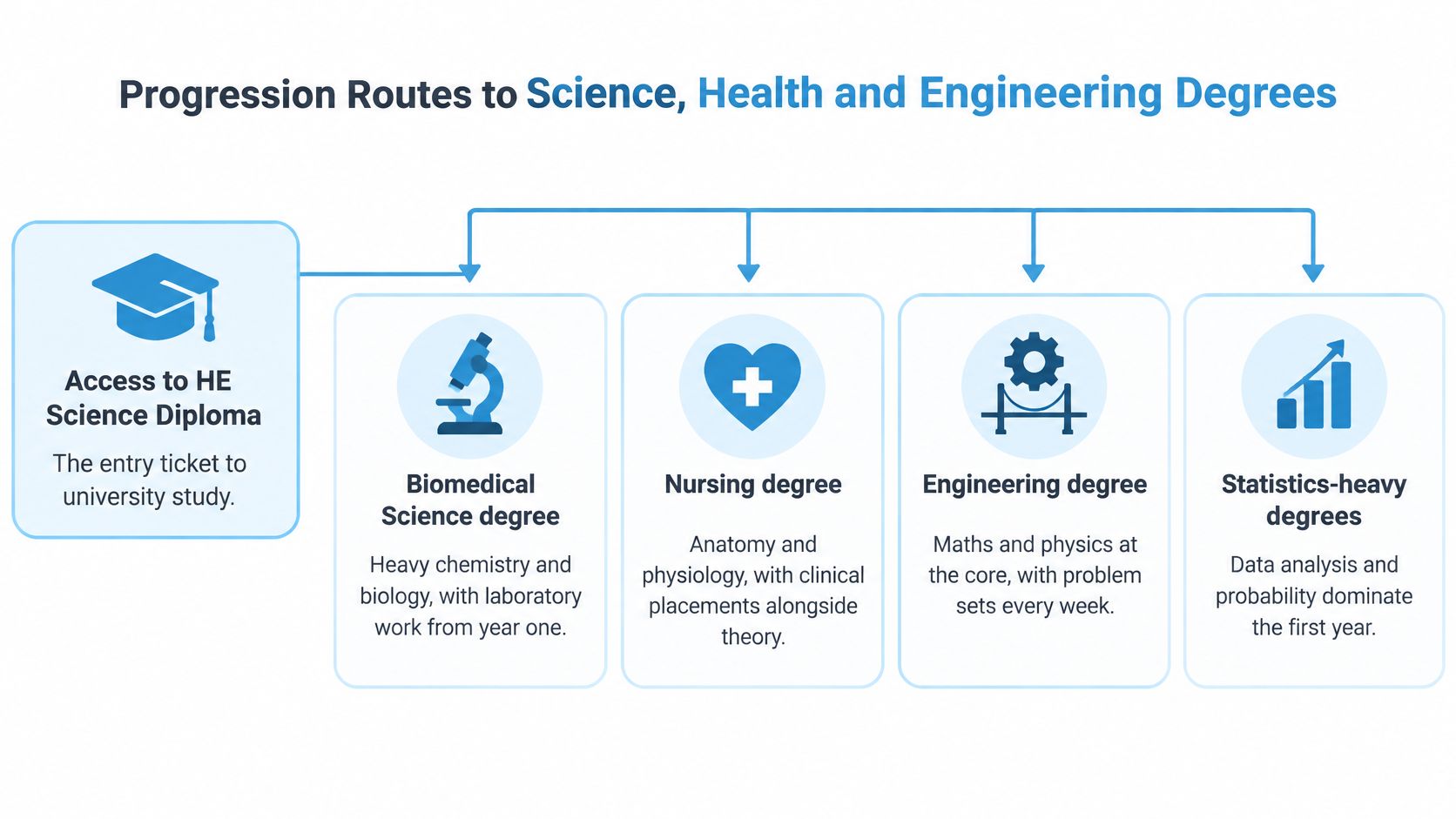
Progression Routes to Science, Health and Engineering Degrees
The diploma is an entry ticket, not a promise that every degree will feel the same. Your chosen subject decides how much chemistry, maths, statistics or practical work you'll meet in the first year. Compare the routes against both your interests and the unit grades you can realistically achieve.
| Degree family | Main science content | Maths demand | Entry note |
|---|---|---|---|
| Nursing, adult, child or mental health | Anatomy, physiology and pharmacology | Medium, including dosage calculations | Usually requires GCSE English and maths or Functional Skills, plus health checks |
| Midwifery | Physiology, public health and obstetrics | Medium, including dosage and clinical calculations | Similar English and maths rules, with placement checks |
| Biomedical science | Biochemistry, microbiology and laboratory techniques | High, including statistics and chemistry | Strong chemistry and biology are expected |
| Pharmacy | Chemistry and pharmacology | High | Chemistry is usually essential |
| Physiotherapy | Anatomy and biomechanics | Medium | Practice placements and health checks |
| Computer science | Algorithms, data structures and logic | High, including discrete maths and logic | Programming experience helps but isn't always required |
| Mechanical or electrical engineering | Physics, materials and design | High, including calculus and mechanics | Physics and maths are strongly expected |
| Environmental science | Ecology, chemistry and data analysis | Medium, including data analysis | Field work is common |
Nursing and midwifery combine academic study with professional preparation. You'll meet anatomy and physiology, pharmacology, placements, health checks and dosage calculations. Check each university's English and maths rules, and ask whether it expects particular Access units or a specified mix of grades.
Biomedical science puts heavier demands on biology and chemistry, while engineering relies strongly on maths and physics. Environmental science may combine field work with data interpretation. For those considering an engineering route, this guide to Access courses for engineering can help you think about the subject match.
From diploma to university application
The application process typically follows this sequence:
- Enrol and complete your units. Choose units that support the requirements of the degrees you may apply for.
- Get provisional results or predicted grades. Your provider can explain what information is available for applications.
- Apply through UCAS. Check the deadline for your course and application year. Medicine, dentistry and veterinary courses may have an earlier application deadline than other degrees.
- Attend interviews or placement checks. Some health courses assess communication, suitability and placement requirements as part of selection.
- Prepare for year one. Make a plan to strengthen any maths topic that will be important in your degree.
Universities can assess Access applicants differently, even when the degree title is similar. Their own course page is the final authority on accepted diplomas, required units, grades and any additional conditions. Choose a route by matching your interests with the course's actual demands, not by relying on a general idea of what the degree involves.
Finishing Strong and Where Graduates Go
Getting a place matters, but continuing through university matters too. Advance HE's analysis of Office for Students data reports that mature students aged over 25 represented 29.9% of undergraduate entrants in 2024/25, up from 25.5% in 2018/19; mature entrants nevertheless had lower continuation rates than younger students, with a 9.2-percentage-point gap in 2022/23. The same Advance HE analysis reports first-year continuation of 83.5% for students in the most deprived quintile, compared with 93.1% in the least deprived quintile. Entry needs to be followed by habits and support that help you keep going.
Five practical routines can make study more manageable:
- Protect a weekly study slot. Put it in your calendar and treat it like a shift you can't casually swap.
- Keep a running revision sheet. Add formulas, key terms and the mistakes you want to avoid.
- Plan for exam periods. Talk through caring arrangements and finances before deadlines pile up.
- Build a support circle. Let family or classmates know when you need uninterrupted time, and find someone you can ask for help.
- Contact tutors early. If a concept isn't clear, use tutor office hours and ask about it within a week instead of waiting until the end of term.
What progression can look like
These are composite examples, not promises of a particular result:
- From care work to nursing: A former care assistant completes an Access diploma, progresses to a nursing degree and later works as a registered nurse.
- From retail to a hospital laboratory: A retail team leader uses the diploma to apply for biomedical science, completes the degree and moves into laboratory work.
- From warehouse work to software: A warehouse worker progresses to computer science and later starts as a junior developer.
Other possible destinations include midwife, pharmacist, engineer, data analyst and environmental consultant. The route depends on your chosen degree, your results and the opportunities available in your local job market.
Confirm Your Route Before You Enrol
Before you commit, make these seven checks:
- Confirm the university's entry rules. Find them on the university's own course page, not just in a provider summary.
- Check credits and grades. Make sure you understand the diploma's Level 3 credit total and the grade profile your target course asks for.
- Take the maths readiness check. Identify gaps now, while there's time to work on them.
- Read the unit list and practical arrangements. Confirm that both suit your intended degree and your schedule.
- Compare fees and payment plans. Work out what you'll pay and when.
- Check tutor access and taster options. Ask how you can get help and whether you can see what studying involves before enrolling.
- Protect weekly study time. Choose a regular slot that fits around work, family and rest.
Compare at least two providers against the same questions. Check whether each is listed on the government's Register of Learning Providers, how it arranges science practicals and what support it offers by email, phone or chat. Access Courses Online provides online Access to HE Diploma courses, tutor guidance, taster options and advice on funding and progression, so you can assess it alongside other providers using the criteria above.
Enrol if your target degree accepts the diploma, you've passed the maths readiness check or have a realistic rebuild plan, and you can protect weekly study time. Your next step is simple: book a taster or ask a provider for advice on the unit route that matches your intended degree.
If you're preparing for a science degree, Access Courses Online offers an online Access to HE Science Diploma, tutor guidance and advice on progression routes. Visit the site to ask which units may suit your target course and whether the study format fits around your work and family commitments.