

Functional Skills Level 2 Maths is a nationally recognised UK qualification, but what does that actually mean for you? It's designed to give you the essential, practical maths skills you need for work, education, and just navigating everyday life.
Crucially, it’s officially recognised as equivalent to a GCSE Grade 4 (what used to be a Grade C). This makes it a key that can unlock doors to higher education and better job prospects you might have thought were closed.
A Practical Alternative To GCSE Maths
Think of Functional Skills Level 2 Maths less like a traditional, theory-heavy school subject and more like a practical toolkit. It’s built entirely for real-world application, helping you solve the kind of problems you'll genuinely run into day-to-day.
Instead of getting bogged down in abstract concepts, this qualification teaches you how to apply solid mathematical principles to everyday scenarios. It’s all about the 'how' and 'why', not just memorising formulas.
This approach is perfect for a whole range of people. Whether you're an adult learner returning to education after a break, someone who just missed out on a GCSE pass, or a professional looking to upskill for a promotion, this qualification is designed with you in mind. It's also a common requirement for many university-level courses, including popular Access to HE Diplomas.
Who Is This Qualification For?
The real beauty of this qualification is how relevant it is. This isn't just about passing an exam; it's about building genuine, lasting confidence with numbers. The main goal is to make sure you can competently handle mathematical tasks in situations that actually matter.
This makes it ideal for:
- Adults returning to study: It offers a supportive and relevant way back into the world of education.
- Career changers: Many professions require a Level 2 maths equivalent for entry or to move up the ladder.
- University applicants: It’s a widely accepted alternative to GCSE for getting onto Access to HE Diplomas and many degree courses.
- Anyone needing a confidence boost: If your past experiences with maths were negative, this practical focus can completely change your perspective for the better.
This qualification's role as a vital alternative pathway is backed up by national statistics. It has become a crucial option for adults and young people looking to improve their numeracy. The importance of qualifications like this is clear when you see that in the 2023/24 academic year, around 40% of 19-year-olds in England achieved Level 2 maths attainment through various routes, including Functional Skills.
Functional Skills is all about context. It finally answers that classic question, "When will I ever use this?" by placing every single mathematical concept into a scenario you can recognise—from calculating sale discounts and understanding payslips to measuring a room for new flooring.
Ultimately, the focus is squarely on practical problem-solving. It strips away the intimidating complexity often associated with academic maths and replaces it with skills you can immediately put to use.
If you're looking for a qualification that values application over abstract theory, this is the path for you. You can learn more about the broader scope of these qualifications in our detailed guide on what Functional Skills qualifications are. This clear, purpose-driven structure is exactly why so many learners find success and renewed confidence through Functional Skills Level 2 Maths.
GCSE Maths vs Functional Skills: A Practical Comparison
Choosing between GCSE Maths and a Functional Skills Level 2 Maths qualification can feel like a huge decision. They're both respected Level 2 qualifications, but they’ve been designed for completely different people with different goals. The question isn't about which one is 'easier'—it's about which one is the right tool for your specific journey.
Think of it like building a piece of furniture. GCSE Maths gives you all the raw materials and the complex theories behind woodworking—the physics of tension, the chemical properties of varnish, and the pure geometry of different joints. It's deep and theoretical.
Functional Skills, on the other hand, hands you a clear set of instructions and the exact tools you need to get the job done right. It's all about practical application.
GCSE Maths is known for covering a very broad, and often abstract, range of mathematical topics. Its main purpose is to build a deep theoretical foundation, which is why it’s often a must-have for A-Levels and more academic university routes.
In complete contrast, Functional Skills is all about real-world use. Every single topic is taught through the lens of a realistic, everyday problem. You won’t just learn about percentages in theory; you’ll learn how to calculate a 20% discount on your shopping or figure out the interest on a loan. It’s maths for life.
The Core Philosophical Difference
The biggest distinction between the two is what they set out to achieve. GCSE Maths aims to build a wide-ranging academic understanding. It essentially asks, "How much maths do you know?"
Functional Skills Level 2 Maths asks a very different question: "How well can you use maths to solve real-world problems?" This practical focus makes it an incredibly effective qualification for adults who need solid numeracy skills for work, higher education, or just managing daily life with more confidence.
This infographic can help you visualise which qualification might be the best fit for your personal and professional goals.
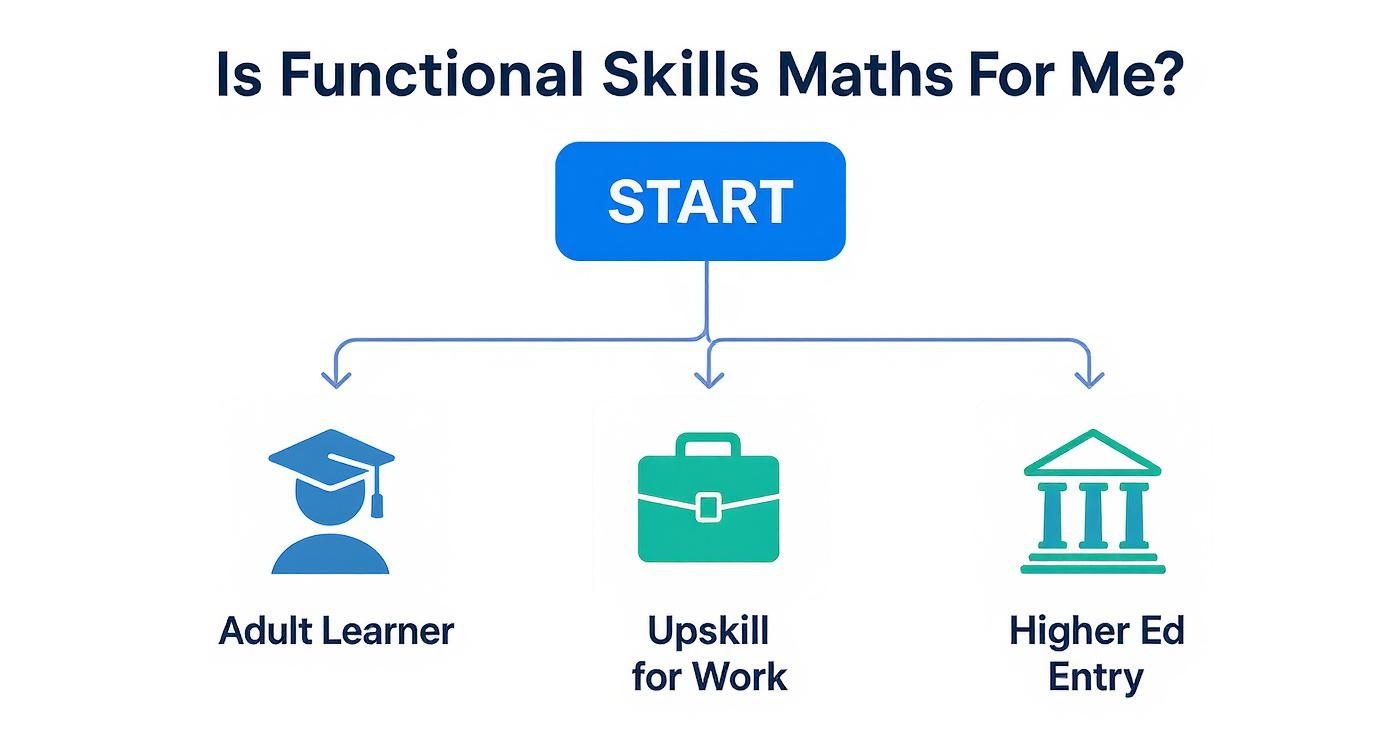
As you can see, the right path often comes down to your immediate goal, whether that’s getting a promotion or securing a place on an Access to HE Diploma.
A Side-by-Side Breakdown
To make the choice crystal clear, let's put them head-to-head. This table lays out how each qualification is structured and who it’s really for. While both can open doors, they take you there on very different paths.
The consensus is that it can be more difficult to pass Level 2 Functional Skills Maths than to achieve a grade 4 in GCSE Mathematics. This is because Functional Skills requires you to not only know the maths but also interpret complex, word-based problems to figure out which skills to apply.
Functional Skills Level 2 Maths vs GCSE Maths
| Feature | Functional Skills Level 2 Maths | GCSE Maths (Foundation Tier) |
|---|---|---|
| Primary Focus | Problem-solving in realistic contexts (work, life). | Broad theoretical knowledge across many maths topics. |
| Content Style | Practical application; scenario-based questions. | Abstract concepts and theoretical principles. |
| Exam Structure | Typically two papers: non-calculator and calculator. | Often three papers, with a mix of calculator and non-calculator sections. |
| Assessment | Pass/Fail. You must demonstrate competence. | Graded system (1-5 for Foundation Tier). |
| Ideal Learner | Adults needing a practical, work-relevant qualification or entry to many university courses. | Students on a traditional academic path, often aiming for A-Levels in maths-heavy subjects. |
At the end of the day, your choice should line up with your end goal. If you need a qualification that proves you can handle numbers effectively in everyday and professional situations, Functional Skills Level 2 Maths is an excellent and highly relevant choice.
For those still weighing up the GCSE route, our guide to GCSE Maths for adults offers some more valuable insights.
Breaking Down The Functional Skills Maths Curriculum
Jumping into any new subject can feel a bit daunting, especially when you’re faced with a curriculum outline. But the real beauty of Functional Skills Level 2 Maths is how logical and, most importantly, useful it is. It cuts through the abstract theory you might remember from school and gets straight to the kind of maths you’ll actually use day-to-day.
Instead of an intimidating list of topics, the course is smartly organised into three core areas. It helps to think of them not as separate subjects, but as three different toolkits for solving everyday problems.
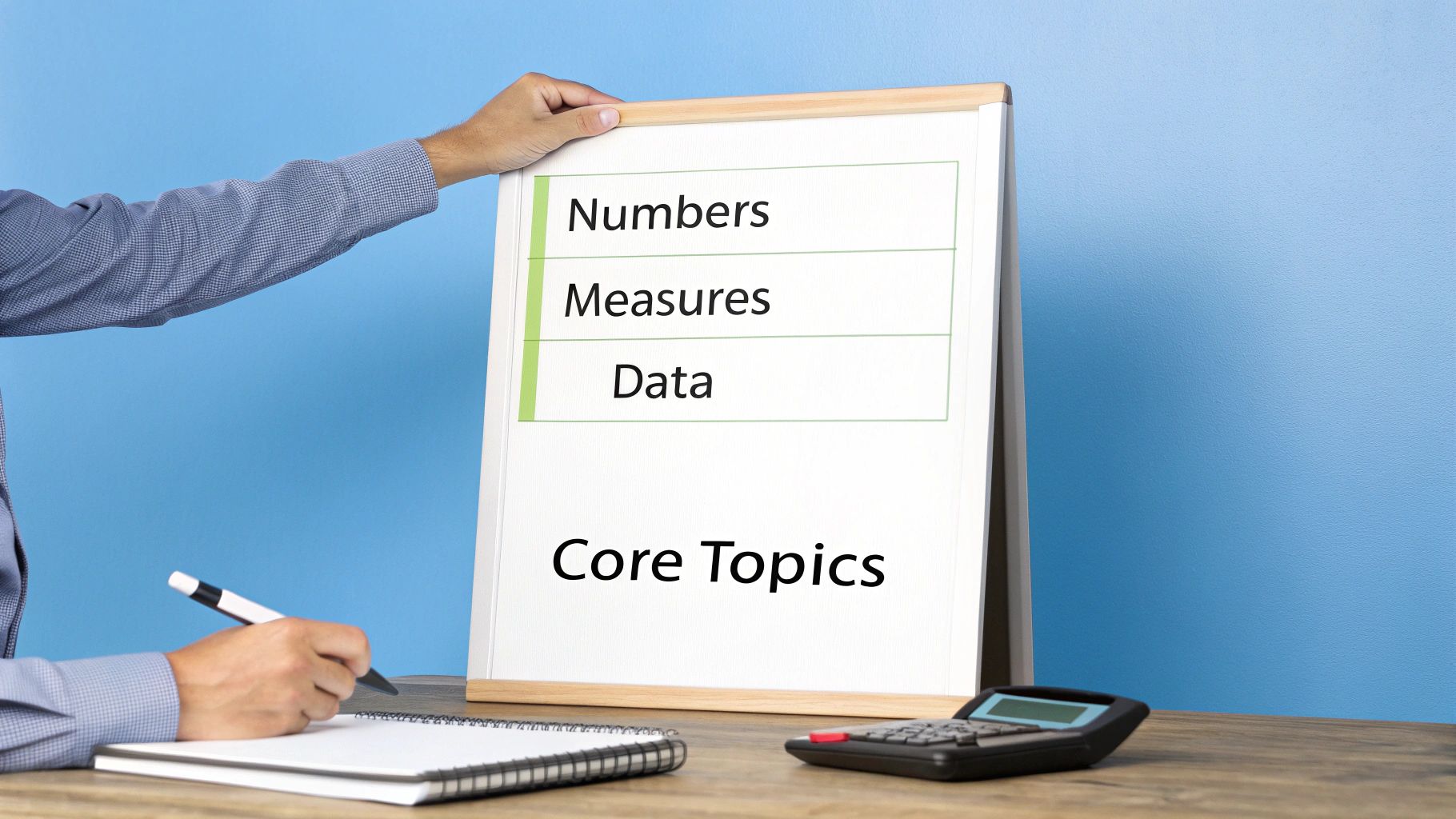
This structure makes the whole process feel much more manageable. It also helps you see the direct link between what you’re studying and your own life. Let’s break down each of these key areas.
Using Numbers And The Number System
This is the bedrock of everything else. It’s all about getting a solid, confident handle on numbers and how they work in the real world. This isn't about chanting times tables; it's about applying those core numerical skills to practical situations that matter.
You’ll get comfortable handling calculations involving whole numbers, fractions, decimals, and percentages. The focus is always on the context. For instance, you won't just learn how to calculate 25% in a vacuum. You’ll learn how to work out a 25% discount on a pair of trainers or figure out the VAT on a restaurant bill.
Key skills you will master in this area include:
- Practical Calculations: Adding, subtracting, multiplying, and dividing numbers in real-life scenarios, like managing a weekly budget or double-checking you haven't been overcharged.
- Fractions and Decimals: Using these to adjust a recipe for more people, or to make sense of distances on a map.
- Percentages: Figuring out interest on savings, understanding a pay rise, or calculating the right amount for a tip.
- Checking Your Answers: A crucial life skill is knowing how to quickly estimate an answer to see if your final calculation actually makes sense.
This part of the curriculum builds your core numerical confidence. It makes sure you can handle the numbers that life throws at you every single day, from shopping and banking to DIY projects.
Measures, Shape, And Space
This section takes maths off the page and puts it into the physical world around you. It’s about understanding dimensions, quantities, and shapes in a way that helps you solve practical, hands-on problems.
Think about any home improvement project. You need to calculate the area of a room to buy the right amount of paint or flooring. You might need to convert measurements from centimetres to metres or work from a scale drawing. These are the exact skills this module is designed to teach.
Here’s what you can expect to cover:
- Working with Measurements: Calculating with money, time, temperature, length, weight, and capacity. This could be anything from planning a journey to converting currency for a holiday.
- Calculating Area, Perimeter, and Volume: This is essential for jobs like fencing a garden (perimeter), tiling a floor (area), or figuring out how much soil a planter can hold (volume).
- Understanding 2D and 3D Shapes: Recognising the properties of common shapes to solve problems related to packing, storage, or even basic design.
Handling Information And Data
We are constantly surrounded by information presented in charts, graphs, and tables. This part of the curriculum gives you the skills to understand, interpret, and use this data to make smart, informed decisions.
It’s about becoming a critical consumer of information. When you see a graph in a news report, you'll be able to understand what it's really telling you. You'll also learn how to collect, organise, and present your own data in a clear and meaningful way.
Core skills include:
- Extracting Information: Reading and properly understanding data from various sources like tables, pie charts, and graphs.
- Calculating Averages: Working out the mean and range of a set of numbers, which is useful for everything from tracking your monthly spending to understanding sports statistics.
- Understanding Probability: Grasping the likelihood of something happening, and being able to express that as a fraction, decimal, or percentage.
By breaking the Functional Skills Level 2 Maths curriculum down into these three practical areas, the path to success becomes much clearer. Each topic is directly tied to a real-world use, making the entire learning process more relevant, engaging, and ultimately, much more achievable.
Getting to Grips with the Exam Structure and How to Pass
Stepping into any exam can feel a bit daunting, but the good news is that the Functional Skills Level 2 Maths assessment is refreshingly straightforward. Once you know exactly what to expect, that anxiety quickly turns into confidence. The whole point of this exam is to test your practical, real-world maths skills – not to trip you up with trick questions.
Most exam boards, like NCFE and City & Guilds, use a standard two-part format. This is designed to check you're comfortable with your numbers both with and without a calculator, giving you a chance to show off a well-rounded skillset.
The Two-Paper Format Explained
Think of it as a two-part challenge. Each part has a different focus, allowing you to demonstrate different sides of your maths ability.
Here’s how it usually breaks down:
- The Non-Calculator Paper: This is the shorter of the two, typically lasting around 30-45 minutes. It’s all about testing your core mental maths and your grasp of the fundamentals. You’ll be showing your workings for things like fractions, percentages, and basic calculations.
- The Calculator Paper: This section is longer, usually about 90 minutes to two hours. Here, you’ll get stuck into more complex, multi-step problems that feel like real-life situations. The focus shifts from pure sums to your ability to read information, figure out the right approach, and then use your calculator to get the job done efficiently.
This two-part approach ensures you can not only do the maths but also understand when and how to apply your skills to solve a problem.
What Score Do I Need to Pass?
This is the big question on everyone's mind. Unlike GCSEs with their confusing grade boundaries, Functional Skills is a simple Pass or Fail. You just need to show you’ve got the skills needed to meet the Level 2 standard.
To get that pass, you’ll generally need to score around 60-65% across both papers combined. With a bit of consistent practice, this is a very achievable target. The marks for each question reflect its difficulty, with more points available for the bigger, multi-step problems.
Your final result is based on the total score from both papers added together. So, if you have a slightly off day on one paper, a strong performance on the other can easily balance things out, giving you a fair shot at success.
Don't Worry – The Pass Rates Are High!
One of the most encouraging things about this qualification is how many people succeed. Because the content is so practical and grounded in everyday scenarios, learners often find it much more relatable and feel better prepared for the exam.
In fact, the pass rates for Functional Skills Level 2 Maths are incredibly high. For the 2023/24 academic year, one of the main providers reported an amazing 93% pass rate for their Level 2 Maths exams. That’s significantly higher than the pass rates for GCSE Maths, which really shows how attainable this qualification is. You can read more about these success stories at Pass Functional Skills.
Let that number sink in. It’s proof that with the right preparation, passing isn't just a possibility—it's the most likely outcome. Think of the exam as a hurdle you can definitely clear, not a wall designed to stop you. Thousands of learners, just like you, successfully get over it every single year.
Your Realistic Study Plan And Preparation Strategies
Let's be honest: juggling studying with work, family, and everything else life throws at you is a massive challenge. The secret to passing Functional Skills Level 2 Maths isn't about magically finding huge chunks of free time you don't have. It's about being smart and strategic with the time you do have.
This isn’t about staring at textbooks for hours on end. Instead, think about short, focused sessions that slot neatly into your existing routine. Many adult learners find that 30-45 minute study blocks, just three or four times a week, are far more effective than trying to cram everything into a marathon weekend session.
This approach stops you from burning out and actually helps your brain soak up new information. The aim is to build a rhythm that feels manageable, not overwhelming.
Building Your Smart Study Framework
A solid plan starts with knowing where you stand. Before you even think about revising, take a quick diagnostic test. Think of it as your personal roadmap, highlighting the exact topics that need your attention so you can skip the stuff you've already mastered.
Once you know your focus areas, you can put together a simple weekly schedule:
- Start with a Diagnostic Test: Use an online assessment to pinpoint your weaker areas. This alone will save you hours of wasted time on concepts you already get.
- Focus on One Topic at a Time: Don't try to tackle fractions, percentages, and area all in one afternoon. Dedicate a couple of study sessions to a single topic until you feel confident, then move on.
- Prioritise Understanding the 'Why': Simply memorising formulas is a recipe for exam-day panic. Instead, focus on understanding why a formula works. This deeper understanding makes it so much easier to apply your knowledge to the real-world, scenario-based questions you'll face.
Your study plan should be a living document, not a rigid set of rules. If you have a crazy week, adjust it. If you master a topic quicker than expected, move on. Flexibility is the key to sticking with it for the long run.
This structured approach puts you back in control of your learning. To get the most out of your time and walk into the exam feeling prepared, it's worth exploring some actionable time management tips for students.
Simulating Exam Conditions For Success
As your exam date gets closer, your focus should shift to practice papers. Honestly, this is probably the most important part of your revision. Working through past papers under timed conditions does more than just test your knowledge—it gets you comfortable with the exam's pace and format.
Try to make this practice as realistic as you can. Find a quiet spot, set a timer, and tackle both the non-calculator and calculator sections just like you would on the day. This simple process builds mental stamina and means there will be no nasty surprises during the real thing.
Here’s a sample weekly plan you can adapt to fit your life:
| Day | Focus Activity (30-45 mins) | Goal |
|---|---|---|
| Monday | Diagnostic Test + Review | Identify weak spots for the week. |
| Wednesday | Topic Focus (e.g., Percentages) | Watch a tutorial and do some practice questions. |
| Friday | Topic Application | Find real-world examples of the week's topic. |
| Sunday | Timed Practice Paper Section | Simulate exam conditions and review your answers. |
Training providers and colleges get it; they know adult learners need flexibility. This is why Functional Skills Level 2 Maths is offered in so many different formats across the UK. A provider like York College, for example, offers courses with both daytime and evening options, making it possible to fit your studies around your job. You can discover more about their course structures to see just how accessible these qualifications can be.
Ready to Take the Next Step?
We’ve covered a lot, but the main takeaway is this: Functional Skills Level 2 Maths isn’t just a qualification, it’s a key that can unlock doors. Whether you’re aiming for higher education, a better job, or simply want to feel more confident with numbers, it’s a powerful and completely achievable goal.
If you’re feeling that spark of motivation, now is the perfect time to act on it. The path to getting qualified is a straightforward one, and breaking it down into small, manageable steps is the best way to build momentum and get started on the right foot.
Your Motivating Checklist
Feeling informed and ready is half the battle. To help you get going, here’s a simple checklist to guide your first moves. This isn't just about hitting the books; it’s about setting yourself up for success from the very beginning.
- Be Honest About Where You Are: Start with a free online diagnostic test. It’s a brilliant first step that shows you what you already know and, more importantly, flags the exact topics you need to focus on. This alone can save you so much time.
- Find a Provider That Fits Your Life: Have a look at local colleges and specialist online providers. Many, like Access Courses Online, offer totally flexible learning designed to fit around work, family, and everything else life throws at you.
- Ask About an Initial Assessment: Once you’ve found a provider you like, get in touch and ask about their assessment process. This will give you a clear picture of your starting point and how they can best support you.
- Start Practising with Free Resources: You can begin building momentum right now. Get stuck into free practice papers and watch a few video tutorials. It’s a great way to get a feel for the question styles and boost your confidence before you even enrol.
Taking that first step is often the hardest part. Remember, this qualification is designed for people just like you, and thousands of adult learners successfully achieve it every single year. Your goal is well within reach.
With these steps, you can start your journey towards earning your Functional Skills Level 2 Maths qualification today. For those ready to explore a flexible and supportive study option, you can learn more about the NCFE Level 2 Functional Skills Mathematics course and take the next step towards achieving your goals.
Common Questions About Functional Skills Maths
As you think about taking the next step, it's completely normal for questions to bubble up. Deciding to get your Functional Skills Level 2 Maths qualification is a big move, so you need clear, honest answers. This section tackles the most common queries we hear, aiming to give you the confidence you need to get started.
Let's dive in.
How Long Does It Take to Complete?
The honest answer? It really depends on you. There’s no one-size-fits-all timeline because everyone's journey is different.
If you’ve got a pretty good grasp of maths and just need to dust off the cobwebs, a few weeks of focused revision might be all you need to feel ready for the exam. On the other hand, if you're building your skills from the ground up or it’s been years since you were in a classroom, a more structured course spread over several months or even an academic year might be a better fit. The great thing is that there are tons of options, from intensive courses to go-at-your-own-pace programmes, so you can find a path that fits around your life.
Is It Accepted by Universities?
Yes, for the most part, it is! A huge number of universities and Access to HE courses across the UK accept a Functional Skills Level 2 Maths qualification as equivalent to a GCSE at Grade 4. This is a massive plus for adult learners who have their sights set on a degree.
But a word of advice: it is absolutely critical to always check the specific entry requirements for the exact course and university you’re interested in. Some very competitive degrees, especially in fields like medicine or engineering, might still insist on a traditional GCSE. Always double-check to be sure.
Can I Take the Exam Online?
You certainly can, and this has been a real game-changer for so many people. More and more providers now offer remotely invigilated online exams. This gives you incredible flexibility, letting you take the assessment right from your own home without the hassle of travelling to a test centre.
All you'll typically need is a steady internet connection, a computer with a webcam and microphone, and a quiet room where you can focus without being interrupted. Your exam provider will give you a full list of all the technical bits and pieces you need well ahead of time.
What Happens If I Fail the Exam?
First things first: don't panic. Failing an exam isn't the end of your journey—far from it. One of the best things about the Functional Skills system is that you can resit. Unlike some qualifications, you can usually have another go relatively quickly.
Your tutor will give you constructive feedback to help you see where you can improve. They’ll then point you towards extra support and revision materials to get you ready for your next attempt. The whole system is designed to help you succeed, not to penalise you for a setback.
At Access Courses Online, we provide fully accredited online Functional Skills qualifications designed to fit around your life. If you're ready to take the next step towards university or a new career, explore our Functional Skills courses.