
So, you're dreaming of a career in nursing but don't have the usual qualifications like A-Levels? Don't let that stop you. An Access to Nursing course is your most direct and respected path to university, designed specifically for adult learners like you.
Think of it as the key that unlocks the door to higher education. It’s a Level 3 qualification, equivalent to three A-Levels, that universities not only recognise but genuinely value.
Your Pathway to a Nursing Career Starts Here
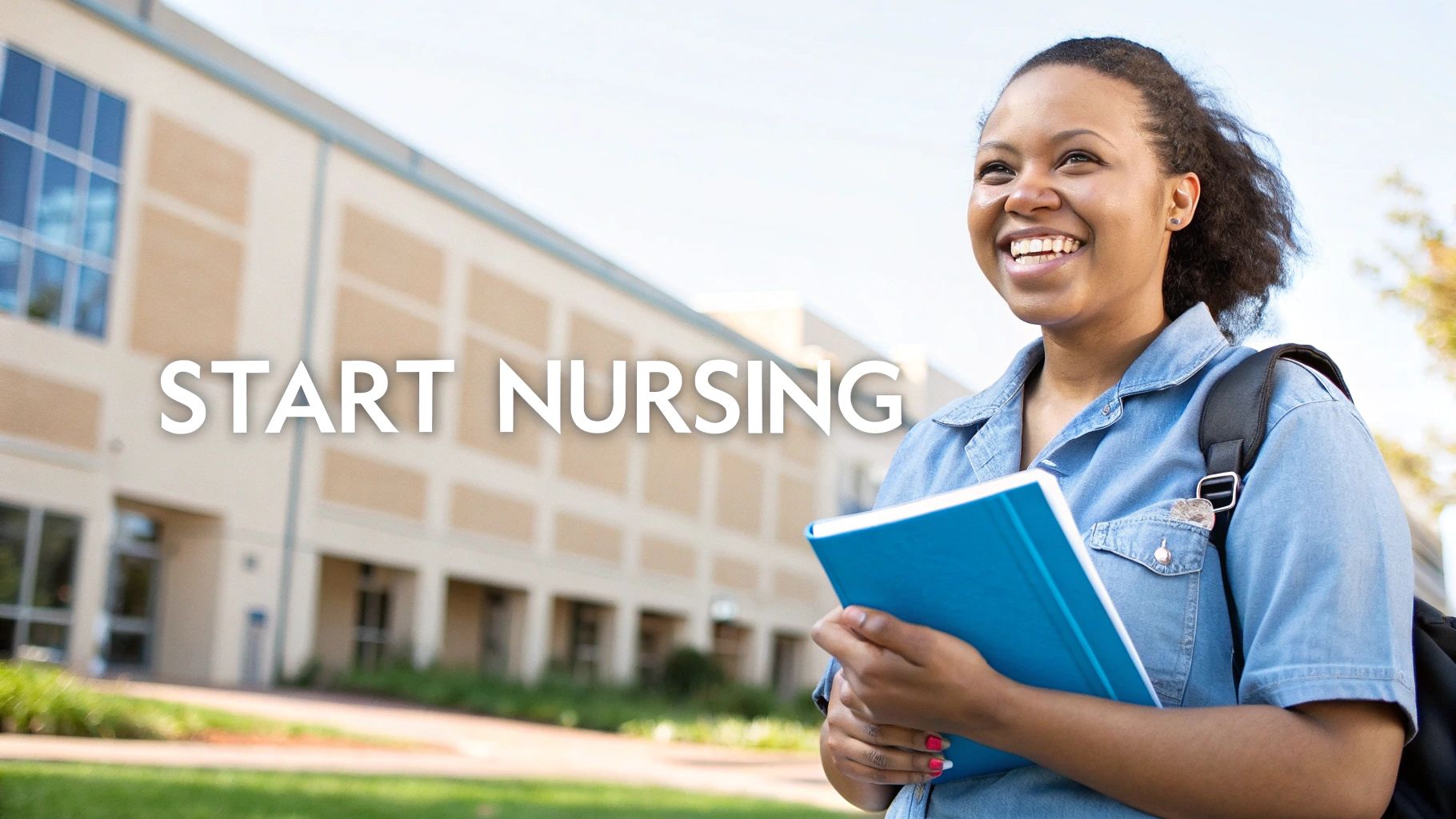
Starting a new career in nursing isn’t just about personal ambition; it’s about becoming a vital part of your community. The UK is facing a real shortage of skilled healthcare professionals, which means the demand for new, passionate nurses has never been higher.
For anyone who feels they missed their first chance at university, the Access to Higher Education Diploma (Nursing) is a purpose-built bridge. It connects your life experience and drive directly to a university nursing degree, giving you the fresh start you’ve been looking for.
This qualification is so much more than just a box-ticking exercise. It's been carefully structured to give you the foundational knowledge and academic skills you'll need to hit the ground running and truly succeed in a demanding healthcare programme.
To give you a quick snapshot, here's what the diploma covers at a high level.
Access to Nursing Diploma at a Glance
| Feature | Description |
|---|---|
| Qualification | Access to Higher Education Diploma (Nursing) |
| Level | Level 3 (Equivalent to three A-Levels) |
| Target Audience | Adult learners (19+) without traditional university entry qualifications |
| Study Mode | Typically online, allowing for flexible, self-paced learning |
| University Recognition | Widely accepted by UK universities for entry onto nursing degree courses |
| Core Focus | Prepares students with the academic skills and subject-specific knowledge for a nursing degree |
This table shows just how focused and practical the diploma is—it’s all about getting you ready for the next step.
Who Is This Course Really For?
The Access to Nursing diploma is crafted for a whole range of motivated people from different walks of life. It provides a clear, structured path for:
- Career Changers: Anyone stuck in a job that feels unfulfilling and is searching for a career with real purpose.
- Parents Returning to Work: Individuals who’ve been raising a family and are now ready to pursue their own professional ambitions.
- Aspiring Students Without A-Levels: People who didn’t follow the traditional academic route after school but now have the focus and maturity to thrive.
This course understands that valuable skills are gained through life, not just in a classroom. It offers a genuine second chance, allowing your determination and real-world experience to pave the way to university and a rewarding career in nursing.
The need for dedicated nurses has never been greater. Right now, the UK is facing a critical shortage, with an expected shortfall of more than 10,000 nurses in the NHS in 2025. This gap continues to grow as healthcare demands increase, highlighting just how essential new nurses are. You can find out more about the NHS workforce shortage and its impact.
Ultimately, this diploma is all about opening doors. It makes the journey to becoming a registered nurse feel achievable, turning a lifelong ambition into a realistic goal for anyone with the passion to care for others.
How the Access to Nursing Diploma Works
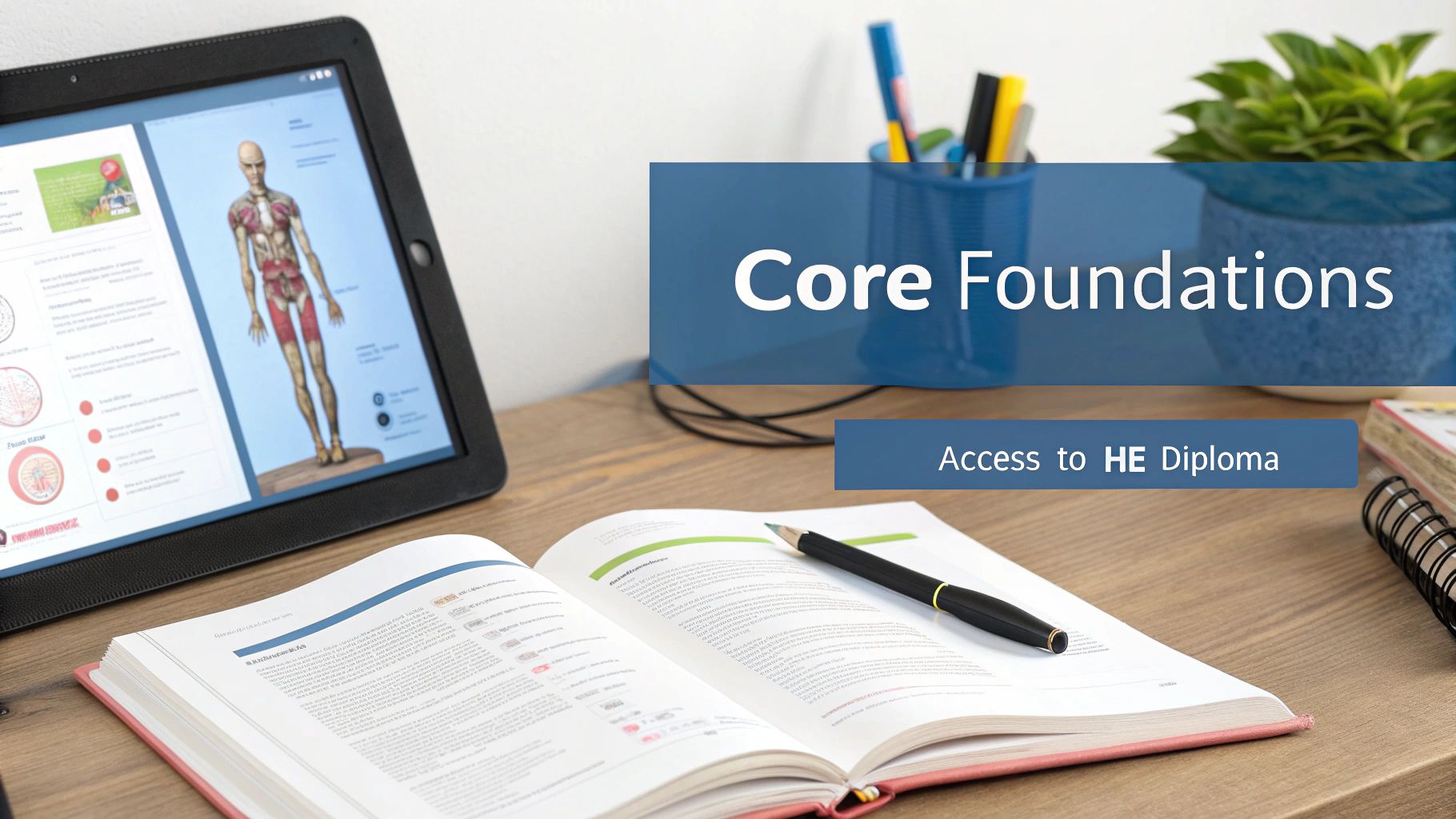
Think of the Access to Nursing diploma as a purpose-built bridge. On one side, you have your ambition and life experience; on the other, a university lecture hall. This course is the structure that connects the two, making sure you can walk across with confidence.
It's much more than just an A-Level alternative. It’s a specialised route designed with adult learners in mind. The whole curriculum is regulated by the Quality Assurance Agency for Higher Education (QAA), which is a big deal. This oversight guarantees the qualification meets the high academic standards universities demand from their future nursing students.
When you finish the diploma, universities get it. They know you’ve been trained to the right level and are ready to tackle a degree programme head-on.
Building Your Foundation with Core Subjects
At its core, the Access to Nursing course gives you the foundational knowledge you’ll need from day one of your nursing degree. The course is broken down into manageable units, and each one contributes credits toward your final diploma.
You’ll need to earn a total of 60 credits. Out of these, 45 credits come from graded academic units, while the other 15 credits are ungraded and focus on sharpening your study skills. This structure gives you a great balance of subject-specific knowledge and the practical academic abilities you'll rely on constantly.
The core subjects are carefully chosen to give you a solid grounding in health and science:
- Human Biology: This is the scientific bedrock of your studies. You’ll explore everything from anatomy and physiology to how our bodies work at a cellular level, which is essential for understanding illness and patient care.
- Health Studies: Here, you’ll look at the bigger picture, like public health, the structure of the NHS, and all the social factors that influence our well-being. It provides the real-world context for the care you’ll one day provide.
- Psychology & Sociology: Nursing is all about people. These units delve into human behaviour, mental health, and how society impacts individuals, helping you build genuine empathy and strong communication skills.
These subjects don’t exist in a vacuum; they work together to give you a complete picture of modern healthcare, preparing you for the dynamic world of nursing.
More Than Just Subjects It Teaches You How to Learn
Knowing the facts about human anatomy is one thing, but it’s not enough to thrive at university. A nursing degree demands critical thinking, solid research skills, and the ability to write about complex ideas clearly and persuasively.
The goal isn't just to get you a place at university; it's to ensure you succeed once you're there. The course teaches you how to be an effective student, building skills that will serve you throughout your degree and your entire career.
You’ll learn how to structure an academic essay, reference your sources properly, and analyse research papers like a pro. These are often the biggest hurdles for people returning to education, and the diploma tackles them directly. Once you master these skills, you’ll feel prepared and confident in seminars and when that first big assignment is due. For a full breakdown of the modules, you can explore the Access to Higher Education Diploma (Nursing) curriculum.
This dual focus on knowledge and skills is what makes the diploma so effective. It doesn't just fill gaps in your academic record; it builds a completely new and solid foundation, making sure you are ready for every part of university life and the incredible nursing career that lies ahead.
Is an Access to Nursing Course Right for You?
Choosing to become a nurse is a huge decision, one that often comes from a place of real passion. But for many, the path isn't a straight line from school A-Levels to a university degree. That's where an Access to Nursing course comes in. It’s built specifically for people whose journeys have taken a few detours but who all share the same goal: to care for others.
This diploma isn’t for a specific "type" of person. It's for anyone with the motivation and life experience to dive into a rewarding new chapter. See if any of these sound familiar.
You're Ready for a Meaningful Career Change
Are you in a job that pays the bills but doesn't feel like it matters? So many people in their 30s and 40s find themselves craving a career with real purpose. If you want a role where you can see the positive impact you're making every single day, nursing delivers that in spades. An Access course takes all the skills you've already built—communication, resilience, problem-solving—and gives you the academic framework to turn them into a new profession.
You're Returning to Work After a Break
Maybe you've spent the last few years raising your family and are now ready for a challenge that’s just for you. The idea of going back to studying can feel a bit daunting, but Access to Nursing courses are designed for the realities of adult life. With online study options, you can fit your learning around school runs and family commitments, making that dream of a new career feel genuinely within reach.
Life experience isn't a gap on your CV; it's a massive asset. The patience, compassion, and organisational skills you've gained are exactly what make a brilliant nurse. This course recognises that and builds on it.
You're Driven but Lack Formal Qualifications
Perhaps you didn't get the A-Levels you wanted back when you were 18. That doesn't mean you're not capable—far from it. Life has a way of giving you a focus and determination you might not have had in your younger years. An Access to Nursing diploma is your second chance to prove what you can do academically, giving you the specific knowledge you need to get into a nursing degree and thrive.
The need for dedicated nurses has never been higher. As of March 2025, the Nursing and Midwifery Council (NMC) register had a record 853,707 qualified professionals. However, with 23,513 UK-educated nurses leaving the register last year, many due to retirement, there's a constant need for fresh talent. You can read more about the current state of the UK nursing register and see how you could help fill this vital gap.
Ultimately, this course is for anyone with the heart for nursing who feels the traditional route to university has sailed. It’s a respected, practical, and empowering pathway that proves it’s never too late to chase a life-changing career. To get ready for a demanding programme, it helps to build strong study habits from the start. Check out these effective study methods for healthcare students to set yourself up for success.
Figuring Out Entry Requirements and How to Apply
Taking that first step towards an Access to Nursing course is a huge moment, but it’s completely normal to feel a bit overwhelmed by the application process. Let’s break it all down, step-by-step, so you have a clear path from that first application form to your first day of class.
Think of the application not as a scary test, but more like a conversation. Colleges aren't looking for a perfect academic record from ten years ago. They want to see your passion for nursing and your potential to succeed. They’re searching for motivated people who are ready to make a real go of it.
What You’ll Typically Need to Get In
The first thing most people worry about is the academic stuff. Nearly every Access to Nursing course provider—and the universities you'll apply to later—will want to see that you have a good grasp of English and Maths.
This usually means you’ll need:
- GCSE English: At Grade C/4 or higher.
- GCSE Maths: At Grade C/4 or higher.
These two are pretty much non-negotiable, and for good reason. Strong literacy and numeracy skills are the bedrock of safe, effective nursing. You'll be using them every single day, whether you're calculating drug dosages or writing clear, accurate notes for a patient's file.
But what if you don't have these GCSEs? Don't panic. You're not alone! This is a really common situation for adult learners. There are fantastic, accessible alternatives like Functional Skills Level 2 courses in English and Maths. Universities widely accept these as a GCSE equivalent, and you can often study for them at the same time as your main Access to Nursing diploma.
The point of these requirements isn't to put up barriers; it's to set you up for success. Providers want to be sure you have the essential tools to thrive on the course and in your future nursing degree.
To give you a clearer picture, here’s a quick rundown of what colleges are generally looking for.
Typical Entry Requirements for Access to Nursing Courses
| Requirement Type | Details and Importance |
|---|---|
| Essential Qualifications | GCSEs in English & Maths at Grade C/4 or above (or equivalent, like Functional Skills Level 2). This is non-negotiable as it proves you have the core academic skills needed for degree-level study. |
| Personal Statement | Your chance to show your motivation and passion for nursing. This is where you connect your life experiences to your desire to care for others. It’s a critical part of your application. |
| Relevant Experience | While not always mandatory, any experience in a healthcare setting (paid or voluntary) is a huge plus. It demonstrates your commitment and understanding of the profession. |
| Core Personal Qualities | Colleges look for evidence of empathy, communication skills, resilience, and teamwork. You can showcase these through examples in your personal statement and interview. |
| IT Skills | Basic computer literacy is important as most Access courses, especially online ones, require you to use a digital learning platform. |
Meeting these requirements is your first step, but how you present yourself is what will really make you stand out.
Writing a Personal Statement That Gets Noticed
Once you've ticked off the academic boxes, your personal statement is where you can really bring your application to life. This isn’t just a list of what you've done; it's your story. Why do you want to be a nurse? What has led you to this point? What makes you a compassionate and capable person?
To make your statement really hit home, try focusing on these three things:
- Your "Why": Be specific. Instead of saying you "want to help people," tell a story about a moment that ignited your passion for nursing. Maybe you cared for a family member or had an inspiring experience with a nurse that stuck with you.
- Your Skills: Think about the skills you’ve picked up from previous jobs, volunteering, or just life itself. Great communication, working well with others, solving problems under pressure, and empathy are all gold dust.
- Your Understanding: Show you’ve done your homework. Mention that you understand nursing is challenging as well as rewarding. If you want to dig deeper into what universities look for, our guide on nursing degree entry requirements has some great insights.
Getting Ready for Your Interview
The final step is usually an interview. This is a two-way street—it’s a chance for the college to meet you, but also for you to see if the course feels right. Interviewers are looking for more than just grades; they want to see if you understand the core values that nursing is built on.
A brilliant way to prepare is to get familiar with the ‘6 Cs’ of Nursing: Care, Compassion, Competence, Communication, Courage, and Commitment. Have a think about times in your own life when you’ve demonstrated these qualities. When did you show courage to speak up for someone? When did you show commitment to finish a tough project?
Having these examples ready shows that you're not just applying for a course, but that you're ready to embrace everything that comes with being a future nurse.
Choosing Your Study Method: Online vs On-Campus
So, you've decided an Access to Nursing diploma is your next big step. That's a huge decision, and the next one is just as important: figuring out how you're going to study. The choice between online and on-campus learning needs to fit the realities of your life, not the other way around.
There's no single "best" option here. It all comes down to your personal circumstances, how you learn best, and the kind of flexibility you need. Let’s break down the pros and cons of each to help you make the right call for your journey into nursing.
The Freedom of Online Learning
Online study has become a massive lifeline, especially for adult learners. Its biggest draw is, without a doubt, flexibility. If you're juggling a full-time job, managing school runs, or have other major commitments, an online course lets you fit your studies around your life.
You can learn from anywhere with an internet connection. Your kitchen table can become your classroom after the kids are in bed, or you can use your lunch break to catch up on a lecture. This self-paced approach puts you firmly in the driver's seat.
If you're a self-motivated person who thrives on independence, online study could be a perfect match. For a deeper dive, our practical guide to online learning offers some great insights into what to expect.
This decision map can help you visualise which path might be a better fit based on where you're starting from.
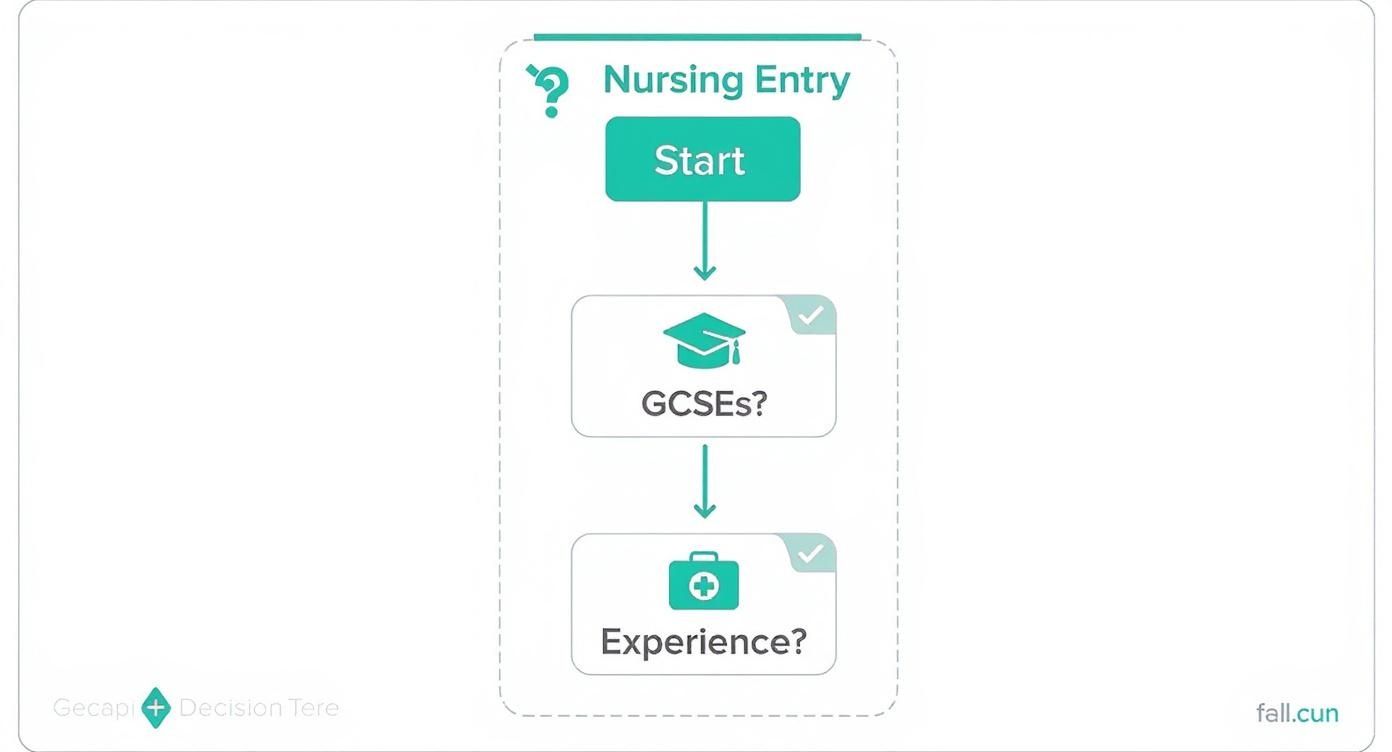
As the infographic shows, whether you have the right GCSEs or relevant experience, there's always a clear next step towards starting your Access to Nursing journey.
The Structure of On-Campus Study
On the other hand, traditional on-campus learning offers a much more structured and collaborative world. Going to a physical college gives you a set timetable, which can be brilliant for anyone who works best with a routine and finds it easier to stay on track with fixed deadlines and face-to-face classes.
One of the biggest pluses of being on campus is the direct interaction. You get immediate support from your tutors and can easily ask questions during or after a lesson without waiting for an email reply.
Then there’s the social side of things. Learning alongside a group of people who share your goals creates a real sense of community and a built-in support network. That camaraderie can be incredibly motivating when you're tackling tougher subjects.
For many, the structured environment of a campus is what keeps them focused. The clear separation between 'home' and 'study' can make it easier to dedicate time to learning without the distractions of daily life.
Making the Right Choice for You
So, how do you decide? The best approach is to be really honest with yourself about your own needs and habits. Think about these key questions:
- How disciplined are you? Online learning takes a high degree of self-motivation to keep up with the work.
- What does your schedule look like? If your commitments are unpredictable, the flexibility of an online course might be non-negotiable.
- How do you learn best? Do you prefer working through problems on your own, or do you thrive on group discussions and instant feedback from a tutor?
- What kind of support do you need? Both options offer great support, just in different ways. Online courses use forums and email, while on-campus gives you in-person office hours.
Ultimately, this choice is a personal one. Whether you opt for the independence of online learning or the structured community of a college campus, both paths lead to the same destination: a place at university to start your nursing degree.
How to Fund Your Access to Nursing Course
One of the biggest hurdles people face when thinking about returning to education is, unsurprisingly, the cost. But what if I told you that funding your Access to Nursing course is much more straightforward than you might think? Thanks to some fantastic options available for adult learners in the UK, you don't have to let finances stand between you and your dream career.
The main option you need to know about is the Advanced Learner Loan. Think of it less as a typical loan and more as a government-backed investment in your future – one that comes with a pretty incredible perk for aspiring nurses.
Understanding the Advanced Learner Loan
This loan is specifically designed for students aged 19 or over who are studying an approved Level 3 qualification, which includes our Access to HE Diplomas. The best part? It isn't means-tested, so your household income won't be a factor in whether you're eligible or not.
You also won't have to worry about paying anything back until you're earning a decent wage. The current threshold is £27,295 a year, so you can focus on your studies and building your career without immediate financial pressure.
The application process is handled directly through Student Finance England and is refreshingly simple. When you enrol, your course provider will give you a "Learning and Funding Information Letter," which has all the details you'll need to apply online.
The Best Part: The Loan Write-Off
Now, here’s the bit that makes all the difference for anyone wanting to get into nursing. If you take out an Advanced Learner Loan to fund your Access to HE Diploma, Student Finance England will completely 'write off' your outstanding loan balance once you complete your nursing degree at university.
That’s right. Once you successfully progress from your Access course and finish your nursing degree, you won’t have to repay the loan for your diploma. It essentially makes the Access to Nursing course free, serving as a powerful incentive to help support our vital NHS workforce.
This write-off policy is a real game-changer. It effectively removes the financial barrier for thousands of adult learners, giving them the freedom to get qualified without the worry of racking up extra debt.
Applying for Your Loan
Getting your loan sorted is a simple, step-by-step process.
- Enrol on your course: The first step is to get accepted onto an approved Access to Nursing course.
- Receive your funding letter: Your provider will then send you a letter with all the specific course details needed for the application.
- Apply online: Head over to the GOV.UK website to fill out your application – it usually only takes about 30 minutes.
- Receive confirmation: Student Finance England will confirm your loan is approved and will pay the tuition fees directly to your course provider. Simple as that!
For a more detailed look, we've put together more information about Access to Higher Education funding and how it all works.
Are There Other Funding Options?
While the Advanced Learner Loan is definitely the most popular route, it’s always smart to see what else might be out there. Some learners might be eligible for grants or bursaries from various charitable organisations. These are less common and often have very specific criteria, but they're still worth a bit of research.
On a practical note, managing your money while you study is key. Taking a little time to create a simple budget can make a huge difference, helping you stay on top of your finances. This way, you can focus all your energy on your studies and take this exciting step towards your new career with total confidence.
Your Access to Nursing Questions Answered
Taking the first step towards a new career is exciting, but it’s natural to have a few questions. We get it. This final section tackles some of the most common queries we hear about the Access to Nursing diploma, giving you the clear, straightforward answers you need to move forward with confidence.
How Long Does an Access to Nursing Course Take?
Most Access to Nursing diplomas are designed to be completed in one academic year, which usually works out to about nine months of full-time study. It's an intensive structure, but it’s built to get you ready for university as quickly as possible.
Of course, life is busy. That’s why many providers, especially for online courses, offer a flexible part-time option. This allows you to spread your studies over two years, making it perfectly possible to balance learning with your job, family, or other commitments. Always check with your chosen provider to see what timelines they offer.
Are Access to Nursing Diplomas Accepted Everywhere?
Yes, absolutely. The Access to Higher Education Diploma is a nationally recognised qualification that is accepted by the vast majority of UK universities for entry onto nursing and other health-related degrees. In fact, it was specifically created for this very purpose.
It's crucial, however, to check the specific entry requirements for each university you are interested in. Some may require a certain number of credits at Merit or Distinction level, so confirming their exact criteria before you enrol is a vital step in your planning.
Doing this bit of homework early on ensures the course you choose lines up perfectly with the universities you’re aiming for.
Do I Need Work Experience in Healthcare?
While it isn't always a strict requirement to get onto the access to nursing course itself, getting some experience in a healthcare or care setting is something we highly recommend. It’s about more than just ticking a box; this experience proves your commitment and gives you a realistic, invaluable insight into what the profession is really like.
This hands-on understanding will be a massive advantage when you apply to university and attend interviews. Volunteering at a hospital, a care home, or with a health-focused charity can really make your application shine and shows you’re serious about your future career.
What Kind of Student Support is Available?
Providers know that many of their students are returning to education after a long break, and they’ve built fantastic support systems to match. You can typically expect to find:
- Dedicated Personal Tutors for one-on-one guidance and support when you need it.
- Academic Skills Support to help you get back into the swing of things with essay writing, research, and referencing.
- Expert UCAS Application Help to guide you through the entire process of applying to university.
For online courses, this support is delivered through dedicated online tutors, active student forums, and huge digital resource libraries, making sure help is always there when you need it.
Ready to take the first step towards your nursing career? At Access Courses Online, we provide accredited, flexible online diplomas that fit around your life. Start your journey to university today.