

You've finished a late shift, the children are finally asleep, and you're scrolling through nursing or midwifery degree pages on your phone. The ambition is there, but the practical questions arrive quickly. How could you study around work, childcare, rent, and changing shifts? Would a university accept you without recent A levels? Could an Access to Nursing and Midwifery course online give you a realistic starting point?
For many adult learners, the answer begins with understanding the difference between joining an Access course and being ready to apply for a degree. The diploma can provide the Level 3 academic route you need, but universities may still ask for separate English and Maths qualifications, evidence of readiness for science-heavy study, and a convincing application.
Rethinking Your Next Step Into Healthcare
An online Access course can make healthcare education feel possible without pretending it will be easy. You may be working in retail, care, hospitality, administration, or another role while managing family responsibilities. You might have left school years ago with qualifications that no longer reflect your ability, or without the A levels that many degree pages mention first.
The important point is that recent A levels aren't the only route into nursing or midwifery. An Access to Higher Education Diploma is designed for adults returning to education and preparing for university-level study. The route is academic, not a shortcut. You'll need to read, write, revise, meet deadlines, and develop enough confidence with science and numeracy to continue into a demanding degree.
A realistic starting question: Can you protect regular study time each week, rather than simply hoping spare time will appear?
Online delivery may remove the need to travel to a college campus, and an Access course generally doesn't involve the clinical placements that belong to the later degree. That can help someone with an unpredictable rota or caring duties. It doesn't remove the workload, though. A shorter course model can require focused weekly effort, particularly when assignments from several units overlap.
The wider picture shows why this route matters. In 2017–18, health courses accounted for 50% of all Access to Higher Education registrations in the UK, and more than a third of Access students entering university chose nursing. The Quality Assurance Agency's Access to HE statistics also recorded over 8,000 Access students entering higher education to study nursing. The same report found that 25.6% of Access students who graduated from university in 2018 achieved a First, compared with a UK average of 26.4%, suggesting broadly comparable degree performance after progression.
So the decision isn't, “Can I study online?” It's, “Can I build the academic, qualification, and application readiness that my target university expects?”
What an Online Access Course Actually Is
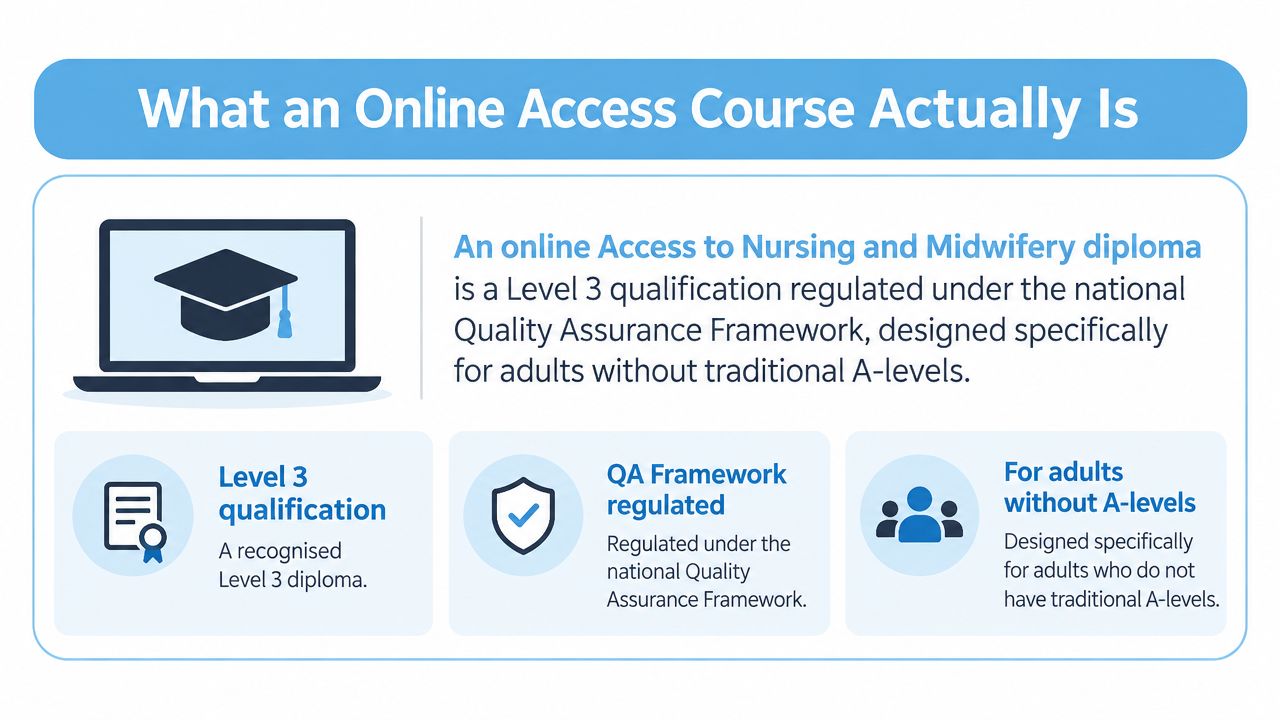
An Access to Higher Education Diploma is a Level 3 qualification created for learners who want to progress to university without following the traditional A-level route. For nursing and midwifery, the diploma normally combines health-related science with academic skills, so you're learning subject knowledge and how to use it in higher education.
A typical diploma has 60 credits, with 45 graded credits and 15 ungraded credits, according to the course information published by Newcastle and Stafford Colleges Group. The graded work contributes to the results universities can consider, while the ungraded work supports your preparation for studying, researching, and communicating at degree level.
What the qualification prepares you for
The course isn't a nursing or midwifery registration programme. It won't qualify you to practise, and it won't replace the approved university degree and clinical training required later. Instead, it gives you an academic bridge into programmes such as:
- Adult nursing: Preparation for degree study focused on care across hospital, community, and other healthcare settings.
- Children's nursing: A route towards university study involving the care of children and young people.
- Mental health nursing: Relevant preparation for degrees centred on psychological wellbeing and therapeutic care.
- Learning disability nursing: A foundation for progression into care that supports people with learning disabilities.
- Midwifery: A Level 3 starting point for applicants who intend to apply to an approved midwifery degree.
Course content varies between providers, so read the specification rather than relying only on the title. Look for a clear explanation of the awarding organisation, credit structure, assessment method, university progression, and any additional requirements.
A fully online model usually means that course materials and submissions are handled through a virtual learning environment. One provider describes a 60-credit, 35-week online model, with a listed fee of £3,384 and possible Adult Learner Loan funding, subject to eligibility. Learners aged 19 to 23 taking their first Level 3 course may qualify for fee remission in eligible circumstances. Check the current provider terms before making a financial decision.
Inside the Nursing and Midwifery Curriculum
The curriculum should do more than introduce healthcare vocabulary. It needs to help you think like a university applicant who can interpret information, explain scientific processes, and connect theory with person-centred care.
You may study subjects such as cell biology, physiology, human nutrition, psychology, sociology of health, health promotion, and research. The exact unit titles differ, but the underlying purpose is consistent. Biology helps you understand the body, psychology supports your understanding of behaviour and wellbeing, and sociology helps you examine inequality, culture, and the wider conditions affecting health.
Why the graded units matter
The 45 graded credits require sustained academic performance. An assignment might ask you to explain a physiological process, examine a health issue, compare perspectives, or evaluate evidence. You aren't only recalling facts. You're learning to structure an argument, use appropriate sources, apply terminology accurately, and respond to a question within a defined word limit.
That practice matters because university nursing and midwifery work includes written assessments, evidence-based reasoning, reflective work, and scientific study. A strong Access assignment can show that you're ready to manage those expectations, while feedback can reveal habits you need to change before degree study.
The value of the ungraded work
The 15 ungraded credits shouldn't be treated as filler. Study skills, academic writing, reflective practice, referencing, and research activities help you become more independent. Many adult learners understand a topic but lose marks because their paragraphs lack structure, their sources aren't integrated, or their conclusions don't answer the question.
You'll also begin developing the professional mindset expected in healthcare. Midwifery and nursing require communication, respect, reflection, and attention to the individual behind the diagnosis. The Access course can't reproduce clinical placement, but it can help you practise the academic and ethical thinking that placement learning later demands.
Tutor's advice: Keep a running glossary from the first week. Write each scientific term in plain English, then use it in a sentence about patient care or health.
Studying Online Around Real Life
Online study works best when you treat it as a planned commitment rather than an activity reserved for spare moments. Your provider may offer recorded teaching, reading materials, discussion spaces, assignment guidance, and tutor contact through an online learning platform. You can often access these resources from home, but you still need a reliable routine.
Start by identifying the parts of your week that are most stable. An early morning before the household wakes up may work better than promising yourself every evening after a tiring shift. If your rota changes, set a weekly minimum and reserve a longer block for reading or assignment drafting when you know your energy is better.
Build a workable study system
A practical setup includes:
- A weekly planner: Record live sessions, assignment deadlines, reading targets, and family commitments in one place.
- A dependable study area: You don't need a dedicated office, but you do need somewhere you can read and write without constant interruption.
- Offline access: Download permitted reading materials before a shift, commute, or period without reliable internet.
- A backup plan: Keep copies of drafts and notes in a secure location so a broken device doesn't erase your work.
- Tutor contact: Ask for clarification early, especially when a question involves science, referencing, or assessment criteria.
Study apps can help you divide large assignments into smaller tasks, track focused sessions, and identify where your time disappears. A guide to science-backed study apps can help you compare approaches without assuming that one method suits every learner.
For further practical ideas about managing study alongside employment and family life, explore how online learning fits into a busy lifestyle. The goal isn't to study constantly. It's to make your study predictable enough that you can keep moving when life becomes busy.
Short video guidance can also help you visualise how online learning may fit into your routine.
Before enrolling, check the practical details. Ask whether teaching is live, recorded, or both, how quickly tutors respond, how assessments are submitted, and whether any attendance is expected. Also confirm how the provider supports learners who need extra help with academic writing, English, Maths, or digital access.
The Hidden Requirement Most People Miss
The Access diploma may be the qualification that replaces A levels, but it may not replace GCSE English and Maths. Many universities ask for these subjects at grade 4/C or above, or an accepted equivalent such as Functional Skills Level 2. Some providers allow learners to enrol when these qualifications are “preferable but not mandatory”, yet that wording describes course entry, not necessarily successful university progression.
That distinction causes avoidable disappointment. You might be accepted onto an Access course, complete the diploma, and then discover that your chosen nursing or midwifery degree still needs separate evidence of English and Maths. The Activate Learning online entry information explains the importance of checking eligibility and notes that funding rules may differ outside England.
Typical university entry requirements at a glance
| Requirement | Nursing | Midwifery |
|---|---|---|
| Access qualification | An accepted Access to HE Diploma in a relevant health subject | An accepted Access to HE Diploma in a relevant health or midwifery subject |
| English evidence | GCSE English Language at grade 4/C or an accepted equivalent may be required | GCSE English Language at grade 4/C or an accepted equivalent may be required |
| Maths evidence | GCSE Maths at grade 4/C or an accepted equivalent may be required | GCSE Maths at grade 4/C or an accepted equivalent may be required |
| Science preparation | Applied biology, physiology, and related study can support progression | Applied biology, reproductive health, and related study can support progression |
| Final decision | Check the exact course page and admissions team | Check the exact course page and admissions team |
Universities set their own requirements, so use the table as a question list, not a guarantee. Before you pay a fee, email every target university and ask whether the exact diploma, credit profile, predicted grades, English qualification, and Maths qualification will be accepted.
If Maths or English is the missing piece, read this practical guide to Maths and English requirements. Treat Level 2 study as a co-requisite, not an emergency repair after the Access course ends.
How Assessment and Tutor Support Work
Online assessment is usually coursework-led, but that doesn't mean it's informal. You may complete essays, short-answer tasks, academic posters, research activities, reflective writing, or timed assessments through the provider's virtual learning environment. Each task tests a different skill, from explaining a scientific process to presenting information clearly for a defined audience.
The assessment brief is your working contract. It tells you what the question means, which learning outcomes you must address, the expected format, and how the work will be judged. Read it before researching. Many learners collect interesting information first and only later realise that their evidence doesn't answer the actual task.
Feedback should change your next draft
Tutor feedback commonly focuses on structure, referencing, clarity, scientific accuracy, and use of evidence. Read it with your next assignment in mind. If a tutor says your analysis is descriptive, underline every paragraph that only reports information and ask where you could compare, interpret, or evaluate it.
You may also receive support through email, online tutorials, drop-in sessions, webinars, or one-to-one meetings. Ask how feedback is delivered and how quickly you can expect it before enrolling. The phrase “tutor support” means little unless the provider explains what contact looks like in practice.
Functional Skills English and Maths, where needed, should be planned alongside the diploma. English work may involve reading comprehension, writing, and communication, while Maths preparation can support percentages, measurements, units, and problem-solving. Those skills are especially relevant when later study involves anatomy, physiology, dosage calculations, or healthcare data.
You can also look at how healthcare tutors support Access students to understand the kind of guidance an experienced tutor can provide. A good support relationship doesn't remove responsibility from you. It gives you a place to test your understanding before a small problem becomes a missed deadline.
Funding, Fees, and Payment Options
Funding depends heavily on where you live and which course you choose. Don't assume that a funding option advertised on an English provider's page applies automatically if you live in Scotland, Wales, or Northern Ireland.
For eligible learners in England, an Advanced Learner Loan may cover the fee for an approved Access to HE Diploma. The published example from Newcastle and Stafford Colleges Group lists a fee of £3,384 and refers to Adult Learner Loan funding, but you should confirm the current fee, course eligibility, and personal criteria directly with the provider.
Access to Nursing and Midwifery funding routes compared
| Funding Route | Who It Suits | Eligibility Region | Repayment Trigger |
|---|---|---|---|
| Advanced Learner Loan | Eligible adult learners taking an approved course | England-specific rules may apply | Check the current loan terms and any linked progression conditions |
| Provider payment plan | Learners who can spread fees from their own income | Depends on the provider | Payments follow the agreed instalment schedule |
| Employer support | Staff whose employer funds development relevant to their role | Depends on employer policy | Usually governed by the employer's sponsorship agreement |
| Fee remission | Learners who meet the provider's stated financial or age criteria | Depends on the scheme and location | Usually no repayment, but eligibility evidence is required |
| Self-funding | Learners outside applicable public funding routes | Any region, subject to provider acceptance | No loan repayment, but provider payment terms apply |
Some Access routes offer fee remission for eligible learners aged 19 to 23 taking their first Level 3 course, as described in the published provider information. That isn't universal, so ask for a written eligibility decision rather than relying on a general advert.
Prepare documents before you apply. Providers may ask for proof of identity, residency, previous qualifications, household or benefit circumstances, and details of any earlier Level 3 study. If you live outside England, ask specifically whether the course is funded in your nation or whether you'll need to self-fund. A payment plan can make the cost manageable, but it doesn't change the university's academic entry requirements.
Your Path From Access Course to Degree
A sensible plan starts before enrolment. Choose your target nursing or midwifery degrees first, then work backwards from their requirements. That approach prevents you from selecting a course that looks suitable but lacks the science content, grading profile, or qualification evidence your preferred universities expect.
A practical application sequence
First, investigate providers and universities. Compare the diploma title, awarding organisation, credit profile, delivery format, tutor support, assessment method, fees, and funding. Contact admissions teams with specific questions about GCSE English, GCSE Maths, Functional Skills, science units, and predicted Access grades.
Next, audit your evidence. Find certificates or request replacement records for your existing qualifications. If English or Maths is missing, arrange an accepted equivalent early. Don't wait until the final assignment is submitted.
Then, establish your study routine. Map work, caring duties, travel, and recovery time. Your plan should include reading, drafting, revision, tutor contact, and application work. A course can be flexible while still demanding consistent attendance to your own schedule.
During the diploma, keep progression visible. Save strong assignments, record relevant learning, attend university open events, and note how your experience connects with nursing or midwifery values. Your personal statement should explain why you're changing direction, what you've learned, and how the Access course has prepared you for the chosen field.
Prepare for selection. Practise discussing communication, compassion, teamwork, accountability, equality, and safe care with concrete examples from employment, volunteering, or caring experience. For interview preparation, a focused nursing manager interview guide can help you rehearse structured answers, although university interviews may use their own format.
Final readiness check
Before enrolling, make sure you can answer yes to these questions:
- Course fit: Have you confirmed that your chosen universities accept this diploma?
- Qualification evidence: Do you have GCSE English and Maths, or a clear plan to obtain accepted equivalents?
- Study capacity: Can you protect regular time each week?
- Financial plan: Do you know which funding or payment route applies to you?
- Application plan: Have you checked current UCAS and university deadlines?
- Support needs: Have you asked how the provider helps with science, writing, Maths, technology, and wellbeing?
An Access course can open a structured route into healthcare, but the strongest applicants plan beyond enrolment. They know what the diploma provides, what it doesn't provide, and which evidence their university choices will request.
Access Courses Online offers fully online Access to Higher Education Diplomas in Nursing and Midwifery, with coursework-based study, tutor guidance, and flexible payment options. If you're ready to check your qualifications, compare progression requirements, and plan your next step, visit Access Courses Online and speak with the provider about the route that fits your circumstances.